Sarah Lindqvist, head of talent acquisition at a Stockholm-based gaming company with four thousand employees, opened the quarterly recruiting efficiency report and noticed a number that captured the entire problem in a single data point. Her twelve recruiters had collectively spent seventy-two percent of their working hours in the previous quarter interacting with recruiting software, navigating systems, entering data, reconciling records, and generating reports. Only twenty-eight percent of their time had been spent on activities that directly contributed to hiring outcomes, conversations with candidates, strategic discussions with hiring managers, and talent market analysis. The software was supposed to make her team more effective. Instead, it had become the primary consumer of their time and attention. Sarah had recently attended a demonstration of an AI recruiting platform that operated autonomously across the full hiring workflow, and she had been struck by a thought that had not occurred to her in her fifteen years in talent acquisition: what if the software could do the recruiting, and her team could focus on the strategy, relationships, and judgment that the software could not replicate? The idea felt radical, but the data in her efficiency report made it feel inevitable. Her team was already spending most of their time serving the technology. It was time for the technology to start serving them.
The Inversion of the Recruiting Technology Model
Sarah Lindqvist, head of talent acquisition at a Stockholm-based gaming company with four thousand employees, conducted a time-motion study of her recruiting team in March 2026 that produced a result she found both illuminating and uncomfortable. Her twelve recruiters spent an average of four and a half hours per day interacting with recruiting software: navigating the applicant tracking system, toggling between the sourcing database and the outreach tool, copying data from the interview feedback form into the ATS, reconciling candidate status across three systems that did not synchronize automatically, and generating reports by manually exporting data from one platform into a spreadsheet for analysis. The recruiters were using software for most of their working day, but the software was not doing their work. It was creating work. Each system required human input to function, and the lack of integration between systems meant that the recruiters served as the data bridge, manually transferring information from one tool to another. Sarah recognized that her team was not using technology to recruit more effectively. They were laboring to keep the technology functioning. This dynamic, where recruiters serve the technology rather than the technology serving the recruiters, is the defining characteristic of the old model that is now giving way to something fundamentally different. Research from McKinsey on technology-driven productivity in professional services has found that knowledge workers using fragmented tool stacks spend thirty to forty percent of their time on tool management and data reconciliation rather than on their core professional activities, a pattern that is particularly acute in recruiting where the number of tools and the frequency of data handoffs have grown rapidly over the past decade.
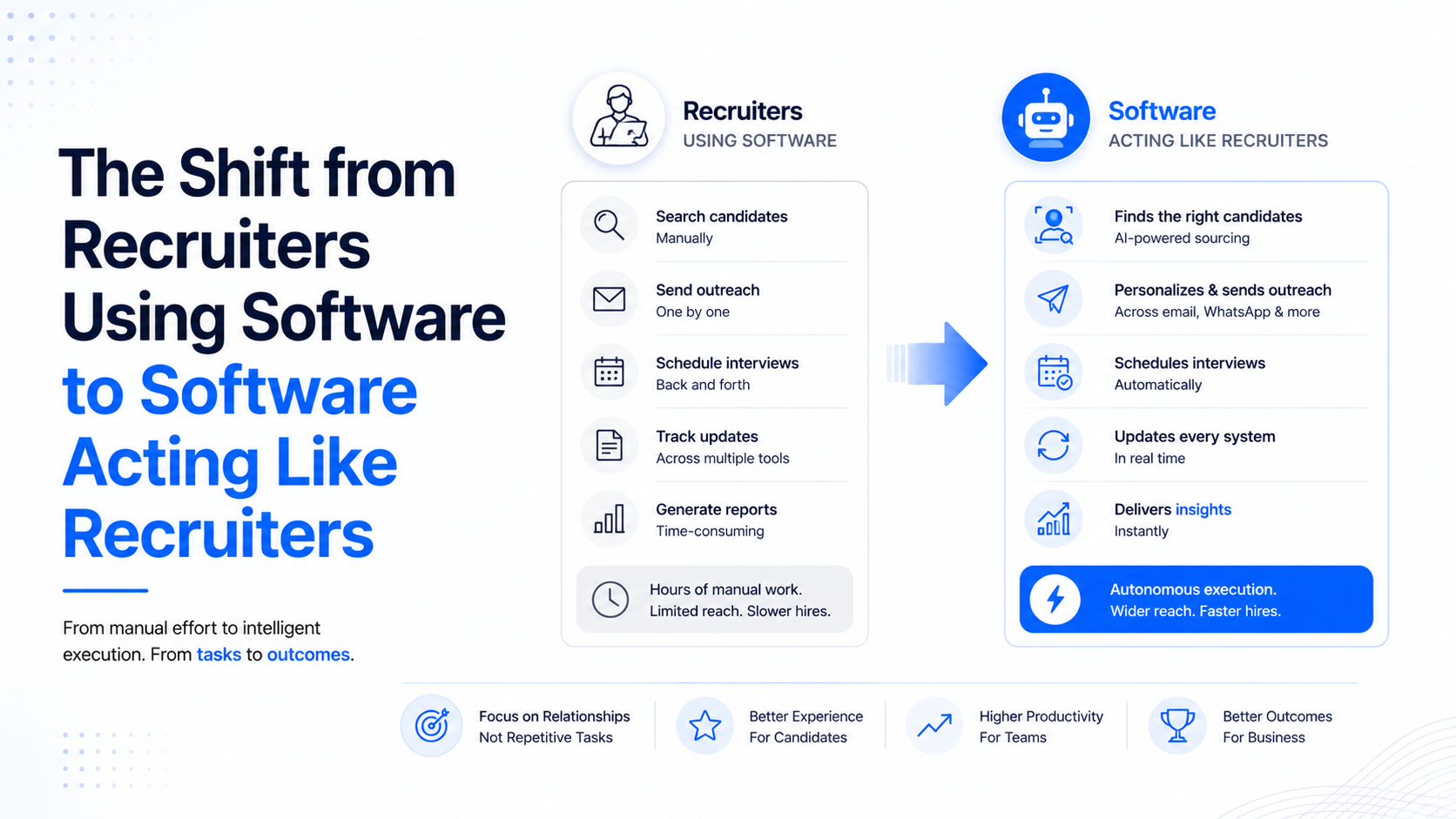
The new model inverts this relationship entirely. Instead of recruiters using software, the software acts like a recruiter. It identifies candidates, evaluates their fit for specific roles, crafts personalized outreach, manages the engagement process, coordinates interviews, synthesizes feedback, and recommends hiring decisions. It does not wait for a human to initiate each step. It operates autonomously within defined parameters, escalating to human recruiters when a situation requires judgment, creativity, or relationship depth that exceeds its capabilities. This inversion, from human-orchestrated tools to tool-orchestrated humans, is the most consequential shift in recruiting technology since the move from paper resumes to digital databases. It is not an incremental improvement in tool capability. It is a fundamental change in the operating model of the recruiting function. The technology is no longer a set of instruments that the recruiter plays. It is an intelligent agent that performs the recruiting workflow and partners with the human recruiter on the strategic and relational dimensions that require genuine human capability. Gartner has identified this inversion as the defining technology trend in talent acquisition for 2026 and beyond, projecting that by 2029, more than half of large enterprises will have at least one hiring workflow where the primary operational decisions are made by AI rather than by human recruiters, a threshold that marks the transition from tool-assisted to AI-directed recruiting.
The practical implications of this inversion are visible in every aspect of the recruiting process. In the old model, a recruiter opens the ATS, reviews open requisitions, opens the sourcing tool, defines search criteria, reviews candidate results, selects candidates for outreach, opens the outreach tool, drafts messages, sends messages, opens the scheduling tool,
coordinates interview times, opens the feedback form, collects interviewer input, and opens the offer tool to generate a compensation package. Each step requires the recruiter to initiate, execute, and coordinate. In the new model, the AI system manages this entire workflow, making sourcing decisions, initiating outreach, managing engagement, coordinating logistics, and recommending actions based on its understanding of the candidates, the roles, and the organizational context. The recruiter reviews the system's recommendations, provides strategic input on high-priority decisions, and intervenes personally at the points where human interaction adds the most value. The distinction between these two models, automated tools that execute tasks versus intelligent agents that make decisions, is the subject of detailed analysis in discussions of what makes an agentic AI recruiting platform fundamentally different from the recruiting software that organizations have been deploying for the past two decades, and it is this distinction that determines whether AI in recruiting produces incremental efficiency gains or transformational outcome improvements.
What It Means for Software to Think Like a Recruiter
For software to act like a recruiter, it must replicate not the mechanical tasks that recruiters perform but the cognitive processes that underlie them. A recruiter sourcing a candidate does not simply match keywords. They consider whether the candidate's career trajectory suggests the adaptability the role requires, whether their recent project work demonstrates relevant problem-solving capability, whether the timing of their career suggests openness to a move, and whether their professional network and industry reputation indicate the caliber of colleague they would be. A recruiter evaluating a candidate for advancement does not simply check qualification boxes. They consider how the candidate's specific experiences map to the team's specific challenges, whether the candidate's communication style would complement the hiring manager's leadership approach, and whether the candidate's motivations align with what the role can actually offer. These cognitive processes, contextual evaluation, holistic assessment, and motivational reasoning, are what distinguish effective recruiting from mechanical processing. Software that acts like a recruiter must perform these same cognitive processes, not by following rigid rules but by evaluating context, weighing multiple factors, and making nuanced judgments. This capability is qualitatively different from the rule-based automation that has characterized recruiting technology to date. According to LinkedIn talent acquisition research, the most effective AI recruiting systems are those that evaluate candidates using contextual reasoning similar to how experienced recruiters make decisions, producing twenty-five to forty percent better hiring outcomes than systems that rely on keyword matching and static qualification thresholds.
The cognitive capabilities required for software to act like a recruiter extend beyond candidate evaluation to encompass the full spectrum of recruiting judgment. The system must be able to prioritize among competing demands, deciding which roles require immediate attention based on business impact, candidate availability, and competitive dynamics. It must be able to adapt its strategy based on feedback, adjusting its sourcing approach when initial candidates do not meet quality expectations, modifying its engagement cadence when response
rates decline, and shifting its assessment criteria when hiring managers provide feedback that the current profile is not capturing the right attributes. It must be able to manage ambiguity, handling situations where the ideal candidate profile is unclear, where a candidate is strong in some areas and weak in others, or where a hiring manager's requirements conflict with market realities. And it must be able to learn from outcomes, recognizing patterns in hiring success and failure that enable it to improve its future decisions. These capabilities, prioritization, adaptation, ambiguity tolerance, and learning, are the hallmarks of intelligent agency, and they are what distinguish software that acts like a recruiter from software that merely automates recruiting tasks. Organizations evaluating AI recruiting platforms should assess these capabilities explicitly, and guidance on how to evaluate an AI sourcing tool before buying provides a structured framework for distinguishing platforms with genuine cognitive capabilities from those that perform sophisticated automation under an AI label.
The implications of this cognitive capability extend to the candidate experience in ways that are both profound and practically significant. When software acts like a recruiter, the candidate interaction feels different. Instead of receiving a generic template email that was triggered by a calendar rule, the candidate receives a message that demonstrates understanding of their specific professional context, the projects they have worked on, the skills they have developed, and the career trajectory they appear to be pursuing. Instead of waiting days for a human recruiter to respond to an inquiry, the candidate receives a contextually relevant response within hours, because the AI system can process and respond to candidate communications continuously rather than waiting for a human to be available. Instead of experiencing a fragmented process where different people handle different stages with different levels of knowledge, the candidate interacts with a single intelligent system that maintains a coherent, continuous understanding of their candidacy from first contact through offer decision. This coherent, responsive, and personalized experience is what candidates expect because it matches the quality of interaction they receive from consumer technology platforms in every other domain of their lives. SHRM research on candidate expectations has found that candidates who perceive the hiring process as personalized and responsive, regardless of whether the personalization comes from a human or an AI, are forty to fifty percent more likely to accept an offer and thirty-five percent more likely to recommend the employer to their network, because the quality of the experience, not the identity of the agent delivering it, is what shapes candidate perception.
The Follow-Up Revolution: How AI Recruiting Changes Candidate Engagement
The follow-up process is one of the most revealing examples of how software acting like a recruiter differs from recruiters using software. In the traditional model, follow-up is one of the first activities to be sacrificed when recruiter workload increases. A recruiter managing fifty active candidates cannot possibly provide personalized, timely follow-up to each one, so follow-up becomes generic, delayed, or omitted entirely. The consequences are significant and
measurable: candidates who do not receive timely follow-up disengage, candidates who receive generic follow-up feel undervalued, and candidates who receive no follow-up at all form negative impressions of the employer brand. Research on how many follow-ups one hire needs consistently demonstrates that the optimal follow-up strategy is responsive and adaptive rather than scheduled and generic, but this responsive approach is precisely what human recruiters cannot execute at scale. An AI system that acts like a recruiter, by contrast, manages the follow-up process for every candidate simultaneously, adapting the timing, content, and channel of each follow-up based on the candidate's behavior signals. A candidate who opened the initial outreach within two hours and visited the careers page receives a substantive follow-up the next day that references their specific interests. A candidate who has not engaged after five days receives a different, lighter-touch follow-up that avoids creating pressure. A candidate who responded with questions receives immediate, detailed answers that address their specific concerns. This signal-responsive engagement is the hallmark of software that thinks like a recruiter, and it produces conversion rates that human-managed follow-up cannot match at scale.
The follow-up revolution extends beyond individual candidate interactions to transform the overall dynamics of the talent pipeline. In the traditional model, the recruiting pipeline is a leaky funnel. Candidates enter at the top through sourcing and job postings, and a large percentage disengage at each stage due to slow responses, impersonal communications, and prolonged process timelines. The recruiter's response to pipeline leakage is typically to pour more candidates into the top of the funnel by increasing sourcing volume, which increases recruiter workload further, which further degrades follow-up quality, which increases leakage in a vicious cycle. Software that acts like a recruiter breaks this cycle by maintaining high-quality engagement across the entire pipeline without increasing human workload. The AI system manages the follow-up cadence for every candidate, identifies candidates who are at risk of disengaging based on their behavioral signals, and escalates those candidates to a human recruiter for personal intervention before they are lost. This proactive retention approach, where the system identifies and addresses disengagement risk before the candidate withdraws, is fundamentally different from the reactive approach of the traditional model, where the recruiter discovers that a candidate has disengaged only after they have already moved on. According to Deloitte research on candidate pipeline management, organizations using AI-driven proactive engagement reduce candidate withdrawal rates by thirty to forty percent compared to those relying on recruiter-initiated follow-up, because the system identifies and addresses disengagement signals that human recruiters, managing large pipelines, consistently miss.
The candidate communication patterns that software acting like a recruiter enables are also qualitatively different from what the traditional model can produce. In the traditional model, most candidate communications fall into a small number of categories, and candidates quickly learn to recognize the templates. The initial outreach follows a standard structure. The interview invitation contains the same logistical information regardless of the candidate's situation. The status update is a generic message that provides no insight into where the candidate
stands in the process. This templated communication, while efficient, signals to candidates that they are being processed rather than courted. AI-generated communications, by contrast, can be unique for each candidate and each situation while maintaining organizational consistency. The system can reference a candidate's specific background in outreach, adjust the tone and detail level of interview preparation materials based on the candidate's experience level, and provide status updates that are genuinely informative because they reflect the system's understanding of the candidate's specific position in the process. This capability to generate communications that are simultaneously personalized and consistent is impossible to achieve at scale with human recruiters and template-based automation, but it is precisely what an AI system acting as a recruiter does naturally. EY analysis of AI-driven candidate communication has found that candidates rate AI-generated personalized communications as equally or more helpful than human-written communications in seventy percent of interactions, because the AI communications are more detailed, more specific to the candidate's situation, and delivered more quickly than human-written messages.
What This Shift Means for the Recruiting Profession
The shift from recruiters using software to software acting like recruiters naturally raises the question of what happens to the recruiting profession. The evidence from organizations that have made this transition provides a clear and encouraging answer: the profession does not shrink. It elevates. In the traditional model, the recruiter's value is primarily operational. The recruiter who sources more candidates, screens more resumes, and manages more pipeline volume is considered more productive. This operational value proposition is precisely what AI can replicate and exceed, which is why the traditional model creates anxiety about job replacement. But in the new model, the recruiter's value is strategic and relational. The recruiter who builds deeper relationships with passive candidates, provides more insightful counsel to hiring managers, develops more sophisticated talent market intelligence, and manages more complex organizational dynamics around hiring decisions is considered more valuable. This strategic value proposition is difficult for AI to replicate, because it requires human judgment, emotional intelligence, and creative problem-solving in ambiguous situations. The question of whether recruiters should worry about AI replacing their jobs is best understood through this lens: AI replaces the operational dimension of the recruiter's role, which is the dimension that has historically been most time-consuming and least strategically rewarding, while creating space for the strategic and relational dimensions to become the primary focus of the recruiter's professional identity and contribution.
The practical evolution of the recruiter role in this new model follows a consistent pattern across organizations that have made the transition. Junior recruiters, who in the traditional model spend most of their time on high-volume operational tasks like resume screening and interview scheduling, are redeployed into talent research and candidate relationship development roles that develop the strategic skills they will need as they advance. Mid-level recruiters, who in the traditional model serve as pipeline managers, are elevated into hiring manager advisory roles where they partner with business leaders on role design, team
composition, and talent strategy. Senior recruiters and recruiting managers shift from operational oversight to talent intelligence and workforce planning, providing the organization with strategic insights about talent market dynamics, competitive positioning, and capability gaps that inform business strategy. This evolution does not happen automatically. It requires deliberate investment in capability development, role redesign, and performance management that aligns incentives with the new model. According to McKinsey research on professional role evolution in response to AI, the organizations most successful in managing this transition are those that redefine role descriptions, performance metrics, and career paths to reflect the strategic value of the new model, rather than attempting to preserve the old role structure while layering AI on top of it. The organizations that simply add AI tools to existing role structures consistently underperform those that redesign roles around the new division of labor between human and AI capabilities.
The hiring manager relationship, which is one of the most important and most frequently underdeveloped aspects of the recruiting function, also transforms significantly in the new model. In the traditional model, the hiring manager's primary interaction with the recruiting function is submitting a requisition and reviewing candidate resumes. The recruiter is a service provider who delivers candidates for evaluation. In the new model, the hiring manager's relationship with the recruiting function becomes a strategic partnership. The AI system handles the operational delivery of candidates, assessments, and scheduling. The human recruiter provides strategic advisory services: helping the hiring manager define what the team actually needs, challenging assumptions about required qualifications, advising on role design and team composition, and providing talent market intelligence that informs hiring strategy. This partnership model produces better hiring outcomes because it combines the hiring manager's deep knowledge of the team and the work with the recruiter's expertise in the talent market and candidate evaluation. According to LinkedIn data on hiring manager satisfaction, organizations where recruiters operate as strategic talent advisors rather than operational service providers report forty to fifty percent higher hiring manager satisfaction scores and twenty-five to thirty percent better new-hire retention, because the strategic conversation improves the quality of the hiring specification, the assessment criteria, and the offer strategy before any candidate is ever evaluated.
How to Navigate the Shift from Tools to Intelligent Agents
The transition from a recruiting function built around tools to one built around intelligent agents is not a single technology deployment. It is a multi-phase transformation that requires changes in technology, process, organizational structure, and professional capability. The first phase is recognizing that the transition is necessary and inevitable. Organizations that continue to invest in tool-centric recruiting technology, adding more point solutions to fragmented stacks, are investing in an architectural model that the market is moving beyond. The evidence is clear: tool-centric recruiting has reached the limits of its effectiveness, and the organizations achieving the strongest hiring outcomes are those that have adopted agent-centric models where the AI system orchestrates the recruiting workflow. Gartner recommends that
recruiting leaders assess their current technology architecture against three criteria, orchestration depth, data integration, and adaptive learning, to determine whether their current platform can support the agent-centric model or whether a generational platform transition is required. This assessment should be conducted with honesty and urgency, because the organizations that delay the transition will face a widening competitive gap as early adopters accumulate the learning data and process optimization that compound over time.
The second phase is selecting the right technology architecture. Agent-centric recruiting requires a platform that was designed from the ground up for autonomous operation, not a legacy platform with AI features added to its existing architecture. The platform must be able to access and integrate data from multiple sources, make contextual decisions that consider the full scope of available information, learn from outcomes to improve its future decisions, and orchestrate the full recruiting workflow without requiring human initiation and coordination at each step. Organizations should evaluate platforms on these capabilities rather than on individual feature checklists, because the architecture determines whether the platform can deliver the agent-centric model or will be constrained to the tool-centric approach. The third phase is process redesign. Agent-centric recruiting requires different processes than tool-centric recruiting. Workflows that were designed for human initiation must be reconfigured for AI orchestration. Decision points that required human judgment must be evaluated to determine which can be delegated to the AI agent and which should remain human. Communication patterns that were designed for human delivery must be reimagined for AI delivery with human oversight. This redesign should produce processes that are simpler, not more complex, because the AI agent handles the coordination that previously required multiple human-managed handoffs. Deloitte research on HR technology transformation has found that organizations that redesign processes alongside platform deployment achieve forty to sixty percent faster time-to-value and thirty percent better outcome improvements compared to those that deploy new technology on existing processes.
The fourth phase is organizational change management, which is the phase that most determines whether the transition succeeds or fails. The shift from tools to intelligent agents changes the daily experience of everyone who interacts with the recruiting function. Recruiters must learn to work alongside an AI agent that handles the operational workflow, developing the strategic advisory skills that the new model requires. Hiring managers must learn to partner with AI-augmented recruiting teams that provide strategic counsel rather than simply delivering candidate resumes. Candidates must experience the AI-driven process as an improvement, not a depersonalization. Each of these transitions requires deliberate investment in communication, training, feedback, and leadership. The narrative matters enormously. When the transition is framed as an investment in recruiter capability and candidate experience, stakeholders engage constructively. When it is framed as a cost reduction or efficiency exercise, stakeholders resist. SHRM has documented that the single strongest predictor of successful AI adoption in talent acquisition is the quality of the change management program, noting that organizations with structured change management achieve three times the improvement in hiring outcomes compared to those that focus exclusively on technology
deployment. The shift from recruiters using software to software acting like recruiters is not a future possibility. It is the current trajectory of the industry, driven by structural forces that make the tool-centric model progressively less viable. The organizations that recognize this reality, invest in the right technology, redesign their processes, and manage the human transition effectively will build recruiting capabilities that compound in effectiveness with every hiring cycle, while those that cling to the tool-centric model will find themselves competing for talent with one hand tied behind their back.