Priya Sharma, head of global talent acquisition at a Munich-based automotive technology company with twenty-two thousand employees across fourteen countries, reviewed the preliminary results of her team's latest AI deployment and felt the familiar weight of disappointment. The new AI screening tool had reduced resume review time by forty percent, exactly as the vendor had promised. But time-to-fill for engineering roles had not improved. Candidate quality scores from hiring managers had not improved. Offer acceptance rates had not improved. The tool was faster, but it was not better. Priya's team had now deployed four separate AI tools over two years, each solving a specific problem but none addressing the fundamental issue: the tools could execute individual tasks, but they could not orchestrate the hiring process as a coherent whole. Her recruiters spent more time managing tool integrations and reconciling conflicting data than they had before the AI deployments. The technology had made the process more complex, not less. Priya had recently attended a conference where a speaker from a competing automotive company described a different approach, an AI system that operated autonomously across the entire hiring workflow, making decisions, managing handoffs, and learning from outcomes without requiring human coordination at every step. The speaker called it agentic AI, and Priya realized that this was not just another tool. It was an entirely different model for how the recruiting function could operate, one that might finally deliver the outcomes her leadership team expected from their AI investments.
From Automation to Agency: The Defining Shift in Recruiting
Technology
Priya Sharma, head of global talent acquisition at a Munich-based automotive technology company with twenty-two thousand employees across fourteen countries, opened her quarterly technology review in March 2026 and faced a room full of frustrated recruiting directors. Her team had spent the previous two years deploying AI tools across the hiring workflow: an AI-powered resume screener from one vendor, an automated outreach platform from another, a chatbot for candidate inquiries from a third, and an interview scheduling assistant from a fourth. Each tool performed its individual function adequately. But the directors reported that the tools had not reduced their workload in the way they had expected. Instead, they had added new coordination tasks: reconciling candidate data across four systems, manually transferring information between tools that did not share a common data layer, and intervening when the automated workflows broke down at the handoff points between systems. Priya recognized the problem because she had seen it before in other enterprise technology domains. The tools were automated but not agentic. They executed individual tasks faster than humans could, but they could not orchestrate themselves. The intelligence lived in the recruiters, not in the technology. According to McKinsey research on AI adoption in enterprise functions, this pattern, where organizations deploy multiple AI point solutions and discover that the integration burden negates the individual efficiency gains, is one of the most common failure modes in AI transformation. The solution is not better point solutions. It is a fundamentally different architectural approach.
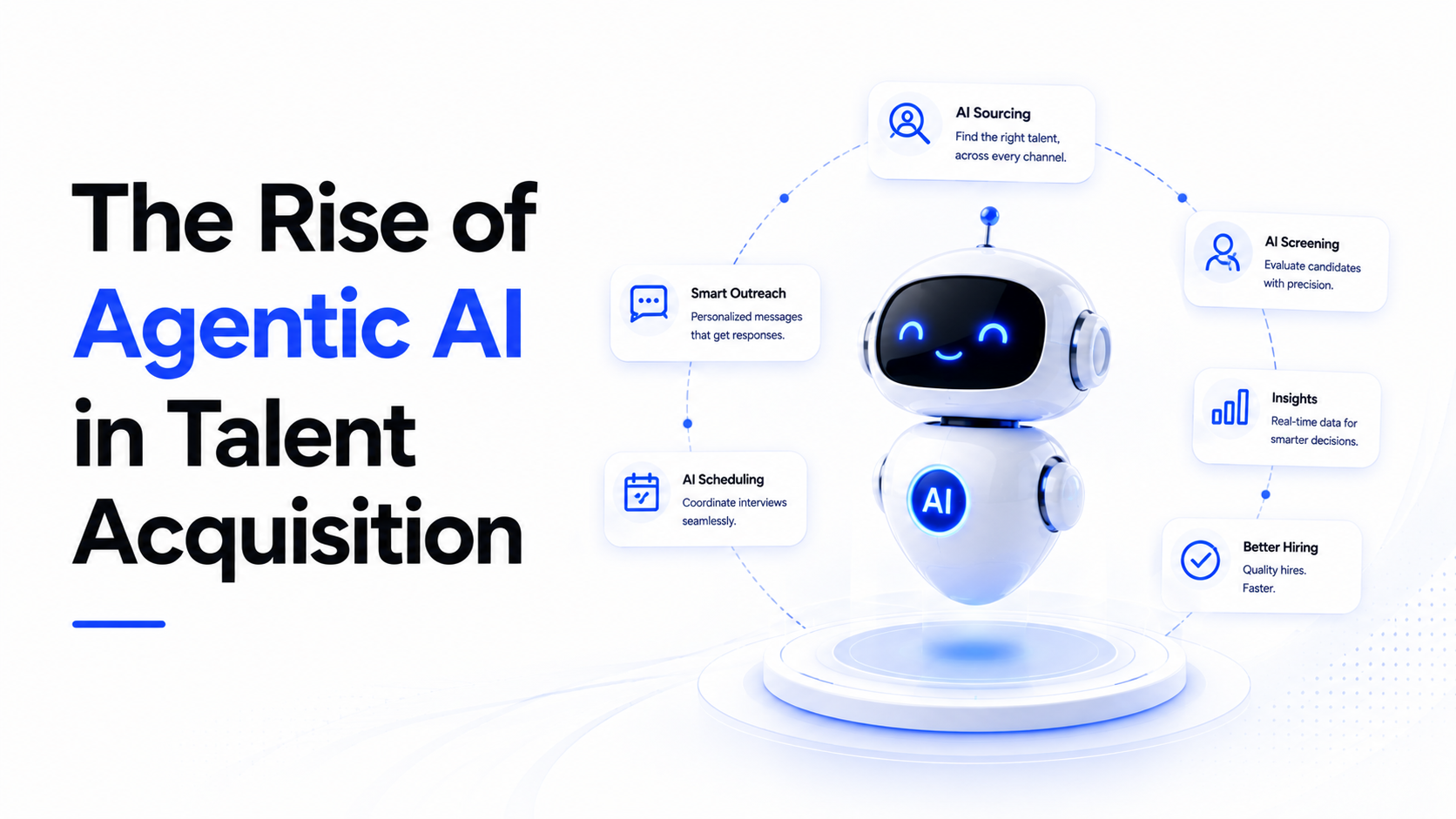
The distinction between automated and agentic AI is the most important concept in recruiting technology today, and it is poorly understood by most practitioners. An automated AI tool executes a specific task within a process that a human designs and manages. An AI resume screener evaluates resumes against criteria that a recruiter defines. An automated outreach tool sends emails based on templates that a recruiter writes. An AI scheduling tool coordinates calendars based on availability that participants provide. In every case, the human is the orchestrator and the AI is the executor. The AI does not decide what to do. It decides how to do what the human has instructed it to do. An agentic AI system inverts this relationship. The AI owns the workflow, making decisions about what to do, when to do it, and how to do it, within parameters defined by the organization. It identifies candidates, determines the appropriate outreach strategy, evaluates responses, schedules interviews, and manages the hiring pipeline without requiring a human to initiate or coordinate each step. The human reviews outcomes, provides strategic direction, and handles exceptions that exceed the system's decision authority. Gartner has identified the transition from automated to agentic AI as the defining technology trend in human resources for 2026 and beyond, noting that agentic systems consistently outperform automated point solutions by thirty to fifty percent on end-to-end hiring metrics because they eliminate the coordination gaps and data silos that fragment the automated approach.
In talent acquisition specifically, agentic AI represents a generational shift in how the recruiting function operates. An agentic system does not wait for a recruiter to run a Boolean search,
review the results, select candidates, draft outreach messages, and initiate contact. It continuously monitors the talent market, identifies candidates whose profiles match current and anticipated hiring needs, develops and executes personalized engagement strategies, and manages the full candidate lifecycle from initial identification through offer acceptance. The system learns from every interaction and every outcome, refining its sourcing criteria, outreach messaging, and evaluation logic based on evidence accumulated across the entire hiring history of the organization. This learning capability is what makes agentic AI fundamentally different from automation. Automated tools perform the same task the same way every time, improving only when a human reconfigures them. Agentic systems improve autonomously, becoming more effective with every hiring cycle. The most advanced form of this capability is found in an agentic AI recruiting platform that operates as an intelligent agent across the entire talent acquisition workflow, making contextual decisions at each stage and escalating to human recruiters only when the situation requires judgment that exceeds its trained capabilities.
How Agentic AI Sources and Engages Talent Differently
The sourcing and engagement capabilities of agentic AI represent the most visible and immediately impactful difference from traditional approaches. In a conventional recruiting operation, sourcing is a reactive activity triggered by an open requisition. A recruiter defines search criteria, runs queries across databases and job boards, reviews results, selects candidates for outreach, and initiates contact through email or messaging. This process is inherently limited by the recruiter's capacity, the breadth of their search criteria, and the time available for each role. Agentic AI eliminates these limitations by operating continuously and at scale. The system maintains a persistent awareness of the talent landscape relevant to the organization, tracking career movements, skill development, publication activity, and professional network changes across the candidate pool. When a role opens, the system does not begin a sourcing sprint. It draws from a continuously cultivated pipeline, engaging candidates whose profiles have been enriched over weeks or months of passive monitoring. According to LinkedIn talent acquisition research, organizations with AI-driven continuous talent intelligence report sixty to seventy percent shorter sourcing-to-engagement timelines and twenty-five to thirty-five percent higher candidate response rates, because the outreach is based on deep, current candidate context rather than generic templates sent to freshly searched lists.
The engagement strategy itself is fundamentally different in the agentic model. Traditional automated outreach tools send the same or similar messages to broad candidate lists, with personalization limited to inserting the candidate's name and current title into a template. This approach was effective when candidates received fewer outreach messages, but it has lost effectiveness as every organization has deployed similar tools and candidate inboxes have become saturated with templated communications. Agentic AI engages each candidate based on their specific professional context: the projects they have worked on recently, the skills they have developed, the career transitions they have made, and the signals they have emitted about their openness to new opportunities. The system generates unique, contextually
relevant outreach for each candidate, drawing on a deep understanding of both the candidate's background and the role's requirements. This contextual personalization is what drives the significantly higher response rates that agentic systems achieve. It is also what makes agentic AI particularly effective for challenging hiring scenarios. Research on whether AI recruiting tools work for niche or technical roles has found that agentic systems outperform conventional sourcing by an even wider margin in specialized talent markets, because the system's ability to identify transferable skills and contextual fit is more valuable when the candidate pool is small and the qualification criteria are complex.
The agentic engagement model also transforms the follow-up process, which is one of the most time-consuming and inconsistently executed activities in traditional recruiting. Most recruiters acknowledge that effective follow-up is critical to converting candidate interest into active engagement, but the operational demands of managing a pipeline of fifty or more active candidates make consistent, personalized follow-up nearly impossible at scale. Agentic systems manage follow-up autonomously, adjusting cadence, messaging, and channel based on each candidate's engagement signals. A candidate who opened the initial message but did not reply receives a different follow-up than a candidate who did not open it. A candidate who visited the company careers page after receiving outreach receives a different follow-up than one who did not. This signal-responsive engagement is impossible to execute manually at scale but straightforward for an agentic system that monitors candidate behavior in real time. SHRM guidance on candidate engagement best practices has identified responsive follow-up cadence as the single strongest driver of candidate conversion, noting that candidates who receive a follow-up within forty-eight hours that references their specific interaction with the organization are three to four times more likely to engage in a conversation than those who receive generic follow-up after a longer delay.
Agentic AI and the Reinvention of Candidate Evaluation
Candidate evaluation is the stage of the hiring process where agentic AI delivers some of its most significant advantages over both traditional methods and first-generation AI tools. Conventional screening relies on keyword matching, qualification thresholds, and structured scoring rubrics that evaluate candidates against a fixed profile. This approach is fast and consistent, but it is also rigid: it filters out candidates who do not match the specified criteria even when their actual capability may exceed what the criteria capture. First-generation AI screeners improved on keyword matching by using machine learning to identify patterns associated with successful hires, but they still operated within the traditional framework of evaluating candidates against a predefined profile. Agentic AI takes a fundamentally different approach by evaluating candidates in the context of the role, the team, and the organization rather than against a static checklist. The system considers career trajectory patterns, skill adjacency and transferability, project complexity and impact, and demonstrated learning velocity alongside traditional qualifications. This holistic, context-aware evaluation identifies high-potential candidates that conventional screening would reject, particularly those from non-traditional backgrounds, career changers, and professionals whose capabilities are not well captured by
standard resume formats.
The evaluation capabilities of agentic AI extend beyond resume analysis to encompass the full spectrum of candidate assessment. Conversational AI interfaces conduct initial candidate interactions that evaluate communication skills, role motivation, cultural alignment, and problem-solving approach in real time, generating assessment data that a static resume cannot provide. The system synthesizes these conversational assessments with resume analysis, work sample evaluations, and reference data into a unified candidate profile that is far richer than what any single assessment method can produce. This multi-modal assessment approach is particularly valuable for roles where traditional qualifications are poor predictors of on-the-job success. Deloitte research on predictive hiring analytics has found that multi-modal AI assessment, which combines conversational analysis with credential evaluation and behavioral indicators, produces fifteen to twenty-five percent more accurate hiring predictions than single-method assessment, because it captures dimensions of candidate capability that are invisible to any individual evaluation method. The agentic system does not just collect more data. It integrates the data into a coherent assessment that reflects the full scope of what the candidate brings to the role.
One of the most impactful applications of agentic evaluation is in the referral hiring process. Employee referrals have long been recognized as one of the highest-quality sources of hire, with referred candidates consistently outperforming sourced candidates on retention, performance, and time-to-productivity. However, most organizations underutilize their referral networks because they lack the capacity to actively manage and cultivate them. Recruiters focus on open requisitions and active sourcing, and referral network development becomes an afterthought. Agentic AI changes this by continuously monitoring the organization's professional network, identifying employees whose connections include professionals who match current or anticipated hiring needs, and facilitating warm introductions at the appropriate moment. The system does not replace the personal relationship that makes referrals effective. It amplifies it by ensuring that referral opportunities are identified and activated systematically rather than relying on employees to self-identify and initiate referrals. Analysis of why referrals outperform cold outreach consistently demonstrates that the quality advantage of referred candidates is driven primarily by the trust and context that the referrer provides, and agentic AI preserves this trust while removing the operational friction that prevents organizations from fully leveraging their referral networks. EY research on talent ecosystem optimization has found that organizations using AI to systematically activate referral networks see thirty to forty percent increases in referral hire volume without any decrease in referral hire quality, because the system identifies referral opportunities that human recruiters and employees would miss.
What Agentic AI Means for Recruiter Roles and Team Structure
The deployment of agentic AI in talent acquisition forces a reckoning with fundamental questions about the recruiter role, team structure, and the skills that will define recruiting
effectiveness in the next decade. The operational tasks that have historically consumed the majority of recruiter time, sourcing, screening, scheduling, correspondence, and pipeline management, are precisely the tasks that agentic systems perform most effectively. This does not mean that recruiters become obsolete. It means that the value proposition of a recruiter changes from operational execution to strategic advisory. In organizations that have successfully deployed agentic AI, recruiters spend the majority of their time on activities that require human judgment, creativity, and relationship depth: building relationships with passive senior candidates, consulting with hiring managers on role design and team composition, developing talent market intelligence that informs workforce planning, and managing the candidate experience at critical moments where human interaction creates disproportionate value. This shift is not a demotion. It is an elevation to a more strategic, more impactful, and ultimately more satisfying role. McKinsey analysis of professional role evolution in response to AI has found that recruiters who transition from operational to strategic roles in AI-augmented environments report higher job satisfaction, stronger hiring manager relationships, and better career advancement outcomes than their peers in traditional recruiting structures.
The team structure implications are equally significant. Traditional recruiting teams are organized around operational functions: sourcers who find candidates, recruiters who manage the hiring process, coordinators who handle logistics, and analysts who generate reports. This structure reflects the human-orchestrated model where each function requires dedicated capacity. Agentic AI dissolves these boundaries because the system handles the operational workflow end-to-end. The recruiting team of the agentic era is organized around strategic capabilities rather than operational functions: talent market specialists who develop deep expertise in specific talent segments, hiring manager advisors who partner with business leaders on workforce strategy, candidate experience designers who ensure that the human touchpoints in the process create genuine connection, and talent intelligence analysts who synthesize market data into actionable insights. This structural shift requires deliberate investment in capability development, because the skills that define success in the operational model, Boolean search expertise, applicant tracking system proficiency, and email template management, are not the skills that define success in the agentic model. LinkedIn research on the evolving skills profile of recruiting professionals has identified strategic advisory, data interpretation, stakeholder management, and relationship building as the four capabilities most strongly associated with high performance in AI-augmented recruiting environments, while traditional operational skills show diminishing correlation with recruiting outcomes.
The follow-up process, which is one of the most universally acknowledged pain points in recruiting, illustrates how agentic AI changes the recruiter's daily reality. Most recruiters know that consistent follow-up is essential for maintaining candidate engagement, particularly in competitive talent markets where top candidates receive multiple simultaneous opportunities. But the operational demands of managing a large candidate pipeline make consistent, personalized follow-up nearly impossible to execute manually. The result is a follow-up process that is sporadic, generic, and often too late to influence the candidate's decision. Agentic systems manage the entire follow-up lifecycle autonomously, adjusting messaging, timing, and
channel based on real-time engagement signals from each candidate. The recruiter reviews the system's follow-up strategy, provides input on high-priority candidates, and intervenes personally at moments where human contact will have the greatest impact. This division of labor, where the AI handles volume and consistency while the human handles depth and personal connection, produces better outcomes than either could achieve alone. Research on how many follow-ups one hire needs reveals that the optimal follow-up strategy is neither the single outreach that many recruiters default to nor the aggressive sequence that risks alienating candidates, but a responsive, signal-driven cadence that adapts to each candidate's engagement pattern, which is precisely what an agentic system is designed to execute.
Building the Organizational Foundation for Agentic AI in Talent Acquisition
Deploying agentic AI in talent acquisition is not a technology selection exercise. It is an organizational transformation that requires alignment across technology infrastructure, process design, data architecture, and team capability. The first and most critical prerequisite is data integration. Agentic systems require access to comprehensive, current, and consistent data from every system that touches the hiring process: applicant tracking systems, human resource information systems, performance management platforms, compensation databases, learning and development records, and external market intelligence feeds. Organizations that attempt to deploy agentic AI on top of fragmented, siloed data achieve disappointing results because the system is making decisions based on an incomplete picture. Gartner recommends conducting a comprehensive data architecture assessment before evaluating any agentic AI solution, because data integration quality is the single strongest predictor of AI deployment success in talent acquisition. The assessment should identify data gaps, inconsistencies in format and definition across systems, latency in data updates, and access restrictions that would limit the AI's ability to operate effectively. Organizations that invest in data infrastructure before deploying agentic AI consistently achieve faster time-to-value and stronger performance outcomes than those that deploy first and attempt to address data issues afterward.
Process redesign is the second critical prerequisite. Agentic AI does not operate effectively within processes that were designed for human orchestration. Workflows must be reimagined for AI-driven execution, with decision points clearly defined for either AI autonomy or human escalation, communication patterns designed for automated delivery with contextual personalization, and feedback loops that enable the system to learn from outcomes. This redesign is not about automating existing processes. It is about rethinking what the process should accomplish and designing it for an intelligent agent rather than for a human coordinator. Organizations that skip this step and simply layer agentic capabilities on top of existing process structures achieve results that are only marginally better than their previous automated tools, because the process itself creates friction that prevents the agentic system from operating at its full potential. SHRM guidance on AI implementation in talent acquisition emphasizes that process redesign should precede technology deployment, because the process
architecture determines whether the AI can operate autonomously or will be constrained by workflows that require human intervention at every step. The most effective approach is to design the target-state process first, then select technology that can execute it, rather than selecting technology and attempting to adapt existing processes around its capabilities.
The third prerequisite is organizational readiness, which encompasses recruiter skill development, hiring manager education, and candidate communication. Recruiters must understand what the agentic system does, how it makes decisions, and how their role changes from process manager to strategic advisor. Hiring managers must learn to interact with an AI-augmented recruiting function that operates differently from the traditional service model, receiving data-driven insights and strategic recommendations rather than simply receiving candidate resumes for evaluation. Candidates must experience the new process as an improvement in responsiveness and personalization, not as a depersonalized interaction with a machine. Each of these stakeholder groups requires deliberate investment in communication, training, and feedback mechanisms. Deloitte research on technology-led transformation consistently finds that organizations investing at least as heavily in change management as in technology deployment are three times more likely to achieve their target outcomes, because the technology realizes its potential only when the people who interact with it understand, trust, and effectively leverage its capabilities. The rise of agentic AI in talent acquisition is not a future possibility. It is the current trajectory of the industry, driven by competitive pressures that reward speed, quality, and scale in ways that human-orchestrated processes cannot sustainably deliver. The organizations that build the foundation now, data, process, and people, will accumulate compounding advantages as their agentic systems learn and improve with every hiring decision.