Rajesh Mehta, chief people officer at a London-based financial services firm with twelve thousand employees, opened the vendor renewal proposal for the company's applicant tracking system and felt a growing unease. The vendor had added seven new AI-powered features in the previous year, each one announced with considerable marketing fanfare. But when Rajesh asked his talent acquisition team which of these features they actually used, the answer was sobering. Three were enabled but produced recommendations that recruiters routinely overrode because they were not contextually accurate. Two had been tested and disabled because they did not integrate with the team's existing workflow. One was used only for reporting and did not influence any decisions. One had never been activated because the implementation required a data integration that the IT team had not yet completed. The vendor's product roadmap promised even more features for the coming year, but Rajesh was no longer interested in more features. He was interested in a fundamentally different kind of platform, one that did not require his team to orchestrate seven disconnected AI modules but instead operated as an intelligent system that managed the hiring workflow end-to-end. He had seen demonstrations of three next-generation platforms in the past month, and the difference in architectural approach was immediately apparent. The question was no longer whether to transition. It was how fast his organization could make the move without disrupting the hiring
pipeline that his business units depended on.
The Platform Generational Shift That Changes Everything
Rajesh Mehta, chief people officer at a London-based financial services firm with twelve thousand employees, signed the renewal for the company's applicant tracking system in January 2026 and immediately questioned whether he had just committed to the wrong generation of technology. His ATS vendor had added AI features over the past two years, an AI screening module, an AI-powered search interface, and an AI chatbot for candidate inquiries. Each feature worked adequately in isolation, but they did not work together. The screening module used different candidate data than the search interface. The chatbot could not access the scheduling system. The AI recommendations from one module did not influence the recommendations from another. Rajesh was paying for a collection of AI features bolted onto a platform that was designed fifteen years ago for a fundamentally different model of recruiting. He had begun evaluating next-generation platforms, and the contrast was stark. Where his current ATS organized data around requisitions and applications, the new platforms organized data around candidates and hiring outcomes. Where his ATS required recruiters to initiate every action, the new platforms operated autonomously and escalated to recruiters only when human judgment was needed. Where his ATS provided reporting on what had happened, the new platforms provided intelligence about what should happen next. This is the generational shift in hiring platforms that research from Gartner has identified as the most significant technology transition in talent acquisition since the move from paper-based to digital recruiting, a shift from tools that record and organize to platforms that think and act.
The generational distinction in hiring platforms is not marketing language. It reflects a fundamental difference in architectural philosophy that produces measurably different outcomes. First-generation digital recruiting platforms, the applicant tracking systems that emerged in the mid-2000s, were designed as systems of record. Their primary function was to capture and organize information about candidates, requisitions, and hiring activities. They made recruiting more organized and more auditable, but they did not make it more intelligent. Second-generation platforms, which emerged in the mid-2010s, added automation capabilities: automated job postings, automated resume parsing, automated interview scheduling, and automated status notifications. They made recruiting faster, but they did not fundamentally change the recruiting model. The recruiter was still the orchestrator, and the platform was still a collection of tools that the recruiter managed. Third-generation platforms, the ones now arriving, are built on a fundamentally different architectural principle: the platform itself is the orchestrator. It operates autonomously across the full hiring workflow, making decisions, managing handoffs, and learning from outcomes. The recruiter is not the manager of the platform. The recruiter is the strategic advisor who partners with the platform, providing human judgment at the points where it adds the most value. According to McKinsey analysis of HR technology evolution, this shift from system-of-record through system-of-automation to system-of-intelligence represents a once-in-a-generation architectural transition, and organizations that continue investing in second-generation platforms are essentially maintaining
legacy technology that will not support the recruiting model the market demands.
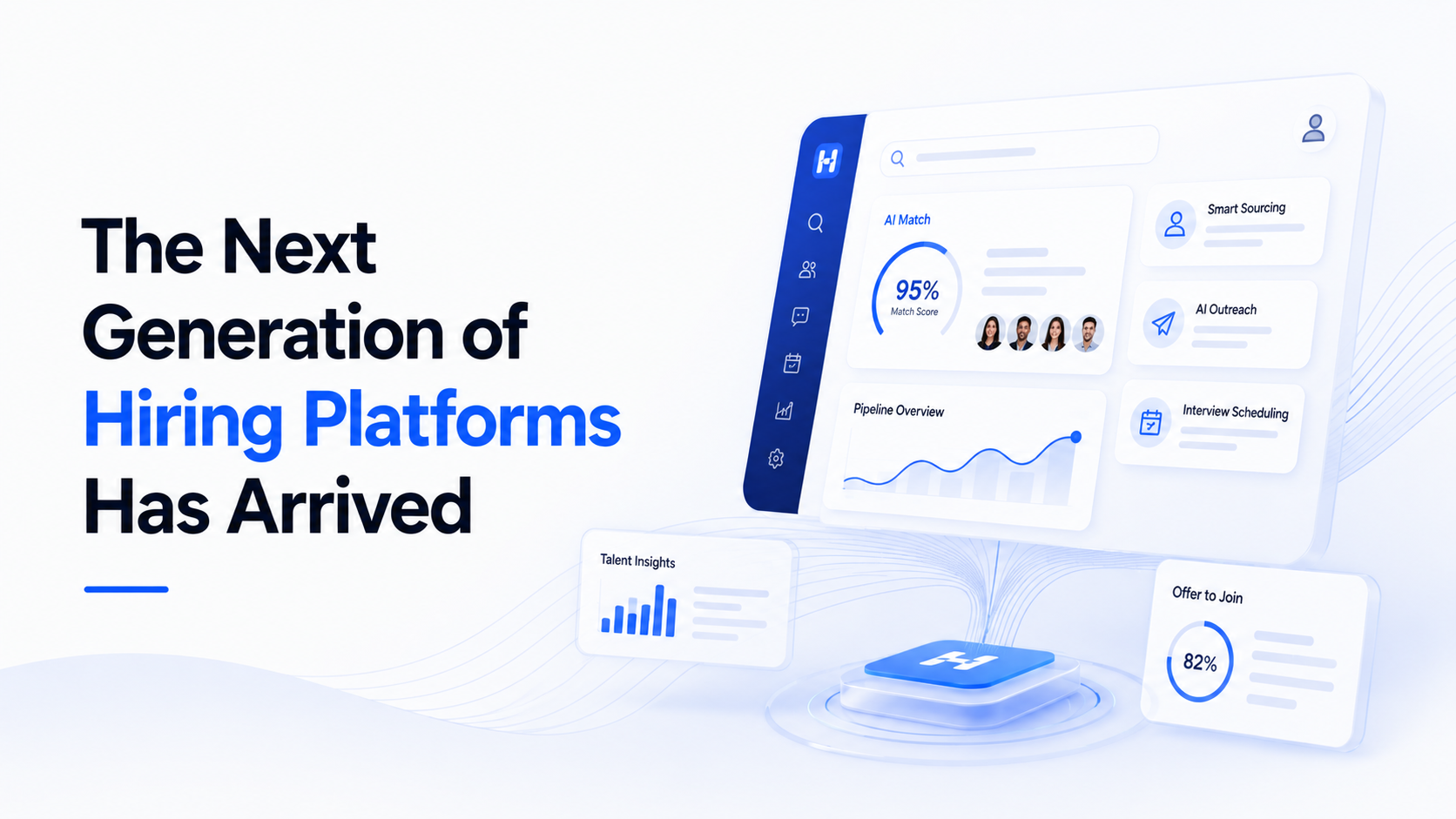
The practical implications of this generational shift are profound. A third-generation platform does not wait for a recruiter to define search criteria, run a search, review results, select candidates, draft outreach, and initiate contact. It continuously maintains a talent pipeline, identifies candidates who match current and anticipated needs, and engages them with personalized, context-aware communications, all autonomously. It does not wait for a recruiter to screen resumes, schedule interviews, collect feedback, and generate an offer. It manages the entire hiring workflow, synthesizing assessment data from multiple sources, optimizing interview panel composition, and recommending offer strategies based on candidate engagement signals and real-time market intelligence. The platform operates as an intelligent agent rather than a passive tool, and this distinction, explored in depth in discussions of what makes an agentic AI recruiting platform genuinely different from automated recruiting software, is what produces the step-change in hiring outcomes that early adopters are reporting. The next generation of hiring platforms has not just improved on the previous generation. It has rendered the fundamental architecture of the previous generation obsolete.
What Separates a Next-Generation Platform from a Legacy One
The differences between next-generation and legacy hiring platforms are not incremental feature improvements. They are architectural differences that affect every aspect of how the platform operates and what outcomes it produces. The first and most important difference is the orchestration model. Legacy platforms are tool collections. They provide discrete capabilities, resume screening, job posting, interview scheduling, offer management, that the recruiter orchestrates by moving between tools, manually transferring data, and making the connective decisions that link one tool's output to the next tool's input. Next-generation platforms are workflow engines. They define and manage the end-to-end hiring workflow, making the connective decisions autonomously and presenting the recruiter with outcomes and exceptions rather than tasks and handoffs. The recruiter does not move between tools. The recruiter reviews the platform's decisions and intervenes when the platform escalates a situation that requires human judgment. According to LinkedIn talent acquisition technology research, organizations using workflow-engine platforms report thirty to forty percent less recruiter time spent on process coordination and twenty-five to thirty-five percent faster hiring cycles, because the platform eliminates the manual orchestration that creates delays and coordination overhead in the legacy model.
The second critical difference is the learning model. Legacy platforms are static. They perform the same functions in the same way unless a human administrator reconfigures them. The screening criteria are what the recruiter defined. The outreach templates are what the recruiter wrote. The scheduling logic is what the vendor implemented. Next-generation platforms are adaptive. They learn from every hiring decision, every candidate interaction, and every market signal, continuously refining their sourcing criteria, engagement strategies, assessment weights, and workflow parameters based on accumulated evidence. This learning
capability means that the platform becomes more effective with every hiring cycle, a compounding advantage that legacy platforms cannot replicate. The difference between static and adaptive platforms is particularly visible in how they handle evolving talent markets. A legacy platform screens against a static profile that becomes progressively less accurate as the market shifts. A next-generation platform continuously updates its understanding of what candidate characteristics predict success in specific roles, based on the actual outcomes of the organization's hiring decisions. Organizations evaluating AI recruiting platforms need to assess this learning capability explicitly, and guidance on how to evaluate an AI sourcing tool before buying provides a framework for distinguishing platforms that genuinely learn and adapt from those that merely automate static processes under an AI label.
The third difference is the data model. Legacy platforms organize data around transactions: applications received, interviews scheduled, offers extended. Each transaction is a discrete record, and the relationships between transactions, the pattern of a candidate's journey through the hiring process, the correlation between sourcing channel and hiring quality, the relationship between engagement timing and offer acceptance, are not captured or analyzed by the platform itself. Next-generation platforms organize data around entities and outcomes: candidates, roles, hiring managers, and the relationships between them. The platform maintains a living profile for each candidate that includes not only their application history but also their professional signals, engagement patterns, and assessment results across multiple interactions with the organization. This entity-centric data model enables the platform to make decisions that consider the full context of a candidate's relationship with the organization, not just the data from a single requisition. SHRM research on recruiting data architecture has found that organizations with entity-centric candidate data models achieve twenty to thirty percent higher candidate re-engagement rates, because the platform recognizes returning candidates and adapts its approach based on previous interactions rather than treating each application as an isolated event.
The Hidden Cost of Staying on Legacy Hiring Platforms
The most significant cost of legacy hiring platforms is not the licensing fee. It is the opportunity cost of operating a recruiting function that is architecturally incapable of competing with organizations that have adopted next-generation platforms. This cost manifests in several ways, each of which compounds over time. First, legacy platforms create data silos that prevent intelligent decision-making. When candidate data lives in the ATS, sourcing data lives in the sourcing tool, assessment data lives in the assessment platform, and communication data lives in the email system, no single system has a complete picture of the candidate or the hiring process. Decisions are made based on partial information, and the quality of those decisions reflects the limitations of the available data. Second, legacy platforms require manual orchestration that creates coordination delays. Every handoff between tools, from sourcing to screening to scheduling to assessment to offer, requires human intervention, and each intervention adds time to the process. In a talent market where top candidates make decisions within days, these delays are not merely inconvenient. They are competitively decisive. The
issue of whether some AI recruiting tools rely on outdated candidate data is a direct consequence of legacy platform architectures that were not designed for real-time data integration, leaving organizations to make sourcing decisions based on candidate profiles that may be weeks or months old.
Third, legacy platforms fragment the candidate experience. A candidate interacting with a legacy platform typically encounters multiple systems with different interfaces, different communication styles, and different data practices. The career site where they discover the role, the application portal where they submit materials, the email system where they receive scheduling information, the video platform where they complete assessments, and the offer portal where they review terms are often separate systems that do not share a common candidate experience framework. This fragmentation communicates organizational disarray to candidates, particularly the high-caliber candidates who have multiple options and who interpret technology experience as a proxy for organizational quality. Deloitte research on candidate experience and employer brand has found that fragmented hiring technology is one of the three strongest negative predictors of offer acceptance, alongside low compensation and extended hiring timelines, because candidates associate technology fragmentation with organizational fragmentation. Fourth, legacy platforms prevent the accumulation of learning data. Every hiring decision produces outcome data, who was hired, how they performed, whether they were retained, but legacy platforms do not systematically capture, analyze, or feed this data back into the hiring process. Each hire is an isolated event rather than a data point in a learning system, and the organization loses the compounding advantage that continuous learning provides.
The compounding nature of these costs means that the gap between legacy and next-generation platforms widens over time. Organizations on next-generation platforms accumulate learning data that makes their sourcing more accurate, their engagement more effective, and their hiring decisions better with every cycle. Organizations on legacy platforms do not accumulate this advantage, and they fall progressively further behind as their competitors improve. This dynamic creates a strategic urgency that is not captured by traditional technology ROI calculations, which compare the cost of the new platform to the cost of the current platform without accounting for the competitive cost of operating with inferior capabilities. EY analysis of technology-driven competitive dynamics in talent markets has found that the performance gap between organizations using next-generation and legacy hiring platforms widens by ten to fifteen percent per year in terms of time-to-fill and quality-of-hire metrics, because the learning advantage of next-generation platforms compounds while legacy platforms remain static. The hidden cost of staying on a legacy platform is not the platform's licensing fee. It is the steadily growing competitive disadvantage that compounds with every hiring cycle the organization runs on outdated technology.
How Next-Generation Platforms Unify Sourcing, Engagement, and Hiring
One of the most visible differences between next-generation and legacy hiring platforms is the elimination of the functional boundaries that fragment the traditional recruiting process. In a legacy environment, sourcing is a separate function from recruiting, often operated by different people using different tools with different data. Sourcing specialists identify candidates in external databases and pass them to recruiters who manage the hiring process through the ATS. This separation creates information loss at every handoff: the sourcing specialist's knowledge of the candidate's context and motivations does not transfer cleanly to the recruiter, and the recruiter's knowledge of the hiring manager's evolving requirements does not transfer back to the sourcer. Next-generation platforms eliminate this separation by unifying sourcing and recruiting into a single, continuous workflow managed by an intelligent agent. The same system that identifies and engages candidates also manages their progression through the hiring process, ensuring that the context and intelligence gathered during sourcing informs every subsequent decision. This unification is a core theme in analyses of the difference between AI sourcing and AI recruiting, where the most effective implementations are those that dissolve the artificial boundary between finding candidates and hiring them, treating the entire process as a unified workflow that a single intelligent system manages from end to end.
The engagement model in next-generation platforms reflects this unification. Rather than treating engagement as a series of discrete communications, an email sequence followed by a screening call followed by an interview invitation, the platform manages engagement as a continuous, adaptive relationship with the candidate. The system monitors the candidate's every interaction with the organization, from initial outreach through final offer decision, and adjusts its approach in real time based on the signals it observes. A candidate who demonstrates high engagement early in the process but becomes less responsive as interviews approach receives a different intervention than a candidate who is slow to engage initially but becomes increasingly interested after learning more about the role. The platform does not follow a predefined sequence. It develops a strategy that is responsive to the specific candidate's behavior, preferences, and context. According to McKinsey research on candidate experience in competitive talent markets, organizations that provide a continuous, adaptive engagement experience achieve thirty to forty-five percent higher candidate satisfaction scores and twenty-five to thirty-five percent higher offer acceptance rates, because candidates perceive the process as personally attentive rather than mechanically scripted.
The hiring workflow itself is also unified in ways that legacy platforms cannot support. In a next-generation platform, the workflow is not a fixed sequence of steps defined by a recruiter. It is a dynamic process that adapts to the specific requirements of each role, each candidate, and each hiring situation. For a high-priority role with a shallow candidate pool, the platform may accelerate the process by conducting initial assessment through conversational AI during the sourcing phase, compressing the typical three-stage process into a more efficient two-stage flow. For a high-volume role with a deep candidate pool, the platform may add additional assessment stages to ensure quality at scale. For a candidate who is actively considering multiple offers, the platform may escalate to a senior recruiter for personal relationship
management at the critical decision point. The platform makes these workflow adaptations autonomously, based on its understanding of the role requirements, the candidate's situation, and the competitive dynamics of the talent market. This adaptive workflow capability is what distinguishes a genuine next-generation platform from a legacy platform with additional features bolted on. According to LinkedIn data on hiring process optimization, organizations using adaptive workflow platforms fill roles twenty to thirty percent faster than those using fixed-sequence processes, because the platform eliminates unnecessary steps for straightforward hires while adding value-adding steps for complex ones, rather than applying the same rigid process to every situation.
Making the Transition to a Next-Generation Hiring Platform
The transition from a legacy to a next-generation hiring platform is one of the most consequential technology decisions a talent acquisition leader will make, and it requires a structured approach that addresses technology, data, process, and organizational readiness simultaneously. The first phase is a comprehensive assessment of the current state that goes beyond feature comparison to evaluate architectural alignment. The question is not whether the current platform has AI features. It is whether the current platform's architecture, its data model, orchestration approach, and learning capability, can support the intelligent, adaptive, end-to-end recruiting model that the talent market demands. Many legacy platforms have added AI features on top of architectures that were designed for record-keeping and process automation, and these bolted-on capabilities cannot match the performance of platforms that were architecturally designed for intelligence from the ground up. Gartner recommends evaluating platforms on three architectural dimensions, data model, orchestration depth, and learning mechanism, rather than on individual feature checklists, because the architecture determines whether the platform can deliver compounding improvements or will plateau as the organization's needs evolve.
The second phase is data migration and integration. Next-generation platforms require access to comprehensive, current, and consistent data from every relevant source. This typically means integrating data from the existing ATS, HRIS, performance management system, compensation database, and external talent intelligence feeds. The integration must be bidirectional: the new platform must be able to read data from these sources and write data back to them, ensuring that the organization's systems of record remain accurate and complete. Data migration from legacy platforms is often the most technically challenging phase of the transition, because legacy systems store data in formats and structures that do not map cleanly to the entity-centric data models of next-generation platforms. Organizations that underinvest in data migration consistently achieve disappointing results from new platform deployments, because the platform is operating with incomplete or inaccurate data. The third phase is process redesign. Next-generation platforms enable fundamentally different recruiting processes, and organizations that simply replicate their existing processes on the new platform leave most of the value unrealized. Process redesign should re-evaluate every step of the hiring workflow, asking which steps should be autonomous, which should involve human
judgment, and how the platform and the recruiting team should collaborate at each stage. Deloitte research on HR technology transformation has found that organizations that invest in process redesign alongside platform deployment achieve fifty to seventy percent better outcomes than those that deploy the platform without redesigning the processes it supports, because the redesigned processes take full advantage of the platform's capabilities rather than constraining it with legacy workflows.
The fourth and most critical phase is organizational change management. The transition to a next-generation platform changes what recruiters do, how hiring managers interact with the recruiting function, and how candidates experience the hiring process. Each of these stakeholder groups requires deliberate preparation. Recruiters must understand that their role is shifting from operational process management to strategic talent advisory, and they must develop the skills, data interpretation, stakeholder management, and candidate relationship depth, that the new model requires. Hiring managers must learn to interact with an AI-augmented recruiting function that provides strategic recommendations rather than simply delivering candidate resumes for evaluation. Candidates must experience the new process as a genuine improvement in responsiveness, personalization, and respect for their time. Organizations that invest in communication, training, and feedback mechanisms for all three stakeholder groups consistently achieve smoother transitions and faster time-to-value. SHRM has documented that the organizations most successful in adopting next-generation hiring platforms are those that frame the transition as an investment in recruiter capability and candidate experience rather than a technology upgrade, because this framing shapes how stakeholders perceive and engage with the change. The next generation of hiring platforms has arrived, and the organizations that recognize this reality and act on it will build a recruiting capability that compounds in effectiveness with every hire, while those that delay will find the transition progressively more difficult as their competitors accumulate learning advantages that cannot be quickly replicated.