Tomás Rivera, chief talent officer at a Mexico City-based financial services company with three thousand employees, stared at the monthly technology spend report and felt a familiar frustration. His talent acquisition team was using thirteen different recruiting tools, each licensed separately, each integrated imperfectly with the others, and each requiring its own training, administration, and support. The total annual cost of this tool stack exceeded one point four million dollars, yet his hiring managers routinely complained about slow time-to-fill, his recruiters spent more time managing tools than talking to candidates, and his candidate satisfaction scores had been declining for three consecutive quarters. Tomás had recently seen a presentation from an AI recruiting platform vendor that described a fundamentally different architecture, one where a single AI agent managed the full recruiting workflow and human recruiters focused exclusively on strategic advisory and relationship building. The vendor called it the new hiring stack, and the core idea was simple: replace the collection of tools with an integrated AI agent layer paired with a human decision layer. Tomás was intrigued but cautious. He had seen technology promises before. What he needed was a clear understanding of what this new stack actually looked like in practice, what evidence supported its effectiveness, and how to migrate his organization without disrupting the hiring his business units depended on every day.
Why the Old Hiring Stack Is Collapsing
The traditional hiring technology stack was built around a sequence of discrete tools, each
designed to handle one step in the recruiting process. An applicant tracking system manages the workflow. A job board distributes the posting. A sourcing platform identifies candidates. An outreach tool sends messages. An interview scheduling application manages calendars. A background check service runs verifications. Each tool was acquired separately, configured separately, and operated separately, with the human recruiter serving as the integration layer that transferred information and coordinated activities across the stack. This architecture made sense when recruiting was a relatively simple, linear process, but it has become progressively more dysfunctional as the talent market has grown more complex and competitive. The fundamental problem is that adding more tools gives you the same hiring problems because the fragmentation of the stack prevents any individual tool from operating with the full context it needs to make optimal decisions. The ATS does not know what the sourcing platform has learned about candidate availability. The outreach tool does not know what the interview feedback system has captured about the hiring manager's preferences. Each tool is making decisions with incomplete information, and the recruiter who bridges these gaps is spending an increasing proportion of their time on data transfer and coordination rather than on the strategic and relational activities that actually improve hiring outcomes.
The collapse of the old stack is not happening because the individual tools are bad. Many of them are quite good at their specific functions. The collapse is happening because the architectural model, a collection of independent point solutions connected by human effort, cannot keep pace with the demands of the current talent market. Candidates today expect fast, personalized, and coherent interactions with potential employers. They do not want to receive a generic outreach message from one system, then have to repeat their career history in a phone screen conducted through another system, then encounter a different communication style when they interact with the scheduling system. This disjointed experience signals organizational dysfunction to candidates, and top performers, who have multiple options, simply disengage from employers who cannot deliver a cohesive experience. The old stack also cannot support the speed that competitive hiring now requires. When a strong candidate enters the market, the organization that can evaluate them, engage them, and advance them through the process fastest will win the hire. A fragmented stack adds days or weeks to this timeline because each handoff between tools creates delays, information loss, and coordination overhead. According to McKinsey research on technology architecture and organizational performance, companies operating with highly fragmented technology stacks in professional services functions report twenty-five to thirty-five percent slower process cycle times and fifteen to twenty percent higher error rates compared to those with integrated platforms, because fragmentation creates exactly the kinds of delays and information gaps that undermine speed and quality.
The economic argument against the old stack has also become compelling. Organizations typically spend fifty to seventy percent more on their fragmented tool stacks than they would on a single integrated platform, when all costs are accounted for, including license fees for multiple products, integration middleware, the recruiter time spent on manual coordination, the IT resources required to maintain and update multiple systems, and the opportunity cost of
suboptimal hiring outcomes caused by information gaps and process delays. Despite this higher spending, fragmented stacks consistently produce worse results: slower time-to-fill, lower candidate satisfaction, higher recruiter turnover, and weaker hiring manager confidence in the talent acquisition function. The old stack persists not because it is effective but because of organizational inertia, the accumulated weight of existing contracts, integration investments, and recruiter familiarity with current tools creates switching costs that feel prohibitive even when the evidence clearly shows that the current approach is failing. According to Gartner analysis of HR technology spending, the average large enterprise uses eleven to fourteen separate tools in its recruiting technology stack, yet only twenty-three percent of recruiting leaders report being satisfied with how well these tools work together, suggesting that the fragmentation problem is widely recognized but poorly addressed.
What the New Stack Looks Like
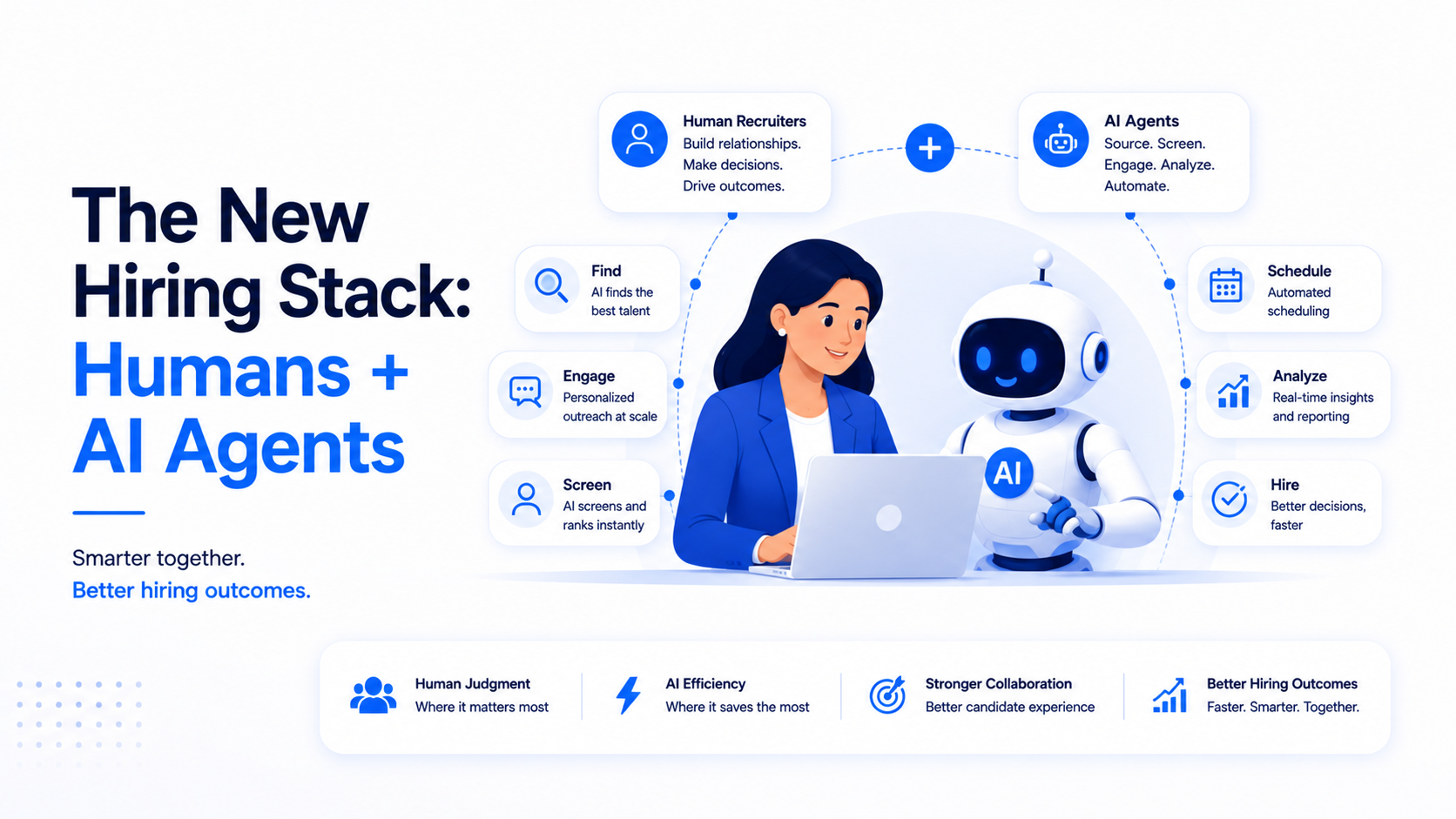
The new hiring stack replaces the collection of independent tools with a two-layer architecture composed of an AI agent layer and a human decision layer. The AI agent layer is a single integrated platform that manages the full recruiting workflow from sourcing through offer acceptance, using autonomous AI agents that can access all relevant data, maintain context across the entire candidate relationship, and make operational decisions without requiring human initiation at each step. The human decision layer is the team of recruiters and hiring managers who provide strategic direction, exercise judgment on complex or ambiguous situations, and manage the relational and political dynamics that require human intelligence. The key architectural principle of the new stack is that these two layers are not operating in sequence, with the AI doing the operational work and the human reviewing the output, but in parallel, with both layers contributing simultaneously to the hiring process. The AI agent maintains continuous awareness of the talent market and the hiring pipeline, taking autonomous action to advance the process, while the human recruiter engages in strategic advisory, relationship deepening, and organizational alignment activities that create value beyond what the AI can provide. Understanding the best way to evaluate an AI sourcing tool before buying is essential at this stage, because the evaluation criteria must focus on the platform's ability to serve as the AI agent layer of a two-layer stack rather than on individual feature comparisons with point solutions.
In the new stack, the AI agent layer handles a specific set of operational activities that it can perform more effectively than human recruiters working with traditional tools. These activities include continuous candidate sourcing across multiple platforms and data sources, personalized outreach at scale with context-aware message generation, real-time candidate engagement including responses to inquiries and scheduling coordination, systematic interview feedback collection and structured summarization, pipeline health monitoring with proactive alerts when candidates disengage or timelines slip, and talent market intelligence gathering that identifies emerging trends in skill availability, compensation, and competitor hiring activity. Each of these activities is operational in nature, meaning it follows defined patterns and can be improved through data-driven learning. The AI agent does not merely automate these
activities. It performs them with a level of consistency, speed, and contextual awareness that human recruiters cannot match when operating manually across multiple tools. A human recruiter managing a pipeline of fifty candidates across ten open positions can provide high-quality attention to perhaps five to eight candidates per day. An AI agent can provide high-quality, personalized engagement to all fifty candidates simultaneously, adjusting its approach for each based on their individual profile, interaction history, and responsiveness patterns. According to Deloitte research on AI-augmented work in HR functions, the AI agent layer in the new hiring stack typically handles sixty to seventy percent of the total operational activities in the recruiting workflow, freeing human recruiters to focus on the thirty to forty percent that requires human judgment, creativity, and relationship skills.
The human decision layer in the new stack concentrates on the activities where human capabilities create the most value. These activities include defining hiring strategy in collaboration with business leaders, exercising contextual judgment on candidates whose profiles do not fit standard evaluation frameworks, building deep relationships with high-priority passive candidates who require a human touch, advising hiring managers on role design, team composition, and evaluation criteria, navigating organizational politics and stakeholder alignment around hiring decisions, and providing the emotional intelligence and empathy that candidates need during high-stakes career decisions. The human layer also serves as the quality assurance mechanism for the AI agent layer, reviewing AI recommendations, providing feedback that improves the AI's decision-making, and overriding AI decisions when human judgment identifies factors the AI has not adequately considered. This quality assurance function is not a burden but a strategic activity, because the feedback that humans provide to the AI system is the primary mechanism through which the system improves over time. According to LinkedIn data on talent acquisition team effectiveness, organizations where the human decision layer actively engages with and provides feedback to the AI agent layer report thirty to forty percent faster improvement in AI recommendation accuracy compared to organizations where recruiters passively accept or ignore AI outputs, because the active feedback loop accelerates the AI's learning and alignment with the organization's specific hiring context.
How Humans and AI Agents Divide the Work
The practical division of labor between humans and AI agents in the new hiring stack follows a consistent principle: the AI agent handles activities that are high-volume, data-intensive, and pattern-driven, while the human handles activities that are low-volume, judgment-intensive, and relationship-driven. This principle produces a specific allocation of responsibilities that looks different at different stages of the hiring process. During the sourcing stage, the AI agent identifies potential candidates across multiple platforms, evaluates their fit against role requirements, and initiates personalized outreach. The human recruiter defines the sourcing strategy, provides the cultural and contextual nuances that the AI cannot infer from data alone, and engages directly with the most high-priority candidates whose profiles require human interpretation. The question of whether AI recruiting tools work for niche or technical roles becomes particularly important at this stage, because the balance between AI and human
effort shifts based on the specificity and scarcity of the talent being sought. For mainstream roles with large candidate pools, the AI agent handles eighty to ninety percent of sourcing activity. For highly specialized roles where candidate profiles are unusual and evaluation requires deep domain expertise, the human recruiter may handle fifty to sixty percent of the activity, with the AI agent providing research support and initial screening that the human recruiter builds upon.
During the engagement and evaluation stages, the division of labor becomes more intertwined. The AI agent manages the cadence of candidate communication, sends follow-up messages at optimal intervals, answers routine questions about the role and the organization, collects structured interview feedback from hiring managers, and maintains the candidate's status record across all stages. The human recruiter conducts the substantive candidate conversations, assesses cultural fit and soft skills that are difficult for AI to evaluate, provides personalized counsel to candidates navigating career decisions, and manages the negotiation process that leads to an accepted offer. The interaction between the layers during these stages is where the new stack delivers its greatest value, because the AI agent's continuous operational management creates the space and the context for the human recruiter to have deeper, more strategic conversations with candidates. Instead of spending the conversation catching up on logistics that the candidate has already discussed with the AI, the human recruiter can focus entirely on the relationship and the assessment, because the AI has already handled the informational groundwork. According to EY analysis of human-AI collaboration patterns in professional hiring, the quality of candidate-recruiter conversations in AI-augmented hiring stacks is rated thirty to forty percent higher by both candidates and hiring managers, because the human recruiter is more prepared, more focused, and more present in the conversation when the AI has handled the operational preparation.
During the closing and post-hire stages, the human layer takes a more prominent role while the AI layer provides critical support. The human recruiter manages the offer negotiation, which requires empathy, creativity, and an understanding of the candidate's personal circumstances and motivations that the AI cannot fully replicate. The human also conducts the relationship-building conversations that convert an accepted offer into a committed new hire, addressing the natural anxiety that accompanies any career transition and reinforcing the candidate's confidence in their decision. The AI agent supports these activities by providing real-time compensation benchmarking that informs the negotiation, generating personalized pre-boarding communications that maintain candidate engagement between offer acceptance and start date, and tracking the post-hire feedback loop that connects hiring outcomes back to the sourcing and evaluation criteria, enabling the system to improve its recommendations for future hires. This feedback loop is a distinctive capability of the new stack, because in the old fragmented model, the connection between hiring outcomes and sourcing decisions was rarely captured systematically. According to McKinsey research on learning systems in talent acquisition, organizations with closed-loop feedback between hiring outcomes and AI sourcing decisions improve their quality-of-hire metrics by twenty to thirty percent within twelve months, because the AI system can identify which sourcing strategies, evaluation criteria, and
engagement patterns produced the best hires and systematically replicate those approaches.
The Performance Data Behind the New Stack
The case for the new hiring stack is not theoretical. Organizations that have made the transition from fragmented tool stacks to integrated human-plus-AI-agent architectures are reporting measurable improvements across every major hiring metric. Time-to-fill for professional and technical roles has decreased by forty to sixty percent in organizations that have fully implemented the new stack, because the AI agent layer eliminates the delays caused by manual coordination between tools and the human layer can focus exclusively on the strategic activities that accelerate decision-making. Cost-per-hire has decreased by twenty-five to forty percent, because the integrated platform eliminates redundant tool licenses, the AI agent reduces the recruiter time required per hire, and the improved candidate experience reduces the need for expensive recruitment agencies. Candidate satisfaction scores have increased by thirty to forty percent, because candidates experience a coherent, responsive, and personalized hiring process rather than the disjointed, slow, and impersonal process that fragmented stacks produce. First-year retention among new hires has improved by fifteen to twenty-five percent, because the AI agent's multi-dimensional evaluation and the human recruiter's deeper candidate conversations produce better mutual fit assessments. These are not projections. They are outcomes reported by organizations that have completed the transition to the new stack and are now operating with a human-plus-AI-agent hiring model. According to Gartner case study analysis of talent acquisition transformations, the average organization that transitions to an integrated AI-agent hiring platform achieves full return on investment within eight to fourteen months, with the payback period shortest for organizations that hire in high-volume or high-competition talent segments where the speed and quality advantages of the new stack create the most immediate competitive value.
The performance improvements are not evenly distributed across all types of hiring. The new stack delivers the largest improvements in exactly the hiring scenarios that are most painful under the old model: high-volume roles where the old stack's manual coordination created bottlenecks, specialized technical roles where the old stack's limited data integration produced poor candidate matching, and senior leadership roles where the old stack's transactional approach failed to build the candidate relationships necessary to attract passive executives. For high-volume hiring, the AI agent layer can manage thousands of candidate interactions simultaneously, maintaining quality and personalization at a scale that would require a human recruiting team ten times the size under the old model. For specialized roles, the integrated data architecture of the new stack allows the AI agent to evaluate candidates against a richer set of criteria than any single tool in the old stack could access, producing more accurate matching and reducing the time required to identify qualified candidates. For senior roles, the AI agent handles the operational groundwork of research, outreach, and scheduling, freeing the human recruiter to invest the concentrated relationship-building effort that executive hiring demands. According to SHRM talent acquisition benchmarking data, organizations using the new hiring stack report the highest satisfaction improvements in precisely these three
scenarios, with seventy to eighty percent of recruiting leaders rating the new stack as significantly better than their previous approach for high-volume, specialized, and senior hiring categories.
The cumulative competitive advantage of the new stack is perhaps its most important but least appreciated benefit. Each hiring cycle in the new stack generates data that improves the AI agent's performance for the next cycle. The system learns which sourcing channels produce the best candidates for specific role types, which outreach messages generate the highest response rates for specific talent segments, which evaluation criteria best predict on-the-job success, and which engagement patterns produce the highest offer acceptance rates. This learning compounds over time, meaning that the new stack does not just produce better outcomes than the old stack at any given point in time. It produces progressively better outcomes with each cycle, because the accumulated learning makes every subsequent hiring decision more informed than the last. Organizations that adopt the new stack early will have a significant learning advantage over those that adopt later, because they will have accumulated more data, more refined models, and more organizational experience with the human-AI collaboration model. According to LinkedIn research on talent acquisition maturity, early adopters of integrated AI hiring platforms report two to three times faster improvement in hiring outcomes over a three-year period compared to organizations that adopt the same technology one to two years later, because the compounding effect of accumulated learning creates an advantage that late adopters cannot quickly close.
Migrating to the New Stack Without Disrupting Hiring
The transition from the old hiring stack to the new one must be managed carefully to avoid disrupting the hiring that the organization needs to continue doing during the transition. The most effective migration approach follows a parallel-run model, where the new integrated platform is deployed alongside the existing tool stack and gradually assumes responsibility for specific hiring processes while the old tools continue to handle the processes that have not yet been migrated. The first phase of the parallel run typically covers sourcing and initial outreach for two to three role types, because these are the processes where the new stack's integrated data architecture produces the most immediate improvement and where the risk of migration is lowest. The second phase extends the new stack's coverage to include candidate engagement, interview coordination, and feedback management. The third phase completes the transition by migrating all remaining processes, including analytics, reporting, and compliance workflows, to the new platform. This phased approach allows the organization to validate the new stack's performance in a controlled environment, build recruiter confidence through demonstrated results, and identify and resolve integration issues before they affect mission-critical hiring. A critical consideration during migration is ensuring data quality in the new platform, because the issue of why some AI recruiting tools have outdated candidate data can undermine the new stack's effectiveness if the migration transfers stale data from legacy systems into the new platform's candidate graph.
The data migration component of the transition requires particular attention, because the new stack's effectiveness depends entirely on the quality and freshness of the data it operates on. Organizations should approach data migration as a data quality improvement initiative rather than a simple data transfer. This means deduplicating candidate records, updating outdated information, enriching profiles with data from additional sources, and establishing ongoing data quality governance processes that maintain the integrity of the new platform's candidate graph over time. Organizations that treat data migration as a mechanical transfer of records from the old system to the new one consistently underperform those that use the migration as an opportunity to clean, enrich, and restructure their candidate data. The difference in outcomes is significant: organizations that invest in data quality during migration report thirty to forty percent better AI recommendation accuracy in the first six months of operation compared to those that migrate data without quality remediation, because the AI agent is operating from a stronger foundation from the start. According to Deloitte guidance on technology platform migration, the data quality investment during migration should represent fifteen to twenty percent of the total migration budget, a proportion that many organizations underestimate but that produces disproportionate returns in system performance and user confidence.
The people dimension of the migration is ultimately the dimension that determines its success. Recruiters who have spent years developing expertise in the old tool stack will naturally feel uncertain about the transition, and this uncertainty can manifest as resistance, disengagement, or active sabotage if it is not addressed through deliberate change management. The most effective change management programs for stack migration include several elements: early involvement of recruiters in the platform selection and configuration process, which creates ownership and ensures the new system reflects the realities of recruiting work; structured training that focuses not just on operating the new platform but on developing the new skills, like strategic advisory and AI collaboration, that the new stack enables and requires; a clear communication narrative that frames the migration as an investment in recruiter capability and career growth rather than as a technology replacement exercise; and visible leadership commitment, where recruiting leaders personally use the new platform and advocate for its benefits. According to EY research on technology-led transformation in HR, organizations that invest in comprehensive change management alongside platform migration achieve three to four times higher recruiter adoption rates and two to three times faster time-to-productivity compared to those that focus primarily on the technology deployment. The new hiring stack is a fundamentally different way of organizing the recruiting function, and realizing its full potential requires a corresponding investment in the people who will bring it to life. McKinsey has documented that the organizations achieving the strongest outcomes from hiring stack transformations are those that treat the migration as a business transformation initiative with a technology component, rather than as a technology deployment with a change management component, because this framing ensures that the human and organizational dimensions receive the strategic attention they deserve.