Daniel Okonkwo, director of talent acquisition at a Chicago-based healthcare technology company with five thousand employees, reviewed the annual recruiting performance report and felt a familiar frustration. Every efficiency metric had improved. Average time-to-screen had dropped from three days to six hours. Interview scheduling, which once consumed a week of back-and-forth coordination, now completed within minutes. Offer generation, previously a multi-day exercise in manual research and approval routing, now produced a market-calibrated recommendation within seconds of a hiring decision. But the outcomes that the leadership team actually cared about, quality of hire as measured by twelve-month performance ratings, new-hire retention, and hiring manager satisfaction, had barely moved in three years. Daniel had automated every step of the recruiting process that could be automated, and his team was operating at unprecedented speed. They were not, however, operating at unprecedented quality. The realization that troubled him was not that the technology had failed. It was that the technology had succeeded at the wrong goal. His organization had optimized for speed when it needed to optimize for intelligence, and no amount of additional automation would close the gap between fast hiring and good hiring. Daniel began sketching out what an intelligence-first recruiting function would look like, one where the technology made better decisions rather than merely faster ones, and he realized that this would require not a new tool but an entirely different approach to how recruiting technology is designed,
selected, and deployed.
The Automation Plateau: Why Faster Tools Are Not Producing Better Hires
Daniel Okonkwo, director of talent acquisition at a Chicago-based healthcare technology company with five thousand employees, stood before his quarterly board presentation in February 2026 and faced an uncomfortable contradiction. His team had fully automated every step of the recruiting process that could be automated. Resume screening ran through an AI keyword matcher. Candidate outreach was handled by an automated email sequence. Interview scheduling was managed by a calendar optimization tool. Offer generation pulled from a compensation benchmarking database. By every efficiency metric, the operation was dramatically faster than it had been three years earlier. Screening that once took four days now took four hours. Scheduling that once required a week of email threads now completed in a single automated negotiation. But the outcomes that mattered, quality of hire, retention at twelve months, hiring manager satisfaction, and diversity of candidate slates, had barely improved. In some cases they had deteriorated. Daniel was experiencing what research from McKinsey has termed the automation plateau, the point at which additional automation of existing processes produces diminishing returns because the process itself, not the speed of its execution, is the constraint. His team was executing a flawed process faster, and faster execution of a flawed process does not produce better results. It produces more of the same results, more quickly.
The automation plateau is the defining challenge in recruiting technology today, and it is widely misunderstood. Most recruiting leaders interpret it as a signal that their AI tools are not good enough, leading them to seek better point solutions for individual tasks. But the plateau is not a technology problem. It is an architecture problem. Automated tools are designed to execute individual tasks within a human-orchestrated process. They do not think, adapt, or make contextual decisions. An automated resume screener evaluates candidates against criteria that a recruiter defines. An automated outreach tool sends messages that a recruiter writes. An automated scheduler coordinates calendars that participants provide. The intelligence resides in the recruiter, and the tool is merely an extension of the recruiter's operational capacity. This architecture has a hard ceiling: the quality of the output is bounded by the quality of the human intelligence that designs and directs the process. No amount of automation can exceed this ceiling, because automation does not add intelligence. It amplifies the intelligence that already exists. When that intelligence is constrained by cognitive limitations, information gaps, and the inherent difficulty of synthesizing dozens of variables across hundreds of candidates, automation amplifies the constraints along with the capabilities. Gartner has documented that organizations at the automation plateau typically spend thirty to forty percent of their recruiting technology budget on tools that duplicate capability without improving outcomes, because each new tool addresses a symptom rather than the underlying architectural limitation.
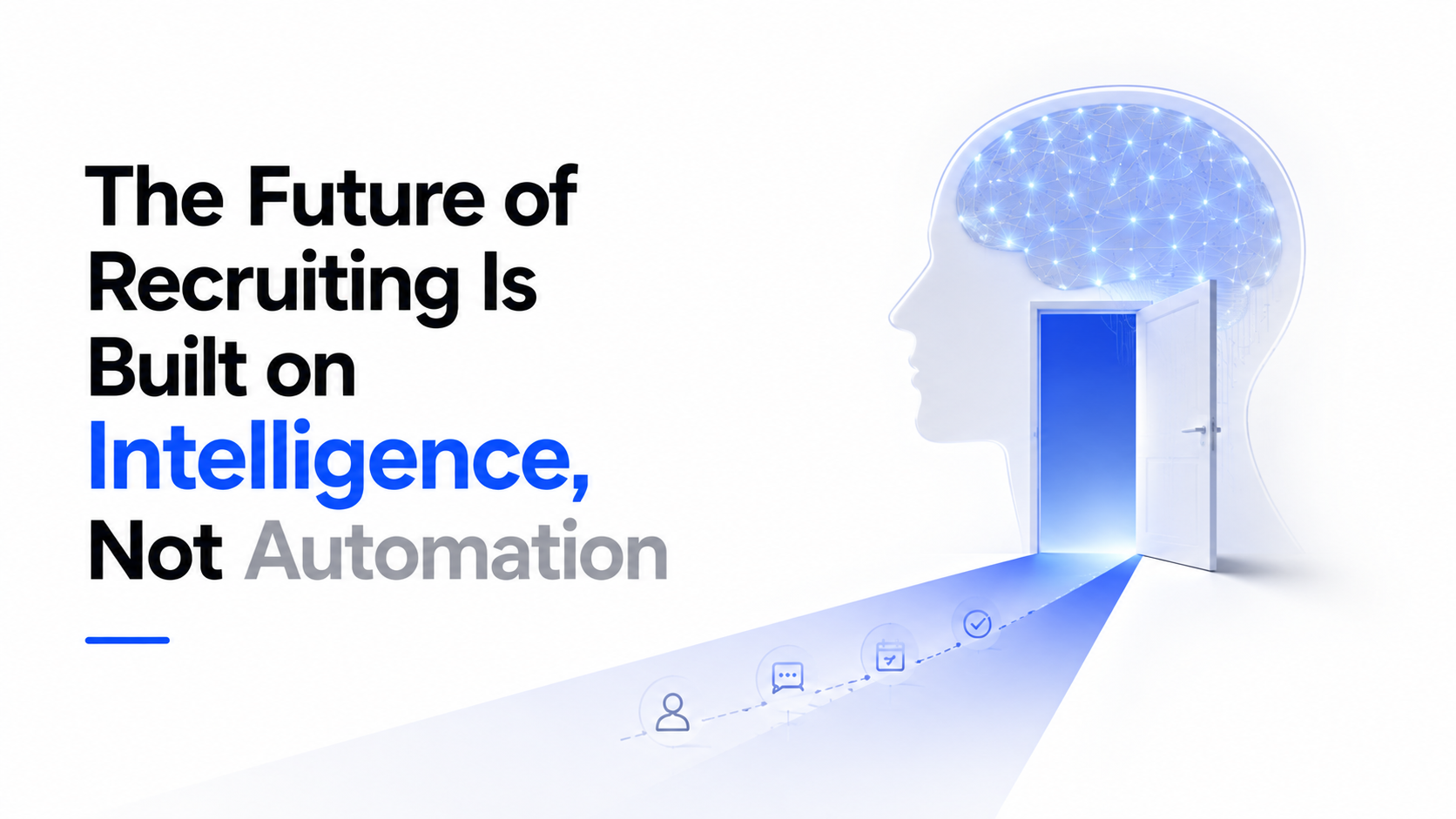
The path beyond the automation plateau requires a fundamentally different kind of technology, one that does not merely execute tasks faster but brings its own intelligence to bear on the recruiting process. This is the distinction between automation and intelligence, and it is the most consequential distinction in recruiting technology. An automated tool does what you tell it to do, the same way, every time. An intelligent system evaluates the situation, considers the context, and decides what to do based on its understanding of the specific circumstances. In recruiting, this means a system that does not just screen resumes against a keyword list but evaluates whether a candidate's career trajectory suggests adaptive capability that compensates for a gap in formal qualifications. A system that does not just send the same outreach template to every matching candidate but crafts a unique message based on the candidate's recent professional activity and the specific challenges of the hiring team. A system that does not just schedule interviews chronologically but optimizes for candidate experience quality, interviewer fatigue, and assessment reliability. This kind of contextual, adaptive decision-making is the hallmark of an agentic AI recruiting platform, and it represents the fundamental shift from automation to intelligence that will define the next era of recruiting technology.
Intelligence in Recruiting Means Contextual Decision-Making, Not Rule Execution
The practical difference between automated and intelligent recruiting becomes visible in the specific decisions that the technology makes. Consider the sourcing decision. An automated sourcing tool identifies candidates whose profiles match a predefined set of criteria: specific keywords, minimum years of experience, particular educational credentials, and current geographic location. The tool returns a list of candidates who meet these criteria, and the recruiter reviews the list and decides whom to contact. The intelligence of the process resides entirely in the recruiter's judgment about which candidates to prioritize, how to approach them, and what messaging to use. An intelligent sourcing system operates differently. It evaluates candidates not only against the formal job requirements but also against the context of the role: the team's current composition and skill gaps, the hiring manager's leadership style and the type of candidate who has historically succeeded in that environment, the competitive landscape for the specific skill set, and the candidate's likely motivations for considering a move based on their career trajectory and recent professional signals. The system then ranks candidates not by how closely they match a keyword profile but by how likely they are to succeed in and accept the specific role being filled. This contextual evaluation produces fundamentally different candidate recommendations, often surfacing candidates that automated screening would have filtered out. According to LinkedIn talent acquisition research, intelligent sourcing systems that incorporate contextual factors beyond keyword matching produce thirty to forty-five percent more diverse shortlists and twenty to thirty percent higher offer acceptance rates, because the system identifies candidates who are genuinely well-suited to the role rather than simply well-matched to a keyword profile.
The same pattern holds across every stage of the recruiting process. In candidate engagement,
an automated tool sends the same sequence of emails to every candidate in a pipeline. An intelligent system adapts its engagement strategy based on each candidate's behavior: a candidate who opens the initial message within two hours and visits the company careers page receives a different follow-up than a candidate who does not open the message for five days. The system is not following a rule. It is interpreting a signal and responding appropriately, which is the essence of intelligence. In assessment, an automated tool scores candidates against a predefined rubric. An intelligent system evaluates the candidate's responses in the context of the role's specific challenges, the team's specific needs, and the candidate's specific background, producing an assessment that reflects not just whether the candidate has certain qualifications but whether they can apply those qualifications effectively in the specific context of the role. In offer management, an automated tool generates an offer based on a compensation range and a formula. An intelligent system considers the candidate's engagement level, competing offers, career motivation, and the hiring manager's urgency to recommend an offer strategy that is optimized for acceptance rather than merely compliant with policy. The well-documented frustration of adding more tools without solving fundamental hiring problems, explored in depth in analyses of why organizations encounter more tools, same hiring problems, is a direct consequence of deploying automated tools when what the recruiting process actually needs is intelligent decision-making at every stage.
The organizational implications of this distinction are significant. An automated recruiting stack requires recruiters to serve as the intelligence layer, interpreting tool outputs, reconciling conflicting data, and making the contextual decisions that the tools cannot make. This creates a paradox: the tools are supposed to reduce recruiter workload, but the need to manage, interpret, and coordinate across multiple automated tools can actually increase the cognitive burden on recruiters. They spend less time on operational execution but more time on tool management, data reconciliation, and exception handling. An intelligent system, by contrast, absorbs the cognitive burden of contextual decision-making, freeing recruiters to focus on the activities that genuinely require human capability: building deep candidate relationships, advising hiring managers on talent strategy, and managing the organizational dynamics that affect hiring outcomes. SHRM research on recruiting technology effectiveness has found that organizations using intelligent, context-aware systems report significantly higher recruiter satisfaction and lower recruiter burnout than those using automated point solutions, because the intelligent system reduces the cognitive burden of managing the hiring process while automated tools often redistribute that burden rather than eliminating it.
Where Intelligence Outperforms Automation: Real Recruiting Scenarios
The most compelling evidence for the intelligence-over-automation thesis comes from the specific hiring scenarios where the two approaches produce visibly different outcomes. Consider the challenge of hiring for niche or highly technical roles, where the qualified candidate pool is small, the required expertise is specialized, and the conventional keyword-based
criteria used by automated tools are poor predictors of actual capability. An automated sourcing tool searching for a machine learning engineer will return candidates who list specific frameworks and techniques on their profiles. But the best candidate for the role may be a physicist who has applied statistical modeling to entirely different domains and who possesses the mathematical foundation and problem-solving approach that would make them exceptional in the machine learning role, despite never having held the specific title. An intelligent system can identify this candidate by evaluating the transferability of their skills and the relevance of their problem-solving experience, a form of contextual reasoning that automated keyword matching cannot perform. Research on whether AI recruiting tools work for niche or technical roles consistently demonstrates that intelligent systems outperform automated screening by even wider margins in specialized talent markets, because the system's ability to identify transferable skills and non-obvious candidate-fit patterns is precisely what is needed when the conventional talent pool is too small to meet demand.
Another scenario where intelligence dramatically outperforms automation is in managing the follow-up and engagement process for high-priority candidates. In a competitive talent market, the difference between hiring a top candidate and losing them to a competitor often comes down to the quality and timing of follow-up communications. An automated follow-up system sends messages on a predefined schedule: an initial outreach, a reminder after three days, a second reminder after seven days. This approach is consistent but completely unresponsive to the candidate's actual behavior and engagement signals. An intelligent system monitors the candidate's every interaction, whether they opened the email, clicked a link, visited the careers page, viewed a specific team page, or returned to the application, and adapts its follow-up strategy accordingly. A candidate who visited the careers page three times in two days is signaling active interest and should receive a different, more personalized follow-up than a candidate who has not opened any communication. A candidate who viewed the engineering team's page and a recent blog post about the team's work should receive a follow-up that references those specific interests. This signal-responsive engagement is impossible to execute at scale with automated tools but is precisely what an intelligent system does naturally. Deloitte research on candidate engagement in competitive talent markets has found that signal-responsive follow-up, where the timing and content of communications adapt to candidate behavior, produces forty to fifty percent higher engagement rates than scheduled follow-up sequences, because candidates perceive the communication as personally relevant rather than generically automated.
A third scenario where intelligence proves decisive is in handling the complexity of high-volume hiring with quality constraints. Many organizations face periods of rapid scaling where they need to hire large numbers of people quickly without sacrificing quality. Automated tools excel at processing volume but struggle to maintain quality, because they apply the same screening criteria and the same engagement approach to every candidate regardless of individual circumstances. An intelligent system can dynamically adjust its evaluation criteria and engagement strategy based on the specific role, the current state of the candidate pipeline, and the organization's quality requirements. When the pipeline for a role is deep, the system
can apply more selective criteria. When the pipeline is shallow, it can broaden its evaluation to include candidates with adjacent skills and non-traditional backgrounds, maintaining quality by adjusting the assessment methodology rather than by filtering more aggressively. This adaptive approach to volume-quality trade-offs is a form of practical intelligence that no automated tool can replicate, because it requires understanding the relationship between pipeline dynamics, assessment methodology, and hiring outcomes, and adjusting all three simultaneously based on real-time conditions. EY analysis of scaling hiring operations has found that organizations using intelligent systems to manage volume-quality trade-offs during growth phases achieve twenty-five to thirty-five percent better new-hire performance ratings than those using automated screening with fixed criteria, because the intelligent system adapts its evaluation to the specific context rather than applying a one-size-fits-all filter.
The Data Foundation That Makes Intelligent Recruiting Possible
Intelligent recruiting systems do not make better decisions by magic. They make better decisions because they have access to better information and the ability to synthesize that information in ways that humans cannot. The data foundation required for intelligent recruiting is fundamentally different from the data foundation required for automated recruiting. Automated tools need structured data in predefined formats: resumes parsed into standard fields, job descriptions with specified requirements, and candidate profiles with consistent attributes. Intelligent systems need all of this plus unstructured data, real-time signals, and cross-source correlation: the content of a candidate's recent publications, the trajectory of their professional network growth, the pattern of their career transitions, the sentiment of their public communications, and the real-time dynamics of the talent market for their specific skill set. Building this data foundation is the essential prerequisite for intelligent recruiting, and it is the step that most organizations skip or underinvest in. According to McKinsey analysis of data-driven transformation in HR, organizations that invest in comprehensive data infrastructure before deploying AI recruiting systems achieve forty to sixty percent better outcomes than those that deploy AI on top of fragmented data, because the quality of the AI's decisions is directly proportional to the quality and breadth of the data it can access. The intelligence of the system is bounded by the information available to it.
The data foundation for intelligent recruiting has four critical dimensions. The first is breadth: the system needs access to data from every relevant source, internal systems like applicant tracking platforms, performance management databases, and compensation records, and external sources like professional networks, publication databases, patent filings, and market intelligence feeds. Automated tools typically access one or two of these sources. Intelligent systems need all of them, because the contextual decisions they make require a comprehensive picture of each candidate and each role. The second dimension is timeliness: the data must be current, not months old. A candidate's professional situation can change rapidly, and an intelligent system needs to reflect those changes in its decision-making. The third dimension is integration: the data from different sources must be reconciled into a coherent profile. A candidate's title in one system may differ from their title in another. Their skills may be described
using different terminology across sources. The intelligent system must be able to resolve these inconsistencies and construct an accurate, unified candidate profile. The fourth dimension is outcome data: the system needs access to the results of past hiring decisions, which candidates were hired, how they performed, whether they were retained, and what factors predicted success or failure. This outcome data is what enables the system to learn and improve over time, developing increasingly accurate models of what candidate characteristics predict success in specific roles and contexts. Research on how many follow-ups one hire needs reveals that the quality of outcome data, specifically the ability to trace candidate engagement patterns through to hiring outcomes, is one of the strongest predictors of AI system performance improvement over time, because the system's learning depends on understanding which actions led to which results.
The challenge of building this data foundation should not be underestimated, but it should also not be used as a reason to delay the transition from automation to intelligence. Organizations can begin with the data they have, deploy intelligent systems in areas where the data is strongest, and progressively expand as the data foundation matures. What they should not do is continue investing in automated tools while waiting for the data foundation to become perfect, because every dollar spent on automation is a dollar not spent on building the intelligence infrastructure that will determine competitive positioning in the talent market of the next decade. The data foundation and the intelligent system must be developed together, because the system generates data, interaction outcomes, candidate behavior patterns, and decision-result correlations, that the data foundation needs, while the data foundation enables the system to make progressively better decisions. This co-development dynamic means that the intelligence advantage compounds over time: organizations that begin building earlier accumulate more outcome data, develop more accurate models, and make better hiring decisions, which in turn generates more outcome data to fuel further improvement. LinkedIn data on talent acquisition maturity shows that organizations with integrated, real-time talent data platforms are thirty to forty percent more likely to report improved hiring quality over a twelve-month period, because their AI systems have the information they need to make genuinely intelligent decisions rather than merely executing predefined rules.
Building an Intelligence-First Recruiting Function
The transition from an automation-first to an intelligence-first recruiting function is not a technology upgrade. It is a strategic reorientation that affects technology selection, process design, data architecture, team structure, and performance measurement. The first step is to redefine what success looks like. Automation-first functions measure success in efficiency metrics: time-to-screen, time-to-schedule, cost-per-contact, and process throughput. These metrics capture how fast the process runs, not how well it runs. Intelligence-first functions measure success in outcome metrics: quality of hire, new-hire retention, hiring manager satisfaction, candidate experience quality, and diversity of candidate slates. These metrics capture whether the process produces the right results, not just whether it produces results quickly. Gartner recommends that recruiting leaders establish outcome-focused success metrics before
evaluating any AI recruiting technology, because the metrics determine whether the organization selects tools that amplify intelligence or merely accelerate automation. An organization measuring time-to-screen will select a faster screening tool. An organization measuring quality of hire will select a more intelligent evaluation system. The metrics shape the technology choice, and the technology choice shapes the recruiting function's trajectory.
The second step is to select technology architectures that support intelligent decision-making rather than task automation. This means prioritizing platforms that integrate data from multiple sources, make contextual decisions, learn from outcomes, and orchestrate the full hiring workflow, rather than point solutions that optimize individual tasks. The evaluation criteria should focus on the depth and quality of the system's decision-making, not on the speed of its task execution. How does the system evaluate candidates whose backgrounds do not match the standard profile? How does it adapt its engagement strategy based on candidate behavior? How does it handle ambiguity, such as a candidate who is strong in some areas and weak in others? How does it incorporate competitive market intelligence into its recommendations? These questions test the system's intelligence, not its automation capability, and they are the questions that determine whether the platform will produce genuinely better hiring outcomes or merely faster execution of the same process. Organizations that have used structured evaluation frameworks report significantly better technology selection outcomes, particularly when the framework explicitly distinguishes between automation features and intelligence capabilities. SHRM guidance on AI technology evaluation in talent acquisition emphasizes that the most common mistake organizations make is selecting AI tools based on automation features, speed and throughput, when the value they actually need is intelligence capability, contextual decision-making and adaptive learning.
The third step is to invest in the human capabilities that complement the intelligent system. An intelligence-first recruiting function does not require fewer recruiters. It requires different recruiters, professionals who can interpret the system's recommendations, provide strategic counsel to hiring managers, build the candidate relationships that require genuine human connection, and manage the organizational dynamics that affect hiring outcomes. The skills that define recruiting success in the automation-first model, Boolean search expertise, applicant tracking system proficiency, and process management, are being replaced by skills that define success in the intelligence-first model: data interpretation, strategic advisory, stakeholder management, and talent market intelligence. Organizations that invest in developing these capabilities alongside their technology deployments consistently achieve better outcomes than those that focus exclusively on technology. Deloitte research on HR technology transformation has found that the combination of intelligent technology and upskilled professionals produces two to three times the improvement in hiring outcomes compared to technology deployment alone, because the technology and the human capabilities are mutually reinforcing. The intelligent system provides the recruiter with better information and more time for strategic work, and the recruiter provides the system with the human judgment, relationship depth, and organizational context that the system cannot replicate. The future of recruiting is not automated. It is intelligent, and the organizations that build the technology, data, and human