Rachel Huang, chief people officer at a Singapore-based fintech company that had tripled its headcount in eighteen months, sat in the executive conference room listening to her CEO describe the hiring plan for the next quarter. The company needed to hire forty engineers, twelve product managers, and eight data scientists by the end of September. The talent acquisition team, which Rachel had expanded from four to eleven recruiters in the past year, was already operating at full capacity managing the current quarter's openings. Rachel knew that asking her team to absorb another sixty positions on top of their existing workload would produce exactly what it always produced in reactive hiring scenarios: stressed recruiters, frustrated hiring managers, a thin candidate pipeline, rushed decisions, and a crop of new hires who were grateful to have jobs but not necessarily well-matched to the roles they filled. She had seen this cycle play out at three previous companies, and she was determined not to repeat it. The problem was not her team's capability. The problem was the model itself. Her team was always reacting to needs that had already become urgent, always starting from zero, always racing against a deadline that had been set by someone else's business plan rather than by the reality of the talent market. Rachel had recently begun exploring continuous hiring approaches, where the recruiting function maintains an ongoing presence in the talent market, building relationships and gathering intelligence before specific positions open. The concept made intuitive sense, but she needed to understand what it would look like in practice, what technology it required, and how to make the transition without disrupting the hiring her team was already doing.
Why Reactive Hiring Is a Competitive Disadvantage
David Okonkwo, vice president of talent acquisition at a Houston-based energy services company with six thousand employees, received an urgent email from the engineering director on a Tuesday morning informing him that two senior petroleum engineers had submitted their resignations the previous Friday, effective in three weeks. The engineering director needed replacements immediately and expected David's team to have qualified candidates in the interview pipeline within ten days. David knew from experience that this was nearly impossible under the current model. His team would need to write a job description, post it on multiple boards, wait for applications to arrive, screen resumes, conduct phone screens, schedule interviews, and manage the offer process, a sequence that typically took forty-five to sixty days for senior technical roles. The engineering director would be frustrated, the team would be understaffed, and the company would lose productivity while the positions sat vacant. This scenario, where hiring is triggered by a departure or an urgent business need and then executed under time pressure, is the standard operating model for most organizations, and it is a model that produces consistently suboptimal outcomes. According to Gartner research on talent acquisition strategy, organizations that rely primarily on reactive hiring take an average of thirty-six percent longer to fill critical roles and report twenty-eight percent lower hiring manager satisfaction compared to organizations that have built continuous hiring capabilities. The reactive model is not just slower. It produces worse hires, because urgency compresses the time available for candidate evaluation, market research, and strategic role design.
The structural problem with reactive hiring is that it inverts the relationship between supply and demand in the talent market. In a reactive model, the organization enters the talent market only when it has an immediate need, which means it is competing against every other organization that also has an immediate need at that moment. This creates periods of intense competition where multiple employers are pursuing the same candidates simultaneously, driving up compensation expectations and reducing the organization's bargaining position. During these periods, the organization is effectively a price-taker in the talent market, accepting whatever terms are necessary to secure a candidate quickly. Between these periods of intense competition, the organization has no presence in the talent market at all. It is invisible to passive candidates who might be open to the right opportunity but are not actively looking. It has no pipeline of pre-engaged talent. It has no market intelligence about shifting skill availability or compensation trends. It is, in the language of supply chain management, operating without inventory or visibility, relying entirely on spot purchases made under conditions of urgent need. McKinsey has documented that organizations operating in this reactive mode spend forty to fifty percent more on recruitment costs per hire, because they are perpetually paying premium pricing for urgent fills rather than building relationships with candidates over time that reduce the cost and risk of each individual hire.
The cost of reactive hiring extends well beyond the direct recruitment expenses. When critical positions remain vacant for extended periods, the organization incurs opportunity costs in the form of delayed projects, reduced team productivity, increased workload on remaining
team members, and degraded service delivery. These costs are typically three to five times the direct recruitment cost, but they are rarely tracked or reported because they are distributed across operational budgets rather than concentrated in the recruiting budget. Furthermore, reactive hiring produces a cascade of additional costs that compound over time. The urgency to fill a position quickly increases the risk of a bad hire, and a bad hire triggers another round of reactive recruiting when the new employee leaves or is terminated within the first year. Organizations with high turnover rates driven by reactive hiring find themselves in a perpetual cycle of urgent recruitment that consumes increasing amounts of management attention and organizational resources. Breaking this cycle requires a fundamentally different approach to the hiring function, one that treats talent acquisition as a continuous process of market engagement and relationship building rather than a series of discrete transactions triggered by departures and business needs. The question of how many follow-ups does one hire need illustrates this point perfectly: in a reactive model, follow-ups are compressed into a narrow window and often abandoned when the position is filled, whereas in a continuous model, follow-ups are part of an ongoing relationship-building process that maintains candidate engagement over months or years.
What Continuous Hiring Actually Looks Like
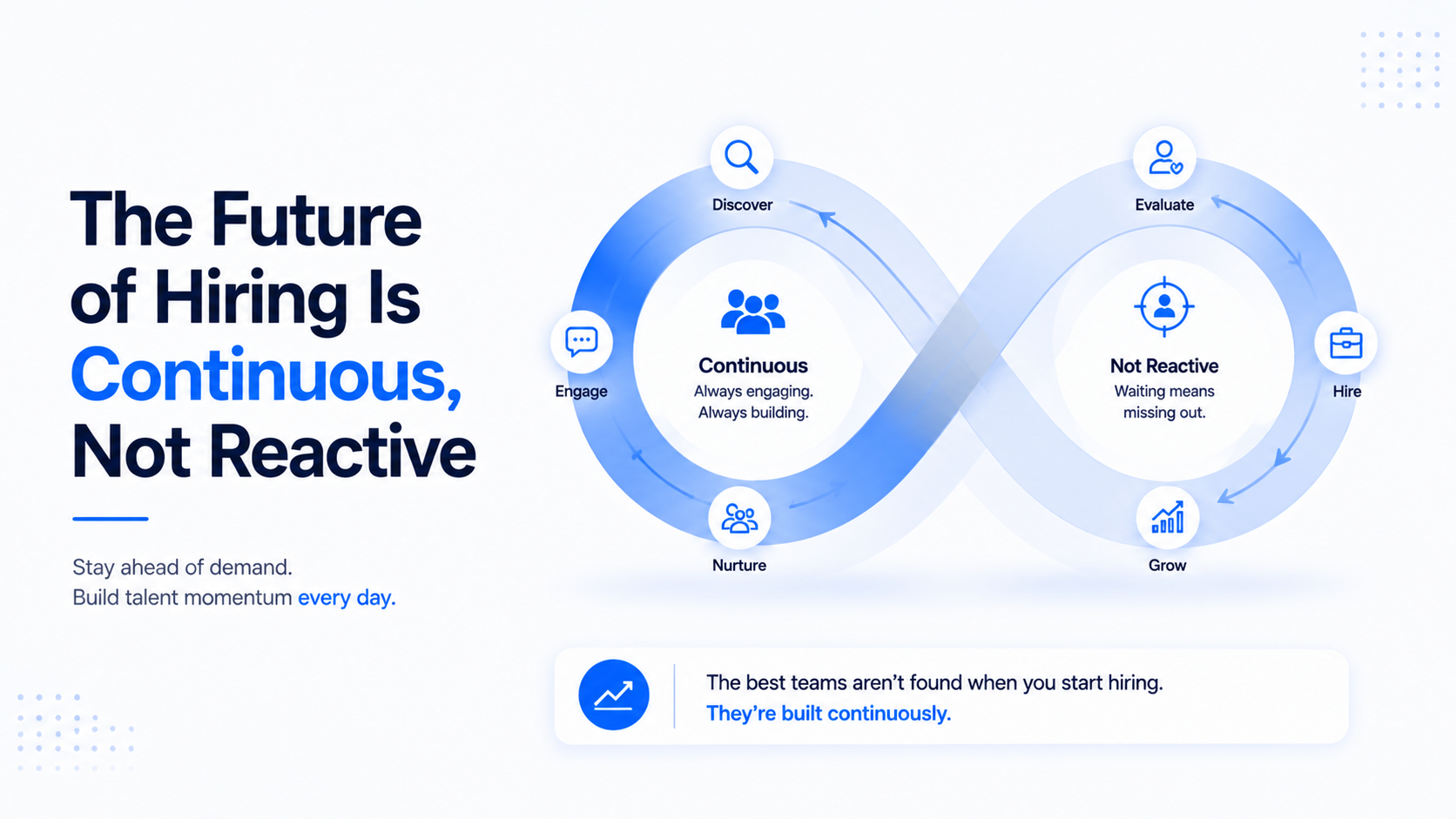
Continuous hiring is not the same as always hiring. It is the practice of maintaining an ongoing, systematic presence in the talent market that builds relationships, gathers intelligence, and creates a qualified pipeline of potential candidates before specific positions become available. In a continuous hiring model, the recruiting function operates like a sales organization that maintains a robust prospect pipeline, nurturing relationships with potential customers through multiple touchpoints over extended periods, so that when a buying signal appears, the organization can respond immediately with a pre-qualified, pre-engaged candidate. The distinction between AI sourcing and AI recruiting becomes particularly relevant in this context, because continuous hiring requires both capabilities operating simultaneously: sourcing to maintain a flowing pipeline of potential talent, and recruiting to convert that pipeline into hires when the timing is right. The sourcing function identifies and engages potential candidates continuously, building relationships and tracking skill development over time. The recruiting function activates when a specific hiring need arises, drawing from the pre-built pipeline rather than starting from zero.
In practice, continuous hiring operates across three interconnected layers. The first layer is talent market monitoring, where the recruiting team systematically tracks the availability, movement, and career trajectory of professionals in the talent segments that matter to the organization. This monitoring is not limited to active job seekers. It includes passive candidates who are not currently looking but whose profiles, publication records, conference participation, and professional network activity indicate skills and interests that align with the organization's future needs. The second layer is relationship nurturing, where the recruiting team maintains regular, value-adding contact with high-potential candidates through personalized outreach, content sharing, event invitations, and conversation. The key insight is that these
interactions provide value to the candidate regardless of whether they are interested in a job at the moment. Sharing industry research, introducing candidates to peers in their field, and providing early access to organizational insights build goodwill and keep the organization top-of-mind when the candidate's career circumstances change. According to LinkedIn data on talent pipeline health, candidates who have had three or more meaningful interactions with an employer before a position is discussed are forty to sixty percent more likely to respond to an outreach message and thirty percent more likely to accept an offer, because the pre-existing relationship reduces the perceived risk of making a career move.
The third layer is activated hiring, where the continuous pipeline converts into actual hires when specific positions become available. Because the pipeline has been nurtured over time, the time-to-fill for activated positions is dramatically shorter. Instead of starting with a blank slate, the recruiting team begins with a list of pre-qualified candidates who already have a relationship with the organization, understand its mission and culture, and have expressed interest in the type of role that is now available. This conversion process is not instantaneous, but it is substantially faster and more effective than starting from zero. SHRM research on proactive talent acquisition has found that organizations with mature continuous hiring programs fill positions forty to fifty percent faster than reactive peers, with thirty to forty percent higher first-year retention among new hires, because the extended pre-hire relationship allows both the organization and the candidate to assess mutual fit more thoroughly than a compressed reactive process permits. The continuous model also produces more diverse candidate slates, because the extended timeline allows recruiters to identify and engage candidates from underrepresented backgrounds who might not appear in a reactive search focused on immediate availability.
The Technology That Makes Continuous Hiring Possible
The primary reason continuous hiring has not been the dominant model until now is that it requires a scale of market monitoring, candidate engagement, and data management that exceeds the capacity of human recruiters working with traditional tools. A recruiting team of ten people can meaningfully maintain relationships with perhaps two to three hundred active candidates at any given time, but a mid-size organization typically needs visibility into thousands of potential candidates across multiple skill domains to operate a genuine continuous hiring program. The labor required to monitor this many candidates, track their career movements, send personalized outreach at appropriate intervals, and maintain accurate records across the pipeline is prohibitive without significant technology augmentation. The fundamental problem is not a lack of recruiter effort or skill. It is that traditional recruiting tools were designed for the reactive model, where the workflow begins with a job requisition and ends with a hire, and each requisition is treated as a discrete project with its own candidate pool, evaluation process, and reporting cycle. This project-based architecture makes continuous hiring impractical, because it has no mechanism for maintaining candidate relationships across requisitions or tracking talent market dynamics over extended periods. The result is a familiar pattern that many organizations have experienced: adding because the tools are designed for the wrong
model.
AI recruiting platforms designed for continuous operation fundamentally change the economics of the continuous hiring model. An AI system can monitor tens of thousands of candidate profiles across multiple platforms, track career transitions and skill development in real time, identify candidates whose profiles match emerging organizational needs before a requisition exists, and initiate personalized outreach at scale without requiring human initiation for each interaction. The system can maintain context across months of candidate engagement, remembering previous conversations, preferences, and career milestones, so that each interaction builds on the last rather than starting from zero. This capability transforms the continuous hiring model from an aspirational best practice into an operationally viable strategy. According to Deloitte research on AI-augmented talent acquisition, organizations that deploy AI platforms with continuous sourcing and engagement capabilities report fifty to seventy percent reductions in time-to-fill for critical roles, because the AI system maintains a pre-qualified pipeline that eliminates the cold-start problem that makes reactive hiring so slow. The same research found that these organizations also report twenty-five to thirty-five percent reductions in cost-per-hire, because continuous engagement reduces the reliance on expensive recruitment agencies and paid job advertising that reactive organizations use to accelerate their hiring timelines.
The technology architecture that supports continuous hiring has several distinctive characteristics that differentiate it from reactive recruiting tools. First, it maintains a persistent candidate graph, a continuously updated database of potential candidates that tracks not just current profiles and contact information, but the full history of interactions, skill development, career transitions, and engagement signals over time. This graph is the foundation of the continuous model, because it provides the organizational memory that makes long-term relationship building possible at scale. Second, it uses predictive analytics to identify candidates whose profiles are trending toward alignment with the organization's anticipated needs, allowing recruiters to begin engagement before a specific requisition exists. Third, it automates the cadence of personalized outreach, ensuring that candidates in the pipeline receive regular, relevant touchpoints that maintain the relationship without requiring manual coordination. Fourth, it provides real-time talent market intelligence that informs workforce planning, helping the organization anticipate skill shortages, compensation shifts, and competitive dynamics. EY has documented that organizations with AI-powered talent intelligence capabilities are thirty to forty percent more likely to accurately forecast their hiring needs twelve months in advance, because the continuous flow of market data allows them to identify emerging trends before they become acute hiring challenges.
How Continuous Hiring Changes Recruiter Roles
The adoption of continuous hiring has profound implications for the recruiting profession, but these implications are more nuanced than the binary narrative of AI replacing recruiters suggests. In a continuous hiring model powered by AI, the recruiter's role shifts from operational
execution to strategic talent advisory, and the scope of that advisory role expands significantly. Instead of spending the majority of their time on transactional tasks like posting jobs, screening resumes, and scheduling interviews, recruiters in a continuous model invest their time in activities that create long-term strategic value for the organization: developing deep expertise in specific talent markets, building relationships with high-potential passive candidates who represent future hiring opportunities, advising hiring managers on role design and team composition based on their understanding of talent market dynamics, and providing the organization with intelligence about competitive positioning, skill availability, and workforce trends. The emergence of agentic AI recruiting platforms that can operate autonomously across the continuous hiring workflow is the enabling technology that makes this role evolution possible, because the AI agent handles the operational execution that previously consumed the recruiter's day.
The practical experience of organizations that have made the transition to continuous hiring reveals a consistent pattern of role evolution. Recruiters who previously managed portfolios of twenty to thirty open requisitions, juggling competing priorities and constant interruptions, now manage talent segments, maintaining deep expertise in specific skill domains and building relationships with communities of potential candidates. The daily experience of the job changes from reactive firefighting, where each day brings a new urgent request or a stalled process that needs intervention, to proactive cultivation, where the recruiter strategically invests time in activities that build the organization's talent position for the future. This shift produces measurable improvements in recruiter satisfaction and retention. According to McKinsey research on the future of work in professional services, roles that combine human judgment and relationship skills with AI-augmented operational capabilities show thirty to forty percent higher job satisfaction and twenty to twenty-five percent lower turnover compared to roles that remain primarily operational, because professionals find more meaning and impact in strategic, relational work than in repetitive transactional tasks.
The implications for recruiting leadership are equally significant. In a reactive model, the recruiting leader's primary metric is time-to-fill, and the primary lever for improvement is adding more recruiters or more tools to increase throughput. In a continuous model, the recruiting leader's primary metrics are pipeline health, talent market positioning, and strategic workforce alignment, and the primary levers are technology architecture, data strategy, and capability development. This shift in metrics and levers requires a different leadership skill set, one that combines traditional recruiting expertise with data literacy, technology strategy, and organizational design. The recruiting leader in a continuous model functions more like a product manager than a service delivery manager, defining the requirements for the talent pipeline, prioritizing investments in market segments and technology capabilities, and measuring outcomes against strategic objectives rather than transactional volume. Gartner has identified this shift from service delivery to talent product management as one of the defining trends in talent acquisition leadership, noting that organizations led by recruiting executives who think in terms of pipeline architecture and market intelligence consistently outperform those led by executives who think in terms of requisition fulfillment and cost-per-hire
reduction.
Building a Continuous Hiring Strategy from Scratch
For organizations that currently operate in reactive mode, the transition to continuous hiring requires a structured approach that builds capability incrementally rather than attempting a wholesale transformation. The first step is identifying the two to three talent segments where reactive hiring creates the most acute pain, typically roles that are critical to business performance, difficult to fill, or subject to high turnover, and concentrating the initial continuous hiring investment on those segments. This focus ensures that the organization sees a measurable return on its investment quickly, which builds organizational support for expanding the model to additional segments. The second step is deploying AI-powered sourcing and engagement technology that can maintain a persistent candidate pipeline in the target segments. This technology must be capable of operating continuously rather than in requisition-triggered bursts, meaning it should be able to monitor candidate activity, initiate outreach, and maintain engagement records regardless of whether an open position exists. The question of whether referrals outperform cold outreach is instructive here: continuous hiring effectively turns every candidate interaction into a warm referral over time, because the extended engagement builds the trust and familiarity that make referral-style conversions possible at scale.
The third step is redesigning the recruiting process to accommodate the continuous model. In a reactive process, the workflow proceeds linearly from requisition to hire, with each step triggering the next. In a continuous process, the workflow operates in parallel: candidate identification, engagement, and relationship building happen continuously, while specific hiring activations happen periodically when positions open. This parallel structure requires different process definitions, different handoff protocols, and different performance metrics. Recruiters need to be measured not only on their ability to fill open positions but also on the health and responsiveness of the talent pipelines they maintain. The fourth step is aligning the continuous hiring program with workforce planning. The most effective continuous hiring programs are informed by forward-looking workforce plans that identify the talent segments where the organization will need to hire in the next six to eighteen months, allowing the recruiting team to concentrate their pipeline-building efforts on the segments that will produce the highest strategic return. Whether the organization is targeting broad talent pools or more specialized segments, understanding whether is essential for calibrating the technology investment and the engagement strategy to the specific characteristics of each talent segment.
The fifth step is investing in the change management and capability development required to make the transition successful. Continuous hiring requires recruiters to think differently about their roles, hiring managers to engage differently with the recruiting function, and organizational leaders to value pipeline health as a strategic asset. Each of these changes requires deliberate communication, training, and reinforcement. According to LinkedIn research on talent acquisition maturity, the organizations most successful in transitioning to continuous
hiring are those that invest at least as much in change management and skill development as they invest in technology, recognizing that the technology enables the model but the people determine whether it produces results. The final step is measurement and iteration. Continuous hiring is a learning system that improves with use, but only if the organization actively tracks pipeline health metrics, conversion rates, time-to-fill improvements, and quality-of-hire outcomes, and uses that data to refine its approach over time. Deloitte has found that organizations that establish formal feedback loops between hiring outcomes and pipeline strategy achieve twenty to thirty percent faster improvement in continuous hiring performance than those that deploy the model without systematic measurement, because the feedback loops allow the organization to identify which engagement strategies, talent segments, and technology configurations produce the best results and to reallocate resources accordingly.
The Competitive Advantage of Continuous Hiring
The organizations that have adopted continuous hiring are not just filling positions faster. They are building a structural competitive advantage that compounds over time. Every month of continuous operation adds to the organization's candidate graph, deepens its talent market intelligence, and strengthens its relationships with potential future hires. This accumulating advantage creates a positive feedback loop: better pipeline health leads to faster, higher-quality hires, which leads to stronger business performance, which makes the organization more attractive to future candidates, which further improves pipeline health. The organizations that start building this capability now will have a significant head start over those that delay, because the value of the candidate graph and the market intelligence it generates increases with each cycle of operation. SHRM has documented that early adopters of continuous talent acquisition strategies report two to three times higher improvement in hiring outcomes over a three-year period compared to organizations that adopt the same strategies later, because the early adopters have accumulated a richer candidate graph, more mature engagement processes, and deeper organizational learning about what works in their specific talent markets.
The competitive dynamics of continuous hiring also reshape the talent market itself. As more organizations adopt continuous models, passive candidates will increasingly expect to be engaged by potential employers before they are actively looking for a job. The candidates who receive thoughtful, personalized outreach from an organization that has been tracking their career development and sharing relevant insights will have a fundamentally different perception of that organization compared to candidates who receive a generic inquiry from a recruiter who found their resume on a job board five minutes ago. This shift in candidate expectations will create a widening gap between organizations that have invested in continuous hiring and those that have not. The former will be able to engage top talent through relationship-based outreach that candidates find valuable and respectful, while the latter will be increasingly reliant on transactional, volume-based recruitment approaches that candidates find impersonal and easy to ignore. According to McKinsey analysis of talent market evolution, the quality of the candidate-employer interaction during the pre-hire phase has become the single
strongest predictor of offer acceptance rates, surpassing compensation by a significant margin, because candidates in high-demand skill segments have multiple options and choose based on the quality of the relationship and the employer brand experience as much as on financial terms.
The future of hiring is continuous because the talent market has become too dynamic, too competitive, and too fast-moving for the reactive model to remain viable. Skill half-lives are shrinking, with many technical skills becoming obsolete within three to five years, which means the talent profiles that were relevant six months ago may not be relevant today. Candidate expectations are evolving, with top performers increasingly expecting employers to demonstrate knowledge of their skills and career trajectory before initiating a hiring conversation. Business cycles are accelerating, with strategic pivots, new product launches, and market expansions creating hiring needs that emerge faster than the traditional requisition-to-hire process can accommodate. The organizations that thrive in this environment will be those that maintain a continuous, intelligent presence in the talent market, building relationships and gathering intelligence that allow them to move quickly and make high-quality hiring decisions when the need arises. EY projects that by 2030, more than sixty percent of knowledge-worker hiring in advanced economies will be conducted through continuous talent acquisition models, with reactive, requisition-driven hiring relegated to lower-skill, high-volume roles where the cost of a slow or imperfect hire is relatively low. The transition from reactive to continuous hiring is not a marginal improvement in recruiting efficiency. It is a fundamental change in how organizations relate to the talent market, and it is already underway.