Why Executive Hiring Is Broken — And What Comes Next
The executive hiring process has not fundamentally changed in decades. A search firm identifies candidates through proprietary networks, a series of phone screens narrows the field, and the final round involves multiple in-person panel interviews spread across weeks or even months. According to McKinsey's research on organizational talent, the average time-to-fill for a C-suite position now exceeds 90 days, and the cost of a failed executive hire can reach two to three times the annual compensation package. For a Vice President of Engineering earning $350,000, a mis-hire does not merely waste a salary — it derails product roadmaps, demoralizes high-performing teams, and forces the organization to absorb months of recovery time.
The problem is not that organizations lack candidates. The problem is that the mechanisms for evaluating those candidates at the executive level are antiquated, inconsistent, and extraordinarily resource-intensive. A 2025 report from the Society for Human Resource Management (SHRM) found that 67% of talent acquisition leaders describe their executive interview process as either "somewhat" or "highly" inefficient. Scheduling conflicts alone account for an average of 23 days of delay per executive search, according to data compiled by Korn Ferry in their annual executive talent monitor. When you factor in travel costs for finalists, interviewer preparation time, and the opportunity cost of vacant leadership positions, the traditional executive interview model represents one of the largest hidden expenses in corporate talent acquisition.
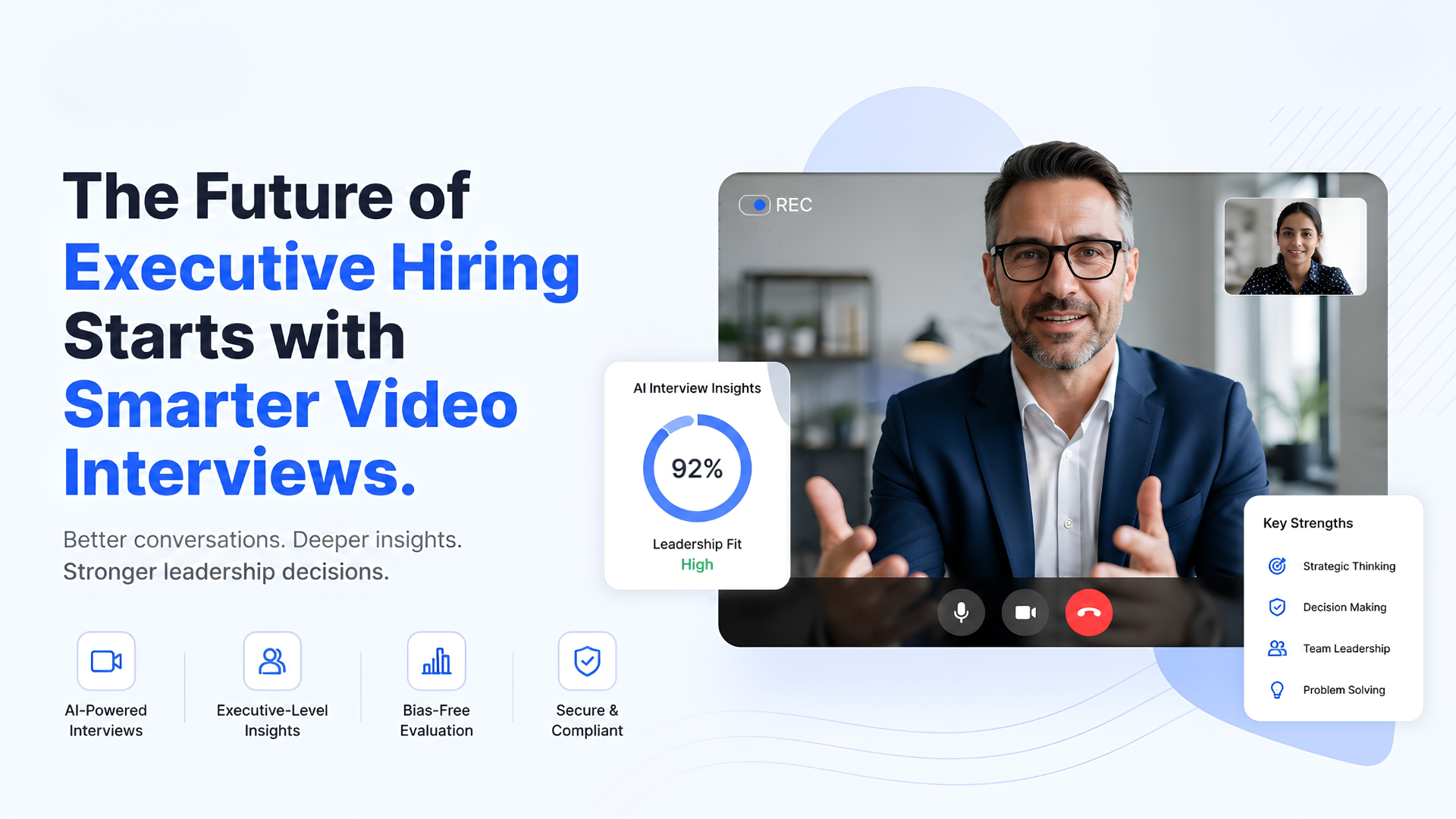
Smarter video interviews — meaning interviews enhanced by artificial intelligence, real-time
behavioral analytics, and conversational screening — are not a marginal improvement to this process. They represent a structural redesign of how organizations identify, evaluate, and secure executive talent. The question is no longer whether video interviews will become the standard for executive hiring. The question is how quickly your organization will adapt, and which competitors will outpace you in the interim. As Heidrick & Struggles noted in their latest leadership market analysis, companies that have already adopted structured video interview frameworks for senior roles report a 40% reduction in time-to-hire and a measurable improvement in new-hire retention at the 18-month mark.
The Executive Hiring Landscape in 2026: Numbers That Demand Change
To understand why smarter video interviews matter, you first need to understand the scale of the executive hiring challenge. The Bureau of Labor Statistics projects that demand for senior management roles will grow by 8% through 2032, outpacing the average for all occupations. At the same time, LinkedIn's Global Talent Trends report reveals that the pool of qualified executive candidates has not expanded proportionally — in fact, voluntary turnover among senior leaders increased by 12% between 2023 and 2025, driven by burnout, competitive counteroffers, and a generational shift in what executives expect from their employers.
The financial stakes are enormous. Deloitte's Workforce Institute estimates that a single vacant C-suite position costs an organization between $7,000 and $10,000 per day in lost productivity, delayed decisions, and team disruption. For a Chief Revenue Officer role left open for 120 days, that translates to nearly $1 million in indirect costs — a figure that dwarfs the typical search firm fee. PwC's hiring trends analysis corroborates this finding, reporting that 54% of CEOs now cite leadership talent acquisition as one of their top three strategic risks, up from 38% just two years ago.
Meanwhile, the candidate side of the equation has shifted dramatically. Executive candidates in 2026 expect a hiring process that respects their time, demonstrates organizational sophistication, and provides a positive candidate experience. Gallup's workplace engagement research shows that 71% of executives who withdraw from a hiring process cite "process friction" — excessive interview rounds, scheduling delays, lack of feedback — as a primary factor, not compensation disagreements. This finding is particularly significant because the executives who withdraw due to process friction are often the most marketable candidates, the ones with multiple competing offers and the least tolerance for bureaucratic inefficiency.
The geographic dimension adds another layer of complexity. EY's workforce analytics reports that 43% of organizations now consider candidates from outside their primary market for executive roles, up from 27% in 2020. This globalization of executive talent pools means that in-person interviews are logistically impractical for a growing share of searches. A startup in Bangalore competing for a VP of Product may be evaluating candidates in London, Singapore, and San Francisco simultaneously — a scenario where video is not merely convenient but essential.
From Boardroom to Screen: How Video Interviews Became Executive Standard
The adoption of video interviews for executive roles has followed a trajectory that surprises even the most optimistic talent technologists. Before 2020, video interviews in executive search were largely confined to initial screening calls — brief, low-stakes conversations designed to confirm basic qualifications before investing in travel. The pandemic accelerated adoption, but what kept video interviews in the executive toolkit after offices reopened was not necessity but performance.
Research published by the Society for Industrial and Organizational Psychology (SIOP) found that structured video interviews, when combined with validated assessment criteria, produce predictive validity coefficients comparable to — and in some domains superior to — traditional in-person panel interviews. The key variable is structure. Unstructured video calls, the kind most recruiters conduct informally, show weak predictive power. But structured video interviews with standardized questions, rubric-based evaluation, and AI-assisted behavioral analysis consistently outperform the unstructured in-person alternative.
This finding has profound implications for executive hiring, where the stakes of each hire are highest but the interview processes remain among the least structured in the entire organization. A Harvard Business Review analysis of executive interview practices across Fortune 500 companies found that fewer than 20% of organizations use a standardized interview scorecard for C-suite candidates. Interviewers at the executive level frequently rely on gut instinct, cultural chemistry, and conversational rapport — all of which are subjective, inconsistent, and demonstrably susceptible to bias. Video interview platforms that enforce structure, even while preserving conversational fluidity, offer a way to maintain the human connection that executive candidates expect while introducing the rigor that executive hiring demands.
The G2 video interviewing software category now lists over 60 platforms, up from 18 in 2020. This market growth reflects a fundamental shift in how organizations think about the interview stage of the hiring funnel. Video is no longer a substitute for in-person meetings. For a growing number of organizations, it is the primary interview modality for every stage of the executive hiring process, from initial screen through final panel.
What Makes a Video Interview "Smart"? The AI Infrastructure Behind It
Not all video interviews are created equal. The distinction between a standard video call and a "smart" video interview lies in the intelligence layer that operates beneath the surface. A standard video interview is essentially a videoconference with a notepad — the recruiter watches, takes notes, and makes judgments based on subjective impression. A smart video interview integrates multiple AI capabilities that transform the conversation into a structured, analyzable, and actionable data point.
Conversational AI Screening
The first layer of intelligence is conversational AI screening. Rather than relying on a human recruiter to conduct every initial executive conversation, platforms like Huntlo.ai deploy conversational AI agents that can engage candidates in nuanced, context-aware dialogue. These are not chatbots that read from scripts. Modern conversational AI for recruiting can discuss specific industry verticals, probe leadership philosophy, and evaluate strategic thinking — all while maintaining a natural conversational cadence that executive candidates expect.
The value of conversational AI at the top of the executive funnel is not about replacing human judgment. It is about ensuring that every candidate receives the same depth of initial engagement, regardless of when they enter the pipeline or which recruiter happens to be available. In a high-volume executive search — say, sourcing for a Chief Marketing Officer role across three continents — the difference between a thorough AI-driven first conversation and a rushed 15-minute phone screen can be the difference between identifying the right candidate and losing them to a competitor.
Real-Time Behavioral and Linguistic Analysis
The second layer is behavioral and linguistic analysis. Advanced video interview platforms analyze not just what candidates say but how they say it. Natural language processing algorithms evaluate response structure, vocabulary sophistication, use of evidence versus assertion, and the degree to which candidates demonstrate strategic versus tactical thinking. For executive roles, where communication skill is a core competency, this analysis provides evaluation dimensions that are nearly impossible to capture consistently through manual note-taking.
According to Gartner's HR research team, organizations using AI-enhanced interview analytics for senior roles report a 28% improvement in inter-rater reliability — meaning that different interviewers evaluating the same candidate arrive at more consistent assessments. This improvement is particularly valuable in executive hiring, where interview panels often include stakeholders from different functions (finance, operations, the board) who may weight different competencies differently. AI analytics provide a common evaluative framework that bridges these perspective gaps without imposing artificial uniformity.
Automated Scheduling and Multi-Channel Coordination
The third layer is orchestration. Smarter video interview platforms integrate with the broader recruiting technology stack to automate scheduling, coordinate across time zones, and manage the sequence of interview stages. For executive searches that involve eight to twelve stakeholders across multiple interview rounds, the logistical coordination alone can consume hundreds of hours of administrative work. Platforms that automate this orchestration free recruiters to focus on candidate evaluation, relationship management, and strategic advisory — the activities that actually drive hiring outcomes.
How AI-Powered Video Interviews Actually Work for Executive Roles
Understanding the technical architecture of AI-powered video interviews helps demystify the process and address the legitimate concerns that some hiring leaders have about algorithmic evaluation. The typical workflow proceeds through four stages, each of which combines human judgment with machine assistance.
Stage 1: AI-Driven Pre-Screening Conversation
The process begins before any human interviewer is involved. A conversational AI agent — such as Huntlo.ai's AI voice and chat capabilities — engages the candidate in an initial dialogue designed to assess baseline qualifications, cultural alignment indicators, and genuine interest level. For executive candidates, this conversation is calibrated differently than for high-volume roles. The AI probes for depth of domain expertise, leadership philosophy, and the specific value proposition the candidate brings. The conversation typically lasts 20 to 30 minutes and generates a structured assessment profile that human interviewers can review before deciding whether to advance the candidate.
Stage 2: Asynchronous Video Assessment
Candidates who pass the AI pre-screen are invited to complete an asynchronous video assessment. In this stage, candidates record responses to pre-determined questions at their convenience, eliminating the scheduling bottlenecks that plague traditional executive interviews. The questions are designed by industrial-organizational psychologists to evaluate competencies specific to the role — strategic vision, change management capability, stakeholder influence, and financial acumen, for example.
The asynchronous format offers a particular advantage for executive candidates, who are often balancing their job search with demanding current roles. A Chief Technology Officer at a publicly traded company cannot easily step away for a 90-minute live interview during business hours. Asynchronous assessments respect that constraint while still delivering rich evaluative data. As Mercer's talent strategy practice has documented, candidate completion rates for asynchronous executive assessments exceed 85% when the experience is well-designed — a figure that surprises organizations accustomed to low response rates for time-intensive executive evaluations.
Stage 3: Live AI-Enhanced Panel Interviews
The third stage brings human interviewers back into the process, but with AI assistance. During live video panel interviews, the platform provides real-time support: suggesting follow-up questions based on gaps in the candidate's responses, flagging inconsistencies between stated experience and verified accomplishments, and generating structured evaluation summaries immediately after the conversation ends. This is not about replacing the panel's judgment but about augmenting it with
data that human interviewers would struggle to capture consistently across a multi-hour, multi-stakeholder process.
Stage 4: Post-Interview AI Synthesis and Recommendation
After all interview stages are complete, the AI synthesizes data from every interaction — the initial AI conversation, asynchronous assessment, and live panel interviews — into a unified candidate profile. This synthesis includes competency scores, risk indicators (such as concerns raised by multiple interviewers independently), cultural fit assessments, and a comparative analysis against other finalists. The final hiring decision always rests with human stakeholders, but the AI-generated synthesis ensures that the decision is informed by a comprehensive and consistent evidence base rather than the fragmented recollections of individual interviewers.
The Strategic Benefits of Smarter Video Interviews in Executive Search
Speed: From 90 Days to 45
The most immediately measurable benefit of smarter video interviews is speed. Organizations that implement structured video interview programs for executive roles consistently report time-to-fill reductions of 35% to 50%. For a typical C-suite search that would otherwise take 90 to 120 days, this means extending an offer in 45 to 60 days. The speed advantage comes from three sources: elimination of scheduling delays through asynchronous and AI-conducted stages, faster interviewer alignment through structured evaluation frameworks, and reduced candidate dropout by minimizing process friction.
The financial impact of this speed improvement is substantial. Using Deloitte's estimated cost of $7,000 to $10,000 per day for a vacant executive position, reducing time-to-fill by 45 days for a single C-suite role saves between $315,000 and $450,000 in indirect costs. For organizations conducting multiple executive searches per year — which describes most mid-market and enterprise companies — the cumulative savings easily reach seven figures.
Quality: Structured Evaluation Beats Gut Feeling
Speed without quality is worthless. The critical insight from the research on structured video interviews is that they do not sacrifice evaluation quality for speed — they improve it. The SIOP research cited earlier demonstrates that structured video interviews with AI-assisted analytics produce higher predictive validity than unstructured in-person interviews. In practical terms, this means that organizations using smarter video interviews make better hiring decisions, as measured by new-hire performance ratings, retention rates, and stakeholder satisfaction at the 12- and 24-month marks.
The quality improvement is driven by consistency. In a traditional executive interview process, each interviewer evaluates candidates against a different implicit standard. The CEO focuses on strategic vision, the CFO on financial acumen, the CHRO on cultural alignment. Without a
structured framework, these evaluations exist in silos, and the final hiring decision often reflects political dynamics within the hiring committee rather than a rigorous assessment of candidate capability. AI-enhanced video interviews provide a common language and common metrics that align all evaluators without constraining their individual perspectives.
Bias Reduction: Objectivity Without Losing the Human Element
Bias in executive hiring is a persistent and well-documented problem. Research from the Harvard Business Review archives shows that similarity bias — the tendency to favor candidates who share background characteristics with the interviewer — is particularly pronounced at the executive level, where interview panels are often homogeneous in terms of educational background, career trajectory, and demographic profile. AI-assisted video interviews do not eliminate bias entirely, and no responsible technology provider claims otherwise. But they do reduce its influence by ensuring that every candidate is evaluated against the same criteria, with the same weighting, using the same evidentiary standards.
The practical impact is measurable. Organizations that have implemented AI-enhanced structured interview programs for executive roles report a 15% to 25% increase in the diversity of their executive hires, as measured by gender, ethnic, and educational background diversity. This improvement is not the result of diversity quotas or preferential treatment — it is the natural consequence of evaluating all candidates against role-relevant competencies rather than subjective impressions of "fit" that often serve as a proxy for homophily.
Candidate Experience: Respecting Executive Time
Candidate experience matters at every level of the hiring funnel, but it matters most at the executive level, where the candidate pool is small, candidates have alternatives, and a negative experience can generate reputational damage that extends far beyond a single search. Smarter video interviews improve candidate experience in several ways. First, they reduce the total time commitment required from candidates by eliminating redundant interview rounds and consolidating evaluation into fewer, more efficient sessions. Second, they provide candidates with flexibility — asynchronous assessments can be completed at any time, in any time zone. Third, they signal organizational sophistication. An executive candidate who experiences a well-designed AI-enhanced interview process draws positive inferences about the organization's technology maturity, operational efficiency, and respect for talent.
Where Traditional Executive Interview Methods Fall Short
To appreciate the value of smarter video interviews, it is worth examining the specific failure modes of the traditional executive interview process. These failures are not hypothetical — they are documented in the experience of organizations that have conducted hundreds or thousands of executive searches using conventional methods.
Scheduling Inefficiency
The most obvious failure is logistical. Coordinating schedules among five to twelve senior stakeholders, each with demanding calendars, across multiple time zones, for a process that spans six to ten weeks, is an exercise in herding cats. The average executive search involves 47 emails and 12 phone calls dedicated solely to scheduling, according to an internal analysis by a major retained search firm. Each scheduling cycle introduces delays of three to seven days, during which candidates may receive competing offers, lose interest, or withdraw entirely. Video interview platforms that automate scheduling, offer asynchronous alternatives, and provide calendar integration eliminate the majority of this overhead.
Evaluation Inconsistency
A more insidious failure is evaluative inconsistency. In the traditional model, each interviewer develops their own ad hoc evaluation criteria. One board member focuses on whether the candidate "thinks like a CEO." Another evaluates whether the candidate "would fit in with the team." A third probes for specific technical knowledge. These criteria are not documented, not calibrated across interviewers, and not weighted systematically. The result is a hiring decision that reflects the collective intuition of the panel rather than a rigorous assessment of candidate capability.
This inconsistency has a direct cost. When the Bureau of Labor Statistics reports that the median tenure of a newly hired C-suite executive is just 4.6 years, and when research from the Center for Creative Leadership suggests that 30% to 50% of new executives underperform in their first two years, part of the explanation lies in the evaluation methods that selected them. If the interview process does not reliably predict on-the-job performance, then every subsequent investment in onboarding, development, and support is partially wasted.
Limited Candidate Pools
Traditional executive interviews, by virtue of their reliance on in-person meetings, implicitly constrain the candidate pool to geographic regions that are accessible to the hiring organization. This constraint eliminates potentially superior candidates who are unwilling or unable to travel for multiple interview rounds. In a globalized talent market, this geographic limitation is not merely inconvenient — it is strategically damaging. The best Chief Financial Officer for your organization might be in Frankfurt, not New York. The ideal Head of Product might be in Seoul, not San Francisco. Video interviews remove the geographic barrier entirely, enabling organizations to compete for the best talent regardless of location.
Conversational AI Screening: The First Intelligent Gate
Within the broader video interview ecosystem, conversational AI screening deserves special attention because it represents the most significant departure from traditional recruiting practice. The concept is straightforward: instead of a human recruiter conducting every initial candidate conversation, an AI agent handles the first interaction, gathering structured data, assessing baseline qualifications, and determining whether the candidate warrants further investment of human evaluation time.
For executive roles, the design of the AI screening conversation is critical. Executives are not entry-level candidates who will tolerate a generic "tell me about yourself" prompt followed by a scripted Q&A. They expect a conversation that reflects an understanding of their industry, their functional expertise, and the strategic context of the role they are being considered for. Huntlo.ai's conversational AI is designed precisely for this use case, engaging candidates in domain-specific dialogue that evaluates depth of knowledge, strategic thinking ability, and leadership philosophy — the dimensions that matter most at the executive level.
The data from conversational AI screening is valuable beyond the immediate hire decision. Over time, the aggregate data from hundreds of AI-screened executive conversations creates a talent intelligence asset that informs future searches. Patterns in candidate responses, competency distributions across geographies, and market-rate expectations for specific role types all become actionable intelligence that improves the efficiency and effectiveness of subsequent searches. This compounding advantage is something that traditional phone-screening processes simply cannot replicate, because the data from phone screens exists only in recruiter notes — unstructured, inconsistent, and impossible to analyze at scale.
Multi-channel outreach amplifies this advantage. When conversational AI screening is integrated with multi-channel sourcing — email, LinkedIn, WhatsApp, and AI voice calls, as Huntlo.ai supports — the AI agent can engage candidates on their preferred channel, maintain conversation continuity across channels, and escalate to a human recruiter when the conversation reaches a depth that requires human judgment. This seamless integration between sourcing and screening is where the most significant efficiency gains emerge. The traditional model treats sourcing, screening, and interviewing as separate activities, each requiring manual handoffs and creating information loss at every transition. AI-native platforms eliminate these handoffs, creating a continuous candidate engagement pipeline from first contact to final offer.
Multi-Channel Sourcing Meets Intelligent Interviewing
The relationship between sourcing and interviewing in executive hiring is often misunderstood. In most organizations, sourcing generates a candidate pipeline, and interviewing evaluates that pipeline. The two activities are managed by different people, tracked in different systems, and measured by different metrics. This separation creates friction, information asymmetry, and delays that undermine the effectiveness of both activities.
Smarter video interview platforms collapse this separation by integrating sourcing intelligence with interview evaluation. When a candidate enters the pipeline through an AI-sourced outreach campaign — for example, an AI voice call or a personalized LinkedIn message sent through Huntlo.ai — the data from that initial interaction flows directly into the interview evaluation framework. The AI already knows the candidate's industry background, current role, expressed interests, and communication style before the formal interview process begins. This continuity means that the interview stages can focus on deeper evaluation rather than repeating basic qualifying questions that were already addressed during sourcing.
The practical impact is a more efficient and more respectful candidate experience. Executive
candidates who have already engaged with the organization through a thoughtful AI-driven outreach interaction do not want to repeat their professional biography in a 30-minute phone screen. They want to engage in substantive conversation about the role, the organization's strategy, and the challenges they would be expected to address. By carrying sourcing intelligence into the interview stages, AI-integrated platforms enable precisely this kind of elevated conversation from the very first human interaction.
For talent acquisition leaders managing executive searches across multiple geographies and functions, this integration also provides unprecedented pipeline visibility. A unified dashboard that shows candidates at every stage — from initial outreach through final panel evaluation — with consistent data fields and evaluation metrics, eliminates the reporting chaos that typically accompanies executive searches. Stakeholders can see real-time pipeline health, identify bottlenecks, and make resource allocation decisions based on data rather than recruiter anecdotes.
Designing a Video Interview Strategy for Executive-Level Hires
Implementing smarter video interviews for executive roles is not a matter of purchasing a technology license and pressing start. It requires a deliberate strategy that addresses role-specific evaluation criteria, interviewer training, candidate communication, and organizational change management. The following framework provides a starting point for organizations at various stages of video interview adoption.
Define Role-Specific Competency Frameworks
Every executive role requires a tailored competency framework. A Chief Financial Officer and a Chief Marketing Officer share some leadership competencies but differ significantly in their functional requirements. Before designing video interview content, the hiring team must define the specific competencies that will be evaluated, the behavioral indicators for each competency, and the relative weighting of each competency in the final assessment. This framework serves as the foundation for both AI-driven and human-led evaluation stages, ensuring that every interviewer — human or artificial — is evaluating the right dimensions.
Calibrate AI Settings to Executive Expectations
AI screening parameters for executive roles must be calibrated differently than for high-volume or mid-level roles. Response time expectations, for example, should be more generous for executive candidates, who are more likely to pause thoughtfully before answering complex strategic questions. Vocabulary analysis should prioritize clarity and precision over complexity. Sentiment analysis should account for the controlled, measured communication style that experienced executives typically exhibit. These calibration adjustments ensure that the AI evaluation reflects executive communication norms rather than penalizing candidates for displaying the very composure that executive roles demand.
Train Interviewers on the Hybrid Model
Human interviewers need training on how to work effectively alongside AI tools. This training should cover how to interpret AI-generated candidate profiles, how to use real-time AI suggestions during live interviews, and how to provide feedback that improves the AI's evaluation accuracy over time. Interviewers who are not trained on the hybrid model tend to either ignore the AI output entirely or defer to it uncritically — both of which undermine the value of the technology. The goal is augmented judgment, where AI data enriches human decision-making without replacing it.
Communicate Transparently with Candidates
Executive candidates deserve transparency about how AI is used in their evaluation. This is both an ethical obligation and a practical necessity. Candidates who discover that AI was involved in their assessment without being informed are likely to view the process as deceptive, regardless of how accurate or fair the AI evaluation actually was. Best practice is to inform candidates at the outset that AI tools will be used to support (not replace) human evaluation, explain what data the AI analyzes and how it contributes to the assessment, and provide candidates with an opportunity to ask questions about the process. Organizations that communicate transparently about AI usage report higher candidate satisfaction scores and lower withdrawal rates.
Measuring What Matters: KPIs for Executive Video Interview Programs
Any significant investment in recruiting technology must be measured against clear performance indicators. For executive video interview programs, the following KPIs provide a comprehensive view of both operational efficiency and hiring quality.
Time-to-First-Interview
This metric measures the elapsed time between a candidate entering the pipeline and completing their first substantive interview (AI-conducted or human-led). For executive roles, the benchmark for traditional processes is typically 14 to 21 days. Organizations with mature video interview programs report time-to-first-interview of 3 to 7 days, a reduction driven primarily by the elimination of scheduling delays and the availability of AI-conducted initial conversations. Monitoring this metric provides early warning of process bottlenecks before they cascade into extended time-to-fill.
Interview-to-Offer Ratio
This metric tracks how many candidates receive an offer relative to the number who complete the interview process. A healthy ratio for executive roles typically falls between 1:3 and 1:5, meaning three to five interviewed candidates for each offer extended. If the ratio is significantly higher — say, 1:10 or above — it indicates that the screening stages are not effectively filtering candidates, leading to wasted interviewer time and candidate fatigue. If the ratio is significantly lower — approaching 1:1 or 1:2 — it suggests that the sourcing pipeline is too narrow or that the interview process is prematurely eliminating qualified candidates.
New-Hire Retention at 18 Months
The ultimate measure of interview program effectiveness is whether the candidates who are hired through the process remain with the organization and perform at the expected level. For executive hires, the 18-month retention rate is a particularly meaningful metric because it captures the period during which a new executive is expected to have moved from onboarding through initial impact to sustained performance. Organizations that track this metric alongside interview process data can identify correlations between specific interview stages or evaluation criteria and long-term hiring outcomes, enabling continuous improvement of the interview framework.
Candidate Net Promoter Score (cNPS)
Candidate experience at the executive level has direct implications for employer brand and future pipeline health. Candidates who have a positive interview experience — even those who do not receive an offer — are more likely to refer other executives, apply for future roles, and speak positively about the organization within their professional networks. Measuring cNPS for executive candidates provides a leading indicator of pipeline health that complements lagging indicators like time-to-fill and retention.
What's Next: The Road Ahead for Video-Driven Executive Hiring
The current generation of AI-powered video interview technology represents an early stage in what will be a much more sophisticated capability set within the next three to five years. Several emerging trends will shape the next evolution of executive video interviewing.
Predictive Performance Modeling
The next frontier in AI-assisted executive hiring is predictive performance modeling — using data from the interview process to predict not just whether a candidate will be hired, but how they will perform in the specific organizational context. This capability would analyze interview responses against a profile of the organization's culture, strategic challenges, team dynamics, and performance expectations to generate a probabilistic assessment of candidate-organization fit at a granular level. While this technology is still emerging, early research from academic institutions and advanced talent analytics firms suggests that predictive accuracy rates of 70% to 80% are achievable for well-defined executive roles with sufficient historical hiring data.
Real-Time Adaptation and Dynamic Interviewing
Future video interview platforms will feature real-time adaptation, where the AI dynamically adjusts the interview flow based on the candidate's responses. If a candidate demonstrates exceptional depth in one competency area, the AI might allocate additional time to explore that strength. If a candidate's responses reveal a potential concern in another area, the AI might introduce targeted
follow-up questions to gather more evidence. This dynamic approach mirrors the best practices of experienced executive interviewers but delivers them consistently at scale, ensuring that every candidate receives a thorough and appropriately customized evaluation.
Continuous Talent Relationship Management
The most forward-thinking organizations are beginning to view video interview data not as a point-in-time evaluation tool but as a foundation for ongoing talent relationships. Candidates who are not selected for a specific role today may be ideal for a future opportunity. AI-powered platforms that maintain structured candidate profiles — including interview performance data, competency assessments, and engagement history — create a reusable talent intelligence asset that accelerates future searches and reduces the cost of re-engagement. This shift from transactional hiring to continuous talent relationship management represents a fundamental change in how organizations think about their executive talent pipelines.
Ethical AI and Regulatory Compliance
As AI plays an increasingly central role in executive hiring, the regulatory and ethical landscape will continue to evolve. New York City's Local Law 144, which requires bias audits for automated employment decision tools, is an early example of the regulatory framework that will likely expand to other jurisdictions. Organizations that invest in AI-powered video interviews should proactively build compliance into their processes: conducting regular bias audits, maintaining human oversight of all hiring decisions, and ensuring that candidates have meaningful recourse if they believe they have been unfairly evaluated. The organizations that lead in ethical AI adoption will not only avoid regulatory risk but will also attract the executive candidates who increasingly evaluate prospective employers on their technology ethics.
The Organizations That Act Now Will Win the Talent War
Executive hiring is at an inflection point. The traditional model — built on proprietary networks, in-person panel interviews, and interviewer intuition — served organizations adequately in an era when executive talent was relatively abundant, geographically concentrated, and patient with lengthy hiring processes. That era is over. Executive candidates in 2026 expect efficiency, transparency, and sophistication from the organizations that seek to hire them. The talent pool is global, the competition is fierce, and the cost of a slow or failed executive hire has never been higher.
Smarter video interviews, powered by conversational AI, behavioral analytics, and multi-channel integration, offer a path forward that addresses every dimension of this challenge. They are faster than traditional interviews without sacrificing evaluation quality. They are more consistent without eliminating human judgment. They reduce bias without imposing rigid standardization. And they create compounding advantages — in the form of talent intelligence, process data, and candidate relationship continuity — that improve with every search.
The technology is available today. Platforms like Huntlo.ai provide AI-powered sourcing across
50+ platforms, conversational screening via email, LinkedIn, WhatsApp, and AI voice, and structured interview evaluation — all for a flat $99 per seat per month with no usage caps. The question for talent acquisition leaders is not whether to adopt smarter video interviews for executive hiring. The question is how much competitive ground they are willing to cede to the organizations that already have.
Related Topics:
https://www.huntlo.ai/blog/how-can-staffing-firms-reduce-recruiter-workload-using-ai
https://www.huntlo.ai/blog/what-is-candidate-sourcing-automation
https://www.huntlo.ai/blog/best-ai-tools-for-recruiter-outreach-and-follow-ups