Most recruiting pipelines don't stall because a recruiter couldn't find good candidates. They stall because the follow-up never got sent. A recruiter juggling a dozen open roles simply can't remember to send a second touch to every candidate on the right day, across the right channel, with a message that doesn't read like a copy-pasted template — and the data on how much that costs is stark. Sourced candidates are 8 times more likely to be hired than inbound applicants, according to Gem's 2026 Recruiting Benchmarks Report cited in GoPerfect's guide to AI sourcing and outreach platforms, yet recruiters are now managing 93% more applications and 40% more open roles than in 2021, while teams themselves have shrunk by 14% — a volume mismatch that makes manual, memory-dependent follow-up close to impossible to sustain.
This guide ranks the AI tools genuinely built to solve that specific problem — automating personalized outreach and keeping multi-touch follow-up sequences running reliably — rather than tools that only handle the initial sourcing step and leave follow-up as an afterthought.
What Actually Makes an Outreach and Follow-Up Tool Effective
Before ranking specific platforms, it's worth defining what separates a genuinely useful outreach tool from one that just automates spam faster. Metaview's 2026 guide to AI candidate outreach platforms lays out three capabilities that matter most:
Message personalization based on actual candidate background, not a mail-merge template with a first name swapped in. Generic outreach measurably underperforms across every source reviewed for this guide, and the gap has only widened as candidates have grown numb to obviously templated messages.
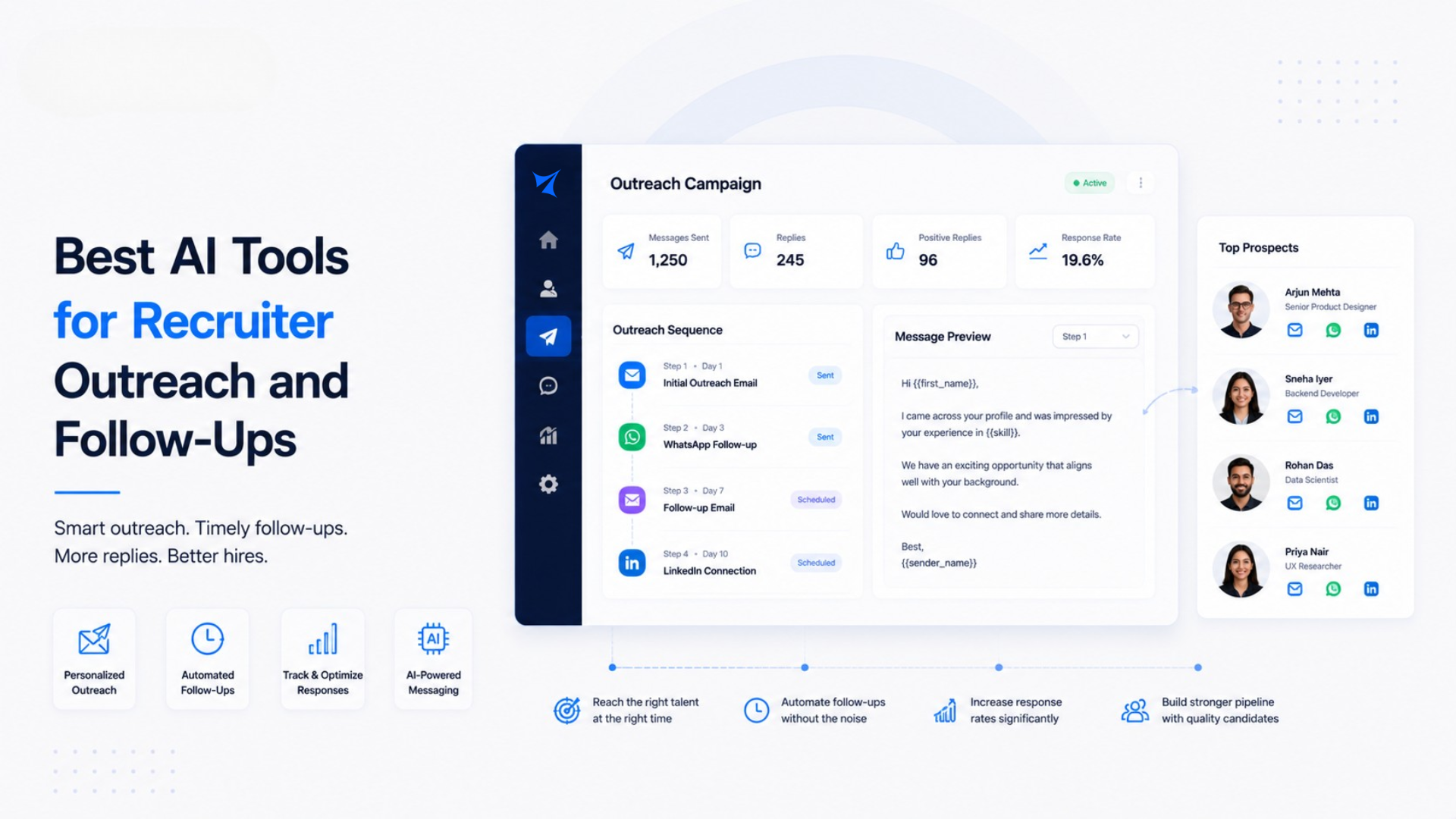
Sequence automation that sends follow-ups at appropriate intervals without manual scheduling. This is the specific capability most directly tied to the data point that opens this guide — the majority of candidate responses across large outreach datasets come from follow-up messages, not the first touch, which means a tool that can't reliably automate follow-up timing is leaving most of its potential response rate on the table by design.
Response tracking that surfaces warm leads and stops the sequence the moment someone replies. Continuing to send scheduled follow-ups to a candidate who already responded is one of the more avoidable failure modes automation can introduce if a tool isn't tracking engagement in real time.
GoPerfect's guide adds a systemic framing worth keeping in mind while evaluating any tool in this category: the core problems automation is solving are volume without filter (candidates piling up while outreach queues go untouched), generic messaging that damages response rates and brand reputation, channel fragmentation (candidates live across LinkedIn, email, and SMS, and manually managing all three doesn't scale), and slow follow-up that lets candidates go cold. A tool worth adopting needs to visibly address more than one of these at once.
The Best AI Tools for Recruiter Outreach and Follow-Ups in 2026
1. Huntlo — Best for Fully Autonomous Multi-Channel Outreach and Follow-Up
Most outreach tools automate one or two channels well and treat the rest as a manual add-on. Huntlo is built around running the entire outreach and follow-up motion — not just the first message — autonomously across email, WhatsApp, and AI voice from a single workflow.
Once a candidate is sourced and scored, Huntlo's agentic AI generates and sends personalized outreach based on the candidate's actual background, then manages follow-up sequences automatically for anyone who doesn't respond to the first touch — timing subsequent messages appropriately rather than firing them off in a rigid, one-size-fits-all schedule. Outreach halts the moment a candidate replies, so a recruiter never has to worry about a follow-up landing after someone's already engaged. For recruiters managing several open roles simultaneously, this removes the exact manual coordination burden that causes follow-up to quietly stop happening once volume exceeds what any one person can track by memory or spreadsheet.
WhatsApp support specifically sets Huntlo apart from outreach tools built primarily around email and LinkedIn norms common in US and UK recruiting — a real advantage for recruiters engaging candidates in markets where WhatsApp is a primary communication channel rather than a secondary one.
Best for: Recruiters and agencies that want sourcing, personalized outreach, and automated multi-touch follow-up running as one autonomous workflow across email, WhatsApp, and voice. Standout feature: Follow-up sequences that run automatically and stop the instant a candidate responds, across three distinct channels rather than one. Pricing: 7-day free trial (3 active roles, 30 candidate searches); paid plans start at $99 per seat/month.
2. Gem — Best CRM-First Platform for Outreach Visibility and Multi-Touch Campaign Management
Gem is frequently described as "HubSpot for recruiting" for good reason — it combines sourcing, outreach sequencing, and pipeline analytics into a single CRM-style system built for long-term candidate relationship visibility. According to Alex Birkett's independent recruiting automation review, Gem's outreach sequencing is where the platform genuinely shines: recruiters can build multi-touch email campaigns with real personalization, set explicit follow-up rules, and track engagement without ever leaving the platform.
Metaview's outreach platforms guide frames Gem's core strength slightly differently but arrives at a similar conclusion: rather than focusing purely on raw automation speed, Gem excels at organizing outreach history and giving recruiting teams visibility into engagement patterns and response rates across an entire team, not just a single recruiter's individual outreach.
Best for: In-house recruiting teams that want strong visibility into outreach performance and long-term candidate relationship tracking, not just fire-and-forget sequencing. Pricing: Free to start; Pro plan around $50/month per user, with custom plans available for larger teams.
3. hireEZ — Best for Established Multi-Channel Outreach at Sourcing Scale
hireEZ pairs its sourcing database with automated engagement workflows spanning personalized multi-channel campaigns, interview scheduling, and follow-up sequencing, according to Upwork's 2026 AI recruiting tools guide. Zapier's independent review describes hireEZ's calibration mechanism specifically: a recruiter starts with a job listing or a few basic qualifications, thumbs-up or thumbs-down a handful of calibration profiles, and the outreach targeting gets progressively sharper based on that feedback loop — reducing the manual tuning that otherwise falls on a recruiter's shoulders.
Best for: Teams whose core bottleneck is sourcing volume and who want outreach automation bundled into the same platform doing discovery. Trade-off: Greenhouse's 2026 buyer's guide flags a real operational risk worth taking seriously — documented cases of hireEZ activity leading to LinkedIn account restrictions, a meaningful concern for any team where LinkedIn remains central to sourcing and outreach.
4. GoPerfect — Best for Fully Autonomous Sourcing-to-Outreach in One Agent
GoPerfect positions itself around running sourcing and outreach as a single autonomous agent rather than two connected but separate steps. According to GoPerfect's own comparison of AI recruiters for automated outreach, the platform sources passive candidates using semantic search and career trajectory analysis, generates hyper-personalized messages based on each candidate's specific history, and sends them across email, LinkedIn, and SMS with automated follow-up — reporting a 55% candidate acceptance rate, described as nearly double the category average.
Best for: Teams that want per-position pricing rather than per-seat licensing, and a single autonomous agent handling sourcing through outreach without separate tool handoffs. Pricing: $250 to $300 per open position, with no credits or per-seat fees and unlimited seats included.
5. Recruiterflow — Best for Agencies Managing Multi-Channel Cadences at Volume
Recruiterflow combines ATS and CRM functionality with AI agents that transcribe calls, update candidate data automatically, and trigger outreach — reducing the administrative burden that otherwise competes directly with a recruiter's time for actual candidate engagement, according to Juicebox's 2026 roundup of AI recruiting tools. Its outreach specifically manages contact cadences across LinkedIn, SMS, and email in a single coordinated system, which matters for agencies running similar outreach cadences across many candidates and multiple simultaneous client mandates.
Best for: Recruiting agencies that need multi-channel outreach cadences standardized across a team of recruiters working multiple client accounts at once.
6. Fetcher — Best for Hands-Off Sourcing With Built-In Outreach Sequences
Fetcher takes a distinctly hands-off approach: recruiters define criteria, and the platform delivers curated batches of candidates along with personalized email sequences already attached, according to Metaview's outreach platforms comparison. SelectSoftwareReviews' hands-on testing notes that Fetcher's automated outreach specifically supports personalized email sequences aimed at effective candidate engagement, backed by a reporting dashboard to track how those sequences are actually performing.
Best for: Lean teams or startups without dedicated sourcing resources who want outreach sequences delivered already built rather than configured from scratch.
7. Loxo — Best All-in-One CRM and Sequencing for Agencies
Loxo combines CRM, ATS, sourcing, and outreach sequencing into a single platform specifically aimed at reducing the number of separate tools an agency has to manage, according to Metaview's comparison. Its automation features are built to support mass outreach while keeping candidate pipelines organized underneath — a combination Metaview's guide specifically recommends for agency environments managing multiple clients simultaneously, where consolidation and outreach speed both matter.
Best for: Recruiting agencies that want sourcing, CRM, and multi-touch outreach sequencing consolidated into one platform rather than stitched together from separate tools. Pricing: Tiered, typically priced per user per month; request a demo for specific figures.
8. LinkedIn Sales Navigator with AI Sales Assistant — Best Lower-Cost Entry Point for LinkedIn-Centric Outreach
For recruiters whose outreach is heavily LinkedIn-centered, Sales Navigator offers a notably better value proposition than LinkedIn Recruiter Lite on pure filtering power — Alex Birkett's review notes it provides more than 30 advanced search filters and 50 InMail credits per month for roughly $99/month, compared to Recruiter Lite's fewer filters at a higher $170/month price point. LinkedIn's 2026 addition of an AI Sales Assistant inside Sales Navigator now handles basic outreach sequence management directly within the platform, though Birkett's review is candid that it's less polished than Gem's dedicated sequencing.
Best for: Recruiters whose sourcing and outreach happen almost entirely on LinkedIn and who want a lower-cost alternative to Recruiter Lite with built-in sequencing. Trade-off: The obvious limitation is that it's a single-platform tool — no ATS, no pipeline management, and no reach into candidates who aren't active on LinkedIn.
9. Zapier — Best for Stitching Outreach Automation Across an Existing Tool Stack
Zapier isn't a dedicated recruiting outreach platform, but it earns a place in this category for a specific reason: it acts as the connective layer between tools that don't talk to each other natively. According to Zapier's own 2026 recruiting tools guide, its AI capabilities can generate personalized candidate outreach emails, summarize application responses, and score candidates against custom criteria, while its agentic workflows autonomously handle multi-step tasks like enriching candidate profiles with public data or preparing interview briefs — all triggerable through natural language via Zapier Copilot or directly from an AI assistant through Zapier MCP.
Best for: Teams with an already-fragmented tool stack who need outreach automation and follow-up reminders to flow between systems that weren't built to integrate with each other directly.
Choosing Based on Where Follow-Up Actually Breaks Down
Rather than picking the single top-ranked tool by default, it's worth diagnosing where follow-up specifically breaks down in a given team's current process:
If follow-ups get sent but arrive too generic — the tool needs stronger personalization based on candidate background, which points toward Huntlo, GoPerfect, or Gem's sequencing depth over a lighter-weight scheduling tool.
If follow-ups simply don't get sent at all because a recruiter forgets or runs out of time — the priority is full automation that doesn't require a human to trigger each step, which points toward Huntlo's or GoPerfect's autonomous agent model over tools that still require manual sequence-building.
If outreach is fragmented across email, LinkedIn, and other channels with no coordination — a genuinely multi-channel platform matters more than raw database size, which favors Huntlo (email, WhatsApp, voice) or hireEZ and Recruiterflow (email, LinkedIn, SMS) over single-channel tools.
If the problem is visibility, not automation itself — a team already sending follow-ups but with no clear sense of what's working — Gem's CRM-style analytics and engagement tracking address that more directly than a pure automation-first tool.
If the underlying issue is tool fragmentation across an entire stack, not outreach specifically — Zapier's integration layer may matter more than adopting another point solution for outreach alone.
Frequently Asked Questions
How much of a difference does automated follow-up actually make to response rates? Independent data across multiple sources in this category consistently shows the majority of candidate responses come from follow-up messages rather than the first touch — meaning a tool or process that reliably automates follow-up timing can meaningfully increase total response rate without requiring any additional outreach volume.
Is a single all-in-one outreach and CRM platform better than combining specialized tools? It depends on team size and existing tool debt. Smaller teams or those without a dedicated sourcing function tend to benefit from an all-in-one platform like Gem or Huntlo that removes tool-switching entirely. Larger teams with an existing ATS may prefer a specialized outreach layer that integrates cleanly rather than replacing what's already working.
What's the biggest risk with automating recruiter outreach at scale? Generic, poorly personalized messaging sent at higher volume — automation makes it possible to send far more outreach, but if personalization quality doesn't scale along with volume, response rates typically drop rather than improve, and candidate experience suffers as a result.
Should outreach automation stop the moment a candidate responds? Yes, and this should be treated as a baseline requirement rather than a nice-to-have feature. Continuing scheduled follow-ups after a candidate has already engaged is one of the more common and avoidable ways automated outreach damages candidate experience and brand reputation.
The Bottom Line
The tools genuinely worth adopting in this category all address the same underlying problem from different angles: recruiters can't manually track and personalize follow-up across dozens of open roles at once, and the data consistently shows that follow-up — not the first message — is where most candidate responses actually come from. Some tools solve this with deep CRM visibility, some with autonomous multi-channel agents, and some by simply connecting an already-fragmented stack together.
If the core problem is follow-up quietly not happening across multiple channels because no single tool is coordinating it, Huntlo's agentic AI sourcing and outreach platform is built specifically to keep that sequence running automatically across email, WhatsApp, and voice — worth testing directly against your next open role with the free trial.
Related Reading on the Huntlo Blog
Email vs. WhatsApp vs. AI Voice: Choosing the Right Outreach Channel for Candidate Engagement
How Agentic AI Is Changing Candidate Sourcing for Staffing Agencies
How to Build a Lean AI Recruiting Tech Stack Without Overspending