When James Whitfield started his recruiting career in 2007, his desk had two monitors, a phone, and a three-ring binder. One monitor showed Monster, the other showed CareerBuilder, and the binder contained his handwritten notes on every candidate he had spoken to that month. His hiring manager would email him a job description, he would search both boards, call the most promising candidates from his desk phone, and track everything in a spreadsheet that he color-coded by stage. Whitfield recently retired from a senior talent acquisition role at a Fortune 500 company where he oversaw the deployment of an AI-native platform that manages the full candidate journey for over eight thousand hires annually. The distance between those two desks, separated by seventeen years of platform evolution, illustrates one of the most dramatic technology transformations in any business function. Understanding how recruitment platforms evolved from job boards to autonomous systems is not just a history lesson. It is essential context for every talent leader making technology investment decisions today.
From Job Boards to Database-Driven Sourcing
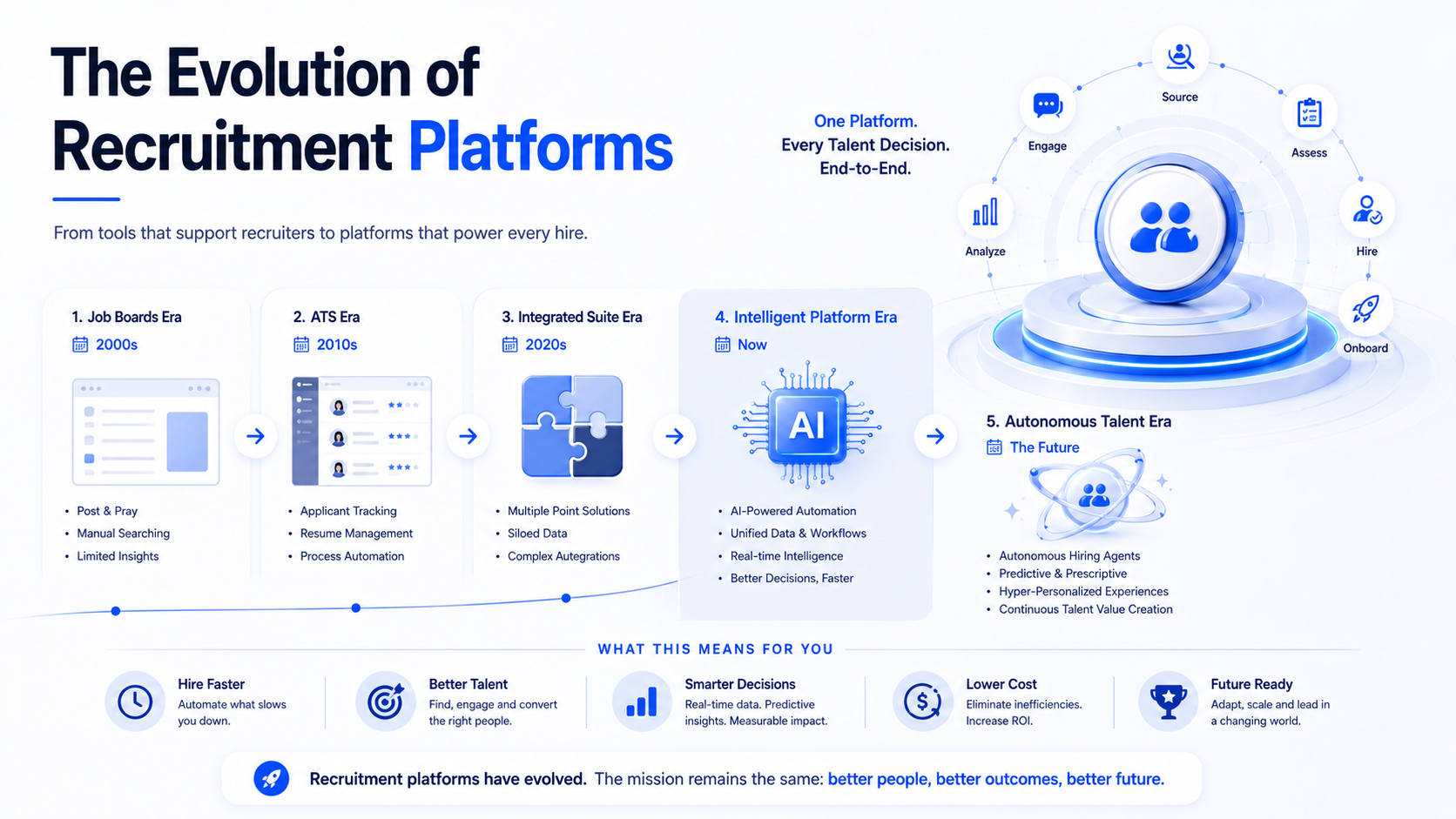
The first generation of recruitment technology was defined by job boards: passive listings that depended entirely on candidate initiative. Employers posted descriptions, and candidates found them through search or serendipity. This model worked adequately when labor markets favored employers and qualified candidates actively scrolled through listings. But it had no intelligence, no outreach capability, and no mechanism for matching candidates to roles beyond keyword proximity. The platforms of this era were essentially digital bulletin boards, replicating the newspaper classifieds model in a browser. They solved the distribution problem of job postings but contributed almost nothing to the quality or efficiency of the hiring decision itself.
The second generation introduced database-driven sourcing, giving recruiters the ability to proactively search for candidates rather than waiting for applications. Platforms like Monster
CareerBuilder and the early versions of LinkedIn Recruiter transformed recruiting from a reactive posting function into an active search discipline. For the first time, recruiters could build talent pipelines, search by specific criteria, and maintain candidate records for future use. This was a meaningful advance, but the underlying architecture remained fundamentally transactional. Each candidate was a record in a database, each interaction was a manual action, and each hiring decision was made entirely by humans using the platform as an information source rather than an analytical tool. McKinsey has documented how this generation of platforms improved recruiter productivity by making candidate information more accessible but did not materially change the quality or consistency of hiring outcomes.
The limitations of this generation became increasingly apparent as the volume of available candidate data exploded. Recruiters had more information than ever but lacked the tools to process it effectively. Boolean search expertise became a prized skill not because it was inherently valuable but because the platforms of this era required it to compensate for their lack of intelligent matching. The platforms could store millions of candidate profiles but could not rank them by relevance to a specific role. They could track application status but could not predict which candidates were most likely to accept an offer. The gap between the data available and the platforms' ability to derive insight from that data set the stage for the next evolutionary leap.
The ATS Era: Structuring the Process but Constraining the Experience
The applicant tracking system represented the third generation of recruitment platforms, and it solved a real problem: the need to structure and track the hiring process across multiple stakeholders. Before ATS platforms became standard, enterprise recruiting was managed through spreadsheets, email folders, and shared calendars. The ATS brought order to this chaos by defining stages, assigning responsibilities, recording decisions, and generating compliance reports. For organizations managing hundreds or thousands of hires annually, this structuring capability was genuinely transformative. Gartner research found that ATS adoption in the mid-2000s reduced average time-to-fill by fifteen to twenty percent simply by eliminating the coordination overhead of unstructured hiring processes.
But the ATS era also introduced constraints that would eventually become liabilities. Because ATS platforms were designed around the employer's internal process, they optimized for administrative efficiency rather than candidate experience. Application forms became longer and more complex as organizations added screening questions and data collection fields. The candidate's interaction with the platform was shaped by what the employer wanted to capture, not by what would engage or inform the candidate. This employer-centric design persisted for over a decade, even as candidate expectations evolved dramatically. LinkedIn survey data shows that candidate frustration with application processes peaked in the late 2010s, with some enterprise applications requiring forty-five minutes or more to complete, a practice that
drove qualified candidates to abandon the process before submitting.
The ATS era also entrenched a structural separation between different aspects of the hiring process. Sourcing happened in one tool, application tracking in another, assessment in a third, and onboarding in a fourth. Each function had its own platform with its own data model, and integrating them required expensive custom work that most organizations could not sustain. This fragmentation was not an accident but a consequence of the ATS's design philosophy: each function was a separate process to be managed independently. The distinction between AI sourcing vs AI recruiting became institutionalized in the technology stack, making it structurally difficult to create the seamless, end-to-end hiring workflows that both recruiters and candidates increasingly expected.
The Automation Wave: Faster but Not Smarter
The fourth generation of recruitment platforms was defined by automation. Starting around 2015, vendors began adding automated workflows to their platforms: automated job postings, automated email sequences, automated interview scheduling, and automated status updates. These capabilities addressed the throughput problem that had plagued enterprise recruiting for years. Recruiters who had been manually posting jobs to multiple boards, sending individual emails, and coordinating schedules by phone could now configure rules that handled these tasks automatically. Deloitte analysis found that automation features reduced the administrative burden on recruiters by thirty to forty percent, a significant efficiency gain that made automation the most in-demand capability in recruitment technology for several years.
However, automation without intelligence has inherent limitations. Automated email sequences send the same message to every candidate at the same interval regardless of individual engagement patterns. Automated screening rules apply uniform criteria to every applicant regardless of the nuances of their experience. Automated scheduling offers time slots without considering candidate preferences or time zone constraints. The phenomenon of more tools same hiring problems illustrates the core problem: adding more automated tools without improving the intelligence underlying those tools produces diminishing returns. Recruiters became more efficient at executing tasks but not necessarily more effective at making hiring decisions, because the platform was still fundamentally executing human-defined rules rather than making intelligent judgments.
The automation wave also exposed the data quality problems that had been building since the database-driven sourcing era. Automated workflows are only as good as the data they operate on, and recruitment data had accumulated years of inconsistencies, duplicates, and stale records. Automated systems amplified these problems by executing actions at scale based on flawed data. A candidate who had already accepted another job might receive an automated outreach sequence because the system did not know they were no longer available. An automated screening rule might reject a qualified candidate because their resume format did not match the system's parsing expectations. These failures eroded recruiter trust in automation
and created demand for a more intelligent approach.
AI Matching and Intelligent Decision Support
The fifth generation of recruitment platforms introduced AI-driven matching and decision support, marking a genuine shift in how technology contributes to hiring outcomes. Unlike automation, which executes predefined rules, AI matching learns from data to identify patterns that humans might miss. Semantic matching engines understand that a machine learning engineer and a data scientist may have overlapping capabilities even if their titles differ. Predictive models analyze historical hiring data to identify which candidate characteristics correlate with long-term success in specific roles. Recommendation engines suggest the most promising candidates from a large pool based on multi-factor analysis rather than simple keyword matching. EY has documented that AI-matching platforms improve quality-of-hire metrics by ten to fifteen percent compared to keyword-based search, primarily because they surface candidates who would be missed by traditional methods.
This generation also introduced the concept of decision support: the platform does not make the hiring decision but provides the recruiter with analytically grounded recommendations. Instead of simply ranking candidates by keyword relevance, a decision-support platform might highlight that a particular candidate has experience with a technology stack that the hiring team has found valuable in past hires, or that a candidate's career trajectory suggests the adaptability that the role requires. This is a fundamentally different relationship between recruiter and platform. The recruiter is no longer using the platform as a tool but engaging with it as an analytical partner. The anxiety about should recruiters worry about AI replacing jobs has been a recurring theme in industry discussions, but the reality of this generation is that AI augments rather than replaces human judgment by providing better information and deeper analysis.
The limitations of this generation are becoming apparent as the technology matures. Decision-support platforms still require human recruiters to initiate and manage most actions. The AI provides recommendations, but the recruiter must act on them manually. This means the productivity gains, while meaningful, are constrained by human bandwidth. A platform might identify a hundred promising candidates for a hard-to-fill role, but if the recruiting team can only personally engage with twenty of them, the AI's analytical capability is only as valuable as the recruiter's capacity to act on its output. This bottleneck is what the current and next generation of platforms are designed to address.
The Autonomous Platform: From Support to Execution
The emerging sixth generation of recruitment platforms represents the most significant architectural shift in the industry's history: the move from decision support to autonomous execution. Platforms in this generation do not merely recommend actions. They take them. An
autonomous platform identifies a hiring need, sources candidates, crafts personalized outreach, manages the engagement sequence, schedules interviews, collects and synthesizes feedback, and presents hiring managers with curated shortlists, all with minimal human intervention for standard roles. The recruiter's role shifts from executing tasks to reviewing outcomes, providing strategic input, and handling the exceptions and edge cases that require human judgment.
Early evidence from organizations deploying autonomous platforms is striking. Deloitte case studies show recruiting teams handling two to three times more requisitions per recruiter while maintaining or improving quality-of-hire. Gartner predicts that by 2028, approximately thirty percent of enterprise recruiting for non-executive roles will be managed primarily by autonomous platforms, with human recruiters providing oversight and handling escalations. The productivity multiplier comes from eliminating the execution bottleneck that constrained previous generations. When the platform handles the end-to-end workflow, the recruiter's analytical capacity becomes the limiting factor rather than their ability to send emails and schedule calls. Research on how many follow-ups one hire needs demonstrates that the timing and personalization of follow-up communication is one of the strongest predictors of hiring success, and autonomous platforms can optimize these factors at a scale that no human team could match.
The critical architectural difference of autonomous platforms is the closed-loop learning system. Every action the platform takes generates data about its effectiveness, and the platform uses this data to refine its future behavior. If a particular outreach message generates a high response rate for candidates with a specific background, the platform incorporates that insight into its messaging strategy. If candidates sourced through a particular channel consistently perform well after being hired, the platform allocates more resources to that channel. This continuous improvement cycle means that autonomous platforms become more effective over time, a quality that fundamentally distinguishes them from all previous generations of recruitment technology.
What the Next Decade of Platform Evolution Will Bring
Looking ahead, the evolution of recruitment platforms will be shaped by three converging forces: the maturation of AI capabilities, the integration of internal and external talent ecosystems, and the increasing importance of data quality as a competitive differentiator. Platforms that combine autonomous execution with deep workforce analytics will become the standard for enterprise talent acquisition, replacing the collection of point solutions that most organizations use today. McKinsey projects that the next five years will see more architectural change in recruitment technology than the previous fifteen years combined, as AI-native platforms reach the maturity required for enterprise-scale deployment.
The integration of internal and external talent management is particularly significant. Today, internal mobility and external recruiting are separate functions with separate platforms. The
next generation of recruitment platforms will treat them as a single talent ecosystem, matching people to opportunities whether they are current employees or external candidates. This convergence will create powerful network effects: the more people in the ecosystem, the better the matching, which attracts more people, which further improves the matching. LinkedIn enterprise research identifies this unified talent ecosystem as the most significant platform trend for the latter half of the decade, and organizations that begin building the data foundations for this convergence now will have a substantial first-mover advantage.
For talent acquisition leaders, the practical implication is that platform selection decisions made in the next two to three years will determine their organization's competitive position for the rest of the decade. The evolutionary trajectory is clear: platforms are moving from passive tools to active agents, from fragmented point solutions to unified ecosystems, and from rule-based automation to learning-based intelligence. SHRM recommends that enterprises evaluate platform vendors not just on current capabilities but on their architectural readiness for this autonomous, integrated future. The organizations that choose platforms capable of evolving with the market will thrive. Those that remain tied to architectures designed for previous generations will find themselves at an increasing and ultimately unsustainable disadvantage.