Natalie Steinberg, the vice president of talent acquisition at a midsize financial services company, opened her quarterly technology review and counted the licenses. Fourteen. Fourteen separate recruiting software platforms, each with its own login, its own interface, its own data model, and its own vendor relationship. The stack had started with an applicant tracking system eight years ago. Then came the job board aggregator, the scheduling tool, the communication platform, the assessment vendor, the referral management system, the analytics dashboard, the candidate relationship management tool, the interview feedback system, the offer management platform, and four more she could not remember requesting but that had been added over the years to solve problems the existing tools could not address. Her team spent more time managing the technology than using it. Recruiters switched between six or seven interfaces daily. Candidate data lived in four different systems, none of which agreed on the numbers. Integration between tools broke regularly, requiring IT tickets that took weeks to resolve. Natalie had increased her technology budget by forty percent over three years. Her recruiting metrics had not improved. They had gotten worse. The problem was not that her team was failing. The problem was that the traditional recruiting software model, a collection of disconnected point solutions held together by recruiter effort and integration middleware, had reached the limits of what it could deliver.
The Stack That Stopped Working
Natalie Steinberg, the vice president of talent acquisition at a midsize financial services company, opened her quarterly technology review and saw a number that made her pause. Her recruiting technology stack, the collection of software tools her team used to source, screen, schedule, communicate with, and track candidates, now consisted of fourteen separate platforms. Fourteen licenses, fourteen vendor relationships, fourteen integration points to maintain, and fourteen user interfaces her team had to navigate daily. The stack had grown incrementally over seven years, each tool added to solve a specific problem: an applicant tracking system for compliance, a job board aggregator for sourcing reach, a scheduling tool for interview coordination, a communication platform for candidate messaging, an assessment tool for screening, a referral management platform, an analytics dashboard, and so on. Each addition had solved its intended problem. Collectively, they had created a new problem that was worse than any of the individual problems they solved. Research published by SHRM on recruiting technology stack complexity found that the average enterprise recruiting organization now uses eleven to fifteen separate technology platforms, up from six to eight in 2019, and that recruiter satisfaction with their technology stack has declined by twenty-two percent over the same period despite the addition of more tools. The paradox is striking: organizations are spending more on recruiting technology than ever before and their recruiters are less satisfied with the technology they have.
The reason traditional recruiting software is failing is not that individual tools are bad. Many of them are competent at the specific task they were designed to perform. The failure is architectural. Traditional recruiting software was designed as a collection of point solutions, each optimizing a single task within the hiring process. This point-solution architecture made sense when recruiting was a sequential, manual process where each step, sourcing, screening, scheduling, interviewing, and offer management, was largely independent of the others. A recruiter could use one tool to source candidates, export the results to another tool for screening, manually schedule interviews through a third tool, and manage the offer through a fourth. The workflow was held together by the recruiter, who served as the integration layer between disconnected systems. This model worked when hiring volumes were moderate, candidate expectations were low, and the recruiter had time to serve as the glue connecting the technology stack. None of those conditions hold anymore. According to McKinsey research on HR technology effectiveness, organizations with highly fragmented recruiting technology stacks report thirty to forty percent lower recruiter productivity than those with integrated platforms, primarily because the time recruiters spend switching between tools, reconciling data inconsistencies, and managing integration failures consumes the capacity that should be dedicated to candidate engagement and strategic advisory work.
The fragmentation problem is compounded by data silos. Each tool in the traditional stack maintains its own data model, its own candidate records, and its own activity history. When a candidate interacts with the organization through multiple touchpoints, each interaction is recorded in a different system with different data fields and different timestamps. The
recruiter trying to understand the full candidate journey must manually piece together information from four or five separate platforms, a process that is time-consuming, error-prone, and fundamentally incompatible with the speed that modern recruiting requires. The organization has no single source of truth for candidate data, no unified view of the hiring pipeline, and no ability to analyze the full candidate journey from first touch to hire. Many organizations attempted to solve this fragmentation by adding more tools to the stack, including integration middleware, data warehousing solutions, and unified dashboard tools. The result was predictable: more tools, more complexity, more integration maintenance, and no meaningful improvement in the fundamental problem. The traditional recruiting software model is not experiencing a temporary rough patch. It is reaching the end of its useful life, because the architectural assumptions on which it was built no longer match the reality of modern recruiting.
Why Point Solutions Cannot Solve Systemic Problems
The fundamental limitation of traditional recruiting software is that it was designed to automate individual tasks rather than optimize entire workflows. A scheduling tool schedules interviews. A screening tool screens resumes. A messaging tool sends emails. Each tool operates within its own boundary, unaware of and unable to respond to the context created by the other tools in the stack. This task-centric architecture creates several systemic problems that no amount of point-solution improvement can resolve. First, workflow gaps emerge between tools. The candidate moves from sourcing to screening to scheduling to interview to offer, and at each transition, information is lost, context is fragmented, and the candidate experience is disrupted. The recruiter must manually bridge each gap, extracting data from one tool, reformatting it, and entering it into the next. These manual transitions are where delays accumulate, errors are introduced, and candidates fall through the cracks. According to LinkedIn research on the candidate experience, the moments of transition between recruiting stages, particularly between screening and interview scheduling, are where the largest share of candidate drop-offs occur, because these transitions are where the fragmentation of the technology stack is most visible to the candidate.
Second, the point-solution model cannot support real-time intelligence. Each tool operates on its own data, which means the data is always somewhat stale by the time it reaches the next tool in the workflow. A candidate updates their availability in the scheduling tool, but that update does not flow back to the sourcing tool or the communication platform. An interviewer provides feedback in the applicant tracking system, but that feedback does not inform the screening tool criteria for future candidates. The organization operates on fragmented, outdated information even though each individual tool may have current data within its own boundary. When scheduling systems rely on outdated candidate or interviewer data that has not been synchronized across the stack, the scheduling decisions are based on an incomplete and often inaccurate picture of reality. This data staleness is not a bug that better integration can fix. It is an architectural consequence of a model where each tool owns its own data and shares it with other tools only through periodic, batch-oriented synchronization processes that
cannot keep pace with the real-time dynamics of the hiring process.
Third, the point-solution model cannot learn and improve across the full hiring workflow. Each tool can optimize its own task based on the data it collects, but no tool has visibility into the full candidate journey from sourcing to hire. The scheduling tool knows how long scheduling takes but cannot correlate that data with candidate quality or offer acceptance rates. The screening tool knows which candidates pass screening but cannot connect that to long-term new-hire performance. The communication tool knows email open rates but cannot relate them to hiring outcomes. This means the organization cannot answer the most important questions about its recruiting process: which sourcing channels produce the best hires, which scheduling approaches lead to the highest offer acceptance rates, and which communication patterns predict candidate success. According to Gartner research on recruiting analytics maturity, organizations with fragmented technology stacks can measure activity metrics, such as time-to-fill and cost-per-hire, but cannot measure outcome metrics, such as quality-of-hire and hiring manager satisfaction, because outcome data is distributed across systems that cannot be correlated. The inability to measure what matters most is a structural limitation of the point-solution model that no amount of incremental improvement can overcome.
The AI-Native Platform Model That Replaces It
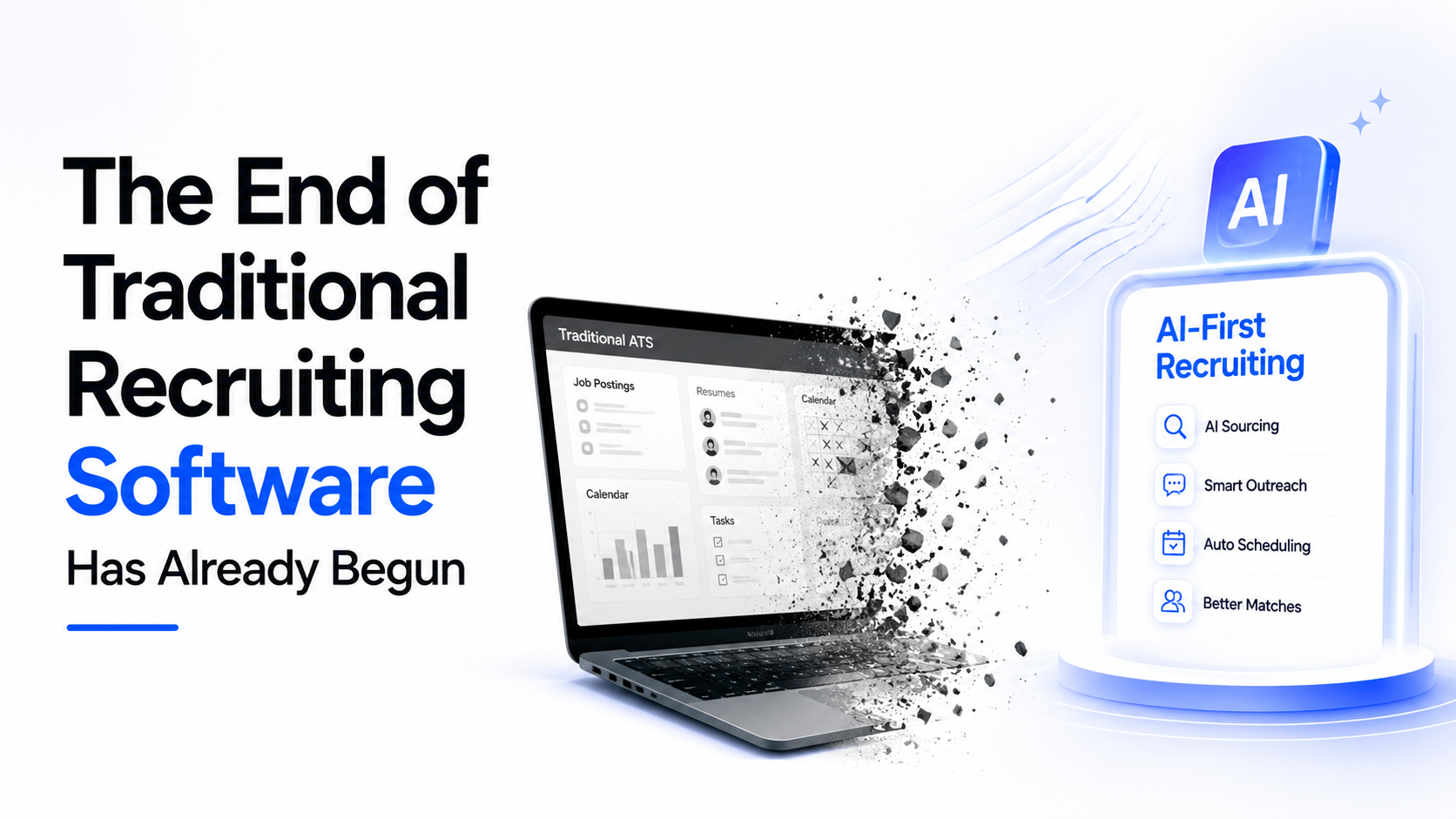
The model that is replacing traditional recruiting software is the AI-native platform: a unified system that manages the entire recruiting workflow, from sourcing through offer, on a single data model with a single intelligence layer. In this model, there are no workflow gaps between tools because there is only one tool. There is no data fragmentation because there is only one data model. There is no integration maintenance because there is nothing to integrate. The platform connects directly to the external systems it needs, calendar platforms, job boards, communication channels, and assessment providers, but all data flows into and out of a single, unified architecture. The intelligence layer, the AI that powers the platform, has complete visibility into the full candidate journey and can make decisions that optimize outcomes across the entire workflow rather than within individual task boundaries. An agentic AI recruiting platform represents this model in practice: a single system that sources candidates, manages engagement, screens and assesses, schedules interviews, coordinates hiring managers, and manages offers, all on a unified data model with AI intelligence that learns and improves from every interaction. The difference between this model and the traditional stack is not incremental. It is architectural and fundamental.
The practical implications of the platform model are significant and measurable. Recruiters work in a single interface rather than switching between fourteen. Candidate data is consistent and current across every stage of the hiring process because it lives in a single database rather than being fragmented across multiple systems. Scheduling decisions are informed by real-time data from every other stage of the process, because the scheduling engine shares the same data model as the sourcing, screening, and communication engines. Analytics span the full candidate journey, enabling the organization to measure the outcome metrics,
quality-of-hire, sourcing channel effectiveness, and candidate experience, that the fragmented stack could never provide. Deloitte analysis of recruiting technology consolidation trends found that organizations that have migrated from multi-tool stacks to AI-native platforms report average recruiter productivity improvements of thirty-five to forty-five percent, candidate experience score improvements of twenty-five to thirty-five percent, and total technology cost reductions of twenty to thirty percent, because the platform model eliminates the licensing, integration, and maintenance overhead of the fragmented stack while delivering superior outcomes across every recruiting metric.
The platform model also enables capabilities that are structurally impossible in the point-solution model. Predictive hiring analytics, which require data from sourcing through onboarding to identify the candidate attributes that predict long-term success, cannot function when that data is distributed across a dozen disconnected systems. Automated workflow optimization, where the AI continuously adjusts the recruiting process based on real-time performance data, requires a unified workflow engine that can modify any stage of the process based on insights from any other stage. Personalized candidate engagement at scale, where every candidate receives communication tailored to their specific context and journey stage, requires a single system that maintains the full context of every candidate relationship. These capabilities, which represent the frontier of recruiting effectiveness, are not features that can be added to a traditional stack through incremental improvement. They require the unified architecture that only an AI-native platform provides. EY technology in hiring research has projected that by 2028, more than half of large enterprises will have migrated from multi-tool recruiting stacks to AI-native platforms, driven by the compelling combination of better outcomes, lower costs, and simpler operations that the platform model delivers.
How to Navigate the Transition from Stack to Platform
For recruiting leaders managing a transition from a traditional technology stack to an AI-native platform, the process requires careful planning and deliberate execution. The first step is a comprehensive audit of the current stack, documenting every tool, its function, its data, its integration points, and its cost. This audit typically reveals that many tools in the stack overlap in function, that several tools are underutilized, and that the total cost of the stack significantly exceeds what a single platform would cost. SHRM guidance on recruiting technology rationalization recommends that organizations categorize their current tools into three groups: tools whose functionality is fully replaced by the platform, tools that provide specialized capabilities the platform does not cover and should be retained as integrated extensions, and tools that are redundant or underutilized and should be eliminated. This categorization provides the roadmap for the transition, identifying which capabilities the platform must deliver, which require supplementary integrations, and which represent immediate cost savings from elimination.
The second step is platform selection based on capability coverage, data integration depth, and learning architecture. The platform must cover the core recruiting workflow end to end,
from sourcing through offer management. It must integrate deeply with the organization existing systems, particularly the applicant tracking system if the organization is not replacing it, and the human resource information system. And it must have a learning architecture that enables it to improve over time based on organizational hiring data. For organizations navigating this selection process, frameworks for how to evaluate an AI sourcing tool before buying provide structured criteria for assessing platform capabilities, but the evaluation must be expanded beyond individual tool assessment to include the platform ability to unify the workflow that the current stack fragments. According to McKinsey research on technology platform transitions, the most successful migrations are those that select the platform based on its ability to absorb existing workflows rather than requiring the organization to redesign its processes around the platform limitations. The platform should adapt to the organization, not the other way around.
The third step is phased deployment with measurable milestones. The transition should not be a big-bang replacement of the entire stack. It should begin with the highest-pain areas, typically scheduling, candidate communication, and sourcing, and expand to cover the full workflow as the organization builds confidence in the platform and the platform accumulates organizational data that improves its performance. Each phase should have clear success metrics, such as scheduling time reduction, candidate response rate improvement, or recruiter time reallocation, that demonstrate the value of the transition to stakeholders and build momentum for the next phase. The fourth step is data migration and system decommissioning. As the platform absorbs each capability from the old stack, the corresponding legacy tool can be decommissioned, reducing licensing costs and integration maintenance. The organizations that navigate this transition most effectively treat it as a strategic program with executive sponsorship, dedicated project management, and regular stakeholder communication, rather than as a technology swap that the recruiting operations team handles independently. The end state is a dramatically simpler, more effective, and less expensive recruiting technology environment that delivers outcomes the fragmented stack could never achieve.
What the Post-Transition Recruiting Function Looks Like
Organizations that have completed the transition from a fragmented tool stack to an AI-native platform report a recruiting function that operates in fundamentally different ways. Recruiters spend less than ten percent of their time on technology administration, compared to thirty to forty percent in the fragmented stack environment. The time they recover is redirected to candidate relationship management, hiring manager advisory, and strategic workforce planning. The recruiting function has access to unified analytics that span the full candidate journey, enabling evidence-based decisions about sourcing strategy, process optimization, and hiring manager effectiveness. Candidate experience improves measurably because the seamless, unified process eliminates the gaps, delays, and data inconsistencies that candidates experienced when the organization relied on a fragmented stack. According to LinkedIn research on recruiting technology and candidate experience, organizations with unified recruiting platforms report Net Promoter Score improvements of fifteen to twenty-five points compared to
organizations with fragmented stacks, because the candidate experience is consistently fast, professional, and coherent across every touchpoint rather than varying in quality depending on which tool in the stack happens to be handling the interaction at any given moment.
The operational simplicity of the platform model also creates strategic agility. When the recruiting function operates on a single, unified platform, it can adapt to changing market conditions rapidly. A sudden increase in hiring demand does not require scrambling to provision additional licenses, configure new integrations, or train recruiters on new tools. The platform scales automatically. A new sourcing channel can be added through a configuration change rather than a procurement and integration project. A new assessment methodology can be incorporated into the screening workflow without disrupting the rest of the process. This agility is a significant competitive advantage in talent markets that change rapidly, because the organizations that can adapt their recruiting processes fastest are the ones that secure the best talent. Gartner has identified operational agility as the primary long-term benefit of platform-based recruiting technology, noting that while cost savings and productivity improvements are the most visible near-term benefits, the ability to adapt the recruiting process rapidly in response to market changes is the benefit that compounds most over time and creates the most durable competitive advantage.
For Natalie, the vice president who reviewed her fourteen-tool technology stack and realized it was producing declining returns despite increasing investment, the transition to an AI-native platform was not a technology decision. It was a strategic decision about the kind of recruiting function she wanted to build. She chose to replace fourteen tools with one platform, not because the platform was cheaper, although it was, but because it enabled a unified, intelligent, data-driven approach to recruiting that the fragmented stack made structurally impossible. The transition took eighteen months. The results justified the investment within the first year: thirty-eight percent reduction in time-to-fill, twenty-two percent improvement in offer acceptance rates, and a recruiting team that spent its time on strategy and relationships rather than technology administration. The end of traditional recruiting software is not a future event. It is already happening, driven by organizations that have recognized the fundamental architectural limitations of the point-solution model and chosen to replace it with something better. The organizations that make this transition will define the next era of recruiting. The ones that do not will continue to manage increasingly complex stacks that deliver increasingly diminishing returns, watching their AI-first competitors hire faster, smarter, and more effectively with a fraction of the technology overhead.