Scaling Executive Recruitment with AI Video Interview Technology
The executive hiring landscape is at an inflection point. Companies that once relied exclusively on retained search firms and months-long evaluation cycles are now facing pressure from every direction — talent shortages, runaway costs, and the relentless pace of business change. According to SHRM's State of Recruiting 2025 report, more than half of recruiting executives (56%) identified talent shortages as a critical challenge, with executive time-to-fill continuing to lengthen across industries. The Recruiting News Network reports that cost-per-hire for executives has spiked by 113% since 2017, a figure that has forced boards and CHROs to fundamentally reconsider how they approach leadership recruitment.
At the same time, the quality of executive hires remains deeply problematic. Gallup's landmark research found that organizations select the wrong candidate for management roles 82% of the time — a statistic that becomes even more consequential at the executive level, where a single bad C-suite hire can cost millions in direct costs and immeasurable damage to organizational culture and strategy. Forbes noted that while the average cost of a bad hire runs $17,000 per recruit, that figure "grows exponentially for the C-suite," where the stakes involve strategic direction, investor confidence, and team morale.
This convergence of escalating costs, lengthening timelines, and persistent quality issues has created an urgent demand for scalable, technology-driven solutions. AI video interview technology has emerged as one of the most promising answers — not as a replacement for human judgment, but as a force multiplier that brings consistency, structure, and data-driven rigor to every stage of executive evaluation.
The Executive Hiring Crisis: Why Traditional Models Are Breaking Down
To understand why AI video interviews matter for executive recruitment, it is essential to first understand the depth of the crisis facing traditional hiring models. Executive recruitment has historically operated as an artisanal craft — built on personal networks, intuition-driven assessments, and a reliance on the perceived expertise of search firms. While this approach produced results in a slower-moving business era, it now struggles under the weight of modern demands.
The Economics of Executive Mis-Hiring
The financial impact of poor executive hiring is staggering. Beyond the direct costs of recruitment fees, onboarding, and severance for failed placements, organizations absorb opportunity costs that are far more significant. A CEO or CFO who fails to deliver within the first 18–24 months can derail strategic initiatives, trigger senior team attrition, and erode board confidence. According to data compiled by SHRM's recruiting executives research, the organizations that struggle most with executive hiring also report lower overall business performance, higher leadership turnover, and diminished employer brand strength.
The timeline problem compounds these costs. Industry data from Genius shows that executive positions take over 120 days to fill on average, with some C-suite roles — particularly in specialized industries like financial services, healthcare, and technology — stretching well beyond six months. During this vacancy period, organizations operate without critical leadership, decisions are delayed or made by committee, and competitors may gain ground. The old model of "slow and careful" executive search has become an unsustainable luxury.
The Scarcity Problem
Beyond cost and time, there is a fundamental scarcity problem. The pool of qualified executive talent is limited, and demand continues to outstrip supply. SHRM's 2025 data shows that 56% of recruiting executives report talent shortages as their primary challenge. This scarcity means that organizations cannot afford to be slow or imprecise in their evaluation processes. When a qualified candidate expresses interest, the window for engagement is narrow — and competitors are often pursuing the same individuals simultaneously.
The traditional response to scarcity has been to cast wider nets through multiple retained search firms, but this approach multiplies costs without necessarily improving quality. It also creates coordination challenges, as different firms may present overlapping candidate slates, duplicate reference checks, and create inconsistent candidate experiences that damage the employer brand.
The Consistency Deficit
Perhaps the most insidious problem with traditional executive hiring is its inherent inconsistency. Unstructured interviews — where different interviewers ask different questions, apply different criteria, and reach conclusions based on different standards — have been shown by decades of industrial-organizational psychology research to be poor predictors of job performance. A NIH-published meta-analysis reviewing collaboration between recruiters and AI systems found that AI tools "outperform humans in screening applicants by at least 25%," a finding that underscores the reliability gap between human-only and technology-augmented assessment approaches.
Harvard Business Review's 2026 analysis goes further, arguing that "AI is rapidly undermining the reliability of traditional hiring signals," and that organizations must fundamentally restructure how they evaluate candidates. The article points out that the ability to perform well in unstructured interviews is becoming less predictive of actual job performance, particularly as AI tools help candidates optimize their interview preparation. For executive roles — where the consequences of a mis-hire are amplified — this consistency deficit represents a strategic risk that boards can no longer ignore.
What Is AI Video Interview Technology? A Primer for Enterprise TA Leaders
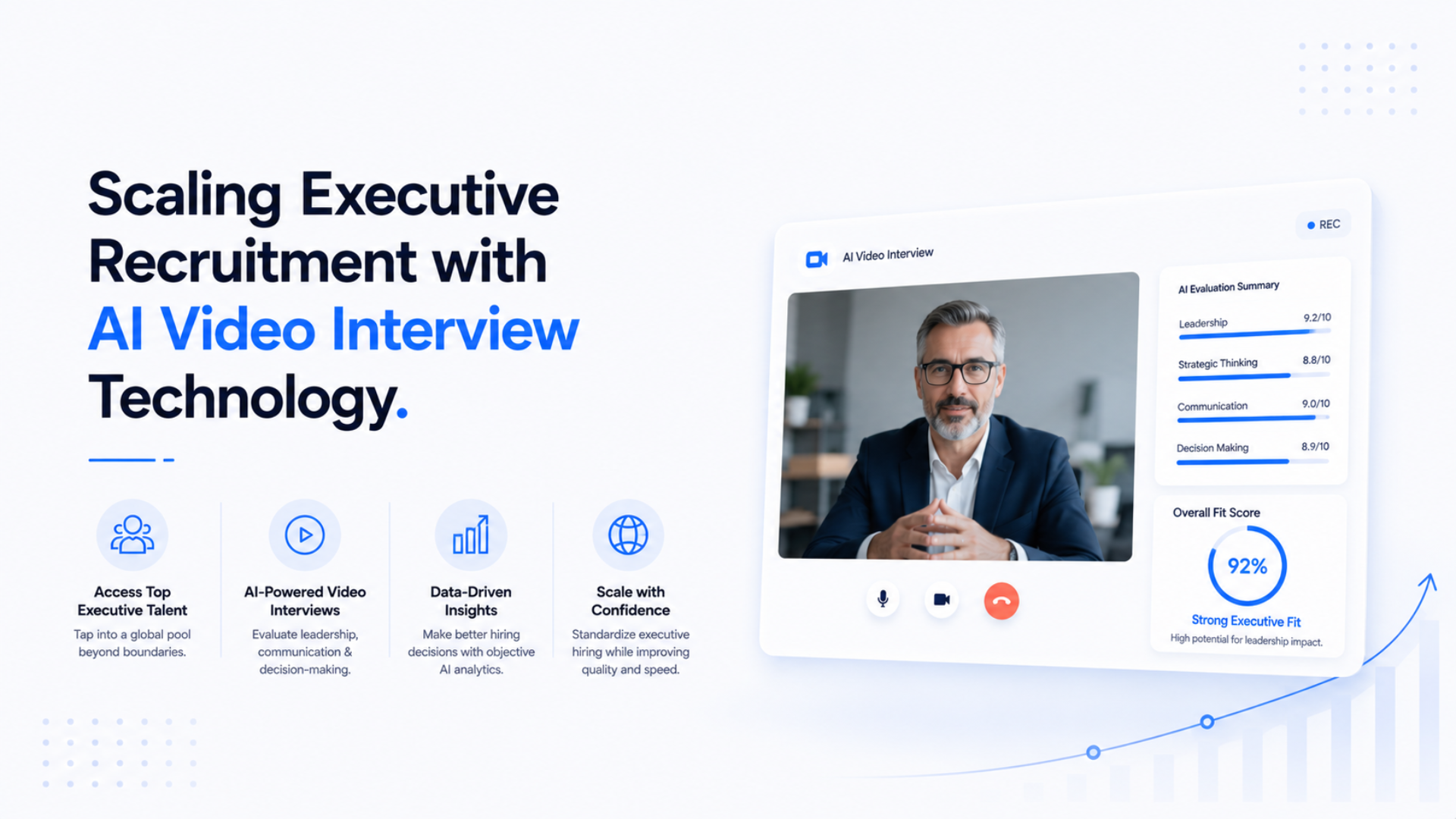
Before exploring the strategic applications of AI video interviews in executive recruitment, it is important to establish a clear understanding of what the technology actually does — and what it does not. AI video interview technology encompasses a range of platforms that use artificial intelligence to conduct, record, analyze, and score candidate interviews, typically through one-way (asynchronous) or two-way (live with AI assistance) video formats.
Core Capabilities
Modern AI video interview platforms offer several core capabilities that are directly relevant to executive hiring. First, they provide structured question delivery, ensuring that every candidate for a given role is asked the same questions in the same format, with consistent time limits and evaluation criteria. Criteria Corp's research on structured interviews confirms that "structured video interviewing is a natural fit for reducing hiring bias, while simultaneously improving the efficiency and effectiveness of the hiring process."
Second, AI video interview systems perform automated response analysis, evaluating not just what candidates say but how they say it — including verbal fluency, logical structure, use of evidence, and relevance to the question asked. SHRM Labs' examination of AI in structured hiring highlights how AI-powered platforms help organizations "reduce unconscious bias, improve hiring accuracy, and minimize" the subjective variables that plague traditional interviews.
Third, these platforms generate standardized scorecards that allow hiring committees to compare candidates on a common set of dimensions — strategic thinking, communication clarity, leadership presence, crisis management orientation, cultural alignment, and other competencies relevant to the specific executive role. This scoring is typically accompanied by evidence excerpts from the candidate's own responses, enabling reviewers to see the reasoning behind each score.
What AI Video Interviews Do Not Do
It is equally important to dispel common misconceptions. AI video interview technology does not make final hiring decisions. It does not replace the judgment of experienced hiring managers, board members, or search consultants. It does not read emotions through facial analysis — in fact, leading platforms have moved away from facial expression analysis in response to ethical concerns and regulatory scrutiny. SHRM reported that employers and candidates alike are becoming more sophisticated about distinguishing between ethical AI assessment tools and invasive surveillance technologies.
What AI video interviews do is create a structured, repeatable, and data-rich first layer of assessment that frees human evaluators to focus their limited time and expertise on the candidates who matter most — and to do so with better context and more reliable baseline information.
How AI Video Interviews Transform Executive Recruitment at Scale
The strategic value of AI video interview technology becomes clearest when examined through the lens of scaling — the ability to evaluate more candidates, more thoroughly, in less time, and at lower cost, without sacrificing assessment quality. For enterprises that need to fill multiple executive roles simultaneously, or that operate across geographies and business units, this scaling capability represents a fundamental competitive advantage.
Stage 1: Expanding the Top-of-Funnel Without Diluting Quality
One of the most significant bottlenecks in traditional executive search is the initial screening phase. Retained search firms typically present a shortlist of four to seven candidates after weeks or months of identification and preliminary outreach. This narrow shortlist is a function of the labor-intensive nature of traditional screening — each candidate requires multiple phone calls, reference precalls, and schedule coordination just to reach the first substantive conversation.
AI video interviews collapse this timeline dramatically. Candidates can complete a structured video interview at their convenience, typically within 30–45 minutes, responding to role-specific questions that probe their leadership experience, strategic thinking, and cultural fit. The AI system then provides an immediate structured assessment, allowing the hiring team to evaluate a much broader pool of candidates — often 20–40 for a single executive role — in the time it would traditionally take to screen five or six.
This expanded top-of-funnel is particularly valuable for organizations pursuing diversity in their executive ranks. When the initial screen is broader, the probability of discovering high-potential candidates from non-traditional backgrounds, underrepresented groups, or adjacent industries increases significantly. The structured nature of AI video interviews ensures that these candidates are evaluated on the same criteria as candidates from more conventional backgrounds, reducing the affinity bias that often limits diversity in executive hiring.
Stage 2: Standardizing Cross-Border and Cross-Functional Executive Searches
For multinational enterprises or organizations with diverse business units, executive hiring often involves coordinating search efforts across geographies, time zones, and functional specializations. A global technology company hiring regional managing directors for Asia-Pacific, EMEA, and the Americas simultaneously faces a coordination challenge that traditional search models handle poorly — each region typically engages a different search firm, applies slightly different evaluation criteria, and operates on different timelines.
AI video interview technology provides a unifying assessment layer. By deploying the same structured interview framework across all regions, the organization ensures that every regional director candidate is evaluated against a common set of leadership competencies. The resulting scorecards are directly comparable, enabling the central talent acquisition team and the hiring committee to make informed decisions about relative candidate strength across regions.
This standardization extends to cross-functional searches as well. When a company is hiring a Chief Marketing Officer, a Chief Financial Officer, and a Chief Technology Officer in the same fiscal year, AI video interviews allow the talent acquisition function to maintain consistent evaluation standards across all three searches — while still customizing the interview content to reflect the unique demands of each functional leadership role.
Stage 3: Accelerating the Long List to Short List Transition
In traditional executive search, the transition from a long list of potential candidates to a short list of finalists is one of the most time-consuming phases. It typically involves multiple rounds of phone screens, calendar juggling across busy executive schedules, and subjective assessments by different members of the search team.
AI video interviews compress this phase by providing structured, scored, and evidence-backed assessments of every candidate on the long list. Rather than spending 60–90 minutes on an initial phone screen with each of 15 candidates, the hiring team can review AI-generated scorecards and response excerpts in a fraction of the time — focusing their live attention on the five to seven candidates who score highest on the dimensions that matter most.
The efficiency gains documented across AI-assisted hiring are substantial: research compiling data from SHRM, LinkedIn, Gartner, and McKinsey shows that "AI-supported interviews see 24–30% higher assessment consistency" compared to traditional methods. For executive recruitment, where assessment consistency directly translates to better hiring decisions, this improvement is not marginal — it is transformational.
Stage 4: Enhancing the Finalist Experience and Decision Quality
The value of AI video interviews extends beyond the initial screening phases. For finalist-round candidates, AI-generated interview summaries and comparative scorecards provide the hiring committee with a rich, structured evidence base for deliberation. Instead of relying on scattered notes from different interviewers who may have asked different questions and applied different implicit standards, the committee can review a unified assessment record that highlights each candidate's strengths, development areas, and overall fit for the role.
This structured evidence base is particularly valuable when the hiring committee includes board members who may not have deep expertise in the specific functional area of the role. A board director evaluating a Chief Information Security Officer candidate, for example, can use the AI-generated assessment to understand the candidate's demonstrated capabilities in areas like risk communication, regulatory navigation, and incident response — even if the director lacks technical cybersecurity expertise.
Moreover, McKinsey's research on AI in the workplace suggests that AI's greatest organizational value comes not from replacing human decision-making but from "empowering people to unlock AI's full potential at work" — a principle that applies directly to executive hiring, where the goal is to augment the committee's collective judgment with better data and more consistent analysis.
Reducing Bias in Executive Hiring Through Structured AI Assessment
Bias in executive hiring is not merely an ethical concern — it is a strategic liability. When organizations consistently select leaders from the same demographic profiles, educational backgrounds, and career trajectories, they limit their access to diverse perspectives, novel strategies, and the cognitive diversity that drives innovation and adaptive capacity.
The Scale of the Problem
Research on hiring bias consistently documents its pervasiveness. SHRM Labs has highlighted how unconscious bias affects "who gets interviewed, who gets hired, and who advances" within organizations. In executive recruitment specifically, bias manifests in subtler but equally damaging ways — the preference for candidates who share educational backgrounds with current leaders, the assumption that industry experience in the same sector is inherently superior to cross-industry leadership, and the tendency to evaluate "cultural fit" in ways that favor demographic similarity.
Gallup's research on talent identification — drawing on "50+ years of employee selection experience" and "16+ million candidates assessed" — demonstrates that structured, validated assessment methods dramatically outperform unstructured evaluations in predicting leadership success. Yet executive hiring remains one of the least structured domains in the talent acquisition landscape, precisely because of the historical reliance on search firm expertise and the perception that executive assessment requires subjective human judgment.
How AI Video Interviews Address Bias
AI video interview technology directly addresses several of the most common sources of hiring bias. First, by asking every candidate the same questions in the same format, it eliminates the variability in question difficulty and framing that can advantage some candidates over others. A candidate interviewed on a Tuesday afternoon in New York faces the same questions, with the same time limits, as a candidate interviewed on a Thursday morning in Singapore.
Second, AI-based scoring applies predetermined evaluation criteria consistently across all candidates. Where human interviewers may unconsciously weight certain responses more heavily based on the candidate's background, communication style, or personal rapport, the AI system evaluates each response against the same rubric. Research published by the NIH confirms that this standardization leads to measurably more accurate candidate assessments, with AI tools outperforming unaided human judgment by a significant margin.
Third, AI video interviews can be designed to focus on competency-based evaluation rather than demographic signals. By structuring questions around specific leadership scenarios, strategic challenges, and behavioral indicators, the assessment directs attention to what candidates have actually done and how they think — rather than where they went to school, what they look like, or how closely their background mirrors that of the hiring manager.
The Nuance: AI as a Bias-Reduction Tool, Not a Bias-Elimination Tool
It is important to acknowledge that AI systems are not immune to bias. The algorithms that power AI video interview platforms are trained on data that may reflect historical biases in hiring outcomes. Question design can inadvertently favor certain communication styles or cultural norms. And the selection of evaluation criteria — which competencies to emphasize, how to weight them, what constitutes a "strong" response — involves human judgment that can introduce bias at the design level.
Responsible deployment of AI video interview technology requires ongoing attention to these risks. Organizations should audit their AI assessment tools regularly, evaluate scoring patterns across demographic groups, and ensure that human reviewers have the ability to override AI-generated scores when they identify potential biases. The goal is not to eliminate human judgment from executive hiring — it is to create a structured, evidence-rich assessment process that makes human judgment more informed and more consistent.
The Economics of AI Video Interviews in Executive Recruitment
For talent acquisition leaders building the business case for AI video interview technology, the economic argument is compelling. The costs of executive hiring are substantial and rising, and AI-driven approaches offer multiple leverage points for cost reduction and return on investment.
Direct Cost Savings
The most immediate economic benefit of AI video interviews is the reduction in direct recruiting costs. Traditional retained executive search typically commands fees of 33% of the first-year compensation for the placed executive — a figure that, for a C-suite role with total compensation of $500,000–$2 million, translates to search fees of $165,000–$660,000 per placement. While AI video interview technology does not entirely replace the need for search expertise (particularly for the sourcing and relationship management functions), it can significantly reduce the number of hours that search consultants spend on initial screening and assessment — and these savings can be reflected in reduced engagement fees or faster time-to-fill.
For enterprises that build internal executive talent acquisition capabilities — an increasingly common strategy as organizations seek to reduce their dependence on external search firms — AI video interview platforms provide the assessment infrastructure that makes internal executive hiring viable at scale. Rather than maintaining a large team of executive recruiters, organizations can deploy a smaller team equipped with AI tools that dramatically amplify their assessment capacity.
Time-to-Fill Reduction
Time is money in executive recruitment. Every day that a critical leadership position remains vacant, the organization incurs opportunity costs — delayed decisions, unfilled strategic gaps, and team uncertainty. AI video interviews can reduce executive time-to-fill by compressing the screening and shortlisting phases from weeks to days. When the initial assessment of 20–30 candidates can be completed asynchronously within a 48–72 hour window, the entire hiring timeline accelerates, and the organization can extend offers to top candidates before competitors.
SHRM's 2025 recruiting data underscores the urgency: with 56% of recruiting executives citing talent shortages, the organizations that can move fastest in securing top leadership talent gain a decisive advantage. AI video interview technology provides the speed layer that makes this possible.
Quality Improvement and Mis-Hire Reduction
The most significant economic benefit of AI video interviews may be the improvement in hiring quality — and the corresponding reduction in the costs associated with executive mis-hires. When assessment is more structured, more consistent, and more evidence-based, the probability of selecting a leader who will succeed in the role increases. And the cost avoidance from preventing even a single executive mis-hire can dwarf the entire annual investment in AI recruitment technology.
Gallup's finding that only 18% of current managers demonstrate "a high level of talent for managing others" suggests the enormous upside available to organizations that improve their selection accuracy. For executive roles, where the consequences of a mis-hire include not only direct costs but also strategic disruption, team attrition, and reputational damage, even modest improvements in selection accuracy generate outsized returns.
Huntlo's Approach: AI Video Interviews Built for Enterprise Recruitment Scale
While many AI video interview platforms serve the volume hiring market, few are designed with the specific requirements of executive recruitment in mind. Huntlo approaches AI video interviews as part of a broader AI recruiting and sourcing ecosystem — one that combines intelligent candidate sourcing from 50+ platforms, multi-channel outreach, conversational AI screening, and AI-powered video assessment into a unified platform priced for enterprise adoption at $99 per seat per month with no usage limits.
Sourcing-to-Interview Pipeline Integration
Huntlo's value proposition for executive recruitment lies not in any single capability but in the integration of the entire sourcing-to-interview pipeline. The platform's AI sourcing engine identifies potential executive candidates across 50+ professional platforms and databases, applying intelligent matching to surface individuals whose experience, skills, and career trajectories align with the role specification. Multi-channel outreach capabilities then engage these candidates through the channels where they are most responsive — email, LinkedIn, SMS, or other platforms — using personalized messaging that reflects the seniority and specificity of the opportunity.
When candidates respond positively and move into the assessment phase, Huntlo's AI video interview capabilities take over. Conversational AI screening conducts an initial dialogue that evaluates the candidate's interest, availability, and baseline qualifications before inviting them to complete a more comprehensive structured video interview. This graduated approach ensures that the executive's time is respected — no one is asked to complete a 45-minute video interview until the AI has confirmed that they meet the fundamental requirements of the role.
Enterprise-Grade Assessment at Accessible Pricing
Perhaps the most distinctive aspect of Huntlo's approach is its pricing model. At $99 per seat per month with no usage limits, the platform makes enterprise-grade AI video interview technology accessible to organizations that might otherwise be priced out of the market. Traditional enterprise video interview platforms charge based on per-interview or per-assessment fees that can escalate quickly in high-volume executive searches. Huntlo's flat pricing eliminates this variability, allowing talent acquisition teams to conduct as many AI video interviews as needed without worrying about cost overruns.
This pricing model is particularly valuable for organizations that are building internal executive recruiting capabilities and need to evaluate large candidate pools across multiple concurrent searches. It also makes AI video interviews economically viable for mid-market companies that are hiring their first C-suite leaders and cannot justify the $35,000+ annual fees charged by some enterprise-only video interview vendors — costs that Huntlo's own analysis of enterprise AI recruiting software has documented in detail.
Talent Pool Intelligence and Long-Term Pipeline Building
Beyond individual searches, Huntlo's AI video interview technology supports long-term executive talent pipeline building. Every candidate who completes an AI video interview — whether they are hired for the current role or not — becomes part of an organizational talent pool that can be searched, scored, and re-engaged for future opportunities. This cumulative intelligence is extraordinarily valuable for enterprises with ongoing leadership needs, as it means that the assessment investment made in today's search compounds over time.
For organizations that hire five to ten executives per year, this talent pool effect can transform the economics of executive recruitment within 12–18 months. Rather than starting every search from zero, the talent acquisition team can begin with a pre-assessed pool of candidates who have already demonstrated — through structured AI video interviews — that they possess the leadership competencies the organization values.
Implementation Strategy: Deploying AI Video Interviews for Executive Hiring
For organizations ready to adopt AI video interview technology for executive recruitment, a thoughtful implementation strategy is essential. The stakes are higher at the executive level, and the candidate population is more discerning, more experienced, and more likely to have strong opinions about how they should be evaluated.
Phase 1: Pilot with Non-Critical Leadership Roles
The most effective implementation approach begins with a pilot program focused on non-critical leadership roles — such as directors, vice presidents in non-revenue-critical functions, or senior individual contributors being considered for their first leadership role. This pilot serves multiple purposes: it allows the talent acquisition team to refine the interview frameworks, calibrate the AI scoring to the organization's specific leadership competencies, and build internal confidence in the technology before deploying it for C-suite searches.
During the pilot phase, it is valuable to run AI video interviews in parallel with traditional assessment methods, comparing the AI-generated scores with the evaluations of experienced interviewers. This parallel validation builds credibility and identifies any calibration adjustments needed before the platform is used for higher-stakes decisions.
Phase 2: Develop Role-Specific Executive Interview Frameworks
Effective AI video interviews for executive roles require role-specific question sets and evaluation rubrics. A generic leadership assessment is insufficient for distinguishing between a Chief Financial Officer who needs to demonstrate M&A expertise and investor relations acumen, and a Chief Marketing Officer who needs to show brand strategy vision and digital transformation leadership.
The development of these frameworks should involve a collaborative process that includes the hiring executive (or the hiring committee for CEO searches), the head of talent acquisition, and subject matter experts who understand the specific demands of the role. Each framework should define the key competencies to be assessed, the behavioral and situational questions that will probe those competencies, and the scoring criteria that will differentiate strong from exceptional performance.
Huntlo's AI video interview capabilities support this customization, allowing organizations to create tailored assessment experiences that reflect their unique leadership requirements and organizational culture.
Phase 3: Integrate with Existing ATS and Search Firm Workflows
Enterprise executive hiring rarely involves a single tool or process. Most organizations use a combination of internal talent acquisition resources, retained search firms, executive assessment consultants, and board-driven evaluation processes. AI video interview technology must integrate with these existing workflows rather than requiring a wholesale replacement.
Huntlo's Webhook-based ATS integration capabilities allow AI video interview data to flow seamlessly into the organization's existing hiring systems, ensuring that candidate records, assessment scores, and interview recordings are accessible to all authorized stakeholders. For organizations working with retained search firms, the AI video interview can serve as a structured supplement to the search firm's assessment — providing the hiring committee with an independent, standardized evaluation that complements the search consultant's qualitative insights.
Phase 4: Candidate Communication and Experience Design
Executive candidates expect a premium experience, and the introduction of AI video interviews must be communicated and designed with this expectation in mind. The best practice is to position the AI video interview as a structured opportunity for the candidate to demonstrate their leadership thinking — not as a screening hurdle or a technology test.
This means providing clear instructions, offering a practice question, allowing adequate time for each response, and ensuring that the technical experience is seamless across devices and browsers. It also means being transparent about how the AI assessment will be used — explaining that it is one input among many, that human reviewers will have access to the full recording, and that the candidate's responses will be evaluated against the same criteria applied to every other candidate.
Organizations that invest in candidate experience design for their AI video interviews consistently report higher completion rates, more positive candidate feedback, and stronger employer brand perception among the senior talent pool — advantages that compound over multiple searches.
Measuring Success: KPIs for AI Video Interview Programs in Executive Recruitment
To ensure that AI video interview technology is delivering value, organizations should establish clear metrics and monitor them continuously. The following key performance indicators are particularly relevant for executive recruitment programs:
Assessment Consistency Score: Measured by comparing AI-generated scores across candidates for the same role and evaluating inter-rater reliability between AI assessments and human evaluator ratings. Target: 85%+ consistency between AI and human evaluators on candidate ranking within the top quartile.
Time-to-Shortlist Reduction: The decrease in calendar days between search initiation and the presentation of a qualified shortlist to the hiring committee. Target: 30–40% reduction compared to the pre-AI baseline.
Candidate Pool Expansion: The increase in the number of candidates who receive a substantive assessment during each search. Target: 3–5x increase in assessed candidates without a proportional increase in recruiter time.
Diversity Impact: The change in demographic composition of shortlisted and hired executives following the introduction of AI video interviews. Track across gender, ethnicity, educational background, and industry origin.
Quality of Hire Retention Rate: The percentage of executives hired through the AI-augmented process who remain in their roles and meet performance expectations at the 12- and 24-month marks. Target: 10–15% improvement over pre-AI baselines.
Candidate Experience Score: Post-interview survey results measuring candidate satisfaction with the AI video interview process. Target: Net Promoter Score of 40+ among candidates who complete the assessment.
Cost-per-Assessed Candidate: The total cost of the AI video interview program divided by the number of candidates assessed. Compare against the equivalent cost per candidate for traditional screening methods.
Regular review of these metrics — ideally quarterly — allows the talent acquisition team to calibrate the technology, refine interview frameworks, and demonstrate the ROI of the AI video interview investment to senior leadership.
The Future of AI Video Interviews in Executive Search
The technology landscape for AI video interviews is evolving rapidly, and several emerging trends are likely to shape the next generation of executive assessment tools.
Multimodal Assessment Integration
Future AI video interview platforms are moving beyond verbal response analysis to incorporate multimodal assessment — evaluating the coherence between what candidates say, how they structure their arguments, and how they respond to follow-up questions that probe deeper into their reasoning. This multimodal approach more closely mirrors the dynamic nature of live executive interviews while preserving the scalability benefits of AI-powered assessment.
Predictive Leadership Analytics
As organizations accumulate data from multiple rounds of AI video interviews, it becomes possible to build predictive models that correlate specific assessment patterns with on-the-job leadership performance. These predictive analytics can help refine interview frameworks over time — identifying the questions and evaluation criteria that are most predictive of executive success within a specific organizational context.
Real-Time AI Assistance in Live Executive Interviews
The next frontier for AI in executive hiring is not asynchronous video interviews but real-time AI assistance during live interviews between candidates and human interviewers. In this model, the AI system listens to the conversation, suggests follow-up questions based on the candidate's responses, and provides the interviewer with real-time cues about areas that merit deeper exploration. This approach preserves the relational and conversational quality of traditional executive interviews while adding the consistency and structure that AI technology provides.
McKinsey's technology trends outlook for 2025 emphasizes that the most impactful technology deployments are those that augment human capabilities rather than replace them — a principle that points directly toward this hybrid model of AI-assisted live interviewing as the future of executive recruitment assessment.
Conclusion
Executive recruitment is being reshaped by a combination of economic pressure, talent scarcity, and technological capability. The organizations that will thrive in this new environment are those that adopt AI video interview technology not as a cost-cutting tool but as a strategic enabler — a way to evaluate more candidates more thoroughly, make faster and more consistent decisions, and build the leadership talent pools that will drive long-term competitive advantage.
The evidence is clear: structured AI-powered assessment outperforms unstructured human evaluation in consistency, reduces the bias that limits diversity in executive ranks, and generates the data-rich candidate profiles that hiring committees need to make high-stakes leadership decisions with confidence. Platforms like Huntlo are making this technology accessible at enterprise scale — with pricing models, integration capabilities, and sourcing-to-interview pipeline designs that reflect the real-world requirements of modern executive recruitment.
The question for talent acquisition leaders is no longer whether to adopt AI video interview technology for executive hiring, but how quickly and how effectively they can deploy it. In a market where 56% of recruiting executives report talent shortages, where executive cost-per-hire has surged 113% in seven years, and where 82% of management hires fail to meet performance expectations, the cost of inaction far exceeds the cost of innovation.
Related Topics:
How Recruitment Firms Can Scale Placements Without Adding Headcount
Best AI Recruiting Software for Enterprise Hiring Teams in 2026
AI Recruiting Software for Staffing Firms: Complete Guide (2026)