James Okafor, chief people officer at a London-based fintech startup that had just closed its Series C funding round, sat in the boardroom listening to his CEO deliver the hiring mandate for the next twelve months. The company needed to double its engineering team from eighty to one hundred sixty people, hire a VP of Product, build out a data science function from scratch, and establish a presence in two new markets, all within a budget that was twenty percent smaller per hire than what they had spent in the previous year. James had heard these kinds of mandates before, and he knew that the traditional recruiting model, post jobs, screen resumes, schedule interviews, negotiate offers, repeat, could not deliver this volume at this speed with this budget. He had also seen enough AI recruiting demonstrations to know that the technology had reached a point where it could fundamentally change what was possible. What he had not yet seen was a clear-eyed assessment of what the recruitment transformation actually meant in practice, beyond the vendor hype and the anxiety-driven headlines about AI replacing recruiters. James decided that before committing his limited budget to any technology or strategy, he needed to understand the full scope of what was changing, what the new model looked like when it worked well, and what it would require from his team and his organization to make the transition successfully. He did not want another tool. He wanted a new operating model.
The Structural Break in How Recruitment Works
Elena Voss, global head of talent acquisition at a Berlin-based climate technology company
with offices in eleven countries, stood before her leadership team in January 2026 and presented a chart that told the story of an industry in the middle of a structural break. The chart showed her team's hiring metrics over the previous four years, and the pattern was unmistakable. Through 2023 and 2024, the team's performance had followed the familiar seasonal rhythms of recruitment: slow in January, ramping through spring, peaking in late summer, and declining into the holidays. Each year looked like the last, with incremental improvements in efficiency but no fundamental change in the shape of the curve. Then, in mid-2025, after deploying an AI recruiting platform that operated autonomously across the full hiring workflow, the curve changed shape entirely. The seasonal pattern flattened. Hiring became a continuous, steady-state process rather than a cyclical one. Time-to-fill dropped by forty-five percent for technical roles. Candidate response rates to outbound outreach doubled. Hiring manager satisfaction scores, which had plateaued at sixty-two percent for two years, jumped to eighty-one percent within six months. Elena had not improved her team's skills. She had not hired more recruiters. She had not changed her employer brand or her compensation strategy. She had changed the operating model of recruitment itself, replacing a human-managed, tool-mediated process with an AI-orchestrated, human-guided system. The distinction between an agentic AI recruiting platform and one that is merely automated was the critical factor, because the agentic system could make contextual decisions, manage multi-step workflows, and learn from outcomes without requiring human initiation at each step. The old model of recruitment, where humans execute processes using software tools, had been disrupted not by a better tool but by a fundamentally different way of organizing the work.
The structural break that Elena's chart revealed is not unique to her organization. It is visible across the talent acquisition industry, driven by the convergence of three forces that have been building for years and have now reached a tipping point. The first force is the maturation of AI technology to the point where it can reliably manage complex, multi-step workflows that require contextual judgment. Early AI recruiting tools could screen resumes and match keywords. Current AI systems can evaluate candidates across multiple dimensions, manage personalized engagement over extended periods, coordinate complex scheduling logistics, and synthesize feedback from multiple interviewers into coherent assessments. This capability leap from simple automation to contextual autonomy is what transforms AI from a productivity tool into an operating model. The second force is the intensification of competition for talent, driven by skill shortages in critical areas like artificial intelligence, cybersecurity, clean energy engineering, and data science. When the talent market is competitive, organizations with faster, more effective, and more personalized recruiting processes win the best candidates, and the difference between winning and losing is increasingly determined by the quality of the recruiting operating model rather than by compensation alone. The third force is the shifting expectations of candidates, particularly the Millennial and Gen Z professionals who now constitute the majority of the professional workforce. These candidates expect the same speed, personalization, and digital experience from potential employers that they receive from consumer technology platforms, and they disengage quickly from employers who cannot deliver. According to McKinsey research on the future of talent acquisition, these
three forces are not temporary disruptions but permanent structural shifts that will continue to reshape recruitment for the foreseeable future, making the pre-2025 model of recruiting progressively less viable.
The implication of this structural break is that incremental improvements to the existing recruiting model, better training, more recruiters, faster tools, will not be sufficient to keep pace with the changes underway. The organizations that will thrive in the new environment are those that recognize the break for what it is, a fundamental change in how the recruiting function creates value, and invest in building the new operating model rather than trying to optimize the old one. This requires a different kind of strategic thinking from talent acquisition leaders. Instead of asking how to make the current process faster, the question becomes how to redesign the process around the capabilities of AI-augmented operation. Instead of asking how to squeeze more productivity from the current team, the question becomes how to redeploy the team's human capabilities toward activities that create the most strategic value. Instead of asking how to get more from existing technology investments, the question becomes how to build a technology architecture that supports the new model rather than constraining it. These are not incremental questions. They are transformational questions, and the organizations that answer them effectively will define the next era of recruitment. According to Gartner talent acquisition strategy research, organizations that treat the current moment as a transformation opportunity rather than an optimization challenge are two to three times more likely to achieve significant improvements in hiring outcomes over the next three years, because the transformational approach produces changes in the operating model that compound over time, while the optimization approach produces one-time improvements that are quickly absorbed by the competitive dynamics of the talent market.
What the Candidate Experience Looks Like Now
The most visible manifestation of the recruitment transformation is the change in the candidate experience. In the old model, a candidate's first interaction with a potential employer was typically a generic job posting, followed by an application submitted into a black hole, followed by a delay of days or weeks before hearing anything, followed by a phone screen with a recruiter who asked the same standard questions, followed by more delays, followed by a panel interview with interviewers who had not coordinated their questions. This experience was frustrating for candidates, but employers tolerated it because the alternative, providing a faster, more personalized experience, required more recruiter time than most organizations were willing or able to invest. The new model delivers a fundamentally different experience. A candidate's first interaction might be a personalized message that references their specific professional background and explains why the role is relevant to their career trajectory. Their questions are answered in real time by an AI system that has full context on the role, the team, and the organization. Their interview schedule is coordinated automatically, with timing optimized for the candidate's availability and the hiring team's priorities. Their feedback after each stage is collected systematically and incorporated into the evaluation in real time. The reason referrals outperform cold outreach has always been that referral candidates
receive a more personalized, informed, and respectful hiring experience. The new model extends this referral-quality experience to every candidate in the pipeline, not just those who come through personal connections, because the AI system can provide the same level of personalized attention at a scale that was previously impossible.
The impact of this improved experience on hiring outcomes is substantial and measurable. Candidates who experience the new model report significantly higher satisfaction with the hiring process, and this satisfaction directly influences their willingness to accept offers and recommend the employer to peers. The hiring experience has become a critical component of the employer brand, because candidates share their experiences on platforms like Glassdoor, Blind, and LinkedIn, and negative experiences can damage an employer's ability to attract future candidates for years. Conversely, positive experiences create a virtuous cycle where satisfied candidates become brand ambassadors who attract additional candidates to the pipeline, reducing the organization's dependence on paid sourcing channels. The data on this dynamic is clear. According to LinkedIn talent acquisition research, candidates who rate their hiring experience as excellent are forty to fifty percent more likely to accept an offer and three times more likely to refer other candidates to the organization compared to candidates who rate their experience as poor. In a competitive talent market where the best candidates have multiple options, the quality of the hiring experience is often the decisive factor in offer acceptance, more important than compensation in many cases, because top candidates are comparing not just the financial terms but the quality of the professional relationship they are being invited to join.
The transformation of the candidate experience also changes the competitive dynamics of recruitment in ways that favor early adopters. When most organizations in an industry offer a traditional, slow, impersonal hiring experience, the few organizations that offer a fast, personalized, AI-augmented experience stand out dramatically. Candidates notice the difference, and they talk about it. The organization that responds to an inquiry within an hour rather than a week, that provides detailed information about the role and the team without requiring the candidate to ask, that coordinates interviews around the candidate's schedule rather than demanding flexibility from the candidate, that provides thoughtful, personalized feedback after each stage, creates a hiring experience that candidates remember and share. This differentiation advantage compounds over time, because the early adopter accumulates a reputation for candidate-friendly hiring that makes it progressively easier to attract top talent. Late adopters, by contrast, find themselves in a race to the bottom where they must increase compensation and addSigning bonuses to overcome the negative perception created by an inferior hiring experience. According to SHRM employer branding research, sixty-five percent of candidates say the quality of the hiring experience significantly influences their decision about whether to accept a job offer, and this percentage is highest among the senior professionals and technical specialists who are most valuable and most difficult to hire, suggesting that the candidate experience advantage is most powerful precisely where it matters most.
What This Means for the Recruiting Profession
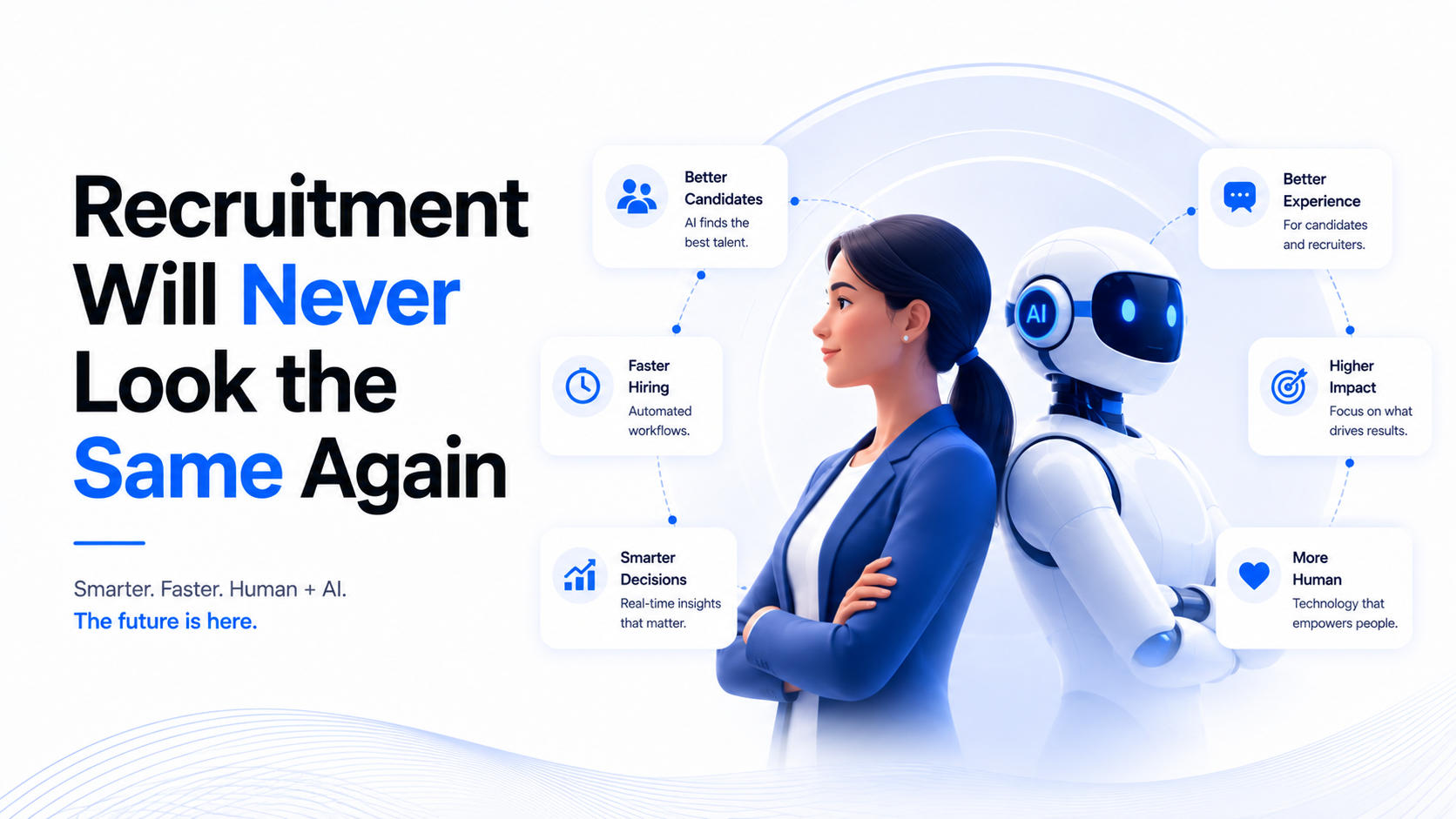
The transformation of recruitment raises the most anxiety-inducing question in the profession: will AI replace recruiters? The evidence from organizations that have already made the transition provides a nuanced and ultimately encouraging answer. The total number of recruiting professionals has not decreased in organizations that have deployed AI recruiting at scale. What has changed is what those professionals do and the value they create. In the old model, the recruiter's primary value was operational: the recruiter who sourced more candidates, screened more resumes, and managed more requisitions was considered more productive. This operational value proposition is precisely the dimension that AI can replicate and exceed, which is why the question of whether recruiters should worry about AI replacing their jobs generates anxiety. But in the new model, the recruiter's value has shifted to dimensions that AI cannot replicate: strategic talent advisory to business leaders, deep relationship building with high-priority candidates, creative problem-solving in complex hiring situations, and organizational influence that shapes how the business thinks about talent. These activities require human judgment, emotional intelligence, political awareness, and creative thinking, capabilities that current AI technology cannot provide even at its most sophisticated. The recruiter's role is not shrinking. It is evolving from operational execution to strategic counsel, and the recruiters who make this evolution successfully will be more valuable to their organizations than ever before.
The practical evolution of recruiter roles follows a consistent pattern across organizations that have completed the transition. Junior recruiters, who in the old model spent their days on repetitive operational tasks like resume screening and interview scheduling, are being redeployed into talent research and candidate relationship development roles that build the strategic skills they need for career advancement. Mid-level recruiters, who previously served as pipeline managers coordinating between candidates and hiring managers, are being elevated into hiring manager advisory roles where they partner with business leaders on role design, team composition, and talent strategy. Senior recruiters and recruiting leaders are shifting from operational oversight to talent intelligence and workforce planning, providing the organization with strategic insights about talent market dynamics, competitive positioning, and capability gaps. This evolution does not happen automatically. It requires deliberate investment in training, mentorship, and role redesign that aligns incentives with the new model. The organizations that simply layer AI on top of existing role structures, without changing what recruiters do and how their performance is measured, consistently underperform those that redesign roles around the new division of labor. According to Deloitte research on the future of work in HR, organizations that invest in role redesign alongside AI deployment achieve forty to fifty percent higher recruiter satisfaction and thirty percent lower recruiter turnover compared to those that deploy AI without changing role structures, because the role redesign gives recruiters a clear path to growth and impact in the new model.
The recruiters who will thrive in the transformed profession share several characteristics that distinguish them from peers who struggle with the transition. They are curious about technology and willing to experiment with new tools rather than resisting them. They have strong business acumen and can connect talent acquisition activities to organizational outcomes that
business leaders care about. They are effective communicators who can build trust with candidates and hiring managers through authentic, consultative interactions. They are comfortable with ambiguity and can exercise good judgment in situations where data is incomplete or conflicting. And they are lifelong learners who continuously develop their skills in response to a changing environment. These characteristics are not new. They have always distinguished great recruiters from good ones. But they have become essential rather than optional, because the operational skills that previously allowed a recruiter to be effective without these qualities have been automated. The recruiting profession is not being de-skilled by AI. It is being re-skilled, with the bar for professional excellence rising to a level that demands more strategic thinking, more business knowledge, and more relational depth than the old model required. According to EY analysis of professional evolution in response to AI, the recruiters who are most successful in AI-augmented environments are those who proactively develop their strategic and relational capabilities before the transition forces them to, treating the technology change as a career development opportunity rather than a threat to be resisted. The recruiting profession will be smaller in terms of headcount relative to hiring volume but higher in terms of individual impact, strategic influence, and professional satisfaction.
The Operational Model That Replaces the Old One
The new operational model of recruitment operates according to principles that are fundamentally different from those of the old model. The first principle is continuous operation rather than cyclical activity. In the old model, recruiting activity was triggered by requisitions and concentrated into hiring campaigns. In the new model, the AI system operates continuously, maintaining talent market presence, building candidate relationships, and gathering intelligence regardless of whether specific positions are open. This continuous operation eliminates the cold-start problem that makes reactive hiring so slow and produces a persistently warm talent pipeline that can be activated whenever a hiring need arises. The second principle is AI orchestration with human oversight rather than human execution with tool support. In the old model, the recruiter executed each step of the process using tools. In the new model, the AI orchestrates the workflow, making operational decisions and taking autonomous action, while the human provides strategic direction and intervenes at key decision points. This principle requires a fundamentally different relationship between the recruiter and the technology, one of collaboration rather than operation. The third principle is data-driven learning rather than experience-driven intuition. In the old model, recruiting effectiveness depended primarily on the individual recruiter's experience and judgment. In the new model, the AI system systematically captures outcomes, identifies patterns, and improves its recommendations with each hiring cycle. The question of how many follow-ups one hire needs illustrates this shift: in the old model, the answer depended on the individual recruiter's intuition. In the new model, the answer is derived from systematic analysis of follow-up cadence and response data across thousands of candidate interactions.
The practical implementation of these principles produces a recruiting operation that looks and feels different from the traditional model in several important ways. First, the pace of
recruiting activity is faster and more consistent. Candidates move through the pipeline in days rather than weeks, because the AI system eliminates the delays caused by manual coordination between tools and stakeholders. Second, the scale of recruiting activity is larger without requiring proportional increases in headcount. A team of five recruiters supported by an AI agent can manage a pipeline that would have required fifteen to twenty recruiters in the old model, because the AI handles the operational volume that previously consumed the majority of recruiter time. Third, the quality of recruiting decisions is higher, because the AI system evaluates candidates against a richer set of data points and maintains consistency across evaluations, while the human recruiter contributes strategic judgment that the AI cannot provide. Fourth, the visibility into the recruiting process is better, because the AI system generates real-time dashboards that show pipeline health, candidate engagement, time-to-fill trends, and quality-of-hire metrics, replacing the manual reports and spreadsheet tracking that characterized the old model. According to Gartner talent acquisition operations research, organizations operating under the new model report fifty to sixty percent higher recruiting efficiency, defined as hires per recruiter per quarter, and twenty-five to thirty-five percent higher quality-of-hire scores, because the combination of AI operational consistency and human strategic judgment produces better outcomes than either could achieve alone.
The transition to the new operational model requires organizations to make changes across three dimensions simultaneously: technology, process, and people. The technology dimension involves deploying an integrated AI recruiting platform that can serve as the orchestration layer for the new model, rather than continuing to operate a fragmented tool stack that constrains the AI to individual point solutions. The process dimension involves redesigning recruiting workflows around the AI-human collaboration model, eliminating steps that were designed for human execution and adding steps that leverage AI capabilities like continuous sourcing, proactive engagement, and automated feedback collection. The people dimension involves investing in recruiter skill development, role redesign, and change management that enables the recruiting team to operate effectively in the new model. Each of these dimensions is necessary but not sufficient on its own. Technology without process redesign produces underutilized AI capabilities. Process redesign without technology investment produces aspirational workflows that cannot be executed. People development without technology and process changes produces skilled recruiters who are frustrated by outdated tools and processes. The organizations that invest in all three dimensions simultaneously are the ones that achieve the fastest and most significant improvements in hiring outcomes. According to McKinsey transformation research, organizations that address technology, process, and people in parallel achieve three to four times the improvement in operational performance compared to those that address them sequentially, because the parallel approach allows each dimension to reinforce the others rather than creating gaps that slow the overall transition.
The Organizations That Will Lead and Those That Will Lag
The recruitment transformation will not affect all organizations equally. The organizations that will lead the transition share several characteristics that position them to capitalize on the
structural break. They have talent acquisition leaders who think strategically about operating models rather than tactically about tools. They have invested in data infrastructure that gives AI systems the information they need to operate effectively. They have recruiting teams with the adaptability and learning orientation required to evolve their roles. And they have organizational cultures that support experimentation, accept the inevitability of change, and invest in capability development as a strategic priority. These organizations are not necessarily the largest or the most resourced. They are the most strategically aligned and operationally agile. Early evidence suggests that mid-size technology companies, professional services firms, and financial services organizations are currently leading the adoption curve, because they combine sufficient scale to benefit from AI augmentation with sufficient organizational agility to implement the new model without the bureaucratic inertia that slows adoption in very large enterprises. According to LinkedIn annual talent acquisition trends report, forty-three percent of mid-size technology companies have deployed or are actively piloting AI recruiting platforms with agentic capabilities, compared to twenty-eight percent of large enterprises and nineteen percent of small organizations, suggesting that the mid-market is where the new model is taking hold fastest.
The organizations that will lag the transition share a different set of characteristics. They view recruiting primarily as a cost center to be optimized rather than a strategic function to be invested in. They have large investments in legacy recruiting technology that create switching costs and organizational resistance to change. Their recruiting teams are deeply experienced in the old model and may perceive the transition as a threat to their expertise and professional identity. Their hiring managers are accustomed to the old model and may resist changes in how they interact with the recruiting function. And their organizational cultures prioritize stability and risk avoidance over experimentation and innovation. These organizations are not doomed to fail. The forces driving the transformation are strong enough that even resistant organizations will eventually adopt the new model, because the competitive pressure to do so will become unbearable. But they will adopt later, at greater cost, and with more disruption than the organizations that lead the transition, because they will be forced into change by competitive necessity rather than choosing it as a strategic opportunity. According to Deloitte research on technology adoption in professional services, organizations that are forced into AI adoption by competitive pressure spend thirty to forty percent more on the transition and take fifty to sixty percent longer to achieve equivalent outcomes, because the reactive approach requires emergency investment, accelerated timelines, and remedial change management that could have been avoided with proactive planning.
The window for proactive adoption is open now but will not remain open indefinitely. As more organizations adopt the new model, the competitive standards for recruiting speed, candidate experience, and hiring quality will rise, making it progressively harder for organizations operating under the old model to compete for talent. The organizations that begin building their AI-augmented recruiting capability today will accumulate the data, process refinement, and organizational learning that compound over time, creating an advantage that late adopters will find difficult to overcome. The recruitment industry is experiencing one of those
rare moments where the rules of the game are being rewritten, and the organizations that recognize the moment, invest strategically, and execute deliberately will define how recruitment works for the next decade. Those that wait for the new model to become fully proven before acting will find that the competitive gap has widened to a point where catching up requires resources and capabilities they no longer possess. According to EY competitive analysis of talent acquisition transformation, the organizations that invest in AI-augmented recruiting in the current cycle will capture sixty to seventy percent of the available competitive advantage, while those that wait for the next cycle will be competing primarily on compensation rather than capability. According to SHRM workforce planning projections, the proportion of organizations using AI agents for at least some recruiting activities will grow from approximately thirty percent in 2026 to more than seventy-five percent by 2029, suggesting that the transformation will be largely complete within three years and that the organizations that have not begun by then will face a steep and costly catch-up process.