Marcus Chen, vice president of talent acquisition at a Seattle-based cloud infrastructure company with three thousand employees, sat in his Monday morning standup and listened to his team report the same problems they had been reporting for eighteen months. The senior recruiter for platform engineering had sourced forty-seven candidates the previous week. Twelve had responded. Four had agreed to initial conversations. One had progressed to the final round. The pipeline conversion rate, which had hovered around eight percent when Marcus joined the company four years ago, was now below three percent. His team had added recruiters, expanded sourcing channels, and increased employer brand investment. The results had not improved. They had deteriorated. Marcus had approved the purchase of two new recruiting platforms in the past year, an AI resume screener and an automated email outreach tool. Neither had moved the needle. The resume screener was faster than manual review, but it filtered out the same candidates a junior recruiter would have filtered out, just more quickly. The outreach tool sent more emails, but response rates continued to decline as every competing company deployed similar tools. Marcus realized that the problem was not the quality of individual tools. It was the fundamental model of recruiting itself, a model where humans orchestrate a sequence of disconnected tools to pursue candidates who have learned to ignore the signals those tools produce. He had recently begun reading about autonomous recruiting systems that operate end-to-end without human orchestration, and he wondered whether the entire category of traditional recruiting software was approaching obsolescence.
Why Autonomous Recruiting Is No Longer a Distant Concept
The conversation about artificial intelligence in recruiting has shifted dramatically over the past eighteen months. What was once a forward-looking discussion about potential use cases has become an urgent operational reality for talent acquisition leaders facing deteriorating hiring metrics. According to research from McKinsey, organizations that have moved beyond piloting AI in isolated recruiting tasks and instead deployed integrated AI systems across their hiring workflows are reporting measurable improvements in time-to-fill, candidate quality, and recruiter productivity. The critical distinction is between AI that assists a human-driven process and AI that operates autonomously within defined parameters, making decisions and taking actions without requiring human approval at each step. This distinction, often described as the difference between automated and agentic AI, is reshaping how recruiting leaders think about their technology investments. The organizations achieving the strongest results are not those with the most AI tools. They are those whose AI systems can operate independently across the full recruiting lifecycle, from initial candidate identification through offer acceptance, escalating to human recruiters only when the situation requires judgment that exceeds the system's decision authority.
The momentum behind autonomous recruiting is not driven by technology enthusiasm. It is driven by operational necessity. Recruiting functions globally are facing a convergence of pressures that make the traditional human-orchestrated model unsustainable. Candidate volumes have increased as application processes have become easier, but candidate quality has not increased proportionally, forcing recruiters to screen larger pools to find the same number of qualified candidates. Candidate expectations for speed and responsiveness have risen sharply, driven by consumer-grade experiences in other domains, making slow recruiting processes a competitive disadvantage. Hiring manager patience for long filling timelines has decreased as business cycles have accelerated and talent needs have become more time-sensitive. These pressures compound on each other: more applications mean more screening work, higher expectations mean faster response times, and shorter filling timelines mean less margin for error. The only way to address all three simultaneously is to remove the human bottleneck from operational execution and reserve human recruiting capacity for the strategic and relational work that genuinely requires it. Gartner research on AI in human resources has identified autonomous workflow orchestration as the capability that most strongly differentiates high-performing recruiting functions from average ones, because it is the orchestration layer that determines whether AI tools operate as a coherent system or as another set of disconnected point solutions that require human coordination.
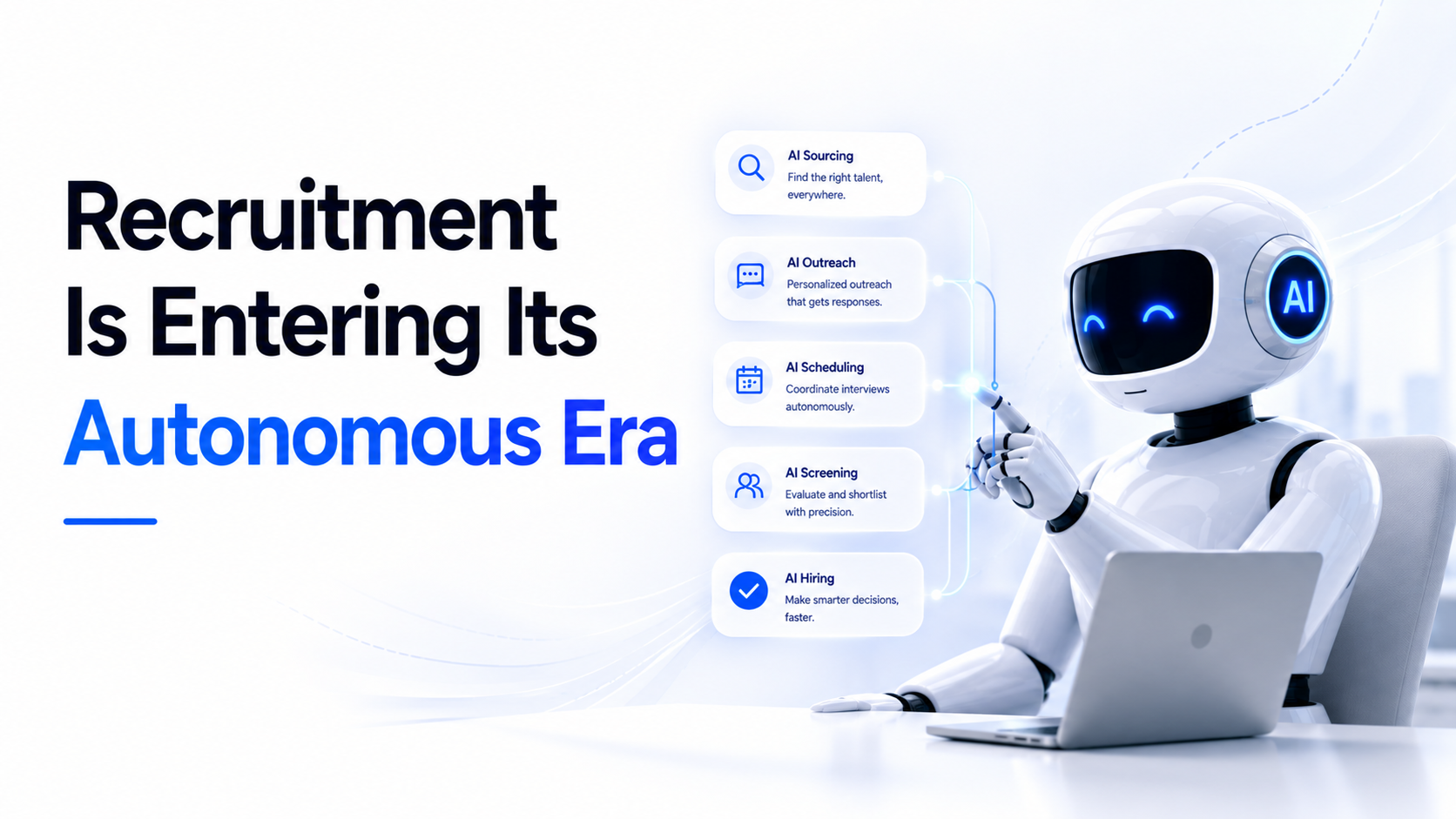
The concept of an autonomous recruiting system is not hypothetical. Platforms that operate across the full hiring workflow, making sourcing decisions, initiating and managing candidate engagement, conducting preliminary assessment, scheduling interviews, and managing offer processes with minimal human intervention, already exist and are being deployed by organizations that have recognized the limitations of the tool-by-tool approach. What distinguishes these systems from the previous generation of recruiting technology is their ability to make
contextual decisions. A traditional automated tool follows rules: if a resume contains these keywords, advance it to the next stage. An autonomous system evaluates context: this candidate's career trajectory suggests growth potential that compensates for a gap in formal qualifications, and their recent project experience aligns closely with the team's current technical challenges, so they should be prioritized despite not matching the keyword profile exactly. This contextual decision-making capability is what defines the autonomous era of recruiting, and an agentic AI recruiting platform embodies this approach by operating as an intelligent agent rather than a passive tool, continuously learning from outcomes and refining its decision-making to improve hiring results over time.
The Architecture of an Autonomous Recruiting System
An autonomous recruiting system is built on three architectural layers that work together to replace the fragmented, human-orchestrated model with a unified, self-directing workflow. The first layer is continuous talent intelligence. Rather than sourcing candidates in response to a specific open role, the system maintains a persistent, dynamically updated understanding of the talent market relevant to the organization. It monitors professional activity, publication patterns, career transitions, and skill development across the talent pool, building rich candidate profiles that evolve in real time. When a role opens, the system does not begin a sourcing sprint. It draws from a pipeline that has been continuously cultivated, meaning the time between role approval and initial candidate engagement is measured in hours rather than weeks. According to LinkedIn talent acquisition research, organizations with continuous talent intelligence capabilities report that their average sourcing-to-engagement time is sixty to seventy percent shorter than organizations that rely on reactive sourcing, because the intelligence layer has already identified and begun relationship-building with qualified candidates before the role becomes formally open. This shift from reactive to proactive sourcing is one of the most tangible and immediately valuable outcomes of the autonomous model.
The second architectural layer is autonomous workflow orchestration. In a traditional recruiting operation, the recruiter manually manages the sequence of activities that moves a candidate from initial contact to hired: sourcing, outreach, screening, interview scheduling, feedback collection, offer generation, and negotiation. Each step typically involves a different tool, a different data source, and a different set of manual actions. The autonomous system unifies these steps into a single intelligent workflow. The system identifies a candidate match, composes and sends a personalized outreach message based on the candidate's specific background and the role's specific requirements, evaluates the candidate's response through conversational AI, schedules interviews based on real-time availability data from all participants, collects and synthesizes interviewer feedback, and generates offer recommendations, all without requiring a recruiter to initiate or coordinate any of these steps. The recruiter monitors the workflow, reviews exceptions, and intervenes when the system escalates a decision that requires human judgment. This architectural approach is fundamentally different from deploying AI tools for individual tasks, a distinction that is central to understanding the difference between AI sourcing and AI recruiting, where the former optimizes a single activity and the
latter orchestrates the entire hiring workflow as an integrated, self-directed process.
The third layer is adaptive learning and optimization. An autonomous recruiting system does not follow a static process. It continuously analyzes outcomes, which candidate profiles produce the best hires, which outreach messages generate the highest response rates, which interview formats most accurately predict on-the-job performance, and which offer strategies most often lead to acceptance. It uses these analyses to refine its own behavior, improving its sourcing criteria, personalizing its outreach more effectively, adjusting its assessment weights, and optimizing its scheduling and offer strategies based on accumulated evidence. This learning capability means that the system becomes more effective with every hiring cycle, a compounding advantage that does not exist in the traditional model where process improvement depends on manual analysis and deliberate intervention. SHRM research on talent acquisition technology adoption has found that organizations using AI systems with closed-loop learning capabilities, where outcomes are fed back into the system to improve future decisions, outperform those using static AI tools by thirty to forty-five percent on key hiring metrics over an eighteen-month period, because the learning systems improve while the static systems remain at their initial performance level.
Where Traditional Recruiting Software Falls Short
The recruiting technology market has grown enormously over the past decade, with hundreds of vendors offering tools for sourcing, screening, assessment, interview scheduling, candidate communication, offer management, and analytics. The proliferation of options has created a paradox: organizations now have access to more recruiting technology than ever before, yet many report that their hiring outcomes have not improved proportionally. The reason is structural. Each tool in the traditional recruiting stack was designed to optimize a specific task within a human-orchestrated process. An applicant tracking system manages the hiring pipeline. A sourcing tool finds candidates. An assessment tool evaluates them. A scheduling tool coordinates interviews. An email tool manages outreach. Each tool produces data, but the data lives in separate systems with separate formats and separate logic. The recruiter must serve as the integration layer, manually transferring information between tools, reconciling conflicting data, and making decisions that none of the individual tools is equipped to make. This is the core problem that the phrase more tools, same hiring problems describes: adding more point solutions to a fragmented stack does not address the fragmentation itself, and may actually compound it by increasing the coordination burden on recruiters who must manage an ever-growing collection of disconnected systems.
The limitations of traditional recruiting software become most visible in the candidate experience. A candidate applying to a large organization today typically interacts with at least four to five separate systems during the hiring process: a career site or job board to find the role, an application portal to submit materials, an automated email system for scheduling, a video interview platform for assessments, and potentially a separate offer management portal. Each system has its own interface, its own login requirements, its own communication style, and
its own data practices. The candidate experience is not a unified journey. It is a series of disconnected interactions that collectively communicate that the organization has not invested in designing a coherent hiring process. Deloitte research on candidate experience and employer branding has consistently found that fragmented hiring technology is one of the strongest negative predictors of candidate satisfaction and offer acceptance, because candidates interpret technology fragmentation as organizational fragmentation, an indication that the company does not value their time or experience. In a talent market where candidates have multiple options and strong opinions about employer quality, this fragmentation directly reduces hiring competitiveness.
The traditional recruiting software model also fails to address the dynamic nature of the talent market. Most recruiting tools operate on static or periodically refreshed data. Candidate profiles in a sourcing database may be weeks or months old. Compensation benchmarking data may be updated quarterly. Market intelligence about talent availability and competitor hiring activity may be based on annual surveys. In a market where candidate availability, compensation expectations, and competitive dynamics can shift within days, static data produces stale decisions. Autonomous systems address this by maintaining real-time connections to data sources and continuously updating their models, but traditional recruiting software was not architected for this kind of continuous operation. EY analysis of technology-driven transformation in talent acquisition has highlighted data latency, the gap between when market conditions change and when recruiting systems incorporate that change, as one of the most significant and least addressed weaknesses of traditional recruiting technology stacks. Organizations relying on static data are consistently slower to respond to market shifts, leading to mispriced offers, irrelevant sourcing criteria, and candidate engagement strategies that do not reflect current talent market realities.
The Real-World Impact on Hiring Teams and Candidates
The transition to autonomous recruiting produces measurable changes in how recruiting teams operate and how candidates experience the hiring process. For recruiting teams, the most immediate impact is a dramatic reduction in time spent on operational coordination. Recruiters in organizations that have deployed autonomous systems report that the time they spend on scheduling, email management, data entry, and status tracking has decreased by fifty to seventy percent, freeing capacity for the activities that generate the highest value: building relationships with passive candidates, consulting with hiring managers on role design and assessment strategy, and developing the talent intelligence that informs workforce planning. This reallocation is not a reduction in the recruiter's importance. It is a fundamental shift in what the recruiter contributes. The recruiter moves from being the operational engine of the hiring process to being its strategic brain, a role that is more satisfying, more impactful, and more difficult to automate. McKinsey research on the future of work in professional services has found that roles which shift from operational execution to strategic advisory in response to automation consistently report higher job satisfaction, stronger performance reviews, and lower turnover, because the work becomes more intellectually engaging and more closely
aligned with the skills that motivated the individual to enter the profession.
For candidates, the autonomous recruiting model produces a hiring experience that is faster, more responsive, and more respectful of their time. In a traditional process, a candidate might wait five to seven business days for an initial response after submitting an application, another week for a screening decision, and two to three weeks for interview scheduling coordination. The total time from application to first interview can easily exceed a month, a duration that is unacceptable in a market where top candidates typically receive multiple offers within two weeks of beginning their search. Autonomous systems compress this timeline significantly by eliminating the manual coordination delays that create bottlenecks. Initial responses can be generated within hours. Screening decisions can be delivered within a day. Interview scheduling, which often requires a week of back-and-forth emails, can be completed in a single automated negotiation. According to LinkedIn data on candidate expectations, seventy-six percent of candidates say that the speed of the hiring process is a major factor in their perception of an employer, and candidates who experience hiring processes longer than three weeks are forty percent more likely to withdraw before receiving an offer. The autonomous model directly addresses this by removing the human scheduling and coordination delays that are the primary cause of process length.
The question that recruiting professionals ask most frequently about autonomous systems is whether AI will replace their jobs. The evidence from early adopters suggests a more nuanced answer. Autonomous systems are not replacing recruiters. They are replacing the operational tasks that recruiters perform, and in doing so, they are creating a new definition of what a recruiter does. The recruiters who thrive in the autonomous era are those who develop expertise in candidate relationship depth, hiring manager advisory, workforce planning, and talent market intelligence. The recruiters who struggle are those whose primary value is operational efficiency, the ability to process high volumes of applications, manage complex scheduling logistics, and maintain detailed pipeline records in an applicant tracking system. These are precisely the tasks that autonomous systems perform better than humans. The discussion about whether recruiters should worry about AI replacing their jobs ultimately resolves into a question about adaptability: recruiters who invest in developing strategic advisory capabilities will find that autonomous systems make them more effective and more valuable, while those who resist the transition and remain focused on operational execution will find their roles progressively narrowed as AI capabilities expand into the tasks they currently perform.
How to Transition Your Recruiting Function to Autonomous
The transition from traditional recruiting software to an autonomous recruiting model is not a single technology purchase. It is a multi-phase strategic initiative that requires changes in technology, process, and organizational capability. The first phase is a candid assessment of the current state. Recruiting leaders should map their existing technology stack, identify the integration gaps and data silos that create manual coordination burden, and quantify the time their team spends on operational tasks versus strategic activities. This assessment provides
the baseline against which the impact of the transition will be measured and identifies the highest-priority areas for autonomous capability deployment. Gartner recommends beginning with a comprehensive audit of existing recruiting technology, process workflows, and data architecture before evaluating any autonomous recruiting solution, because the audit reveals the specific integration points and data dependencies that will determine whether a new system can operate effectively within the existing technology ecosystem or whether foundational infrastructure changes are needed first.
The second phase is process redesign. Autonomous recruiting requires fundamentally different processes than the human-orchestrated model. Workflows that were designed for sequential human execution, where each step waits for a person to complete the previous step, must be reconfigured for parallel AI execution, where multiple activities happen simultaneously and the system manages dependencies dynamically. Decision points that were designed for human judgment, such as whether a candidate meets the minimum qualifications for a role, must be re-evaluated to determine which decisions can be delegated to the autonomous system and which genuinely require human involvement. Communication patterns that were designed for manual management, such as personalized follow-up emails sent by a recruiter, must be reimagined for automated delivery with contextual personalization. This redesign is not about making the current process faster. It is about rethinking what the process should accomplish and designing it for an autonomous system rather than for a human coordinator. Organizations that skip this step and simply layer autonomous capabilities on top of existing processes achieve disappointing results, because the processes create friction that prevents the autonomous system from operating effectively.
The third phase is organizational change management, which is arguably the most important and most frequently underestimated element of the transition. Recruiting teams must understand why the transition is happening, what it means for their daily work, and what new capabilities they need to develop. Hiring managers must learn to interact with an AI-augmented recruiting function that operates differently from the service model they are accustomed to. Candidates must experience the new process as an improvement, not a depersonalization. Each of these stakeholder groups requires deliberate communication, training, and support. Deloitte research on human capital transformation consistently identifies change management as the strongest predictor of technology deployment success, noting that organizations that invest at least as much in stakeholder alignment and capability development as they do in technology selection and implementation are three times more likely to achieve their target outcomes. The autonomous era of recruiting is not a future possibility. It is the current trajectory of the industry, driven by structural market forces that are not subject to reversal. The organizations that begin the transition now, methodically and deliberately, will build the data assets, process architectures, and team capabilities that produce compounding advantages over time. Those that wait will face not only the challenge of catching up, but the additional challenge of competing against organizations whose autonomous systems have been learning and improving for years.