When David Park published his first recruiting technology landscape map in 2019, the document fit on a single slide and covered roughly forty vendors across six categories. Park, who spent twelve years as a talent technology analyst at a major research firm before launching his own advisory practice, updated that map annually. By 2023, the map had expanded to four slides and over two hundred vendors across eleven categories. When he began drafting the 2025 edition, he abandoned the slide format entirely and built an interactive database because the landscape had become too complex and too dynamic to capture in a static image. Park's experience is not unique. Every talent leader, technology advisor, and procurement professional in the recruiting space is grappling with the same challenge: the technology options available for recruiting have exploded in both number and capability, and the pace of change is accelerating. Making sense of this landscape is no longer optional. It is a core competency for anyone responsible for talent acquisition strategy.
Why a Map Matters Now
The recruiting technology market has undergone more change in the past three years than in the previous decade, and the rate of change is still increasing. New categories have emerged, established categories have blurred, and the underlying technology foundation has shifted from software to artificial intelligence. For talent acquisition leaders, this creates a paradox. On one hand, there are more tools available than ever, each promising to solve a specific recruiting challenge. On the other hand, the sheer volume and complexity of options makes it harder than ever to build a coherent technology strategy. Without a clear map of the landscape, organizations end up with fragmented tool stacks that create data silos, integration headaches, and inconsistent candidate experiences.
The need for a structured map is particularly urgent because the consequences of poor technology decisions in recruiting have become more severe. McKinsey research on enterprise technology strategy shows that organizations with fragmented HR technology stacks spend significantly more on integration, maintenance, and training than those with consolidated platforms, and they achieve worse hiring outcomes because their tools cannot share data or coordinate actions. In recruiting specifically, the cost of a fragmented stack is measured not just in software licenses but in missed hires, slow response times, and candidate experiences that drive qualified people to competitors. The technology decisions that talent leaders make in the next two years will determine their organization's recruiting effectiveness for the rest of the decade.
A useful map must do more than list vendors and categories. It must identify which capabilities are mature enough to deliver reliable value, which are still experimental and carry implementation risk, and which have been commoditized to the point where they no longer provide competitive differentiation. It must also account for the structural shifts that are reshaping the market, such as the move from standalone tools to integrated platforms and from software features to AI capabilities. The challenge of AI tools for niche technical roles technical roles is a good example of why this matters. Organizations hiring for specialized positions need to understand which technology categories can actually support their specific requirements, not just which vendors have the most marketing visibility. A map that does not make these distinctions is a vendor directory, not a strategic framework.
The Five Categories of Recruiting Technology
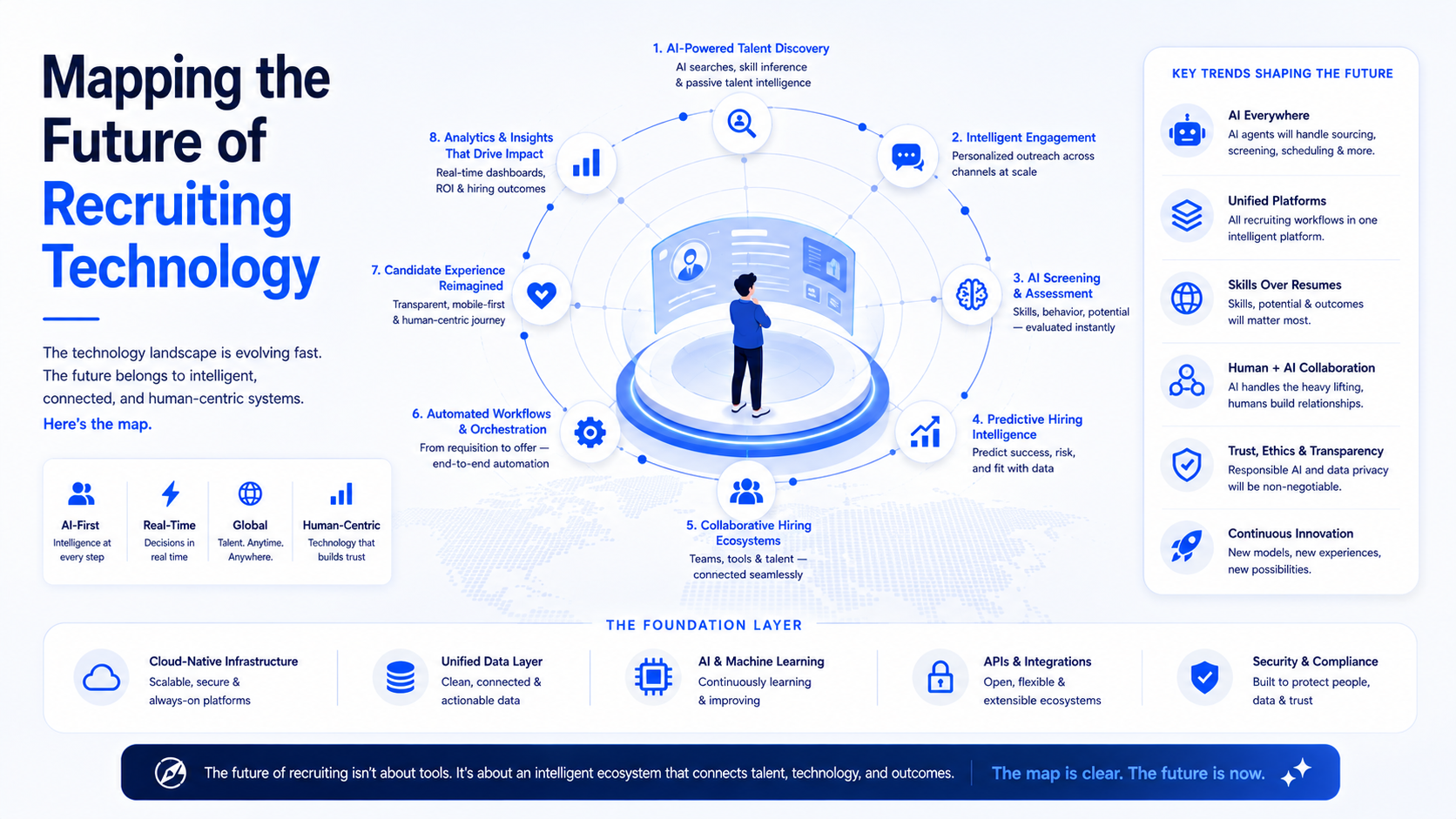
The recruiting technology landscape can be organized into five broad capability categories, each representing a distinct stage of the hiring process and each with its own technology dynamics. The first category is candidate identification and sourcing, which encompasses the tools used to find and surface potential candidates. This category has been the most thoroughly transformed by AI, with semantic search, predictive matching, and automated pipeline building replacing manual Boolean searches and resume database queries. LinkedIn data shows that AI-powered sourcing tools now account for the majority of candidate discovery activity in enterprise recruiting, a dramatic shift from just five years ago when manual search dominated.
The second category is candidate engagement and communication, which covers the tools used to initiate and maintain contact with potential hires. This category is in the midst of its own AI transformation, with personalized outreach generation, response prediction, and engagement scoring becoming standard capabilities. The third category is assessment and evaluation, which includes skills testing, behavioral assessments, interview intelligence, and predictive hiring models. This category is evolving rapidly as AI enables more sophisticated and less biased evaluation methods. The distinction between AI sourcing vs AI recruiting is relevant here because the boundary between the first and second categories is blurring: AI platforms that can both identify candidates and engage them with personalized messaging are
making the traditional separation between sourcing and recruiting increasingly artificial.
The fourth category is hiring workflow and process management, which encompasses the orchestration of interviews, feedback collection, offer management, and hiring committee coordination. This category has historically been dominated by applicant tracking systems, but AI is enabling more intelligent workflow automation that adapts to the specific needs of each role and each hiring team. The fifth category is workforce intelligence and analytics, which includes labor market data, compensation benchmarking, workforce planning models, and hiring outcome analysis. This category is becoming increasingly important as organizations seek to move beyond filling individual roles to building strategic talent capabilities. Together, these five categories form the foundation of any recruiting technology strategy, and understanding how they interact is essential for building an effective technology stack.
Capabilities That Are Maturing
Within the five categories, several specific capabilities have reached a level of maturity that makes them reliable choices for enterprise deployment. AI-powered candidate matching has moved from experimental to essential. The early versions of AI matching were essentially keyword search with extra steps, but current systems use semantic understanding, context analysis, and multi-signal scoring to identify candidates whose capabilities align with role requirements even when their job titles or skill labels do not match. Gartner maturity assessments now classify AI candidate matching as entering the early majority phase of adoption, meaning the technology is proven enough for mainstream enterprise use but still improving rapidly enough to create meaningful differentiation between vendors.
Automated candidate engagement is another maturing capability. The first generation of automated outreach was template-based and easily identified by candidates as impersonal. Current AI-driven engagement tools generate contextually relevant messages that reference specific aspects of a candidate's background, career trajectory, and likely interests. These tools also optimize send timing, channel selection, and follow-up cadence based on engagement data. While response rates to all recruiter outreach have declined due to inbox volume, AI-personalized messages consistently outperform generic templates by a significant margin, making this capability a practical necessity rather than a nice-to-have.
Interview intelligence, the use of AI to capture, analyze, and score interview conversations, has also reached practical maturity. Deloitte evaluation of interview intelligence platforms finds that they provide consistent value in reducing interviewer bias, improving hiring consistency across teams, and creating structured data that can be analyzed for continuous process improvement. These systems do not replace human judgment in hiring decisions but they provide a more reliable and comprehensive information base for those decisions. The key for talent leaders is understanding that maturity does not mean commoditization. These capabilities are reliable enough to deploy, but the quality of implementation still varies significantly between vendors, and the organizations that select and implement them thoughtfully will achieve better outcomes than those that treat them as undifferentiated utilities.
Capabilities That Are Still Emerging
Several capabilities are generating significant excitement but have not yet reached the maturity threshold required for confident enterprise deployment. The research on why referrals outperform cold outreach illustrates an important pattern: even well-established recruiting practices like employee referrals are being reimagined through AI, with platforms now using network analysis to identify potential referral candidates, predict which employees are most likely to make successful referrals, and automate the referral follow-up process. These applications are promising but still early in their adoption curve, and organizations implementing them should expect to iterate on their approach as the technology evolves.
Predictive hiring analytics, the use of AI to predict not just which candidates will perform well but which will stay, grow, and become cultural contributors, represents another emerging capability. EY analysis of predictive hiring models notes that the most sophisticated versions incorporate data from multiple stages of the hiring process, from initial engagement through final interview, to build multi-dimensional candidate profiles that predict long-term outcomes. However, the accuracy of these predictions depends heavily on the quality and quantity of historical hiring data available, which means they work best for large organizations with established hiring programs and are less reliable for smaller companies or new role types where historical data is limited.
Autonomous recruiting agents, AI systems that can manage significant portions of the end-to-end hiring process with minimal human intervention, are the most closely watched emerging capability. Gartner emerging technology reports place autonomous recruiting agents on the cusp of the innovation trigger phase, meaning significant development is underway but enterprise-scale deployments remain rare. These agents represent the logical endpoint of the trends discussed throughout this article: as each individual capability matures and the integration between them improves, the platform can manage more of the process autonomously. The question is not whether this will happen but how quickly, and talent leaders who understand the building blocks described in this map will be better positioned to adopt autonomous agents when they reach practical maturity.
The Consolidation Paradox
One of the most striking features of the current recruiting technology landscape is the simultaneous fragmentation and consolidation occurring in the market. On one hand, new AI-native startups continue to emerge at a rapid pace, each addressing a specific capability gap or use case. LinkedIn market analysis shows that the number of new HRTech startups founded annually has increased over the past three years, driven by the availability of AI development tools and the perceived opportunity in applying AI to recruiting workflows. On the other hand, the major platform vendors are aggressively acquiring these startups and building broader capabilities, leading to increasing market concentration at the top.
This paradox creates a strategic challenge for buyers. The phenomenon of more tools same hiring problems accumulating in enterprise recruiting departments is the inevitable result of a fragmented market. Each new tool addresses a real need, but the cumulative effect is a technology environment that is difficult to manage, expensive to maintain, and incapable of delivering the integrated experience that both recruiters and candidates expect. Yet the alternative, consolidating onto a single platform, risks locking the organization into a vendor's development roadmap and forgoing the innovation that specialized startups provide. The optimal approach for most organizations is not pure consolidation or pure best-of-breed but a deliberate hub-and-spoke model where a primary platform handles core workflows and a carefully curated set of specialized tools extends its capabilities through integrations.
The consolidation dynamic is also being driven by the data advantages that larger platforms enjoy. McKinsey analysis of AI platform economics shows that platforms with more users generate more data, which improves their AI models, which attracts more users, creating a flywheel effect that is difficult for smaller competitors to overcome. This data network effect means that the recruiting technology market will likely continue to consolidate around a smaller number of AI-native platforms, even as new point solutions continue to emerge. Talent leaders should expect the market to look significantly different in three years than it does today, and their technology strategy should account for this expected consolidation rather than assuming the current vendor landscape will remain stable.
Building a Technology Roadmap for 2026 and Beyond
For talent acquisition leaders, the practical question is how to translate this landscape map into an actionable technology strategy. The first step is to audit the current technology stack against the five-category framework described in this article, identifying gaps, redundancies, and integration failures. Deloitte technology assessment methodologies recommend that organizations evaluate their current tools not just on individual capability but on how well they work together as a system. A sourcing tool that produces excellent candidate lists but cannot pass those candidates into the engagement platform without manual data transfer is creating work rather than eliminating it.
The second step is to prioritize investments based on capability maturity and organizational impact. SHRM strategic planning guidance for talent acquisition suggests a three-horizon approach: deploy mature capabilities like AI matching and automated engagement immediately to capture available value, pilot emerging capabilities like predictive analytics in controlled environments to build experience and assess fit, and monitor frontier capabilities like autonomous agents through vendor relationships and industry networks to prepare for future adoption. This phased approach allows organizations to capture the benefits of current technology while building the readiness to adopt new capabilities as they mature, without taking excessive risk on unproven tools.
The third and most important step is to align technology investment with a clear understanding of where recruiter value actually lives. Technology should handle the tasks that are
high-volume, repetitive, and data-intensive, freeing recruiters to focus on the activities that require human judgment, relationship building, and strategic thinking. Organizations that invest in technology without simultaneously redefining recruiter roles and expectations will find that they have automated tasks without improving outcomes. The future of recruiting technology is not about replacing recruiters with AI. It is about building a technology environment that amplifies recruiter effectiveness by handling the mechanical aspects of hiring and providing the intelligence needed to make better decisions. The map provided in this article is a starting point for that journey, but the destination is an organization where technology and human expertise work together to attract, evaluate, and hire exceptional talent.