How Recruiters Can Use AI Without Losing the Human Touch
Two numbers from 2026 sit uncomfortably close to each other and explain most of the tension in this topic. Roughly 87% of companies now use AI somewhere in their hiring process, per data compiled by DisherTalent, with usage having doubled from 26% to 53% in a single year according to the same source. And yet a Gartner figure cited by CareerPuck finds that only 26% of applicants say they trust AI to evaluate them fairly. Adoption and trust are moving in almost opposite directions, and that gap isn't a reason to back away from AI in recruiting — it's close to a map of exactly where the human touch still needs to sit in the process.
This guide covers where AI in recruiting genuinely helps without candidates or recruiters noticing any loss of humanity, where it backfires specifically because it removes something a person needed to be present for, and a practical way to draw that line for your own team rather than guessing at it role by role.
The Fear Is Understandable, and Mostly Wrong in Practice
The instinct that AI removes the human element from hiring is a reasonable one to start from, and most current guidance in this category treats it as a real question rather than dismissing it outright. Borderlessmind's guide to AI-powered recruitment addresses it directly: in reality, AI enhances the human element rather than removing it, specifically by handling repetitive administrative tasks so recruiters can spend more time on the parts of the job that actually require a person — building stronger relationships with candidates, having deeper and more insight-driven conversations, and assessing cultural fit and long-term potential more carefully than a rushed process allows.
Phenom's 2026 recruiting guide frames the underlying capacity problem this solves concretely: recruiters spend up to 30 hours a week on sourcing alone in a fully manual process, and a guide from Perelson & Associates reports that AI recruiting saves organizations an average of 20% of the work week — over eight hours, or roughly a full workday — freed up specifically from data-heavy administrative tasks. The consistent argument across nearly every current guide in this category isn't that AI makes recruiting less human — it's that manual, repetitive work was already the thing crowding out the human parts of the job, and AI's real contribution is giving that time back rather than replacing the person doing it.
Where AI Genuinely Helps Without Costing the Human Touch
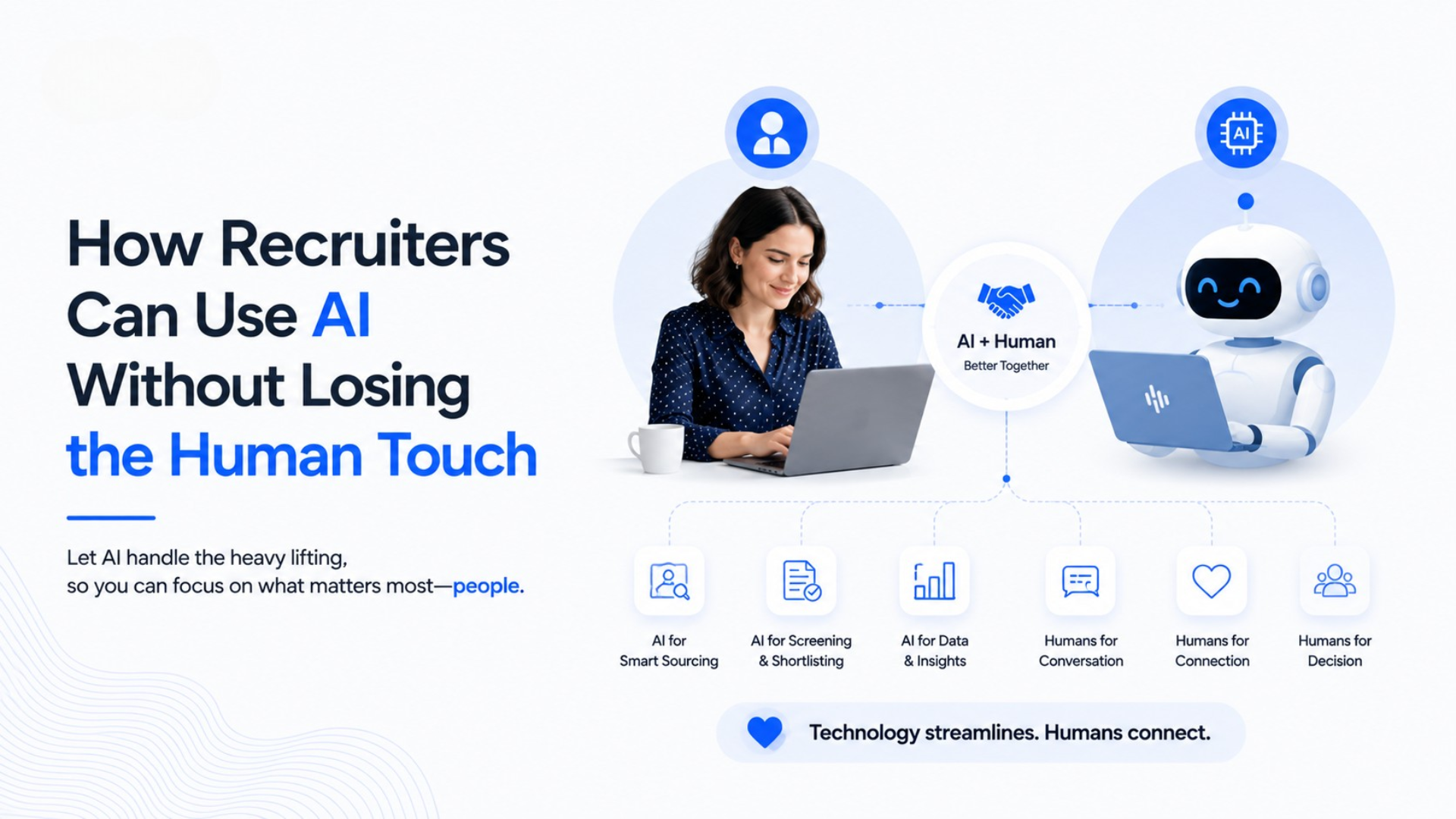
A few applications of AI in recruiting show up consistently across current guidance as clear wins with little downside for candidate experience, precisely because they replace tasks that were never particularly human to begin with. Resume screening and initial shortlisting is the most cited example — Borderlessmind's guide describes this shift as processing resumes in minutes rather than days, filtering noise and ranking candidates by role fit, which speeds up a stage that a candidate never directly experiences as personal in the first place. Interview scheduling is a similarly uncontroversial win: coordinating calendars across a candidate and multiple interviewers is logistics, not relationship-building, and automating it removes friction without removing anything a candidate would have valued keeping.
Generative AI applied to drafting — job descriptions, initial outreach messages, interview question banks, feedback summaries — is a third area where current guidance is broadly comfortable with automation, provided a person reviews and personalizes the output rather than sending it unedited. Recruiterflow's 2026 guide to AI recruiting frames the useful distinction here precisely: generative AI writes when prompted, predictive AI ranks and matches candidates against a role, and AI agents combine reasoning with action to run multi-step work like building a shortlist or updating a CRM after a call — all three are legitimately useful, and none of them is the part of recruiting candidates actually value a human for.
Where the Human Touch Has to Stay
The same body of guidance is just as consistent about where automation should stop, and the pattern across sources points to the same handful of moments. Final hiring decisions are the clearest line — a guide from Humaanized states it plainly: AI should recommend, not decide, and final hiring calls must remain human-led, especially for high-impact roles, a position echoed by GoPerfect's 2026 recruitment guide, which frames the same principle as AI surfacing candidates while humans make the final selection, applying judgment on culture fit and soft skills that algorithms can't fully assess.
Rejections are a second moment worth flagging specifically, because a badly handled one does disproportionate damage to how a candidate remembers the entire process, and DisherTalent's 2026 analysis names thoughtful rejections directly as one of the moments the highest-performing teams keep human-led even as they automate everything around it. And GoPerfect's guide cites a specific data point worth taking seriously when deciding how far to push automation: 68% of candidates prefer human interaction over AI or chatbots, a preference that guide notes is especially pronounced for senior roles, where the relationship and trust-building component of the hiring process carries more weight relative to pure throughput.
Why the Trust Gap Exists — And What Closes It
The 26% trust figure cited earlier isn't really a verdict on AI's accuracy — CareerPuck's guide traces it back to something more specific and more fixable: when AI screening isn't explained clearly, it creates hesitancy and unease, and that uncertainty, especially early in a hiring process, quickly turns into distrust. The same guide points to a specific category of past missteps that damaged trust further — early screening tools that analyzed facial expressions or body language crossed a line candidates experienced as intrusive and overly monitored, closer to surveillance than to legitimate evaluation, and that specific failure mode is part of why the baseline trust number sits as low as it does today.
The fix multiple guides converge on is transparency, treated as a design requirement rather than a nice-to-have. Humaanized's guide states it directly: tell candidates when AI is used and why, since transparency builds trust even when automation is genuinely involved in the process. CareerPuck's guide extends that into practical language: explain how an AI interview works, what's actually being evaluated, and how responses get reviewed by a person afterward — candidates who understand the process, that guide argues, come to appreciate the efficiency rather than resent the automation, whereas candidates left to guess at how they're being evaluated default to suspicion.
The Regulatory Backdrop Makes This More Than a Trust Question
Transparency around AI hiring tools isn't purely a candidate-experience choice anymore — it increasingly carries legal weight. Recruiterflow's 2026 guide notes that AI hiring is now actively regulated in several major jurisdictions: New York City requires bias audits on automated employment decision tools, the EU AI Act treats hiring-related AI as high-risk, and US federal disparate-impact law applies to algorithmic hiring decisions regardless of whether a company intended any discriminatory effect. DisherTalent's analysis adds that these regulatory frameworks are specifically pushing companies to document how automated decisions get made and to be able to answer, honestly and specifically, when a candidate asks how they were evaluated and why — a requirement that pushes transparency from a soft trust-building tactic toward a genuine compliance obligation.
Used with human oversight, candidate notice, and clear documentation, Recruiterflow's guide argues AI can actually produce fairer outcomes than unaided human judgment, which is worth holding alongside the trust gap discussed above: the goal isn't avoiding AI to sidestep bias risk, since unaided human screening carries its own well-documented bias problems, but building the audit trail and disclosure practices that let a team demonstrate its process is fair rather than simply asserting that it is.
A Practical Framework for Drawing the Line Yourself
Rather than treating "how much AI is too much" as an abstract question, Recruiterflow's guide lays out a concrete way to answer it for a specific team: start small and specific by auditing where recruiters actually lose the most time, automate one low-risk administrative task first — call notes or routine follow-ups are a reasonable starting point — choose a tool that integrates with the existing system of record rather than creating a parallel one, and keep a human explicitly approving decisions rather than letting automation run unsupervised. Measure the hours actually returned before expanding further, rather than automating broadly on the assumption that it will work.
Perelson & Associates' 2026 trends guide frames the same principle from the allocation side: apply AI specifically where it has the most value in scaling without becoming impersonal — resume screening, candidate matching, and initial outreach are named directly as high-volume, low-relationship-value tasks where AI drives real efficiency, freeing recruiters to spend their time on the high-impact talent decisions that are actually their comparative advantage. The organizing question worth asking about any specific task under consideration for automation is simple: does a candidate experience this step as personal, or as pure logistics? Scheduling, initial resume triage, and routine status updates sit clearly on the logistics side. A rejection after a final interview, a negotiation conversation, or an assessment of whether someone will thrive on a specific team sits clearly on the personal side, and current guidance is consistent that the second category should stay human-led regardless of how capable the underlying AI becomes.
What This Looks Like for the Recruiter's Actual Role
The consistent theme across every current guide in this category is that AI done well changes what a recruiter's week looks like rather than shrinking the role. ATS OnDemand's 2026 trends analysis frames this as a genuine partnership model: AI provides speed and surfaces the data, while humans provide trust and interpret what that data actually means — a division of labor rather than a competition between the two. DisherTalent's guide describes the resulting shift in the recruiter's own value proposition directly: rather than functioning as a process coordinator moving candidates through a pipeline, the recruiter becomes an advisor who understands each candidate's strengths and gaps, helps hiring managers compare people clearly, and brings live insight into what the talent market actually looks like right now — work that requires judgment and context a system doesn't have, applied to decisions a system shouldn't be making alone in the first place.
AI Is Also Changing What "Human Judgment" Gets Applied To
One shift worth naming directly is that AI isn't just changing how recruiters evaluate candidates — it's changing what they're evaluating in the first place. ATS OnDemand's 2026 trends guide points to skills-based hiring as one of the clearest examples: degrees, job titles, and brand-name employers are losing relevance as signals, and AI is accelerating that shift by making it practical to identify relevant skills faster across a much larger and more varied applicant pool than a person could manually assess. Perelson & Associates' trends analysis backs this with a specific figure: only 37% of employers now view credentials or prior learning history as a reliable talent indicator, which that guide calls the first year skills have become the dominant measure over credentials in mainstream hiring practice.
That shift changes rather than removes the role of human judgment. AI can surface that a candidate has demonstrated a given skill through work samples, project history, or informal learning paths; a human still has to validate whether that skill translates to genuine fit, adaptability, and potential in a specific role and team context — exactly the kind of contextual judgment ATS OnDemand's guide points to when it frames AI as surfacing the data while humans interpret the truth behind it.
The Overlooked Organizational Risk of Automating Too Aggressively
A less commonly discussed risk worth flagging directly: automating away entry-level recruiting roles too aggressively creates a problem beyond any individual hiring process. DisherTalent's 2026 analysis raises this concern specifically — replacing entry-level HR and talent-acquisition roles with AI can look like a straightforward budget win in isolation, but it quietly removes the internal pathway through which today's junior recruiters become tomorrow's senior talent leaders. A team that automates its way out of training a new generation of recruiters is solving this year's efficiency problem while creating next decade's leadership gap, and that tradeoff rarely shows up in the same budget conversation that approved the automation in the first place.
The same guide notes a related and more immediate challenge: as automation raises the bar on what recruiters are expected to evaluate — informal skills, self-taught expertise, nontraditional career paths — about half of hiring decision-makers report candidates lacking clearly relevant experience, and roughly a quarter say they struggle specifically to assess informal or self-taught skills fairly. That's a genuine skills gap on the hiring side, not just the candidate side, and it argues for treating AI adoption as paired with active investment in recruiter judgment and training, rather than as a substitute for either.
Where a Tool Like Huntlo Fits
The line this guide has been drawing throughout — automate the logistics, keep the relationship and judgment work human — is the specific design principle behind Huntlo. Rather than treating AI as a way to compress the entire hiring process into fewer human touchpoints, Huntlo's agentic AI is built to take over exactly the high-volume, low-relationship-value work this guide keeps pointing to: continuously sourcing and re-scoring candidates across 50+ public platforms against a described ideal profile, then handling personalized outreach and follow-up autonomously across email, WhatsApp, and AI voice — the sourcing and initial-engagement layer candidates rarely experience as personal in the first place, freeing a recruiter's time for the interviews, the negotiations, and the judgment calls the guidance above consistently says should stay human.
That's also why transparency matters in how a tool like this gets deployed, not just in what it automates: candidates responding to Huntlo-driven outreach are engaging with a described, real opportunity and a real recruiting team behind it, with the AI handling reach and timing rather than replacing the actual conversation once a candidate responds. Huntlo's free trial is a practical way to see where that line falls for your own team's workflow before committing to a broader rollout.
Frequently Asked Questions
Will AI eventually replace recruiters entirely? No, according to every current guide covering this question. The consistent view across the category is that AI automates the repetitive, data-heavy administrative work, while judgment, empathy, relationship-building, and final hiring decisions remain human tasks that current AI systems aren't built to take over, and that recruiters who use AI well become more valuable rather than less.
Why don't candidates trust AI in hiring, even as adoption grows? Primarily because of unclear communication about how AI is being used, not because AI screening is inherently less accurate. When candidates understand what's being evaluated and how, and know a person reviews the output before any decision is made, the specific unease driving the trust gap tends to ease considerably.
Which parts of hiring should never be automated end-to-end? Final hiring decisions and rejections are the two most consistently cited. Both current best-practice guidance and, in several jurisdictions, current regulation require a human to be meaningfully involved in these specific moments rather than letting an automated system decide or communicate them alone.
Does using AI in recruiting create legal risk? It can, if deployed without oversight, documentation, or candidate disclosure — New York City's bias audit requirement and the EU AI Act's high-risk classification for hiring AI are both active regulatory frameworks in 2026. Used with human oversight, bias testing, and clear disclosure, AI can be deployed compliantly and, per some current guidance, more fairly than unaided human judgment.
How should a team decide which recruiting tasks to automate first? Start with tasks a candidate experiences as pure logistics rather than as personal — scheduling, resume triage, and routine status updates are the safest and most commonly cited starting points. Automate one such task, keep a human explicitly reviewing the output, measure the actual time saved, and expand deliberately rather than automating broadly from the outset.
The Bottom Line
The gap between how many companies use AI in hiring and how many candidates trust it to evaluate them fairly isn't an argument against using AI — it's a fairly precise map of where the human touch actually needs to stay. Sourcing, screening, scheduling, and routine outreach are logistics candidates rarely experience as personal, and automating them well tends to improve the candidate experience by removing delay rather than damaging it. Final decisions, rejections, and any moment requiring real judgment about fit or motivation are where a person needs to stay directly involved, both because current guidance is consistent that AI isn't built to make those calls alone and, increasingly, because regulation in several jurisdictions requires it. The recruiters and teams getting the most out of AI in 2026 aren't the ones automating the most — they're the ones who've drawn that line deliberately and use AI to buy back time for exactly the human work it was never meant to replace.
If the goal is reclaiming time on the logistics side without touching the relationship side, Huntlo's agentic AI recruiting platform is built specifically around that division — worth testing directly against a real hiring need with the free trial to see how much sourcing and outreach work it can absorb before your recruiters ever need to weigh in.