Introduction
Recruiting has always been a time-intensive process.
Recruiters spend hours searching for candidates, reviewing profiles, writing outreach messages, following up, updating systems, coordinating interviews, and managing pipelines.
While AI sourcing tools promise faster hiring, many teams still ask:
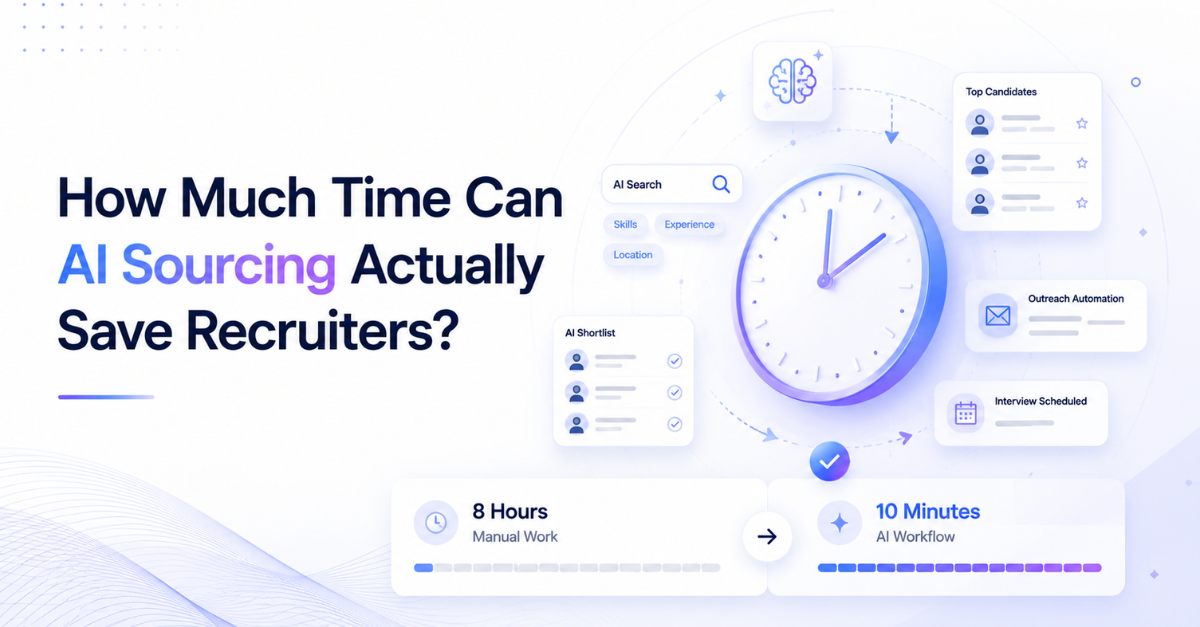
How much time can AI actually save recruiters?
The answer depends on how AI is used.
AI does not create real productivity by simply finding more profiles.
The biggest gains happen when AI reduces repetitive recruiting operations and allows recruiters to focus on higher-value work:
Building candidate relationships
Evaluating talent
Closing candidates
Partnering with hiring teams
Modern AI recruiting systems are moving beyond search automation.
They are becoming Agentic AI Recruiting Infrastructure — systems that help recruiters discover, engage, qualify, and coordinate hiring workflows.
The Hidden Time Cost of Manual Recruiting
Traditional recruiting involves many manual tasks that silently consume recruiter capacity.
A recruiter may spend hours every week on:
Searching databases
Reviewing resumes
Finding candidate information
Writing personalized messages
Sending follow-ups
Updating candidate records
Scheduling interviews
Coordinating communication
Individually, these tasks seem manageable.
Together, they create operational bottlenecks.
Searching for Candidates
Candidate discovery is one of the biggest time-consuming activities.
Recruiters often need to:
Build search queries
Filter profiles
Compare experience
Validate skills
Shortlist candidates
For specialized roles, this process can take hours.
AI sourcing tools reduce this workload by analyzing requirements and identifying relevant candidates faster.
Repetitive Recruiter Tasks
The biggest productivity loss is often not sourcing.
It is everything around sourcing.
Examples:
Manual Task
Recruiter Impact
Writing outreach messages
Reduces time for relationship building
Sending follow-ups
Creates repetitive workload
Candidate screening
Slows pipeline movement
Scheduling interviews
Creates coordination delays
Updating systems
Takes time away from hiring
AI automation helps remove these repetitive actions.
Where AI Sourcing Saves Recruiter Time
AI sourcing creates time savings across multiple stages of recruiting.
1. Candidate Discovery
AI can analyze job requirements and identify suitable candidates based on:
Skills
Experience
Career history
Role fit
Availability signals
Instead of manually searching through hundreds of profiles, recruiters can start with a prioritized candidate pipeline.
The result:
Less searching.
More evaluating.
2. Candidate Research
Before contacting candidates, recruiters often spend time researching:
Current role
Previous companies
Relevant experience
Career movement
Possible motivations
AI can summarize candidate information and surface important context faster.
This helps recruiters prepare better conversations without spending excessive time gathering information.
3. Outreach Preparation
Personalized outreach is important.
But creating every message manually does not scale.
AI recruiter tools can help:
Draft personalized messages
Adapt tone
Suggest relevant talking points
Create follow-up sequences
The recruiter remains in control while AI reduces preparation time.
The Tasks AI Can Automate
AI recruiting automation is most valuable when it handles repetitive execution.
Candidate Sourcing
AI can help recruiters:
Find matching candidates
Rank profiles
Identify relevant talent pools
Candidate Engagement
Candidate engagement automation helps teams:
Create outreach sequences
Manage follow-ups
Track responses
This reduces the chance of losing candidates because of delayed communication.
Follow-Up Management
Recruiters often lose time tracking:
Who replied
Who needs follow-up
Which candidates need attention
AI workflows can automate reminders and communication steps.
Interview Coordination
Scheduling is another major time drain.
AI can assist with:
Availability coordination
Interview reminders
Candidate updates
This helps recruiters spend less time managing calendars.
Where Recruiters Still Add Value
AI does not replace recruiter judgment.
Recruiters remain essential for:
Relationship Building
Candidates do not only evaluate opportunities.
They evaluate conversations.
Recruiters provide:
Trust
Context
Career guidance
Human connection
Hiring Decisions
AI can support decisions.
It cannot replace:
Understanding team dynamics
Assessing motivation
Managing stakeholder expectations
The best recruiting teams combine AI efficiency with human expertise.
How to Measure AI Time Savings
To understand AI recruiting productivity gains, teams need measurable benchmarks.
Before AI
Track:
Hours spent sourcing
Number of roles handled
Candidate response rate
Time-to-submit
Recruiter workload
After AI
Compare:
Hours saved
More candidates engaged
Faster pipeline movement
Increased recruiter capacity
A simple measurement framework:
Metric
Before AI
After AI
Sourcing hours
Manual effort
Reduced workload
Candidate outreach
Limited capacity
Higher volume
Follow-ups
Manual tracking
Automated
Recruiter focus
Admin-heavy
Relationship-focused
Why Sourcing Alone Is Not Enough
Many AI sourcing tools focus only on finding candidates.
But finding candidates is only the first step.
A complete recruiting workflow includes:
Discover → Engage → Qualify → Coordinate → Hire
If recruiters still manually manage everything after sourcing, productivity gains remain limited.
The future of AI recruiting is not just AI search.
It is intelligent workflow execution.
The Future: AI-Powered Recruiting Teams
The next generation of recruiting technology will move from tools to systems.
Instead of asking:
"Can AI find candidates?"
Teams will ask:
"Can AI improve our entire recruiting operation?"
Agentic AI recruiting enables AI systems to:
Identify talent
Prioritize candidates
Support communication
Manage workflows
Reduce repetitive execution
Recruiters become more strategic because AI handles operational complexity.
Building an AI-Powered Recruiting Team
Successful AI adoption requires balance.
Start With Repetitive Work
Automate tasks that consume recruiter time:
Searching
Follow-ups
Scheduling
Administrative updates
Keep Humans In The Loop
AI should support recruiters, not remove ownership.
Human recruiters should control:
Candidate conversations
Hiring decisions
Relationship management
Scale What Works
The goal is not fewer recruiters.
The goal is:
More output per recruiter.
Conclusion
AI sourcing tools can save recruiters significant time, but the biggest impact comes from using AI beyond candidate discovery.
Real productivity gains happen when AI removes repetitive recruiting operations.
The future is not AI replacing recruiters.
It is Agentic AI Recruiting Infrastructure helping recruiters spend less time operating and more time hiring.
FAQs
1. How much time does AI sourcing save recruiters?
AI sourcing can reduce time spent on manual candidate search, research, outreach preparation, and repetitive workflows. The exact savings depend on hiring volume and workflow maturity.
2. Can AI replace sourcing recruiters?
No. AI reduces repetitive sourcing work, but recruiters remain important for relationship building, candidate evaluation, and hiring decisions.
3. What recruiting tasks can AI automate?
AI can automate candidate discovery, outreach preparation, follow-ups, screening support, scheduling, and workflow management.
4. How does AI improve recruiter productivity?
AI improves productivity by reducing manual work and allowing recruiters to focus on higher-value activities.
5. Is AI sourcing faster than manual sourcing?
AI can accelerate candidate discovery and prioritization, especially for repetitive searches and large talent pools.
6. What is the ROI of AI recruiting?
AI recruiting ROI is measured through time saved, recruiter capacity, faster hiring, improved response rates, and operational efficiency.
7. How do agencies measure AI time savings?
Agencies compare metrics like sourcing hours, roles handled per recruiter, candidate engagement, and placement speed before and after AI adoption.
8. Can AI improve hiring speed?
Yes. AI reduces delays across sourcing, communication, qualification, and coordination workflows.
9. What is Agentic AI recruiting?
Agentic AI recruiting refers to AI systems that execute recruiting workflows instead of only providing recommendations.
10. How should recruiters adopt AI?
Recruiters should start by automating repetitive tasks, measuring impact, and expanding AI usage across workflows.
CTA
Increase recruiter capacity without increasing manual workload.
See how Huntlo transforms recruiting operations with Agentic AI.
Related Topic
The Role of AI in Reducing Recruiter Workload by 2030
AI Sourcing Tools: Cost Savings Breakdown for Recruitment Agencies