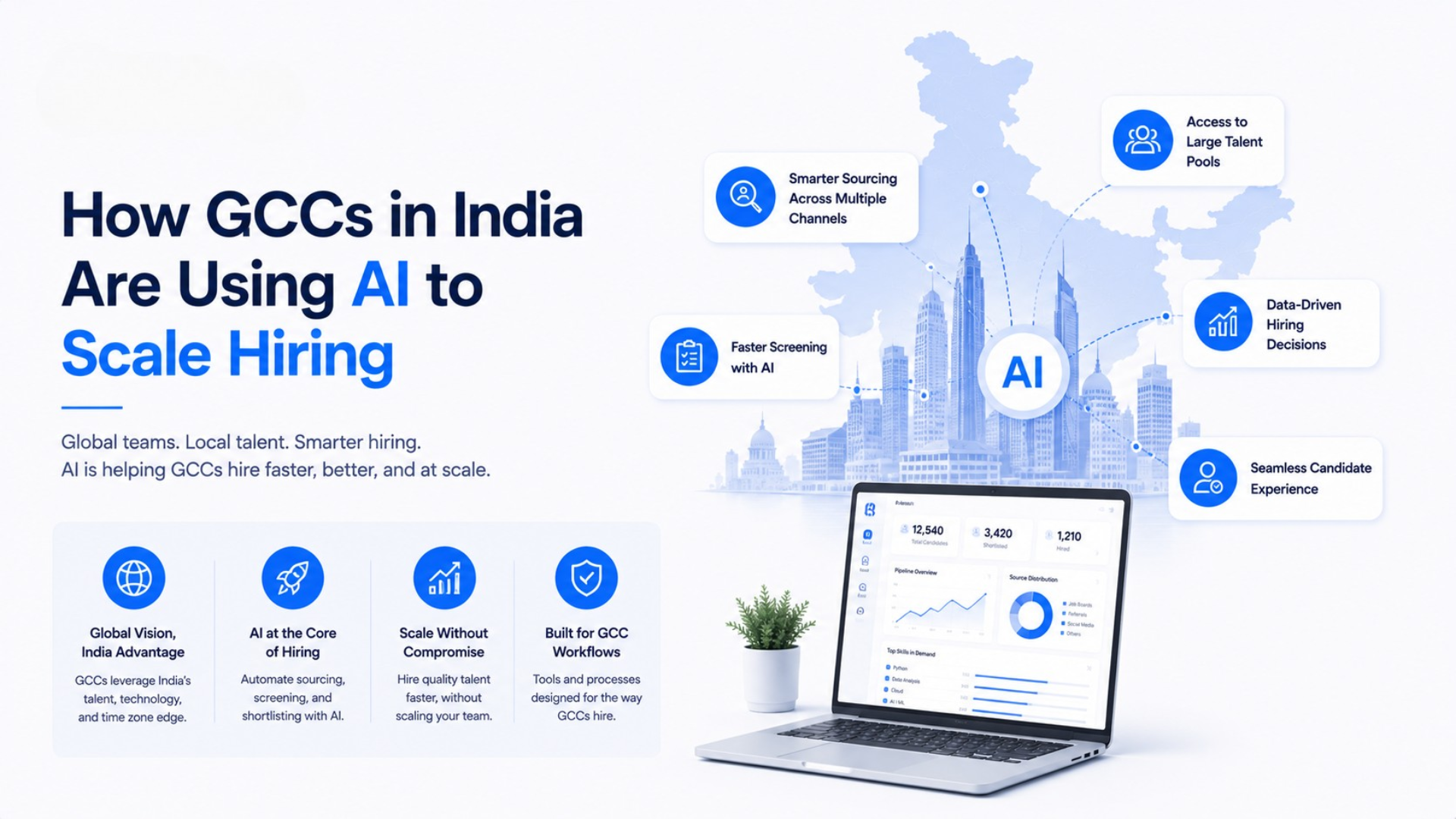
Global Capability Centers in India recorded 227,991 hires in just the first six months of 2026, up 11% over the same period a year earlier, even as the broader white-collar job market saw hiring decline 9% year-on-year over the same window, according to Swarajya's coverage of the sector's hiring surge. That same reporting puts the ecosystem at more than 2,100 centres employing over 2.3 million professionals and generating close to $100 billion in annual revenue — and, more tellingly, finds that nearly two in three new GCC roles created in 2026 now require AI, data science, or intelligent automation skills specifically.
Behind that headline growth sits a genuinely different recruiting operation than the one GCCs ran even three years ago. This guide walks through how AI is actually being used across GCC talent acquisition in India in 2026 — not the abstract promise of "AI-powered hiring," but the specific sourcing, assessment, and outbound engagement mechanics driving the numbers above, and why the underlying hiring strategy has shifted as much as the tooling has.
The Shift From Cost Arbitrage to Capability Arbitrage
The most important context for understanding how GCCs use AI in hiring is understanding what's changed about why GCCs hire at all. Findings from the EY India GCC Pulse Survey, cited in the Observer Research Foundation's 2026 analysis of India's GCC ecosystem, describe a systematic shift from labour-cost arbitrage toward what the survey calls capability arbitrage — India is being leveraged not because labour is cheaper, but because mature GCCs can combine technical talent, deep operating knowledge, and genuine AI deployment experience at scale. That distinction matters enormously for recruiting strategy, because hiring for capability requires a fundamentally different sourcing approach than hiring for volume at the lowest available cost.
This shows up directly in who's actually getting hired. theintechgroup's 2026 GCC hiring trends analysis reports that the EY GCC Pulse Survey found 58% of Indian GCCs are already investing in agentic AI specifically, while 83% are scaling generative AI projects — and separately notes that India is home to roughly 120,000 AI professionals across GCCs today, against demand projected to cross one million AI-related roles. Swarajya's data adds useful texture: professionals with four to ten years of experience now account for 56% of GCC hiring, reflecting genuine demand for specialists in engineering, AI, cloud, and digital transformation rather than broad entry-level volume hiring — though early-career talent still represents a meaningful 30% of hires, so the shift is toward specialization, not away from junior hiring entirely.
The Recruiter Productivity Numbers Behind the Adoption Curve
The clearest, most concrete measure of how AI has changed GCC recruiting operations comes from productivity data rather than headcount figures. According to Inductus GCC's 2026 analysis of AI in talent acquisition for offshore delivery centers, recruiter-to-requisition ratios have improved by 40-60% in organizations that have implemented AI at scale in their recruitment processes, without a corresponding increase in headcount on the recruiting team itself. That same analysis is careful to frame this as more than a pure efficiency gain — it describes the shift as a structural realignment of how the recruitment function operates, not simply the same process running faster.
The analysis also flags an important caveat worth taking seriously rather than treating AI adoption as automatically beneficial: organizations see significant benefits specifically when AI is deployed as genuine operational capability, backed by robust data quality, real system integration, and continuous human oversight. GCCs adopting AI tools without those fundamentals in place, the same analysis notes, tend to see only modest improvement over their prior manual processes — meaning the productivity gains cited above aren't automatic just from buying AI-labeled software, but depend on how deliberately the underlying data and integration work gets done.
Where AI Actually Gets Used: Sourcing, Assessment, and Reducing Staffing Dependency
Breaking down the recruiting funnel specifically, Inductus GCC's research identifies AI sourcing as having some of the clearest impact at the earliest funnel stages. AI sourcing tools scan public professional networks, job boards, and internal ATS records to identify candidates matching a defined profile — and this matters especially for GCCs hiring for genuinely rare positions where almost no one is actively applying, since the sourcing approach specifically targets passive talent who would never respond to a standard job listing in the first place.
That capability has a direct financial consequence several GCCs have acted on: the same research notes that several Global Capability Centers in India have adopted AI sourcing specifically to reduce their reliance on third-party staffing firms for skilled technical roles, building an internal talent pipeline that lowers the ongoing cost of hiring for those positions compared to paying agency fees on every technical requisition. AI-driven assessment platforms occupy the next stage of the funnel — widely used across offshore delivery centers to generate a skill score from structured test and response analysis, functioning as an additional, more objective screening layer before a candidate reaches a human interviewer.
The Senior Talent Bottleneck AI Sourcing Is Specifically Trying to Solve
A pattern showing up consistently across current market data is that GCC hiring difficulty is concentrating at the senior end of the market, even as overall hiring volume grows. Writing in Forbes, Weekday cofounder Chetan Dalal describes this directly from his company's own customer data: interviews per hire rose from 18 to 24 across their client base in 2025, and the average seniority requested in roles they fill increased by roughly 30% — while offer drop-off rates, notably, stayed flat, meaning candidates who do get multiple offers are increasingly the same small pool of specialized people every company is competing for simultaneously.
The underlying cause, per that same analysis, is the same capability-arbitrage shift described above playing out at the individual role level: as GCCs move from cost arbitrage to capability arbitrage, senior talent becomes the actual bottleneck, since capability-driven centers need architects, staff engineers, security leads, and AI practitioners capable of taking real ownership of global systems — a fundamentally different hiring problem than filling a large cohort of similarly-qualified entry-level analysts. This is precisely the scenario where AI-driven passive sourcing earns its keep: when the qualified candidate pool for a specific senior, specialized role might be measured in the low hundreds globally, finding and engaging them requires genuinely different tooling than posting a job and managing inbound volume.
Why Inbound Applications Are Losing Signal, Forcing a Shift to Outbound
A less-discussed but increasingly important driver of GCC AI adoption is a problem on the candidate side of the market, not the employer side. Dalal's Forbes analysis describes a consistent split across Weekday's customer base: generic roles get flooded with inbound interest, while niche senior roles remain thin on qualified supply — and, more specifically, recruiters are increasingly reporting being swamped by AI-generated job applications, as candidates use generative AI to mass-produce tailored resumes and deploy auto-apply bots across many roles simultaneously. The practical effect is that inbound application volume is rising while the actual signal contained in that volume is falling, since a flood of AI-polished, auto-submitted applications is harder to differentiate on genuine fit than a smaller pool of applications that took real candidate effort to produce.
This is the specific dynamic pushing GCC recruiting further toward aggressive, AI-assisted outbound rather than away from it. As Dalal puts it directly, recruitment in 2026's AI-driven hiring market will be defined by aggressive outbound as the new normal — and describes Weekday's own approach as integrating deeply across email, WhatsApp, calls, and LinkedIn specifically so that passive candidates who aren't actively checking any single inbox or platform still see the outreach and can respond, backed by AI search capable of surfacing a shortlist from a candidate database well over 100 million profiles for a specific specialized role.
The Blended Workforce Shift: Contractual Roles and Precision Hiring
AI-enabled hiring speed has also made a structurally different workforce model more operationally viable for GCCs. theintechgroup's analysis projects that by the end of 2026, one in four roles within Indian GCCs will be contractual — a shift the analysis frames as reflecting agility rather than pure cost-cutting: GCCs need specialized expertise for genuinely time-bound engagements, whether a six-month cloud migration, a regulatory compliance sprint, or a GenAI proof-of-concept, and hiring full-time employees for work with a defined endpoint doesn't make economic or operational sense in the way it might for a permanent capability.
This blended model depends on being able to source and vet contract specialists quickly enough to actually capture the agility benefit, which is where AI-driven sourcing and pre-vetted talent pools matter directly — the same analysis notes that GCCs are increasingly building curated pools of pre-vetted contractors specifically so that time-bound engagements can be staffed quickly rather than starting a full search from zero each time a project-based need arises.
The Build-vs-Buy Calculation: Internal Upskilling as a Genuine Alternative to External Hiring
One of the more consequential shifts in how GCCs approach talent isn't about hiring tooling at all — it's about how much hiring gets replaced by internal development in the first place. theintechgroup's analysis reports that 81% of Indian GCCs are actively upskilling internal teams on GenAI specifically, alongside 66% prioritizing deep domain expertise and 71% treating reskilling broadly as a core talent strategy component. The economic logic behind this is explicit in the same research: external hiring for niche AI and cloud roles can take three to six months and carry a salary premium of roughly 1.7 times a comparable role, while internal upskilling, despite requiring real upfront investment, produces role-ready talent faster and with meaningfully better retention.
The most sophisticated GCCs, per that analysis, are becoming what industry observers describe as "talent factories" — organizations that don't just hire for the skills needed today, but deliberately build the capabilities they expect to need eighteen months out. This reframes AI's role in GCC talent strategy beyond pure recruiting automation: AI adoption is simultaneously changing how GCCs source external candidates and how aggressively they invest in growing capability internally rather than hiring it, with the two strategies operating as genuine alternatives being weighed against each other rather than sourcing automation simply accelerating a fixed hiring plan.
Geographic Strategy: The Hub-and-Spoke Model as an AI Sourcing Problem
GCC hiring strategy in 2026 increasingly treats geography as a deliberate lever rather than a fixed constraint. V3 Staffing's 2026 analysis of GCC hiring trends and strategies describes the emerging default as a hub-and-spoke model, where Bengaluru, Hyderabad, and Mumbai continue serving as Centres of Excellence for R&D and global leadership, while Tier-2 cities absorb a growing share of overall volume specifically because they offer lower attrition and real cost advantages for 2026 expansion.
This geographic strategy is itself increasingly AI-sourcing-dependent, since sourcing effectively across a hub-and-spoke footprint spanning several cities simultaneously — rather than concentrating entirely in one or two metro hubs — requires tooling that can genuinely reach candidates across each specific market rather than defaulting to whichever city a sourcing platform's underlying data happens to be weighted toward.
Governance and Audit-Readiness as a Growing AI Deployment Requirement
A theme running through GCC hiring strategy that connects directly back to the earlier point about global headquarters scrutiny is the growing emphasis on documented, standardized, audit-ready hiring processes. V3 Staffing's research describes this explicitly as a "public sector hiring tool" approach being adopted more broadly across GCCs — not because GCCs are becoming public-sector entities, but because that model's emphasis on documentation, standardized assessments, and audit-friendly practices is exactly what a growing number of global parent companies now expect from their India-based hiring operations, particularly as AI plays a larger role in screening and assessment decisions that a headquarters compliance or legal team might eventually need to review.
Where a Tool Like Huntlo Fits Into This Picture
Several of the specific gaps described throughout this guide — sourcing passive candidates for rare, senior technical roles rather than managing inbound volume, reaching candidates across multiple channels as inbound signal degrades, and doing this consistently across a hub-and-spoke footprint spanning several Indian cities — are directly relevant to what Huntlo is built to support for GCCs scaling hiring in this environment.
Rather than a recruiter manually building separate outbound approaches for each open specialized role and each city a GCC is expanding into, Huntlo's agentic AI sources candidates across 50+ public platforms from a natural-language description of the role, then moves directly into autonomous outreach across email, WhatsApp, and AI voice — addressing the same "reach passive candidates across whichever channel they actually check" problem that GCC hiring leaders describe as central to competing effectively for the small pool of senior, specialized candidates every organization is now chasing simultaneously. This doesn't replace the internal upskilling and workforce-planning decisions covered earlier — those remain genuine strategic choices a GCC has to make independent of any sourcing tool — but as the outbound sourcing and engagement layer sitting underneath a broader talent strategy, it's built specifically for the aggressive, multi-channel outbound approach that's become the operating norm across the sector in 2026.
Frequently Asked Questions
Is GCC hiring in India actually slowing down, given broader job market headwinds? No — GCC hiring specifically has remained resilient even as broader white-collar hiring in India declined, growing 11% year-on-year in the first half of 2026 while overall hiring fell 9% over a comparable window. What's changed is the composition of that hiring, shifting toward specialized, AI-and-data-skilled roles rather than broad volume hiring.
Why are GCCs relying more on AI sourcing instead of traditional job postings? Partly because the target candidates for GCCs' highest-priority roles are increasingly senior and specialized enough that they were never going to respond to a standard job posting, and partly because inbound application volume has become less reliable as a signal due to the rise of AI-generated, mass-submitted applications.
Are GCCs replacing hiring with internal upskilling instead? Not entirely, but a meaningful shift is happening — a large majority of Indian GCCs are actively investing in internal GenAI upskilling as a genuine alternative to external hiring for some roles, driven by the time and cost premium associated with external hiring for niche AI and cloud specialists specifically.
Does AI adoption in GCC recruiting always produce the productivity gains reported in industry research? Not automatically. Current analysis is specific that the reported 40-60% improvement in recruiter-to-requisition ratios shows up in organizations pairing AI tools with genuine data quality, system integration, and human oversight — organizations deploying AI tools without those fundamentals tend to see comparatively modest gains over their prior manual process.
The Bottom Line
GCC hiring in India in 2026 is growing, but the growth is concentrated in a genuinely different kind of hiring than the volume-driven model that built the sector over the past two decades — specialized, AI-and-data-skilled, increasingly senior, and competing directly against every other GCC chasing the same narrow pool of candidates. The AI tools driving that hiring are working precisely because they're solving for that specific problem: finding passive, specialized talent that traditional job postings will never reach, and engaging them across whichever channel they actually check before a competitor does.
If reaching that specific pool of specialized, passive candidates across a growing multi-city footprint is the current gap in your GCC's hiring strategy, Huntlo's agentic AI sourcing and outreach platform is worth testing directly against your hardest-to-fill open role with the free trial.
Related Reading on the Huntlo Blog
Over-Automating Outreach: When AI Sourcing Hurts Your Brand
AI Sourcing Tool Comparison Framework: 10 Criteria That Matter
AI Recruiting Software for Staffing Firms: Complete Guide (2026)