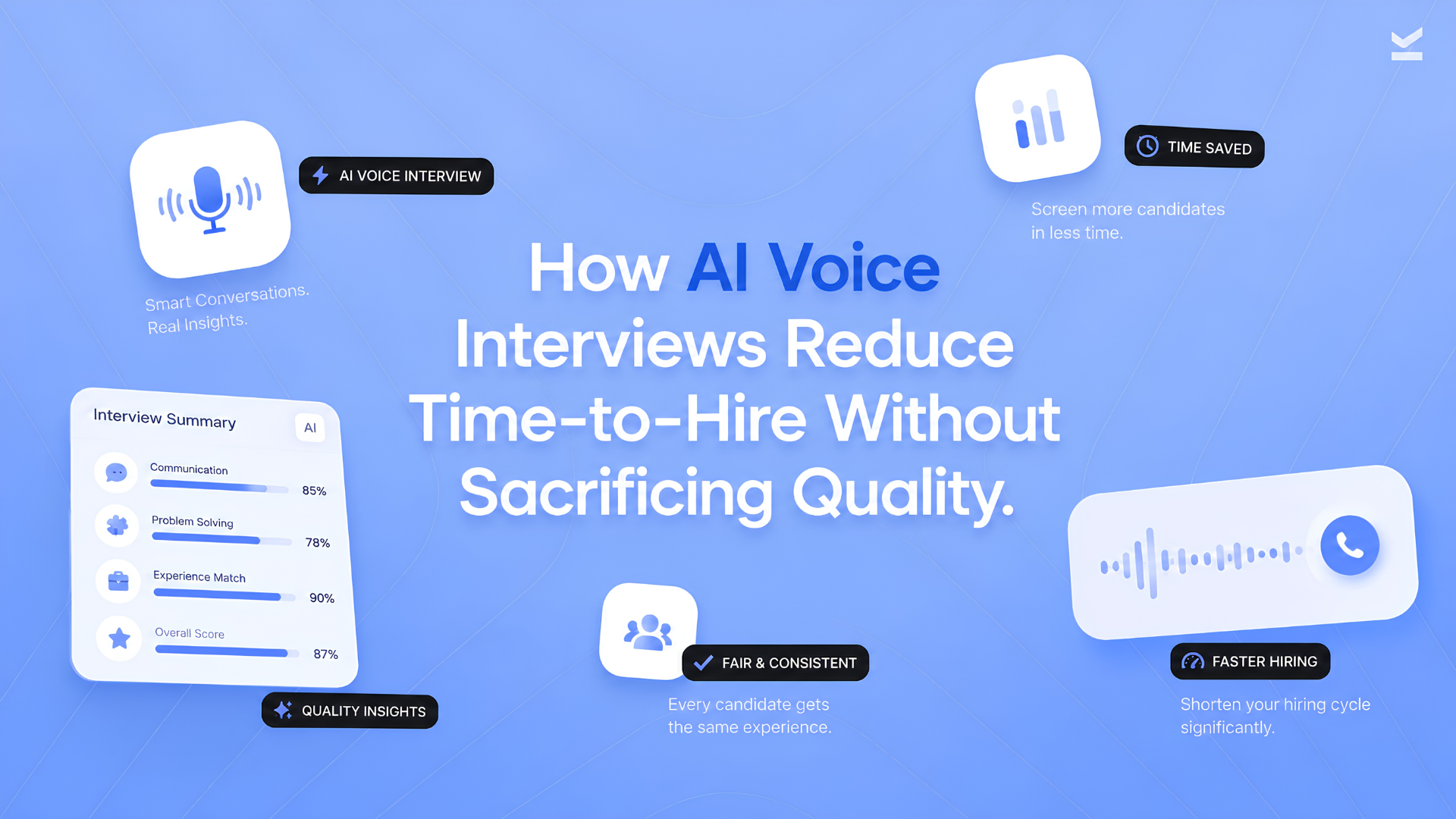
The recruiting industry has accepted a false tradeoff for years: you can hire fast or you can hire well, but you cannot do both. Speed and quality are treated as opposing forces — compress the timeline and the shortlist gets weaker; strengthen the evaluation and the timeline extends. This assumption is so deeply embedded in how talent acquisition teams operate that it rarely gets questioned. It should be. AI voice interviews challenge this tradeoff directly by addressing the specific process step where speed and quality conflict most acutely: the initial phone screen. By replacing manual phone screens with structured, AI-evaluated voice conversations, organizations are reducing time-to-shortlist by 40–60% while producing evaluation data that is more consistent and more predictive than what human screens deliver. The speed comes from eliminating scheduling friction and recruiter bottlenecks. The quality comes from applying the same evaluation framework to every candidate, regardless of when they are screened or how many other candidates are in the queue.
Where Time-to-Hire Gets Wasted
Time-to-hire is not a single number. It is the sum of discrete process stages, each with its own bottlenecks and delays. Sourcing typically accounts for the largest share, followed by screening, then interview coordination, then offer management. For most organizations, the screening stage — the phone screen — is where the most controllable time loss occurs. It is also where the speed-quality tradeoff bites hardest. A recruiter who needs to screen 40 candidates for an open requisition and can conduct 20 screens per week will need two full
weeks just for initial screening. During those two weeks, candidates are waiting, hiring managers are waiting, and top candidates are accepting offers from competitors who moved faster.
According to SHRM’s talent acquisition benchmarks, the average time from application to first screening contact is 6.4 business days across all industries. For enterprise employers with complex approval workflows, that number exceeds 10 days. LinkedIn’s global hiring trends data shows that each day of delay beyond a candidate’s expected timeline reduces the probability of offer acceptance by approximately 1.5%. Over a two-week screening delay, that compounds to a 15–20% reduction in acceptance probability — not because the candidate lost interest in the role, but because they received and accepted another offer while waiting for your team to finish screening. This is the hidden cost of phone screen bottlenecks: the candidates you lose are disproportionately the ones you most wanted to hire, because strong candidates have more options and shorter patience.
How AI Voice Interviews Compress the Screening Timeline
AI voice interviews eliminate the two primary time drivers in traditional screening: scheduling coordination and sequential processing. Scheduling coordination — the back-and-forth emails, calendar checks, and time zone math required to align a recruiter and a candidate — adds an average of 2.3 days to each phone screen according to Deloitte’s workforce research. For cross-border hiring, that number climbs higher. AI voice interviews eliminate this entirely because the candidate completes the interview at any hour, without any recruiter availability required. The screening process shifts from synchronous (two people must be available simultaneously) to asynchronous (the candidate completes the interview independently), and the time savings are immediate.
Sequential processing — the requirement that each candidate wait for previous candidates to be screened before receiving attention — is the second major time driver. In a manual process, candidates are screened one at a time, and the queue builds quickly when application volume spikes. AI voice interviews process candidates in parallel. Fifty candidates can complete their AI voice interviews on the same day, and the recruiter receives 50 completed scorecards the next morning. The entire screening phase that would have taken two to three weeks with manual phone screens is compressed to two to three days of scorecard review. For organizations hiring at volume, this timeline compression at the top of the funnel cascades through every subsequent stage: faster shortlists mean faster interviews, faster interviews mean faster offers, and faster offers mean fewer candidates lost to competing employers.
Why Quality Does Not Suffer — And Often Improves
The conventional concern with faster screening is that speed comes at the expense of thoroughness. If a recruiter spends less time per candidate, the reasoning goes, they must be making less informed decisions. AI voice interviews invert this logic. The AI does not spend less time evaluating the candidate — it spends the same amount of structured
evaluation time on every candidate, with no quality degradation from fatigue, volume pressure, or end-of-day rush. A candidate screened at 9 AM receives the same evaluation rigor as a candidate screened at 6 PM. In a manual process, this consistency is impossible to achieve. Recruiters conducting their fifteenth phone screen of the week are not evaluating with the same focus as they applied to their first. Research from Gallup’s workplace analytics on evaluator fatigue shows that judgment quality degrades measurably after sustained periods of repetitive evaluation, with the most significant decline occurring in the second half of a high-volume screening day.
Beyond consistency, AI voice interviews offer a quality advantage that manual screens cannot match: structured, criterion-referenced evaluation. Every candidate is scored against the same competency dimensions using the same scoring methodology. This is not how most phone screens work. In practice, recruiter phone screens are semi-structured at best — the recruiter asks some standard questions but also improvises based on the conversation flow, follows interesting threads, and makes subjective judgments that are not anchored to a formal rubric. SIOP’s research on structured versus unstructured interviews has demonstrated that structured evaluation methodologies produce predictive validity coefficients 2 to 3 times higher than unstructured conversations. The AI voice interview enforces this structured methodology by design, and the result is a shortlist that is built on more rigorous evaluation data than a manually screened shortlist, not less.
The Shortlist Quality Paradox
One of the most counterintuitive findings from organizations that have adopted AI voice screening is that faster shortlists are often better shortlists. The reason is a phenomenon that might be called the screening completeness paradox. In a manual process, the recruiter does not screen every applicant. They screen the ones they have time for, and they screen those candidates with less thoroughness as volume pressure increases. The shortlist is built from an incomplete and inconsistently evaluated candidate pool. With AI voice interviews, every candidate who meets basic qualifications is screened with the same thoroughness. The shortlist is built from a complete, consistently evaluated pool — which means the AI has actually seen and evaluated candidates that the manual process would have skipped entirely.
The practical impact is measurable. PwC’s HR technology analysis has found that organizations using AI screening report 20–30% improvements in first-year retention for hires that came through AI-screened pipelines, compared to hires from manually screened pipelines for the same role families. The reason is not that the AI is better at identifying good candidates than experienced recruiters — it is that the AI evaluates every candidate thoroughly and consistently, while the manual process evaluates some candidates thoroughly, some superficially, and some not at all. Completeness and consistency, applied at scale, produce better outcomes than selective thoroughness.
Candidate Responsiveness and Pipeline Velocity
Time-to-hire is not only about how fast the recruiting team moves. It is also about how quickly candidates respond, engage, and progress through the pipeline. A screening process that takes two weeks does not just delay the shortlist — it also allows candidate interest to decay. Candidates who were enthusiastic when they applied become less engaged when they hear nothing for ten days. Candidates who respond to initial outreach stop returning messages when the process drags on. The follow-up persistence required to keep candidates engaged during a slow screening process is substantial — and as explored in research on follow-up cadence in recruiting, most recruiting teams systematically underinvest in follow-up precisely because their screening bottleneck consumes the time they would otherwise spend on candidate engagement.
AI voice interviews create a faster pipeline that naturally sustains candidate engagement. When a candidate can complete a screening interview within hours of applying and receive a status update within a day, their perception of the hiring process changes. It feels responsive, professional, and respectful of their time. This perception has direct consequences: The Talent Board’s CandE benchmarking shows that candidates who experience fast, technology-enabled hiring processes are 25–35% more likely to refer others and 20% more likely to reapply for future openings. Pipeline velocity and candidate engagement are mutually reinforcing — faster screening produces more engaged candidates, who in turn move through the pipeline faster, which further compresses time-to-hire.
The Integration Requirement: Why Standalone AI Screening Falls Short
AI voice interviews can compress the screening stage of the hiring funnel. But screening is only one stage. If the AI screening tool is not connected to the sourcing, outreach, and interview scheduling systems that feed into and follow from screening, the time saved at the screening stage is partially or fully consumed by manual data handoffs between tools. The recruiter exports candidate records from the sourcing platform, imports them into the AI screening tool, exports the completed scorecards, and imports them back into the ATS for interview scheduling. Each handoff adds time, introduces errors, and erodes the efficiency gains the AI was supposed to deliver.
This fragmentation — more tools creating more handoffs instead of fewer — is one of the most common reasons AI screening implementations fail to deliver their expected ROI. As explored in More Tools. Same Hiring Problems., the problem is not a lack of capable technology. The problem is that adding a capable screening tool to a fragmented technology stack addresses one bottleneck while creating another. The organizations that achieve genuine time-to-hire reduction without quality sacrifice are the ones that use AI voice screening within an integrated platform where sourcing, outreach, screening, and scheduling share the same candidate data and operate as a continuous workflow.
Huntlo: Speed and Quality in One System
Huntlo delivers the integrated approach that makes AI voice interviews a genuine time-to-hire accelerator rather than an isolated tool with fragmented connections. Its AI
sourcing engine searches across 50+ platforms and surfaces candidates in seconds. Its multi-channel outreach engages candidates through email, LinkedIn, and WhatsApp with persistent follow-up sequences. Its AI voice screening produces structured evaluation scorecards that recruiters review in minutes. And its scheduling system coordinates next-round interviews without manual coordination. Every stage operates on the same candidate data, within the same platform, without manual handoffs.
For the recruiting teams using Huntlo, the speed-quality tradeoff is not a theoretical debate. It is a measurable outcome. Screening timelines compress from weeks to days. Shortlist quality improves because every candidate is evaluated against the same standard. Candidate engagement increases because the pipeline moves faster and responds sooner. And recruiters spend their time on the human conversations that actually close hires — not on repetitive phone screens that could have been handled by an AI in the first place. As discussed in What Makes an AI Recruiting Platform “Agentic” vs Just Automated?, the platforms that deliver this kind of end-to-end acceleration are the ones where AI does not just automate individual steps but operates as a coherent system that enhances every stage of the hiring process.
Reducing time-to-hire without sacrificing quality is not about cutting corners. It is about removing the inefficiencies — scheduling friction, sequential processing, inconsistent evaluation, and fragmented tool stacks — that slow hiring down without making it better. AI voice interviews address each of these inefficiencies directly. The organizations adopting them are not choosing speed over quality. They are discovering that the fastest path to a quality hire runs through AI-powered screening.
Related Topics:
What Makes an AI Recruiting Platform “Agentic” vs Just Automated?