Kenji Morales, the director of recruiting operations at a logistics company with eight thousand employees, was preparing for his annual technology review when the data made the problem impossible to ignore. His applicant tracking system, a market-leading platform his organization had used since 2018, was the repository for every candidate record and hiring decision. It was also, by his own measurement, the least effective tool in his recruiting stack. Recruiters spent forty percent of their time working in the ATS, but the work they did there was primarily administrative data entry: logging interactions that had happened elsewhere, updating status fields, and generating compliance reports. The ATS was a record-keeping system, not a hiring intelligence system. It captured what had happened but contributed nothing to helping the team decide what should happen next. Kenji had attended three vendor conferences in the past year and seen AI-powered platforms that could source, engage, screen, schedule, and analyze candidates in a unified workflow. His ATS could do none of these things natively. It could record them after they happened elsewhere. Kenji realized he was not managing a recruiting technology strategy. He was managing a technology debt problem that was growing with every additional tool layered on top of an inadequate foundation.
The ATS Was Never Designed for How We Hire Today
Kenji Morales, the director of recruiting operations at a logistics company with eight
thousand employees, was preparing for his annual technology review when the data made the problem impossible to ignore. His applicant tracking system, a market-leading platform that his organization had used since 2018, was the repository for every candidate record, every interview note, and every hiring decision. It was also, by his own measurement, the least effective tool in his recruiting stack. Recruiters spent forty percent of their time working in the ATS, but the work they did there was primarily administrative data entry: logging candidate interactions that had happened in other systems, updating status fields, and generating compliance reports. The ATS was a record-keeping system, not a hiring intelligence system. It captured what had happened but contributed almost nothing to helping the recruiting team make better decisions about what should happen next. Research published by SHRM on applicant tracking system satisfaction found that only thirty-four percent of recruiting leaders describe their ATS as a strategic asset, while fifty-one percent describe it primarily as a compliance and record-keeping tool. The gap between what organizations need from hiring technology and what the ATS was designed to deliver has been widening for a decade, and it has now reached a point where the ATS, in its traditional form, is constraining recruiting effectiveness rather than enabling it.
The origins of the applicant tracking system explain its limitations. The first ATS platforms were built in the late 1990s and early 2000s to solve a specific problem: managing the compliance and record-keeping requirements of high-volume hiring in an era of paper resumes and email-based communication. The ATS was designed as a database with workflow rules, a system that stored candidate information, tracked hiring stages, and enforced the process steps required for regulatory compliance. This design was appropriate for its time, when recruiting was a sequential, document-driven process and the primary technology challenge was managing the volume of paper and email that hiring generated. But recruiting has transformed fundamentally since the ATS was designed. Candidates now expect real-time, personalized communication across multiple channels. Hiring decisions are informed by data from dozens of sources far beyond the resume. Scheduling involves multi-participant, multi-time-zone coordination that the ATS was never designed to handle. According to McKinsey analysis of HR technology evolution, the average large enterprise ATS platform contains core architecture that was designed between 2005 and 2012, and while the user interface has been modernized, the underlying data model, workflow engine, and integration architecture remain fundamentally designed for an era of recruiting that no longer exists. The ATS is not a bad tool. It is a tool built for a different era.
The consequence of using a record-keeping system as the foundation of modern hiring is that the entire recruiting technology stack is built on an inadequate base. Every additional tool that organizations layer on top of the ATS, sourcing platforms, assessment tools, scheduling systems, communication platforms, and analytics dashboards, must integrate with a data model and workflow architecture that was not designed to support them. This integration is costly, fragile, and incomplete, producing the fragmented, data-siloed technology environments that recruiting teams increasingly struggle with. The distinction between AI that operates within the constraints of an ATS-centric architecture and AI that is built on a modern,
unified architecture designed for intelligent hiring is explored in discussions about the difference between AI sourcing and AI recruiting, where the most capable systems are those that are not constrained by legacy data models but are built from the ground up to support AI-driven decision-making across the full hiring workflow. The evolution from ATS to AI Hiring OS is not a rename or a rebranding. It is a fundamental architectural shift from a system designed to record hiring activity to a system designed to drive hiring outcomes.
Why Adding AI Features to an ATS Does Not Create an AI Hiring OS
The most common response to ATS limitations has been to add AI features to existing platforms: AI resume screening, AI candidate matching, AI interview scheduling, and AI-powered analytics. These features provide incremental improvement, but they are constrained by the same architectural limitations that make the ATS inadequate in the first place. AI resume screening built on top of an ATS data model can only evaluate the data that the ATS captures, which is typically limited to resume text, application form responses, and interview notes. It cannot incorporate the rich candidate data that lives in other systems: communication history, assessment results, engagement signals, and market intelligence. The AI is intelligent but operating on incomplete information, which limits its effectiveness. According to LinkedIn 2025 talent solutions report, organizations that added AI features to their existing ATS reported average improvements of twelve to eighteen percent in screening efficiency, while organizations that deployed AI-native platforms reported improvements of forty to sixty percent, because the AI-native platforms could operate on complete, unified data rather than the fragmented data available to ATS-embedded AI features.
The architectural constraints of the ATS model create specific limitations that AI features cannot overcome. First, the ATS data model is candidate-centric rather than workflow-centric, meaning it stores information about candidates but does not model the hiring workflow as an intelligent, adaptive process. AI features added to this model can automate individual tasks but cannot orchestrate the full workflow because the underlying system does not support workflow intelligence. Second, the ATS integration architecture is batch-oriented and API-limited, meaning data flows between the ATS and other tools in periodic batches rather than in real time. AI scheduling that depends on real-time calendar data cannot function effectively when the calendar integration refreshes every thirty minutes. Third, the ATS was designed for compliance reporting rather than decision intelligence, meaning its analytics capabilities are optimized for producing audit trails and EEOC reports rather than predictive insights and optimization recommendations. Many organizations have attempted to overcome these limitations by adding more tools alongside the ATS, creating hybrid environments where AI capabilities live in separate systems that must be coordinated by recruiters. This approach multiplies the fragmentation problem rather than solving it, because each additional tool introduces its own data model and integration requirements that further complicate the technology landscape.
The difference between an ATS with AI features and an AI Hiring OS is analogous to the difference between a calculator built into a filing cabinet and a modern computer. The calculator-filing-cabinet hybrid can perform calculations, but it is constrained by the filing cabinet architecture in ways that limit its utility: the display is small, the input is awkward, and the results cannot be easily shared or combined with other information. The computer, by contrast, was designed from the ground up to support computation, communication, and information management in an integrated way. Similarly, an AI Hiring OS is designed from the ground up to support intelligent hiring: sourcing, engagement, assessment, scheduling, communication, analytics, and decision support are native capabilities built on a unified data model and workflow engine, not add-on features grafted onto a record-keeping system. According to Gartner research on the evolution of HR technology platforms, the distinction between legacy systems with embedded AI and AI-native platforms is the most important technology decision facing recruiting leaders, because the two approaches produce qualitatively different outcomes that diverge further apart as AI capabilities become more sophisticated. Organizations that choose the hybrid approach will find their AI capabilities increasingly constrained by the legacy architecture, while those that choose the AI-native approach will have a platform that improves with each hiring cycle.
What an AI Hiring OS Actually Does
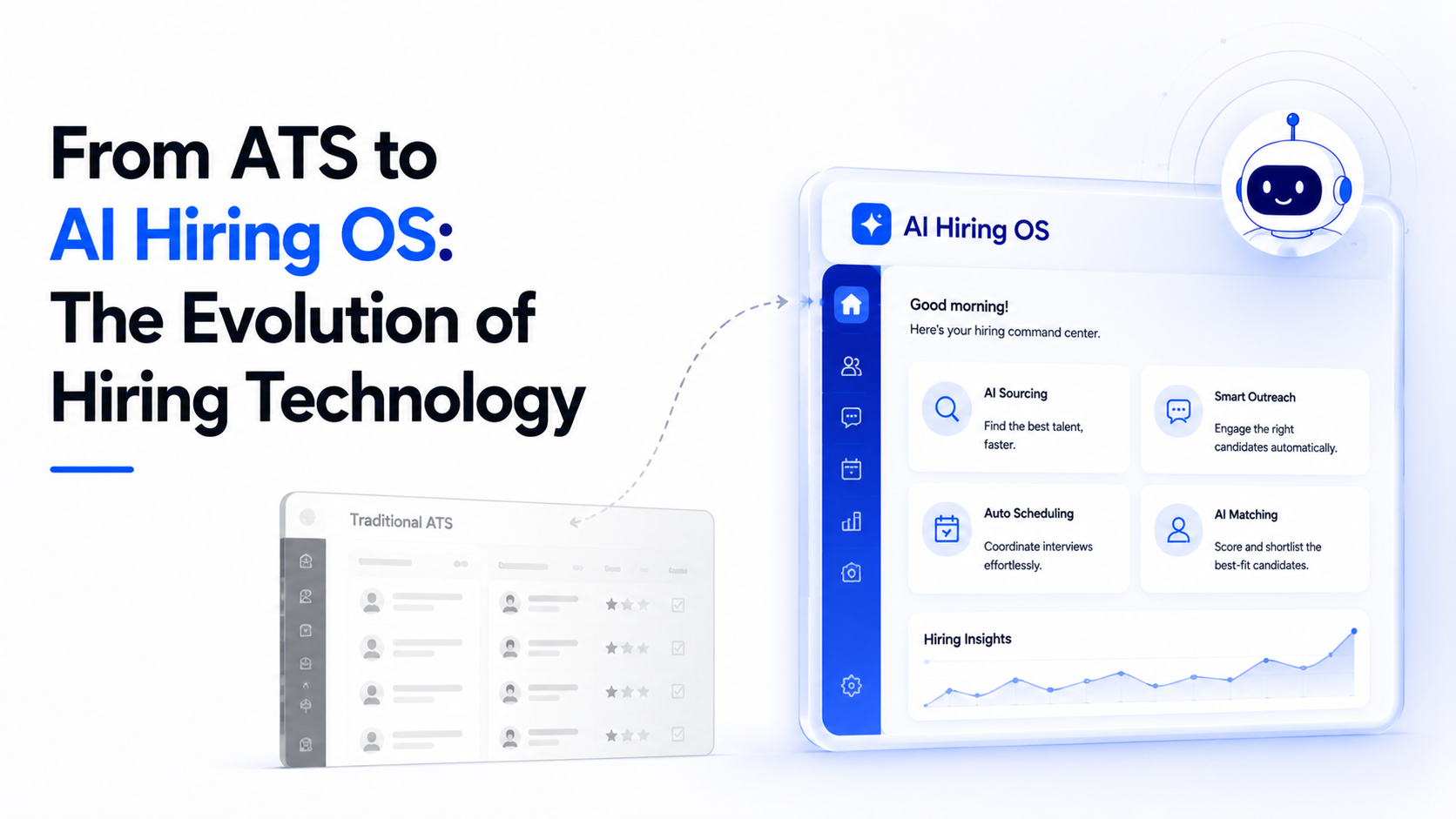
An AI Hiring OS operates as the intelligent operating system for the entire recruiting function. Just as a computer operating system manages hardware resources, runs applications, and provides a unified user interface, an AI Hiring OS manages data resources, runs recruiting workflows, and provides a unified experience for recruiters, hiring managers, and candidates. The system maintains a single, real-time data model of the entire hiring operation: every candidate, every open role, every interviewer, every scheduling constraint, every communication, and every hiring decision. All data flows into and out of this unified model, eliminating the silos and inconsistencies that plague ATS-centric environments. The AI layer operates on this unified data model, making intelligent decisions about sourcing prioritization, candidate engagement, screening criteria, scheduling optimization, communication timing, and workflow escalation. An agentic AI recruiting platform embodies this operating system model, operating autonomously across the full hiring workflow and involving human recruiters only when their judgment, creativity, or relationship skills are required.
The practical capabilities of an AI Hiring OS go well beyond what any ATS, even one with AI features, can deliver. Unified candidate intelligence means the system has a complete, real-time view of every candidate interaction across every channel and stage, enabling it to make engagement and scheduling decisions based on the full candidate context rather than isolated data points. Workflow orchestration means the system manages the end-to-end hiring process as a unified, intelligent workflow rather than a series of disconnected stages, automatically adjusting the process based on real-time conditions such as candidate engagement level, hiring manager availability, and competitive market dynamics. Predictive analytics means the system uses historical hiring data to forecast outcomes, identify risks, and recommend
interventions before problems materialize. According to Deloitte 2025 report on intelligent HR platforms, organizations operating on AI Hiring OS platforms report forty to fifty-five percent faster hiring cycles, twenty to thirty percent lower cost-per-hire, and fifteen to twenty-five percent higher new-hire quality ratings compared to organizations operating on ATS-centric architectures, because the unified data model and workflow intelligence eliminate the inefficiencies and blind spots that the fragmented stack creates.
The AI Hiring OS also transforms the candidate experience by providing a unified, coherent journey from first contact to offer acceptance. In an ATS-centric environment, the candidate experience is fragmented because different stages of the process are managed by different tools with different interfaces and different data. The candidate may receive a professional outreach message from the sourcing tool, a clunky application form from the ATS, a generic scheduling invitation from the calendar tool, and a templated offer letter from the offer management platform. Each interaction reflects the limitations of the specific tool rather than the organization commitment to a seamless experience. In an AI Hiring OS, the candidate interacts with a single, intelligent system that maintains context across every touchpoint, personalizes communication based on the full candidate journey, and provides a consistent, professional experience that reflects well on the employer brand. EY research on candidate experience and technology architecture has found that the primary driver of candidate experience satisfaction is not the quality of any individual touchpoint but the coherence and consistency of the experience across all touchpoints, a quality that only a unified platform can deliver at scale. The AI Hiring OS does not just make hiring faster. It makes hiring feel intelligent to every participant.
How the Recruiter Role Evolves on an AI Hiring OS
The transition from an ATS to an AI Hiring OS does not eliminate the need for recruiters. It fundamentally changes what recruiters do and how they create value. On an ATS-centric platform, the recruiter primary role is data entry and process management: moving candidates through workflow stages, updating status fields, logging activities, and generating reports. These tasks are necessary for compliance and record-keeping but they generate no strategic value and consume the majority of recruiter time. On an AI Hiring OS, these operational tasks are handled autonomously. The recruiter role shifts to activities that require human judgment, creativity, and relationship skills: strategic candidate engagement, hiring manager advisory, workforce planning, and employer brand development. This shift is not theoretical. Research on whether recruiters should worry about AI replacing their jobs consistently demonstrates that recruiters working on AI-native platforms report higher job satisfaction, lower burnout, and stronger perceived impact on hiring outcomes, because they are doing work that is more intellectually stimulating and strategically valuable than the administrative tasks that dominated their days on ATS-centric platforms.
The hiring manager experience also transforms. On an ATS, the hiring manager interacts with the system primarily as a data consumer, viewing candidate profiles, providing interview
feedback, and approving hiring decisions. The ATS does not actively help the hiring manager make better decisions. It simply presents information and records the decisions the manager makes. An AI Hiring OS, by contrast, serves as an intelligent advisor to the hiring manager. The system provides data-driven insights about candidate fit, market compensation benchmarks, interview panel recommendations, and hiring timeline projections. It highlights risks, such as candidate engagement decline or competing offer probability, and recommends interventions. It learns from the hiring manager past decisions and preferences to provide increasingly personalized and relevant guidance over time. According to SHRM research on hiring manager satisfaction with recruiting technology, hiring managers who interact with AI-advisory platforms report thirty to forty percent higher satisfaction with the recruiting process than those who interact with traditional ATS interfaces, because the advisory experience makes them feel supported and informed rather than burdened by administrative requirements.
The operational simplicity of the AI Hiring OS also enables recruiting leaders to focus on strategy rather than technology management. In an ATS-centric environment, recruiting leaders spend significant time on technology governance: managing vendor relationships, resolving integration issues, evaluating new tools, and advocating for technology budget. In an AI Hiring OS environment, the technology governance burden is dramatically reduced because there is a single platform to manage, a single vendor relationship to maintain, and a single data architecture to govern. The recruiting leader time is freed for strategic activities: workforce planning, talent market analysis, process innovation, and organizational development. According to McKinsey research on HR leadership effectiveness, recruiting leaders who operate on unified platforms spend sixty to seventy percent more time on strategic activities than those managing fragmented stacks, and their organizations report significantly stronger alignment between recruiting strategy and business objectives. The AI Hiring OS does not just change the tools recruiters use. It changes the role of the recruiting function within the organization.
Making the Transition: From ATS to AI Hiring OS
The transition from an ATS-centric environment to an AI Hiring OS is a multi-phase journey that requires careful planning. The first phase is assessment and vision. Organizations must honestly evaluate the limitations of their current ATS environment, quantify the cost of fragmentation and data silos, and define the target state that the AI Hiring OS will deliver. This phase should produce a clear business case that quantifies the expected improvements in hiring speed, cost, quality, and recruiter effectiveness, and a roadmap that defines the sequence of capability migration. The second phase is platform selection and data foundation. The AI Hiring OS must be evaluated on its ability to unify the existing data landscape, integrate with the systems the organization will retain, and support the workflows that drive the highest hiring impact. Data migration from the ATS to the new platform is a critical workstream that must be planned with the same rigor as any enterprise data migration, because the quality of the historical hiring data that flows into the AI Hiring OS determines how quickly the system
can deliver intelligent recommendations. According to LinkedIn guidance on recruiting technology migration, organizations that invest in thorough data cleansing and migration during the transition achieve twenty-five to thirty-five percent better AI performance in the first year compared to organizations that migrate data without quality assurance.
The third phase is phased deployment. The AI Hiring OS should be deployed incrementally, beginning with the capabilities that address the most painful limitations of the current ATS environment. For most organizations, this means starting with candidate engagement and scheduling, which are the areas where ATS limitations are most visible to candidates and hiring managers, and expanding to cover sourcing intelligence, screening and assessment, offer management, and analytics. Each phase should have measurable success criteria and regular retrospectives that inform the next phase. The fourth phase is ATS decommissioning. As the AI Hiring OS absorbs each capability, the corresponding ATS modules can be retired. In many cases, the organization will retain the ATS for compliance record-keeping while migrating all operational recruiting activity to the AI Hiring OS, a hybrid model that satisfies regulatory requirements while delivering the operational benefits of the new platform. Gartner projects that by 2029, more than forty percent of large enterprises will operate AI Hiring OS platforms alongside retained compliance-focused ATS systems, a pragmatic model that acknowledges the regulatory role of the ATS while directing operational recruiting to the more capable platform.
For Kenji, the director of recruiting operations who realized his ATS was a record-keeping system being asked to drive intelligent hiring, the transition to an AI Hiring OS was the most consequential technology decision of his career. He began with a pilot deployment focused on candidate engagement and scheduling, the areas where ATS limitations were most painful. Within six months, time-to-interview had decreased by forty-five percent, candidate satisfaction scores had improved by thirty-two percent, and his recruiters were spending thirty-five percent less time on administrative data entry. The results convinced the executive team to fund a full migration, and two years later, the organization operates on a unified AI Hiring OS with the retained in a compliance-only role. The recruiting function is faster, more effective, and more strategic than it has ever been. The ATS did not fail. It served its purpose for two decades. But the hiring function has evolved beyond what the ATS was designed to support, and the organizations that recognize this reality, and invest in the AI Hiring OS that the modern hiring function requires, will define the future of talent acquisition. The transition is already underway. The question is not whether your organization will make it, but how quickly.