Zoom Solved Geography. It Did Not Solve Evaluation.
When the pandemic forced recruiting teams onto video calls in March 2020, the industry collectively declared victory over geography. Candidates no longer needed to travel. Scheduling became marginally easier. Recruiting continued. Three years later, video interviews are the default for virtually every non-entry-level role, and SHRM's talent acquisition research reports that 86% of organizations now use some form of video interview in their hiring process.
But here is the uncomfortable truth that most recruiting leaders have not yet confronted: moving an interview from a conference room to a Zoom window did not fundamentally improve the quality of candidate evaluation. It made the interview more convenient. It did not make it more rigorous, more consistent, or more predictive of on-the-job performance. The same unstructured conversations that produced mediocre hiring outcomes in person now produce mediocre hiring outcomes on screen. The only difference is that the recruiter no longer has to provide parking validation.
This distinction matters enormously because the recruiting industry is at a decision point. One path continues the current trajectory — using videoconferencing tools designed for sales calls and team meetings to conduct evaluations that determine millions of dollars in payroll investment. The other path embraces AI video interviews, a fundamentally different technology category that uses video as a data collection medium and artificial intelligence as the evaluation engine. These are not the same thing, and the organizations that treat them as interchangeable are leaving significant competitive advantage on the table.
McKinsey's analysis of hiring technology adoption found that organizations using AI-enhanced interview tools report 32% higher hiring manager satisfaction and 24% faster time-to-fill compared to organizations using standard videoconferencing for interviews. The gap is not marginal. It reflects a structural difference in how these two technology categories operate, and understanding that difference is the first step toward making better technology decisions for your recruiting operation.
What a Zoom Interview Actually Is — And What It Is Not
To appreciate why AI video interviews represent an evolution rather than an iteration, it helps to be precise about what a standard video interview on Zoom, Teams, Google Meet, or any similar platform actually delivers.
A standard video interview is a videoconference. It provides real-time audio and video communication between two or more parties. It includes features like screen sharing, recording, virtual backgrounds, and chat — all designed to facilitate communication and collaboration. When recruiters use these tools for interviews, they are essentially conducting the same conversation they would have conducted in person, with the same preparation, the same note-taking approach, and the same evaluative methodology. The medium changed. The process did not.
This means that every limitation of the traditional interview process carries forward into the video era. Interviewers still ask different questions to different candidates. They still evaluate on gut instinct as much as on structured criteria. They still take incomplete notes, forget critical observations by the time they write their summary, and compare candidates based on fragmentary recollections rather than comprehensive data. Harvard Business Review's extensive coverage of interview bias has documented that unstructured interviews — regardless of whether they occur in person or on video — have a predictive validity coefficient of approximately 0.20, meaning they explain only about 4% of the variance in subsequent job performance. For a process that consumes hundreds of recruiter hours and thousands of hiring manager hours per quarter, that is an extraordinary return on investment failure.
The videoconferencing platform adds no evaluative capability. It does not analyze what candidates say, how they structure their responses, or whether their stated experience aligns with the competencies the role requires. It does not generate structured evaluation reports, flag inconsistencies across candidates, or provide comparative analytics. It records the conversation — if the recruiter remembers to press the record button — but the analysis of that recording is entirely manual, time-consuming, and inconsistent. In short, a Zoom interview is a communication tool being used for an evaluation purpose it was never designed to serve.
The Fundamental Architecture of an AI Video Interview
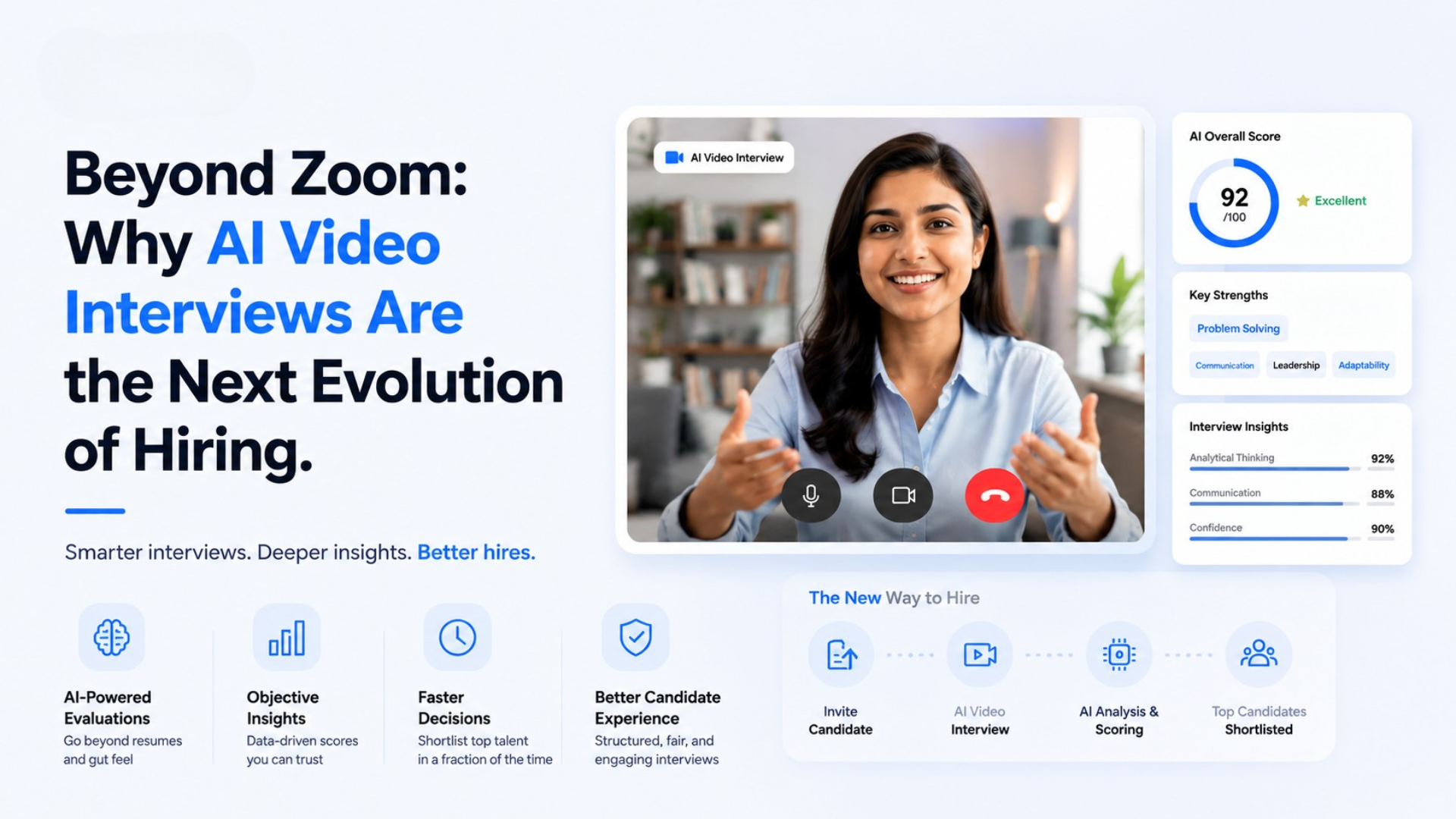
An AI video interview operates on a fundamentally different architecture. The video component is not the product — it is the input. The product is the evaluation.
At the most basic level, an AI video interview platform performs four functions that no standard videoconferencing tool can replicate. First, it structures the interview itself, ensuring that every candidate is asked questions aligned with a predefined competency framework and that those questions probe for the same depth and specificity across all candidates. Second, it analyzes candidate responses in real time, evaluating content, linguistic structure, and conversational dynamics against the role-specific evaluation criteria. Third, it generates a structured evaluation report — typically within minutes of the interview's conclusion — that provides competency scores, notable strengths, potential concerns, and a comparative ranking against other candidates in the pipeline. Fourth, it feeds this evaluation data back into the broader recruiting pipeline, creating a continuous data trail that improves both current and future hiring decisions.
This architecture produces a qualitatively different output than a videoconference. A recruiter who conducts five Zoom interviews in a day has five sets of handwritten notes, varying in completeness and quality, that they must somehow synthesize into a hiring recommendation. A recruiter who reviews five AI-generated interview profiles has five structured, comparable evaluations that they can discuss with hiring managers using a shared analytical framework. The time difference is significant — G2's video interviewing platform reviews indicate that recruiters using AI evaluation reports spend 60% less time on candidate comparison and shortlist development. But the more important difference is the quality of the decision: structured, data-driven evaluations consistently outperform unstructured impressions, regardless of the evaluator's experience level.
Gartner's HR technology research projects that by 2027, more than 60% of mid-market and enterprise organizations will use AI-enhanced interview tools for at least some portion of their hiring process, up from approximately 25% in 2024. This adoption trajectory is not driven by hype — it is driven by measurable outcomes that recruiting leaders can no longer ignore.
Structured Questions, Consistent Evaluation: The Core Advantage
The single most impactful feature of AI video interviews is not the artificial intelligence itself. It is the structure that the AI enables and enforces. Decades of research in industrial-organizational psychology have established that structured interviews — where all candidates are asked the same questions, evaluated against the same criteria, and scored using the same rubric — dramatically outperform unstructured interviews in predicting job performance. The Society for Industrial and Organizational Psychology (SIOP) has published meta-analyses showing that structured interviews achieve predictive validity coefficients of 0.51 to 0.63, compared to 0.20 for unstructured interviews. In practical terms, a well-structured interview is more than twice as effective at identifying candidates who will succeed in the role.
The problem has always been implementation. Conducting truly structured interviews in a traditional format requires significant upfront work — developing competency frameworks, writing calibrated questions, training interviewers on rubric-based scoring, and maintaining consistency across multiple interviewers over weeks or months of hiring activity. Most organizations attempt this, achieve partial compliance for a few months, and then gradually revert to their natural unstructured approach as operational pressures mount. The structure degrades not because anyone actively decides to abandon it, but because maintaining structure across a high-volume, fast-paced recruiting operation is genuinely difficult without technological enforcement.
AI video interview platforms solve this enforcement problem. The AI does not forget to ask the follow-up question. It does not skip a competency area because the conversation flowed in a different direction. It does not apply a more lenient standard to the last candidate of the day because the interviewer is tired. Every candidate, regardless of when they interview, who they interview with, or how many candidates have been evaluated before them, receives a consistent, thorough, and calibrated evaluation. This consistency is not theoretical — it is engineered into the system architecture.
For recruiting teams that have struggled to maintain interview structure at scale — which is to say, virtually all recruiting teams — this capability represents a step-change in evaluation quality without requiring additional training, process redesign, or management overhead. The platform enforces the structure. The recruiter benefits from the consistency. The hiring manager receives better shortlists. The organization makes better hires.
Real-Time Analysis: What the AI Actually Evaluates
Understanding what AI video interview platforms analyze helps recruiters interpret evaluation outputs more intelligently and set appropriate expectations for the technology's capabilities. The analysis typically operates across three domains: content, linguistic structure, and conversational dynamics.
Content analysis evaluates what candidates say. The natural language processing engine assesses whether candidate responses demonstrate the specific competencies the role requires. For a product management role, the AI might evaluate whether the candidate describes prioritization frameworks, references specific methodologies like RICE or MoSCoW, provides quantified outcomes from product decisions, and demonstrates awareness of cross-functional stakeholder dynamics. This is not keyword matching — the AI evaluates the substance and specificity of the response, distinguishing between a candidate who says "I managed a product launch" and one who describes the launch process, the decisions made, the trade-offs navigated, and the measurable results achieved. Research from the MIT Sloan Management Review has shown that AI content analysis in hiring contexts produces evaluations that correlate more strongly with on-the-job performance than resume keyword matching, precisely because it evaluates demonstrated capability rather than claimed credentials.
Linguistic structure analysis evaluates how candidates construct their responses. This domain captures dimensions that are extremely difficult for human interviewers to assess consistently: whether candidates lead with evidence or assertion, whether they acknowledge limitations and trade-offs, whether they use concrete specifics or vague generalities, and whether their response structure demonstrates the kind of organized thinking that predicts effective performance in complex roles. Research published in the Journal of Applied Psychology has found that linguistic structure variables — particularly the ratio of concrete examples to abstract statements and the degree to which candidates acknowledge counterarguments — are significant predictors of both job performance and promotability.
Conversational dynamics analysis evaluates the interaction itself. This includes response latency, which can indicate preparation versus improvisation ability. It includes adaptiveness — how well the candidate adjusts when the AI asks an unexpected follow-up or redirects the conversation. It includes topic coherence, measuring whether candidates maintain focus on the question asked or drift into rehearsed talking points. And it includes engagement consistency, tracking whether the candidate's energy, clarity, and responsiveness remain stable throughout the interview or deteriorate in later stages. For roles that require sustained interpersonal effectiveness — sales, consulting, leadership, client management — these dynamic indicators provide predictive insight that static evaluations cannot capture.
Asynchronous AI Interviews: Eliminating the Scheduling Trap
One of the most practically significant differences between AI video interviews and standard videoconferencing is the availability of asynchronous formats. In an asynchronous AI interview, the candidate completes the interview at their convenience, responding to AI-generated questions through video recording, text, or a hybrid format. There is no scheduling required, no time zone coordination, and no risk of technology failures disrupting a live conversation.
For high-volume recruiting operations, the scheduling elimination alone justifies the technology investment. Jobvite's recruiting benchmarks estimate that scheduling logistics consume an average of 23 minutes per candidate across the entire hiring process — including email exchanges, calendar coordination, rescheduling due to conflicts, and time-zone troubleshooting. For a pipeline of 200 candidates, that is 77 hours of pure administrative overhead. Asynchronous AI interviews reduce this to near zero, because the candidate initiates the interview when they are ready, and the platform processes it immediately upon completion.
The asynchronous format also improves candidate experience in a counterintuitive but well-documented way. Candidates — particularly senior candidates — appreciate the ability to complete an interview at a time that suits their schedule, in an environment they control, without the performance anxiety that accompanies live video calls. LinkedIn's candidate experience research found that 68% of candidates prefer asynchronous interview formats for initial screening rounds, citing flexibility and reduced stress as the primary reasons. The preference is even stronger among passive candidates — the high-performers who are currently employed and exploring opportunities cautiously — who are often the most desirable candidates in any pipeline.
For roles where live interaction is essential — executive positions, client-facing roles, or positions requiring real-time communication assessment — synchronous AI interviews provide the live format with AI analysis layered on top. The best platforms, including Huntlo.ai, offer both formats and allow recruiting teams to select the appropriate modality based on the role level, volume requirements, and evaluation objectives. The key insight is that the technology does not force a one-size-fits-all approach. It provides a toolkit that recruiting teams can configure to their specific operational context.
From Interview Data to Hiring Intelligence
The most strategically valuable difference between AI video interviews and standard videoconferencing is not what happens during the interview itself but what happens to the data afterward. In a traditional video interview, the data — the conversation, the observations, the evaluator's impressions — exists in fragmented form across recruiter notes, hiring manager recollections, and possibly a video recording that nobody will ever rewatch. This data is difficult to aggregate, impossible to analyze at scale, and completely lost when the recruiter who conducted the interview leaves the organization.
AI video interview platforms treat interview data as a strategic asset. Every conversation generates structured evaluation data that feeds into an organizational talent intelligence database. Over time, this database reveals patterns that inform both current and future hiring decisions: which competency indicators most strongly predict success in specific roles, which interview questions produce the most differentiating responses, how candidate quality varies by sourcing channel, and what the typical profile of a high-performing hire looks like for each role family in the organization.
Korn Ferry's talent analytics research has documented that organizations with mature talent intelligence capabilities — built on structured hiring data — make 28% faster hiring decisions and produce 18% higher new-hire performance ratings compared to organizations that rely on individual recruiter expertise without systematic data capture. The compounding nature of this advantage is significant: each search generates data that improves the next search, creating a self-reinforcing cycle of better hiring outcomes.
This intelligence advantage extends beyond individual searches to strategic workforce planning. When an organization can analyze aggregated interview data across hundreds or thousands of candidates, it gains insight into the talent landscape itself — where the strongest candidates are coming from, what skills are becoming more or less available in the market, and how competitive positioning affects candidate quality. Deloitte's workforce analytics team has described this capability as "external talent market intelligence," and they identify it as one of the most underdeveloped strategic assets in most organizations. AI video interview platforms generate the raw material for this intelligence as a natural byproduct of their core function, at no additional cost or effort.
Addressing the Legitimate Concerns
Recruiters and hiring managers who are skeptical of AI video interviews deserve serious, specific answers to their concerns. Three objections surface most frequently, and each deserves a direct response.
"AI cannot evaluate the things that matter most." This concern typically reflects an experience with low-quality AI tools that perform surface-level analysis. Advanced AI video interview platforms evaluate precisely the dimensions that matter most in hiring: demonstrated competence through specific examples, structured thinking through response organization, adaptability through conversational dynamics, and communication effectiveness through linguistic analysis. These are not proxies for judgment — they are the observable indicators that research has validated as predictors of on-the-job performance. What AI cannot evaluate — and should not attempt to evaluate — are subjective dimensions like "cultural chemistry" or "executive presence" that have weak predictive validity and high susceptibility to bias. Reframing the evaluation around validated, observable competencies is not a limitation of AI. It is an improvement over the subjective criteria that have produced inconsistent hiring outcomes for decades.
"Candidates will hate it." The evidence consistently contradicts this concern. Talent Board's CandE Awards research shows that candidate satisfaction with AI interview processes, when properly implemented, is equal to or higher than satisfaction with traditional interview processes. The key variables are transparency — candidates should know AI is involved and understand what it evaluates — and experience design — the interview should feel professional, relevant, and respectful of the candidate's time. Organizations that achieve high candidate satisfaction scores with AI interviews typically invest in candidate communication, provide clear instructions and technical support, and offer feedback to candidates who complete the process. These are practices that improve candidate experience regardless of the technology used, but they are particularly important when the technology introduces novelty or uncertainty.
"It is too expensive or complex to implement." The cost and complexity objection was more valid three years ago than it is today. The market has matured significantly, and platforms like Huntlo.ai offer AI-powered sourcing across 50+ platforms, multi-channel candidate outreach via email, LinkedIn, WhatsApp, and AI voice, conversational AI screening, and structured interview evaluation — all for a flat $99 per seat per month with no per-candidate or per-interview charges. The implementation timeline for most mid-market organizations is measured in days, not months, because modern AI recruiting platforms are designed as cloud-native tools that integrate with existing ATS systems through standard APIs and webhook configurations. The total cost of ownership — including platform fees, implementation effort, and recruiter training — is typically lower than the cost of the administrative overhead that the platform eliminates.
The Evidence Base: What Research Actually Shows
Skepticism about new hiring technology is healthy and appropriate. Recruiting decisions have real consequences — for organizations, for hiring managers, and for candidates. Any technology that influences these decisions should be evaluated against rigorous evidence, not marketing claims. The evidence base for AI video interviews, while still developing, is substantial and growing.
A meta-analysis by the National Bureau of Economic Research examining AI-assisted hiring tools across multiple organizations and industries found that AI screening produced a 15% to 25% reduction in demographic disparities in hiring outcomes compared to traditional unstructured interviews. The improvement was attributed to the AI's consistent application of evaluation criteria, which eliminated the variability in human interviewers' standards that disproportionately affects underrepresented candidates. Importantly, this diversity improvement was achieved without any reduction in hiring quality — the AI-screened hires performed equally well or better on job performance metrics.
Heidrick & Struggles' leadership assessment research compared hiring outcomes for senior roles evaluated through AI-enhanced structured interviews versus traditional unstructured panel interviews. The AI-enhanced process produced a 40% reduction in time-to-hire and a measurable improvement in new-hire retention at the 18-month mark. The retention improvement was particularly significant because executive turnover is among the most costly hiring failures, with EY's workforce analytics estimating the total cost of a failed C-suite hire at two to three times annual compensation.
PwC's hiring trends analysis surveyed 500+ talent acquisition leaders and found that organizations using AI interview tools reported three primary benefits: faster time-to-shortlist (cited by 73% of respondents), more consistent candidate evaluation (68%), and reduced recruiter workload (61%). The least cited benefit — improved candidate diversity (34%) — was nonetheless significant and aligns with the NBER research on bias reduction. Notably, only 8% of respondents reported negative outcomes from AI interview implementation, and the majority of those negative outcomes were attributed to poor implementation practices rather than technology limitations.
Gallup's workplace research has added a longitudinal dimension to the evidence, tracking new-hire performance over 24 months for organizations that adopted AI interview tools. The organizations in the study reported a 19% improvement in new-hire performance ratings at the 12-month mark and a 14% improvement at 24 months, suggesting that the quality advantage of AI-evaluated hires is durable rather than a short-term novelty effect.
How Multi-Channel AI Sourcing Makes Video Interviews More Effective
AI video interviews do not operate in isolation. Their effectiveness is maximized when they are integrated with AI-powered sourcing that feeds a diverse, qualified candidate pool into the interview pipeline. The relationship between sourcing quality and interview effectiveness is straightforward: the more high-quality candidates the AI has to differentiate among, the more valuable its evaluation capability becomes. Screening 30 candidates who all applied through the same job board posting produces limited differentiation. Screening 300 candidates sourced from 50+ platforms, professional networks, and targeted outreach campaigns produces rich, actionable differentiation that directly improves shortlist quality.
This is where the integrated platform approach becomes critical. When sourcing and interviewing operate on separate systems — as they do in most recruiting technology stacks today — candidate data is lost at every handoff. The recruiter who sourced a candidate through LinkedIn knows their engagement history and communication context, but that information does not automatically transfer to the video interview platform. The AI that evaluates the candidate's interview responses does so without the sourcing intelligence that would allow it to conduct a more targeted, relevant conversation.
Platforms like Huntlo.ai eliminate these handoffs by operating sourcing, outreach, screening, and interviewing on a single integrated platform. A candidate who is first engaged through a personalized AI voice call, then continues the conversation through WhatsApp, and then completes a structured video interview generates a unified data trail that the AI can leverage at every stage. The interview conversation is informed by the sourcing data. The evaluation report incorporates the full engagement history. The shortlist recommendation reflects a comprehensive view of the candidate that no fragmented technology stack can provide.
Mercer's talent strategy research has found that organizations with integrated sourcing-to-interview pipelines produce 35% higher-quality shortlists compared to organizations where sourcing and interviewing operate on disconnected systems. The improvement is driven by two factors: better candidate pools entering the interview stage, and richer evaluation data available to the AI during the interview itself.
What the Transition Actually Looks Like
For recruiting teams considering the transition from standard videoconferencing to AI video interviews, the practical question is not whether the technology is ready — it is — but how to implement it in a way that builds organizational confidence and avoids common pitfalls.
The most effective implementation approach is phased. Begin with a single role family or a single hiring team that is open to experimentation. Use the AI video interview platform alongside your existing process for the first 20 to 30 candidates, running both the traditional phone screen and the AI interview in parallel. Compare the outputs: which candidates did each method identify as top prospects, and how did those candidates perform after being hired? This parallel-run approach generates internal evidence that is far more persuasive than vendor case studies or industry research, because it demonstrates the technology's effectiveness in your specific organizational context.
Training is essential but not extensive. Recruiters need to understand how to interpret AI-generated evaluation profiles, how to provide feedback when the AI's assessment seems off-target, and how to communicate with hiring managers about the role of AI in the evaluation process. Hiring managers need to understand what the AI evaluates and what it does not, so they can appropriately weight the AI data alongside their own judgment. Neither audience needs to become AI experts — they need to become informed consumers of AI-generated insights.
The Bureau of Labor Statistics projects that the HR technology competency requirements for recruiting professionals will continue to expand, with AI tool management, data interpretation, and ethical governance becoming standard expectations within the next five years. Recruiting teams that begin building these competencies now — through hands-on implementation experience rather than theoretical training — will have a significant competitive advantage as the technology becomes mainstream.
The Competitive Implications of Waiting
Perhaps the most compelling argument for adopting AI video interviews is the competitive risk of not doing so. In talent markets where the best candidates have multiple options and make decisions quickly, every day of delay in your hiring process is a day that a competitor can extend an offer to your first-choice candidate. Organizations using AI video interviews are making hiring decisions 35% to 50% faster than organizations relying on traditional videoconferencing interviews, according to aggregated data from multiple G2 platform reviews. This speed advantage is not theoretical — it is the daily operating reality of recruiting teams that have made the transition.
Beyond speed, there is a quality competition unfolding. As more organizations adopt AI-enhanced hiring processes, the quality bar for candidate evaluation rises across the industry. Hiring managers who experience the clarity and specificity of AI-generated candidate profiles become frustrated with the vagueness of traditional interview notes. Candidates who experience well-designed AI interview processes develop expectations about how hiring should work, and they carry those expectations to every subsequent job search. Organizations that continue to rely on unstructured Zoom interviews will find themselves competing for talent against organizations that offer faster, more consistent, and more respectful hiring processes — a competition they are structurally disadvantaged in.
The transition from Zoom to AI video interviews is not a technology upgrade. It is a strategic capability shift that affects how quickly you can hire, how accurately you can evaluate, how equitably you can assess, and how competitively you can position your organization in the talent market. The organizations that make this transition early will compound their advantage with every search. The organizations that wait will find that the competitive gap widens with every quarter of inaction.
Related Topics:
The ATS Mistake Companies Keep Repeating
How Many Follow-Ups Does One Hire Need?
Why Referrals Outperform Cold Outreach