Recruiter Outreach Has Changed More Than Candidate Sourcing
For years, recruiters believed that sourcing was the hardest part of hiring.
Finding qualified candidates meant hours of searching across professional networks, job boards, company websites, and internal databases. Recruiters relied heavily on Boolean search strings, manual filtering, and repetitive outreach campaigns to identify potential candidates.
Artificial intelligence changed that.
Modern AI recruiting software can search millions of professional profiles, recommend qualified candidates, summarize resumes, and even personalize outreach messages within seconds.
Yet something interesting happened.
Recruiters solved one problem and uncovered another.
Finding candidates became easier.
Building relationships became harder.
Candidates today expect personalized communication, quick responses, transparent hiring processes, and consistent follow-ups. Whether someone is exploring jobs near me, work from home jobs, online jobs, part time jobs, or executive leadership opportunities, expectations have changed dramatically.
Recruiters are no longer competing only for talent.
They are competing for attention.
This is precisely why platforms like Gem have become increasingly popular.
Rather than focusing exclusively on sourcing, Gem helped organizations strengthen recruiter outreach and candidate engagement through automation and relationship management.
However, recruitment has continued evolving.
Today's hiring teams expect much more than outreach software.
According to the LinkedIn Talent Solutions, improving candidate experience and recruiter productivity has become one of the defining priorities for modern talent acquisition teams. Likewise, the World Economic Forum Future of Jobs Reporthighlights how AI is reshaping workforce strategies while increasing demand for more agile recruitment technologies.
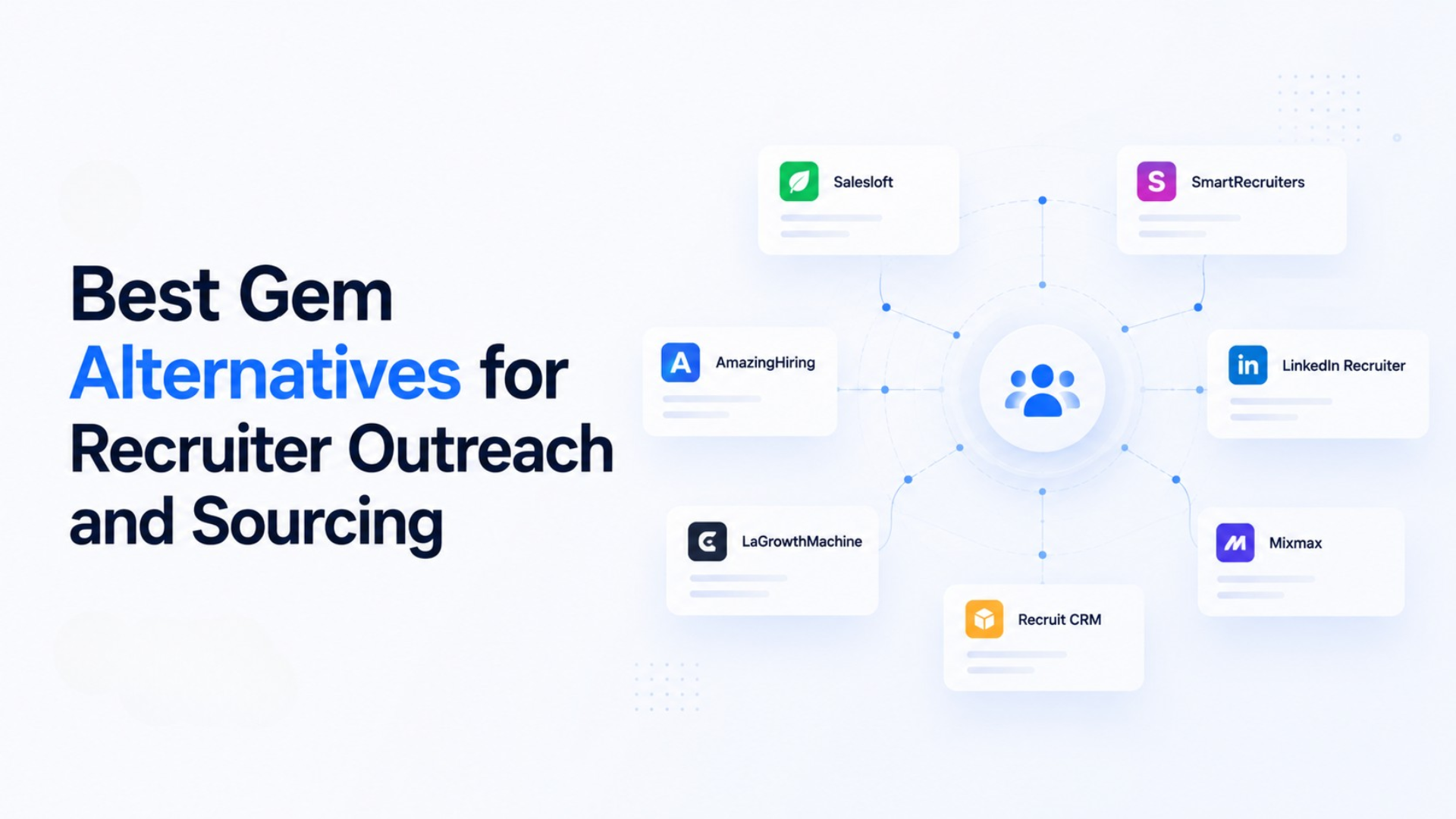
These changes explain why many organizations are evaluating Gem alternatives.
The question is no longer:
"Which platform sends the best outreach?"
Instead, recruiters increasingly ask:
"Which platform helps us build stronger hiring workflows from sourcing to placement?"
That shift has transformed how recruitment software is evaluated.
Why Companies Are Looking Beyond Gem
Gem continues to be one of the strongest recruiter engagement platforms in the market.
Its ability to manage outreach campaigns, maintain talent relationships, and provide recruiting analytics has made it particularly valuable for organizations building long-term candidate pipelines.
But outreach represents only one stage of recruitment.
Once a candidate responds, recruiters still need to schedule interviews, collaborate with hiring managers, manage applicant tracking, automate repetitive communication, and maintain visibility throughout the hiring funnel.
Using multiple disconnected systems for these activities often creates operational complexity.
This is especially true for recruitment agencies and fast-growing organizations handling dozens of open positions simultaneously.
Whether recruiting for HR jobs, recruiter jobs, freshers jobs, internship jobs, or large-scale hiring campaigns for data entry jobs, recruiters increasingly prefer connected recruiting ecosystems over standalone tools.
The industry is gradually moving away from individual point solutions toward platforms capable of managing the entire hiring lifecycle.
That evolution has encouraged many organizations to explore alternatives that combine recruiter outreach with sourcing, AI automation, workflow management, and candidate engagement.
Huntlo: Connecting Recruiter Outreach With the Entire Hiring Journey
One of the biggest differences between Huntlo and traditional outreach platforms is its broader understanding of recruitment.
Recruiter outreach does not exist in isolation.
It begins with sourcing.
It continues through personalized communication.
It extends into candidate qualification, interview scheduling, hiring collaboration, and ongoing relationship management.
Huntlo connects these activities within a single AI-powered platform.
Rather than requiring recruiters to switch between sourcing software, outreach platforms, messaging tools, applicant tracking systems, and scheduling applications, Huntlo centralizes the entire workflow.
This significantly reduces administrative effort while allowing recruiters to focus on conversations that influence hiring decisions.
That advantage becomes particularly valuable for organizations managing multiple hiring campaigns simultaneously.
Companies recruiting for jobs for women, work from home jobs for women, graduate hiring initiatives, campus recruitment, and regional expansion programs often spend more time coordinating recruitment activities than actually engaging candidates.
Simplifying these workflows creates measurable productivity gains.
Instead of positioning artificial intelligence as a replacement for recruiters, Huntlo uses AI to remove repetitive work while keeping recruiters at the center of hiring decisions.
This philosophy increasingly reflects the future direction of recruitment technology.
Ashby: Operational Excellence Through Structured Hiring
Recruitment grows more complex as organizations expand.
Hiring managers require visibility.
Recruiters need collaboration.
Leadership expects measurable hiring outcomes.
Ashby approaches these challenges through structured recruitment operations rather than focusing exclusively on sourcing or outreach.
Its combination of applicant tracking, interview scheduling, analytics, and workflow automation helps organizations build repeatable hiring processes that remain consistent as recruitment volumes increase.
According to Ashby, the platform aims to improve recruiter productivity by centralizing hiring operations and reducing operational complexity.
Rather than simply helping recruiters send more outreach messages, Ashby focuses on helping organizations build stronger hiring systems.
SeekOut: Expanding Talent Intelligence
Some organizations struggle with recruiter productivity.
Others struggle with candidate availability.
SeekOut has built its reputation around solving the second challenge.
Its AI-powered talent intelligence platform helps recruiters discover difficult-to-find professionals by combining semantic search, workforce intelligence, and skills-based discovery.
According to SeekOut, the platform specializes in identifying specialized talent across technical, healthcare, engineering, and executive hiring markets.
For organizations where sourcing remains the primary challenge, SeekOut continues to be one of the industry's strongest platforms.
However, recruiters seeking broader workflow automation often evaluate platforms that integrate sourcing with outreach, communication, and applicant management.
Greenhouse: Consistency That Scales With Your Organization
As organizations grow, hiring becomes increasingly structured.
Recruiters are no longer making decisions alone. Hiring managers, interview panels, HR business partners, department leaders, and executives all become part of the recruitment process. Without clear workflows, communication quickly becomes fragmented, interview quality varies, and hiring decisions become inconsistent.
Greenhouse has built its reputation by addressing these operational challenges.
Rather than positioning itself purely as AI recruiting software, Greenhouse focuses on structured hiring. Standardized interview scorecards, collaborative workflows, reporting capabilities, and extensive integrations help organizations build repeatable hiring processes across multiple departments and locations.
According to Greenhouse, structured hiring improves consistency while helping organizations make more objective hiring decisions. This makes Greenhouse particularly attractive for enterprise companies where governance, collaboration, and scalability are priorities.
While its sourcing capabilities are not its primary strength, Greenhouse complements organizations that value operational maturity alongside recruiting efficiency.
Lever: Recruitment Built Around Long-Term Relationships
The strongest recruiting teams rarely begin sourcing after a role opens.
Instead, they continuously build relationships with talented professionals before hiring demand exists.
This philosophy has become increasingly important as organizations compete for experienced professionals who are not actively searching through online jobs, jobs near me, or traditional job boards.
Lever was one of the earliest platforms to combine Applicant Tracking with Candidate Relationship Management, allowing recruiters to nurture talent communities over time rather than treating every hiring campaign as a separate project.
Instead of asking candidates to restart conversations every time a suitable opportunity becomes available, recruiters can maintain ongoing engagement, creating a smoother hiring experience for both sides.
According to Lever, relationship-driven recruiting helps organizations improve long-term hiring efficiency by keeping qualified candidates engaged before vacancies arise.
For businesses experiencing recurring hiring demand, this approach can significantly reduce sourcing effort over time.
hireEZ: Expanding Candidate Discovery Through AI
Although recruiter outreach has become increasingly important, sourcing remains the foundation of every successful hiring strategy.
Organizations cannot build strong candidate relationships without first discovering qualified talent.
hireEZ continues to perform exceptionally well in this area.
Its AI-powered sourcing capabilities help recruiters identify candidates across multiple professional data sources while reducing dependence on traditional keyword searches.
Instead of searching only for exact job titles, modern semantic AI identifies related skills, career progression, and contextual experience that traditional Boolean searches frequently overlook.
According to hireEZ, the platform combines sourcing, engagement, and automation to help recruiters build stronger candidate pipelines.
Organizations focused primarily on talent acquisition often continue to view hireEZ as one of the industry's strongest sourcing solutions.
SmartRecruiters: Collaboration Across Every Hiring Decision
Successful recruitment depends on more than recruiters.
Hiring managers evaluate candidates.
Department heads define role requirements.
Executives approve final offers.
HR teams manage compliance.
Candidates expect timely communication throughout the process.
SmartRecruiters has positioned itself around this collaborative hiring model by connecting every stakeholder within one recruiting environment.
Instead of optimizing only recruiter productivity, the platform simplifies communication between everyone involved in hiring while supporting enterprise-scale recruiting operations.
According to SmartRecruiters, collaborative hiring remains one of the platform's defining strengths, enabling organizations to improve decision-making while maintaining hiring consistency.
For organizations where multiple departments participate in recruitment, collaboration often becomes just as important as sourcing itself.
Manatal: AI Recruiting Without Enterprise Complexity
Not every recruiting team needs highly customized enterprise software.
Many growing businesses simply want recruiting technology that is intuitive, affordable, and capable of supporting long-term growth.
Manatal has established itself within this market by combining applicant tracking, AI-powered recommendations, recruitment CRM, and automation within an accessible platform.
Its relatively simple implementation makes it attractive for startups, SMEs, and organizations regularly hiring for freshers jobs, internship jobs, part time jobs, and regional recruitment campaigns.
Instead of overwhelming recruiters with unnecessary complexity, Manatal focuses on helping hiring teams become productive quickly while still benefiting from modern AI capabilities.
For organizations beginning their AI recruiting journey, simplicity often creates more value than extensive customization.
Fetcher: Keeping Human Recruiters at the Center
Artificial intelligence has transformed recruitment.
But successful hiring still depends on human judgment.
Recruiters evaluate communication skills.
Hiring managers assess leadership potential.
Organizations consider cultural contribution.
Candidates negotiate career opportunities.
These are decisions that AI continues to support rather than replace.
Fetcher reflects this philosophy by combining automation with recruiter oversight.
Rather than attempting fully autonomous recruitment, the platform helps recruiters automate repetitive sourcing and outreach while maintaining human involvement throughout hiring.
This approach mirrors a broader industry trend.
According to the Microsoft Work Trend Index, AI increasingly functions as a productivity partner, allowing professionals to spend less time on repetitive work and more time on strategic decision-making.
Recruitment appears to be following the same direction.
Choosing the Right Gem Alternative
Selecting recruitment software has become significantly more complex than comparing feature lists.
Organizations now evaluate platforms based on how well they support complete hiring workflows rather than isolated recruitment activities.
Some companies prioritize sourcing.
Others prioritize outreach.
Some require analytics.
Others focus on automation.
Increasingly, however, recruiting teams are seeking platforms capable of connecting every stage of hiring into one streamlined experience.
This shift explains why integrated recruiting platforms continue gaining momentum.
Instead of maintaining five or six disconnected applications, organizations are simplifying recruitment technology by consolidating sourcing, communication, screening, scheduling, and candidate management into unified ecosystems.
This is where Huntlo distinguishes itself.
Rather than specializing in one stage of recruitment, Huntlo supports the complete hiring journey—from AI-powered sourcing and recruiter outreach to workflow automation, interview coordination, candidate engagement, and ongoing relationship management.
For modern recruitment teams, reducing operational complexity often creates greater long-term value than adding another specialized tool.
Final Thoughts
Gem remains one of the market's leading recruiter outreach platforms.
Its ability to strengthen candidate engagement and improve recruiter productivity continues to make it a valuable solution for many organizations.
However, recruitment has evolved beyond outreach alone.
Today's hiring teams need connected workflows.
Candidates expect seamless communication.
Recruiters require automation.
Leadership expects measurable business outcomes.
As these expectations continue growing, organizations are naturally evaluating platforms capable of supporting every stage of recruitment rather than individual activities.
That evolution explains why Gem alternatives continue attracting attention in 2026.
Not because outreach has become less important.
But because recruitment itself has become more connected.
For organizations looking to combine sourcing, recruiter outreach, AI automation, candidate engagement, and workflow management within one platform, Huntlo offers one of the strongest alternatives available today.
The future of recruitment isn't about using more software.
It's about using smarter software that enables recruiters to spend more time connecting with people and less time managing technology.
Frequently Asked Questions
What is the best Gem alternative in 2026?
The best alternative depends on your hiring goals. Organizations looking for an end-to-end AI recruiting workflow often evaluate Huntlo alongside platforms such as Ashby, SeekOut, Greenhouse, and Lever.
Is Gem primarily an outreach platform?
Gem is widely recognized for recruiter outreach, candidate engagement, recruiting CRM, and analytics. Companies seeking broader recruiting workflows often compare it with integrated AI recruiting platforms.
Which AI recruiting software is best for recruiter outreach?
Modern recruiting platforms increasingly combine outreach automation with sourcing, AI screening, workflow management, and candidate engagement, allowing recruiters to manage the complete hiring lifecycle from one platform.
Can AI improve recruiter productivity?
Yes. AI automates repetitive tasks such as sourcing, candidate communication, scheduling, and administrative workflows, allowing recruiters to focus on relationship building and hiring decisions.
Why are companies moving toward integrated recruiting platforms?
Managing multiple disconnected recruiting tools often creates operational complexity. Integrated platforms simplify hiring by combining sourcing, outreach, automation, applicant tracking, and candidate engagement into one connected workflow.