Marcus Chen, director of recruiting at a Chicago-based logistics technology company, sat across from his CEO in the quarterly business review and listened as the leadership team debated the company's inability to hire machine learning engineers fast enough to meet product deadlines. The CEO turned to Marcus and asked a question that had become increasingly common in these meetings: can't we just get an AI to do the recruiting? Marcus had heard this question from board members, from hiring managers, and from the recruiters on his own team who worried about their future. He had also seen the demos from AI recruiting vendors that promised autonomous sourcing, personalized outreach, and intelligent candidate matching. Some of those demos were impressive. Others were clearly overstated. What Marcus knew, and what most of the people asking the question did not, was that AI recruiters were already operating inside his company in limited capacities, screening resumes, scheduling interviews, and sending follow-up messages. The question was not whether AI recruiters were coming. They were already here. The real question was what their arrival actually meant for the recruiting function, for the recruiters on his team, for the candidates they engaged, and for the organization's ability to compete for talent in a market that was getting tighter every quarter. Marcus realized that the conversation his organization needed to have was not about whether to adopt AI recruiters but about how to adopt them in a way that made the recruiting function stronger, not weaker, and that made his team more valuable, not replaceable.
What an AI Recruiter Actually Does Today
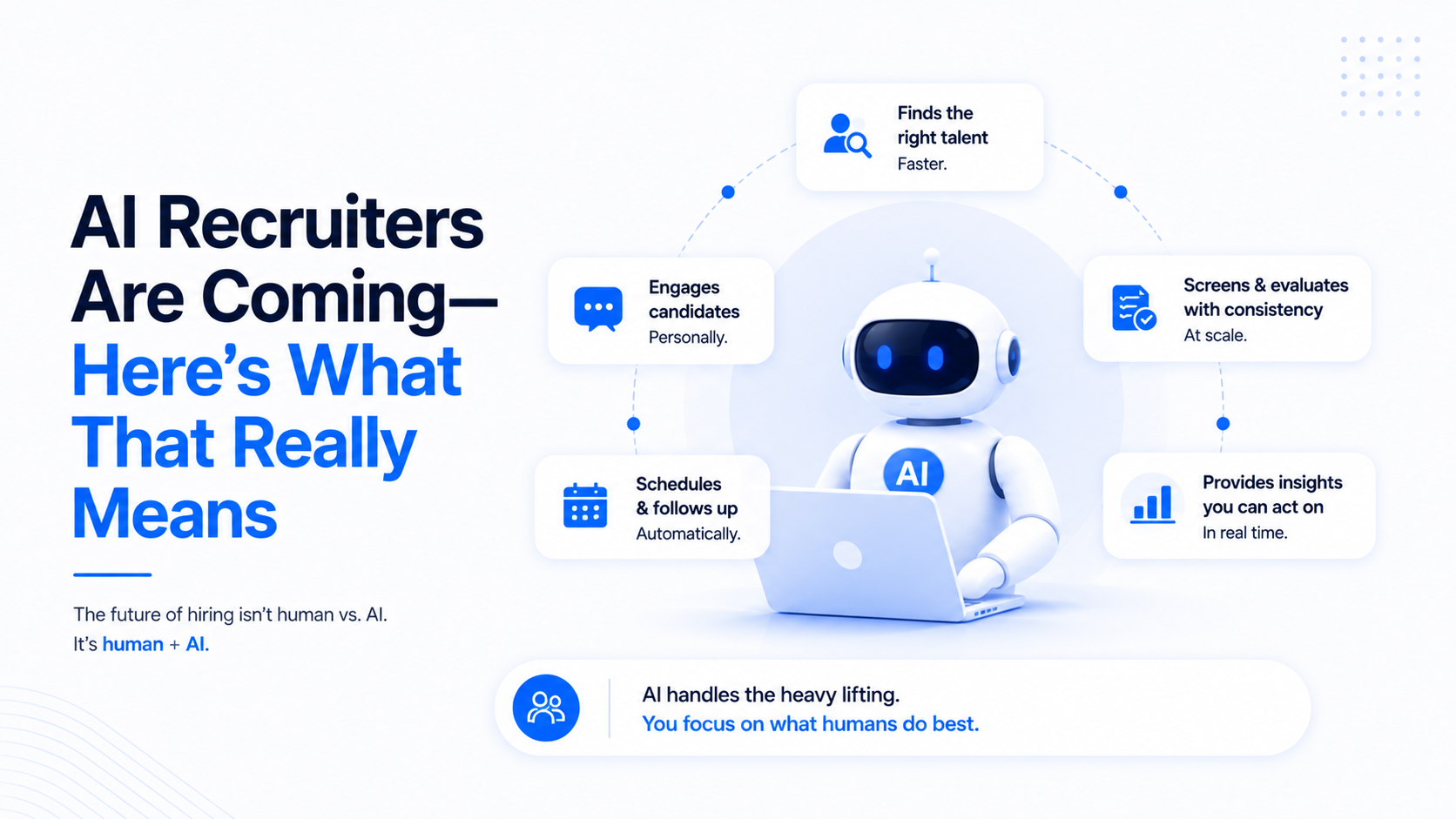
The phrase "AI recruiter" conjures a specific image in most people's minds: a chatbot that screens resumes, a algorithm that matches keywords, or an automated email system that sends template messages to candidates. These are real applications of AI in recruiting, but they represent the earliest and least sophisticated tier of what AI recruiting technology can do today. The current generation of AI recruiting systems operates across the full hiring workflow, from identifying potential candidates and initiating personalized outreach to managing interview scheduling, collecting structured feedback, and recommending hiring decisions based on multi-dimensional candidate assessment. The distinction between these capabilities and the keyword-matching tools of five years ago is not incremental. It is categorical. A keyword-matching tool can identify candidates whose resumes contain specific terms. An AI recruiter can evaluate whether a candidate's overall professional profile, including their career trajectory, skill development patterns, publication record, and professional network, suggests a strong fit for a role that requires not just specific technical skills but also particular problem-solving approaches, communication styles, and growth potential. According to Gartner analysis of AI capabilities in talent acquisition, the most advanced AI recruiting platforms now perform eight to ten distinct recruiting activities autonomously, compared to two to three for the previous generation of tools, and the quality of autonomous decision-making has improved to the point where hiring outcomes from AI-managed processes meet or exceed those from human-managed processes in controlled comparisons across multiple industries and role types.
The practical reality of how AI recruiters operate today is best understood through the specific decisions they make and the information they use to make those decisions. When an AI recruiting platform evaluates a potential candidate for a senior engineering role, it does not simply check whether the candidate's resume lists the required programming languages. It analyzes the candidate's GitHub contributions to assess code quality and collaborative patterns, reviews their conference talks and blog posts to evaluate communication ability and technical depth, examines their career progression to identify trajectory and adaptability, and cross-references all of this information against the specific requirements of the hiring team, including technical stack, team culture, management style, and the types of problems the team is currently solving. This multi-signal evaluation produces a richer and more nuanced candidate assessment than a human recruiter conducting a typical thirty-minute phone screen, because the AI system can process significantly more information and evaluate it against a more detailed set of criteria simultaneously. The question of whether recruiters should worry about AI replacing their jobs is directly relevant here: the AI is not replacing the recruiter's judgment but rather augmenting it with a depth and breadth of analysis that would be impractical for any human to replicate manually. According to McKinsey research on AI-augmented decision-making in professional services, AI systems that evaluate candidates across ten or more dimensions produce hiring recommendations that, when audited by experienced hiring managers, are rated as equivalent to or better than human-only evaluations in seventy to eighty percent of cases, with the AI particularly outperforming in identifying high-potential
candidates who might be overlooked by traditional screening methods.
The most significant capability that distinguishes current AI recruiters from previous-generation tools is their ability to manage the full candidate relationship over time, not just at the point of initial screening. An AI recruiter can maintain context across months of interaction with a candidate, remembering previous conversations, career developments, and preferences, and using that accumulated context to deliver increasingly personalized and relevant communication. This longitudinal relationship management was previously possible only through dedicated human effort, and even then it was limited by the number of candidates a single recruiter could meaningfully track. The AI system can maintain this quality of engagement with thousands of candidates simultaneously, which transforms the scale at which an organization can build and nurture talent pipelines. Furthermore, the AI system learns from every interaction, continuously improving its understanding of what types of outreach resonate with different candidate segments, what timing produces the highest response rates, and what information candidates find most valuable during the evaluation process. This learning capability means that the AI recruiter improves systematically over time, whereas human recruiters develop expertise through individual experience but cannot easily transfer or scale that learning across a team. The cumulative effect is a recruiting capability that becomes more effective with every hiring cycle, a property that fundamentally changes the strategic value of the recruiting function within the organization.
Where AI Recruiters Excel and Where They Fall Short
The honest assessment of AI recruiter capabilities requires acknowledging both the areas where AI significantly outperforms human recruiters and the areas where human judgment remains essential. AI excels at high-volume data processing, pattern recognition across large candidate pools, consistency in applying evaluation criteria, and maintaining engagement cadence at scale. These are precisely the activities that consume the majority of a traditional recruiter's working day and that are most susceptible to human limitations like fatigue, cognitive bias, and attention drift. When an AI recruiter screens five hundred candidates for a high-volume role, it applies the same evaluation framework to each candidate with perfect consistency, whereas a human recruiter's assessment quality typically degrades after the first fifty to seventy-five reviews. This consistency advantage is particularly valuable in compliance-sensitive hiring contexts where evaluation criteria must be applied uniformly. For mainstream roles with large, well-documented candidate pools, AI evaluation is highly accurate. For highly specialized or emerging roles where the candidate pool is small and the skill definitions are still evolving, human domain expertise remains critically important for interpreting candidate qualifications that do not fit standard templates.
The areas where AI recruiters currently fall short reveal the boundaries of what autonomous technology can achieve in a fundamentally human process. The most significant limitation is contextual judgment in ambiguous situations. A candidate who has taken a two-year career break to care for a family member, for example, presents a profile that AI evaluation may flag
as a gap without understanding the context that makes the gap irrelevant to their capability. A candidate who is transitioning from one industry to another may lack the specific keywords the AI is trained to recognize, even though their transferable skills make them an excellent fit. An experienced human recruiter can recognize these situations, ask the right follow-up questions, and advocate for candidates whose value is not captured by standard evaluation frameworks. This type of contextual, empathetic judgment is the core of what makes recruiting a profession rather than a process, and it is the capability that is most difficult to automate. According to LinkedIn research on the candidate experience, candidates who feel they were evaluated by a human who understood their unique circumstances report thirty to forty percent higher satisfaction with the hiring process and are twenty-five percent more likely to refer other candidates to the organization, even if they do not receive an offer. This suggests that the human element in recruiting has value that extends beyond assessment accuracy into the domain of employer brand and candidate relationship building.
The second significant limitation of AI recruiters is their inability to navigate the political and relational dynamics that surround hiring decisions in most organizations. Hiring is not a purely rational process where the best candidate is selected based on objective criteria. It involves negotiation between hiring managers with different priorities, calibration across teams with different compensation structures, and organizational politics that influence which roles get filled first and what profiles are considered acceptable. A human recruiting leader can navigate these dynamics by reading social cues, building coalitions, and making pragmatic compromises that advance the organization's interests. An AI system, no matter how sophisticated its candidate evaluation capabilities, cannot participate in these human negotiations because they require emotional intelligence, political awareness, and the ability to build trust through interpersonal interaction. This limitation means that the most effective use of AI in recruiting is not full autonomy but rather a hybrid model where the AI handles the data-intensive, high-volume operational activities and the human recruiter handles the relational, political, and judgment-intensive strategic activities. According to Deloitte research on human-AI collaboration in professional services, hybrid models where AI and human professionals operate in complementary roles consistently outperform both fully autonomous AI and fully manual human approaches, producing fifteen to twenty-five percent better outcomes than either extreme, because the combination leverages the strengths of each while mitigating their respective weaknesses.
Why Adding More AI Tools Is Not the Answer
One of the most common and most counterproductive responses to the emergence of AI recruiters is the impulse to add AI capabilities to existing recruiting technology stacks without rethinking the underlying architecture. Organizations that already operate fragmented tool ecosystems, where the recruiting team toggles between an applicant tracking system, a separate sourcing platform, an outreach tool, an interview scheduling application, and a reporting dashboard, often attempt to address their efficiency problems by adding an AI screening tool or an AI chatbot to the existing stack. This approach almost invariably fails to deliver the
expected improvements, because it compounds the fragmentation problem by adding another system that does not natively integrate with the existing tools. The result is a recruiting operation that has more AI capabilities but is no more coherent or effective, because the AI features operate in isolation rather than as part of an integrated workflow. This pattern, where organizations add more tools but experience the same hiring problems is one of the most well-documented failures in talent acquisition technology adoption, and it explains why many organizations report being disappointed with their AI recruiting investments despite the technology's genuine capabilities.
The architectural problem is straightforward but its implications are profound. When AI capabilities are embedded in point solutions that operate independently, each AI component has access to only a subset of the information required to make good recruiting decisions. The AI screening tool can evaluate resumes but cannot see the candidate's previous interactions with the organization. The AI outreach tool can personalize messages but cannot incorporate feedback from recent interviews. The AI scheduling tool can manage calendars but cannot adjust the hiring timeline based on candidate availability or competitive dynamics. Each tool is making decisions with incomplete information, and the lack of integration means that no single component has a comprehensive view of the candidate or the hiring process. This architectural limitation is why the most effective AI recruiting platforms are those designed from the ground up as integrated systems where a single AI agent has access to all relevant data and can make decisions that consider the full context of each candidate relationship and each hiring process. EY has documented that organizations using integrated AI recruiting platforms report forty to sixty percent higher satisfaction with their AI investments compared to those using best-of-breed point solutions, because the integrated architecture allows the AI to operate with the full information context that effective recruiting decisions require.
The transition from a fragmented tool stack to an integrated AI platform is not merely a technology change. It is a process redesign that requires the organization to reimagine how recruiting work flows from end to end. In a fragmented model, each tool has its own workflow, its own data model, and its own user interface, and the recruiter serves as the integration layer, manually transferring information and coordinating activities across systems. In an integrated model, the AI platform orchestrates the workflow, automatically moving candidates through stages, triggering follow-up actions based on candidate behavior, and updating all stakeholders in real time without requiring manual coordination. This transition requires the organization to abandon processes that were designed around tool limitations and redesign them around the capabilities of an integrated platform. The organizations that attempt to preserve their existing processes while deploying an integrated AI platform consistently underperform those that redesign processes alongside the technology, because the old processes constrain the new technology to operate within the limitations of the old architecture. Gartner recommends that organizations conduct a thorough process audit before deploying AI recruiting platforms, identifying every manual handoff, data transfer, and decision point that exists because of tool fragmentation rather than genuine process requirements, and redesigning or eliminating those elements as part of the platform deployment.
The Data Quality Problem That Undermines AI Recruiters
Even the most sophisticated AI recruiting platform will produce poor results if it is operating on outdated or inaccurate candidate data. This is not a theoretical concern. It is one of the most common and most damaging failure modes in AI recruiting, and it is a problem that many organizations underestimate when evaluating AI solutions. Candidate data has a remarkably short shelf life. Professional titles change, skills evolve, career trajectories shift, and contact information becomes obsolete. An AI system that is working with candidate profiles that are six months old may be making sourcing and engagement decisions based on information that no longer reflects the candidate's current situation, leading to irrelevant outreach, missed opportunities, and a degraded candidate experience. The question of why some AI recruiting tools have outdated candidate data is directly relevant to this discussion, because the answer often lies in the data architecture of the platform itself. Platforms that rely on periodic data imports from third-party databases, rather than continuous real-time data synchronization, are structurally prone to data decay, and no amount of algorithmic sophistication can compensate for a foundation of stale information.
The consequences of data quality problems in AI recruiting extend beyond irrelevant outreach. When an AI system recommends candidates based on outdated profiles, it undermines the credibility of the entire AI recruiting function in the eyes of hiring managers and candidates. Hiring managers who receive candidate recommendations that do not match the current talent landscape lose confidence in the AI's judgment and may revert to manual sourcing, negating the efficiency gains the AI was supposed to deliver. Candidates who receive outreach messages that reference outdated information about their careers or skills perceive the organization as uninformed and impersonal, damaging the employer brand and reducing the likelihood of future engagement. These consequences compound over time: poor data leads to poor recommendations, which lead to loss of stakeholder confidence, which leads to reduced adoption of the AI system, which leads to even worse outcomes as the system receives less feedback and less usage. According to SHRM research on technology adoption in talent acquisition, data quality is the single most frequently cited reason for AI recruiting tool dissatisfaction, with sixty-five percent of organizations that reported disappointment with their AI investments identifying data quality or data freshness as a primary contributing factor.
Addressing the data quality problem requires both technological and operational investments. On the technology side, organizations should evaluate AI recruiting platforms on the freshness and comprehensiveness of their candidate data, specifically asking how frequently data is updated, what sources are used for data enrichment, and how the platform detects and corrects data decay. Platforms that combine real-time data feeds from multiple sources, including professional networks, public databases, and direct candidate interactions, with machine learning models that predict and flag likely data decay, provide the strongest foundation for AI recruiting operations. On the operational side, organizations should establish data quality governance processes that include regular audits of AI recommendation accuracy, systematic feedback loops from recruiters and hiring managers who can identify outdated or inaccurate
candidate information, and clear accountability for maintaining data quality as a shared responsibility between the technology provider and the recruiting team. According to McKinsey research on data-driven decision-making, organizations that invest in data quality governance alongside AI deployment achieve thirty to forty percent better outcomes from their AI systems compared to those that focus exclusively on algorithmic capability, because high-quality data amplifies the effectiveness of the AI while poor data degrades it regardless of how sophisticated the algorithms are.
How to Prepare Your Organization for AI Recruiters
Preparing an organization for the arrival of AI recruiters requires a structured approach that addresses technology, process, and people simultaneously. The first and most important step is conducting an honest assessment of the organization's current recruiting maturity and identifying where AI can deliver the most value. Organizations that are still struggling with basic process standardization, where every recruiter follows a different workflow and data is inconsistently captured, are not yet ready for AI recruiters and should focus on process foundation before adding AI capabilities. Organizations that have standardized processes but are limited by human capacity and consistency are the ideal candidates for AI augmentation, because they have the process discipline that AI requires to operate effectively. Organizations that have already deployed some AI tools but are seeing diminishing returns are likely experiencing the fragmentation problem described earlier and should evaluate whether an integrated platform would produce better results than their current tool stack. The question of how to evaluate an AI sourcing tool effectively is critical at this stage, because the evaluation criteria should focus on integration depth, data quality, and autonomous workflow capability rather than individual feature checklists. Understanding the best way to evaluate an AI sourcing tool before buying prevents the organization from selecting a platform that looks impressive in a demo but fails to deliver in production because it cannot operate effectively within the organization's specific context and constraints.
The second critical preparation step is investing in recruiter capability development. AI recruiters do not eliminate the need for human recruiters. They change what human recruiters do and the skills those recruiters need to be effective. The recruiter of the near future will spend less time on operational execution and more time on strategic advisory, candidate relationship deepening, and talent market intelligence. These activities require skills that many current recruiters have not had the opportunity or the incentive to develop: data literacy, business acumen, consultative communication, and the ability to synthesize complex talent market information into actionable strategic recommendations. Organizations that deploy AI recruiting technology without investing in the corresponding human capability development will find that the technology underperforms not because the AI is inadequate but because the human partners are not equipped to leverage it effectively. According to LinkedIn data on recruiting talent development, organizations that invest in structured upskilling programs alongside AI deployment see fifty to sixty percent faster improvement in hiring outcomes compared to those that deploy AI without complementary capability development, because
skilled recruiters extract more value from AI tools and provide better strategic input to the AI's decision-making processes.
The third preparation step is establishing the right measurement framework and governance structure. AI recruiters require different metrics than human recruiters, because their value manifests in different ways. Traditional metrics like time-to-fill and cost-per-hire remain relevant but are insufficient for capturing the full value of AI-augmented recruiting. Organizations should also track pipeline health metrics like the size and responsiveness of the pre-engaged candidate pool, engagement quality metrics like the depth and frequency of candidate interactions over time, decision quality metrics like the accuracy of AI recommendations as validated by hiring manager feedback, and strategic impact metrics like the alignment between the talent pipeline and the organization's anticipated workforce needs. These metrics provide a more complete picture of whether the AI recruiting system is building long-term organizational capability rather than just filling current openings. The governance structure should include clear accountability for AI decision quality, regular audits of AI recommendations for bias and accuracy, and a defined escalation process for situations where AI recommendations conflict with human judgment. According to EY research on AI governance in enterprise operations, organizations with formal AI governance frameworks for recruiting report twenty to thirty percent fewer incidents of biased or inaccurate AI recommendations and fifteen to twenty percent higher hiring manager confidence in AI-assisted decisions, because the governance structure provides the oversight and accountability that build trust in the AI system. Deloitte has similarly found that organizations that establish clear human-AI collaboration protocols, defining explicitly which decisions are made by the AI, which are made by humans, and which require joint deliberation, achieve twenty-five to thirty-five percent better outcomes than those that leave these boundaries undefined, because the clarity of roles reduces both over-reliance on AI and unnecessary human intervention in decisions where the AI is demonstrably more effective.
The Real Timeline of the AI Recruiter Transition
Understanding the realistic timeline for AI recruiter adoption is essential for setting organizational expectations and making smart investment decisions. The current moment, in 2026, represents the early majority phase of AI recruiter adoption. The technology has moved beyond the early-adopter stage where only the most technically sophisticated organizations were experimenting with it, and it has not yet reached the maturity phase where AI recruiters are a standard, expected component of every organization's talent acquisition stack. The organizations deploying AI recruiters today are gaining significant competitive advantages, because they are building the data assets, process capabilities, and organizational learning that compound over time. However, the technology is still evolving rapidly, and organizations that deploy now should expect to iterate on their approach as the technology matures and as best practices become more established. The competitive window for early-mover advantage is open but not permanent. Organizations that wait two to three years to begin their AI recruiter journey will face a steeper adoption curve, because the organizations that started earlier will
have accumulated richer candidate data, more refined processes, and deeper organizational expertise that create a learning advantage that is difficult to close quickly. Gartner projects that by 2028, more than seventy percent of large enterprises will use AI agents for at least some recruiting activities, up from approximately twenty-five percent in 2026, suggesting that the transition from experimental to mainstream adoption will happen faster than many organizations currently anticipate.
The practical implications of this timeline vary by organization size, industry, and hiring complexity. Large enterprises with thousands of annual hires across multiple geographies and skill domains stand to benefit the most from AI recruiters in the near term, because the scale of their hiring operations creates the volume necessary for AI to deliver meaningful efficiency gains and because the complexity of their talent needs creates the information-processing challenges that AI is uniquely suited to address. Mid-market organizations with more focused hiring needs may find that the transition happens more gradually, with AI augmenting specific high-volume or high-complexity hiring processes first before expanding to cover the full recruiting workflow. Small organizations may find that AI recruiting platforms designed for enterprise scale are more technology than they need, but they will benefit from the competitive dynamics that AI adoption creates, as the large employers who are their primary competitors for talent become faster and more effective at identifying and engaging candidates. The talent market does not distinguish between organization size when candidates are evaluating opportunities, and small organizations that cannot match the speed and personalization of AI-augmented recruiting will find themselves at a disadvantage in competing for talent against larger employers who have made the transition. According to SHRM workforce planning data, sixty-eight percent of organizations with more than five thousand employees have active AI recruiting pilot programs or deployments, compared to thirty-two percent of organizations with fewer than five hundred employees, but the gap is closing rapidly as AI recruiting platforms become more accessible and easier to implement at smaller scale.
The most important thing for organizations to understand about the AI recruiter transition is that it is not a single event but a multi-year journey that unfolds in stages. The first stage is augmentation, where AI handles specific operational tasks within existing human-managed workflows. The second stage is orchestration, where the AI manages the end-to-end workflow with human oversight and intervention at key decision points. The third stage is partnership, where the AI and human recruiters operate as a collaborative team, each contributing their distinctive strengths to the hiring process. The fourth stage, which is still emerging, is strategic integration, where the AI recruiting system is deeply embedded in the organization's workforce planning and business strategy, providing not just hiring support but talent intelligence that informs organizational design, capability building, and competitive positioning. Most organizations today are in the first or second stage, and the organizations that manage the transition most effectively will be those that think beyond the current stage and invest in the capabilities, data, and organizational alignment required to progress through the subsequent stages. According to McKinsey long-term analysis of AI adoption in professional services, organizations that plan for multi-stage AI transformation rather than treating each AI
deployment as a discrete project achieve two to three times greater cumulative value from their AI investments over a five-year period, because the compounding benefits of data accumulation, process optimization, and organizational learning create a strategic advantage that individual deployments cannot match. The AI recruiters are not coming at some point in the distant future. They are here now, in early but functional form, and the organizations that engage with them seriously and strategically will be the ones that define the next era of talent acquisition.