Natalie Park, chief talent officer at a Seoul-based e-commerce company with eighteen thousand employees, received the third resignation letter in six weeks from a senior engineer who was leaving for the same competitor. Each departure followed the same pattern. The engineer had been approached by the competitor with a personalized message that demonstrated detailed knowledge of their work and career interests. The competitor's hiring process had been fast, responsive, and respectful of the engineer's time. The offer had been competitive but not dramatically higher than what Natalie's company could have matched. The engineer's stated reason for leaving was not about compensation. It was about the recruiting experience itself. They felt more valued by the competitor's process than by their current employer's, and this perception, shaped by the speed, personalization, and professionalism of the competitor's AI-driven hiring process, had been the deciding factor. Natalie ordered a competitive analysis of the competitor's talent acquisition capabilities and discovered that they had deployed an AI recruiting platform eighteen months earlier. The platform had enabled continuous talent intelligence, proactive candidate engagement, and a hiring experience that her own team, operating on traditional methods, could not match at scale. She was not losing a talent competition based on employer value. She was losing based on recruiting model, and no amount of employer brand investment would close that gap without a fundamental shift in how her organization competed for talent.
The New Competitive Battlefield for Talent Is AI-Driven
Natalie Park, chief talent officer at a Seoul-based e-commerce company with eighteen thousand employees, lost three senior engineers to the same competitor in a single quarter of 2025. In each case, the competitor had identified the engineer, initiated contact, conducted interviews, and extended an offer before Natalie's team had even begun sourcing for comparable roles. When she investigated how the competitor was moving so fast, she discovered that they had deployed an AI recruiting platform that operated autonomously across the full hiring workflow, maintaining a continuous talent pipeline and engaging candidates proactively rather than reactively. Her team, by contrast, was still operating on the traditional model, waiting for a requisition to open, running a sourcing sprint, and initiating outreach manually. The competitor was not winning because they offered higher compensation or a stronger employer brand. They were winning because their AI system identified and engaged candidates weeks before Natalie's team knew those candidates were available. This experience, where an organization loses talent not because of an inferior value proposition but because of an inferior recruiting model, is becoming increasingly common as AI adoption in talent acquisition accelerates. According to research from McKinsey, organizations that have deployed AI-driven recruiting capabilities are filling critical roles thirty to fifty percent faster than those relying on traditional methods, creating a speed advantage that is often the decisive factor in competitive talent markets where top candidates receive multiple offers within days of becoming available.
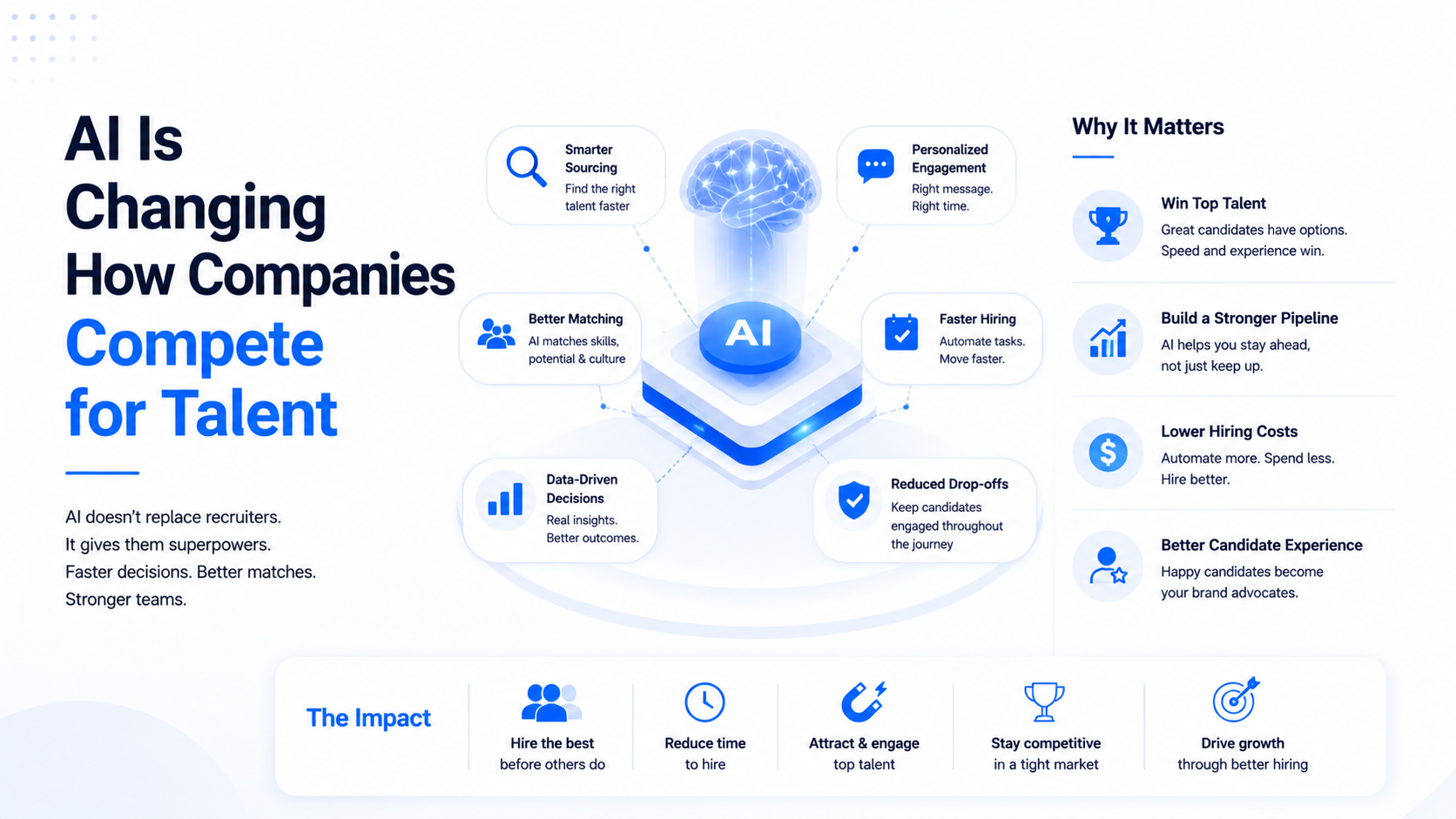
The competitive dynamics of AI-driven talent acquisition are fundamentally different from the competitive dynamics of the traditional model. In the traditional model, companies compete for talent primarily through employer brand, compensation, and role appeal. These factors remain important, but they are now necessary conditions rather than sufficient ones. A strong employer brand and competitive compensation will not win a talent competition if the organization's recruiting process is too slow to reach the candidate before competitors do. AI introduces a new competitive dimension, the speed and intelligence of the recruiting process itself, which operates independently of employer brand and compensation. An organization with a mediocre employer brand but an AI-driven recruiting process that identifies and engages candidates in hours rather than weeks can outcompete an organization with a strong employer brand but a slow, manual recruiting process. This shift in competitive dynamics means that AI is not merely a tool for improving recruiting efficiency. It is a competitive weapon that changes the calculus of talent competition. Gartner has identified AI-driven recruiting speed and intelligence as an emerging competitive differentiator, projecting that by 2028, organizations without AI-native recruiting capabilities will face significant competitive disadvantage in talent acquisition, particularly for high-demand roles where candidate availability is limited and competitor response times are measured in hours rather than weeks.
The competitive advantage created by AI in talent acquisition is not a one-time gain. It is a compounding advantage that grows stronger over time. An AI recruiting system that operates across the full hiring workflow learns from every candidate interaction, every hiring decision, and every market signal, becoming progressively more effective with each cycle. Early adopters are building AI systems that have been learning for years, accumulating data about
which candidate profiles succeed in their organization, which outreach strategies generate the highest response rates, and which assessment methods most accurately predict on-the-job performance. Late adopters must build these capabilities from scratch, and they face the additional challenge of competing for talent against organizations whose AI systems are already operating at a high level of effectiveness. This compounding dynamic, where early adoption creates a self-reinforcing advantage, means that the window for organizations to begin building AI-driven recruiting capabilities is narrowing. The most advanced expression of this competitive advantage is found in an agentic AI recruiting platform that continuously learns and improves, creating a talent acquisition capability that becomes more effective with every hire and increasingly difficult for competitors to replicate.
Speed, Intelligence, and the Three New Dimensions of Talent Competition
AI-driven talent competition operates along three dimensions that did not exist in the traditional model, and organizations that compete effectively on all three gain a decisive advantage. The first dimension is speed. In a market where top candidates make decisions within days, the speed of the recruiting process is itself a competitive factor. AI systems compress every stage of the hiring process: initial candidate identification and engagement happens within hours of a role opening rather than weeks, assessment decisions are delivered in real time rather than after manual review, interview scheduling is resolved in minutes rather than days of email coordination, and offer recommendations are generated immediately after the final interview rather than after days of manual analysis. The cumulative effect of compressing every stage is a hiring process that operates on a fundamentally different timeline than the traditional model. According to LinkedIn talent acquisition research, organizations with AI-compressed hiring timelines are thirty-five to forty-five percent more likely to win competing offer situations, because they reach candidates earlier, maintain engagement more consistently, and deliver offers before competitors have completed their initial screening. In talent markets where speed is a proxy for how much an organization values a candidate, a fast process is itself a competitive advantage that no amount of employer branding can fully compensate for.
The second dimension is intelligence. Traditional recruiting competes on the breadth of sourcing, the number of candidates identified, and the efficiency of screening. AI-driven recruiting competes on the depth of understanding, how well the organization knows each candidate, each role, and the fit between them. An AI system can evaluate a candidate's career trajectory, project complexity, skill adjacency, and learning velocity alongside traditional qualifications, producing a richer and more accurate assessment than keyword matching or checklist evaluation. It can identify candidates from non-traditional backgrounds who possess the capabilities the role requires but would be filtered out by conventional screening. It can adapt its engagement strategy based on each candidate's specific behavior signals, providing a personalized experience that demonstrates the organization's genuine interest in the individual
rather than processing them as one of many. This intelligence advantage is particularly powerful in competitive talent markets where multiple organizations are pursuing the same candidates, because the organization with the deepest understanding of the candidate's motivations and context can craft the most compelling value proposition. The distinction between AI that optimizes individual tasks and AI that provides intelligence across the full lifecycle, explored in analyses of the difference between AI sourcing and AI recruiting, determines whether an organization competes on operational efficiency or on the quality of its talent decisions, and the organizations competing on decision quality consistently outperform those competing on throughput volume.
The third dimension is adaptiveness. The talent market changes continuously. Skill demand shifts, compensation benchmarks move, candidate expectations evolve, and competitive dynamics shift with every new entrant and every new hiring initiative. Traditional recruiting processes adapt slowly because they depend on human analysis of market data, manual adjustment of search criteria and outreach strategies, and organizational approval cycles for process changes. AI-driven recruiting processes adapt continuously because the system monitors market signals in real time, adjusts its behavior based on incoming data, and optimizes its strategies without requiring human intervention for every adjustment. When candidate response rates to a particular outreach approach decline, the system modifies its messaging. When a competitor launches a major hiring initiative that affects the talent pool for a shared skill set, the system adjusts its sourcing and engagement strategy to account for the increased competition. When compensation market data shifts, the system updates its offer recommendations accordingly. This continuous adaptiveness means that an AI-driven recruiting function is always operating on current market intelligence rather than periodic market snapshots. According to Deloitte research on competitive talent dynamics, organizations with real-time adaptive recruiting capabilities respond to market changes forty to fifty percent faster than those relying on periodic analysis, because the AI system processes market signals as they emerge rather than waiting for quarterly or monthly reports to reveal trends that have already shifted the competitive landscape.
How AI Changes the Talent Competition for Candidates and Employers
The transformation of talent competition by AI affects both sides of the hiring equation, candidates and employers, and the changes are mutually reinforcing. For candidates, AI-driven recruiting raises the baseline expectation for the hiring experience. Candidates who interact with an AI system that responds within hours, provides personalized communication, and manages the process smoothly begin to expect this level of service from every employer. When they encounter an employer whose hiring process is slow, impersonal, and fragmented, the contrast is stark and negatively impactful. This rising expectation baseline means that organizations with traditional recruiting processes are not just competing against the AI-driven processes of their competitors. They are competing against the expectations that those
AI-driven processes have created in the candidate population. The candidate pool has been conditioned by consumer technology and by the best recruiting experiences to expect responsiveness, personalization, and respect for their time, and they increasingly perceive employers who fail to meet these expectations as unserious about talent. This dynamic is particularly intense in the referral hiring channel, where candidates who are referred by employees have high expectations because they are engaging based on a trusted recommendation. Research on why referrals outperform cold outreach shows that referred candidates expect a significantly better hiring experience than cold-sourced candidates, and when the experience fails to meet that expectation, the candidate not only withdraws but the referring employee's trust in the organization's talent capabilities is damaged, creating a double loss.
For employers, AI changes the talent competition by expanding the competitive field and compressing the decision window. Before AI, companies primarily competed for talent against local and regional employers who could reach the same candidate pool through similar channels. AI-driven sourcing and remote work have expanded every role competition to a global scale, meaning that a company in Bangalore is now directly competing for software engineers against companies in San Francisco, Berlin, and Singapore. This expansion of the competitive field increases the number of competitors for every open role, compresses the timeline for candidate engagement, and raises the importance of recruiting process quality as a differentiator. An employer that can identify a candidate, understand their context, craft a compelling personalized message, and deliver a smooth, fast hiring experience will win against an employer that offers slightly higher compensation but delivers a slow, impersonal process. This is a fundamentally different competitive environment than the one that existed five years ago, and organizations that have not adapted their recruiting model to this reality are competing with outdated strategies in a market that has moved past them. EY analysis of global talent competition dynamics has found that the expansion of competitive fields through AI-driven sourcing and remote work has increased the average number of competing employers for high-demand technical roles from three to four to seven to ten, while the average time available to engage a top candidate before they accept an offer has decreased from fourteen days to five days, fundamentally changing the speed and sophistication required to compete effectively.
The mutual reinforcement between rising candidate expectations and expanding employer competition creates a feedback loop that accelerates AI adoption. As more organizations deploy AI-driven recruiting, the candidate experience baseline rises, which increases the competitive pressure on organizations that have not yet adopted AI, which drives further AI adoption, which raises the baseline again. This feedback loop is self-reinforcing and progressive, meaning that the competitive pressure to adopt AI in recruiting will continue to increase regardless of any individual organization's decisions. Organizations that adopt early and build effective AI-driven recruiting capabilities will benefit from the rising baseline because their systems are already delivering the experience that candidates expect. Organizations that delay adoption will face a progressively widening gap between candidate expectations and their recruiting process capability, making it harder to attract top talent and increasing the urgency of
adoption. According to SHRM talent acquisition benchmarking data, organizations that deployed AI recruiting capabilities before 2026 report thirty to forty percent higher candidate satisfaction scores than those that have not yet deployed, and the gap is widening as AI-adopting organizations continue to improve while non-adopters remain static. The feedback loop ensures that early adoption is rewarded and delayed adoption is penalized, creating strategic urgency for talent acquisition leaders.
Where AI Gives the Biggest Competitive Edge in Talent Markets
While AI provides competitive advantages across all hiring categories, the edge is largest and most decisive in specific talent market conditions where traditional recruiting methods are most constrained. The first and most impactful condition is high-demand, low-supply talent markets, where the ratio of qualified candidates to open roles is unfavorable. In these markets, the organization that identifies and engages candidates first has a significant advantage, because the candidate is likely to receive multiple offers and the first employer to deliver a compelling experience often wins. AI systems provide this first-mover advantage by maintaining continuous talent intelligence and initiating engagement proactively rather than waiting for a requisition-driven sourcing sprint. The advantage is particularly pronounced for specialized roles where the qualified candidate pool is small and difficult to identify through conventional search methods. Research on whether AI recruiting tools work for niche or technical roles demonstrates that the competitive advantage of AI-driven recruiting is widest in precisely these markets, because the AI's ability to identify transferable skills, evaluate non-obvious candidate-fit patterns, and engage candidates with contextually personalized messaging is most valuable when the conventional talent pool is too small to meet demand and competitive intensity is highest.
The second condition where AI provides a decisive competitive edge is in high-volume hiring scenarios where quality constraints make the volume-quality trade-off particularly challenging. Organizations undergoing rapid scaling, launching new product lines, or entering new markets often need to hire large numbers of people quickly without sacrificing quality. Traditional recruiting handles volume by increasing the number of recruiters and sourcing channels, which increases throughput but often degrades quality as recruiters handle larger pipelines with less time per candidate. AI handles volume by maintaining consistent quality at scale, applying the same depth of evaluation and personalization to every candidate regardless of pipeline size. The system does not experience the fatigue, cognitive overload, and time pressure that cause human recruiters to shortcut their evaluation and engagement processes when volumes are high. This means that the organization can scale its hiring without the quality degradation that typically accompanies growth in traditional recruiting operations. According to McKinsey research on scaling hiring operations, organizations using AI-driven recruiting to manage volume-quality trade-offs during growth phases achieve twenty-five to thirty-five percent better new-hire performance ratings and fifteen to twenty percent higher retention at the twelve-month mark compared to those using traditional high-volume recruiting methods, because the AI system maintains evaluation quality and engagement consistency
across the entire pipeline regardless of size.
The third condition is in competitive employer markets where multiple organizations are pursuing the same candidate pool and differentiating on recruiting process quality is a significant advantage. In technology hubs like Silicon Valley, financial centers like London and New York, and emerging tech ecosystems like Bangalore and Berlin, the same candidates are often being pursued by five to ten organizations simultaneously. In these markets, the employer brand, compensation, and role content that candidates compare across opportunities are often similar, and the hiring experience itself becomes a decisive differentiator. A candidate choosing between two comparable offers will often select the employer that provided a faster, more responsive, and more personalized hiring experience, because the experience signals how the organization will treat them as an employee. AI-driven recruiting provides this experiential advantage by ensuring that every interaction is timely, personalized, and coherent across the entire process. According to LinkedIn data on candidate decision factors in competitive markets, the quality of the hiring experience ranks among the top three factors influencing offer acceptance when compensation and role content are comparable, and organizations with AI-driven processes consistently outperform those with traditional processes on experience quality metrics, giving them a decisive edge in the most competitive talent markets.
Building an AI-Driven Talent Competition Strategy
The strategic implication for talent acquisition leaders is that AI is no longer an optional efficiency tool. It is a competitive necessity that determines whether the organization can compete effectively for the talent it needs. Building an AI-driven talent competition strategy requires a systematic approach that addresses technology, data, process, and organizational capability. The first strategic priority is deploying an AI recruiting platform that operates autonomously across the full hiring workflow rather than deploying individual AI tools for specific tasks. The competitive advantages of speed, intelligence, and adaptiveness emerge from the integration of AI capabilities into a coherent system, not from the deployment of individual tools. An AI screening tool that evaluates resumes faster than a human does not create a competitive speed advantage if the outreach, scheduling, and offer processes remain manual and slow. The platform must orchestrate the entire workflow to compress the end-to-end timeline and deliver the coherent, responsive candidate experience that competitive talent markets demand. Gartner recommends evaluating AI recruiting platforms on their ability to operate as autonomous agents across the full hiring lifecycle, because this orchestration capability is what produces the competitive speed and intelligence advantages that individual tools cannot deliver.
The second strategic priority is investing in the data infrastructure that enables intelligent, adaptive recruiting. AI systems compete for talent more effectively when they have access to comprehensive, current, and integrated data from every relevant source. This includes internal data, applicant tracking systems, performance management records, compensation databases, and workforce planning models, and external data, professional network signals,
market intelligence feeds, and competitive hiring dynamics. The integration of internal and external data is what enables the AI system to make decisions that are both organizationally relevant and market-aware, combining an understanding of what the organization needs with an understanding of what the market offers. Organizations that invest in data integration before deploying AI recruiting achieve significantly better competitive outcomes, because the AI's decisions are informed by a complete picture rather than a partial one. The third strategic priority is redefining success metrics to reflect competitive positioning rather than internal efficiency. Traditional recruiting metrics, cost-per-hire, time-to-fill, and recruiter productivity, measure internal process efficiency. In an AI-driven competitive environment, the metrics that matter are competitive, win rate against competing offers, speed advantage relative to competitors, candidate experience quality relative to market expectations, and quality-of-hire improvement over time. These competitive metrics focus the organization on outcomes that determine talent market success rather than process throughput. Deloitte research on talent acquisition strategy recommends that organizations shift at least half of their recruiting performance metrics to competitive benchmarks by 2027, because internal efficiency metrics create a false sense of progress when the organization is losing ground to competitors who are improving faster.
The fourth and final strategic priority is building the organizational capability to sustain competitive advantage over time. AI-driven competitive advantage in talent acquisition is not a one-time technology deployment. It is a continuously evolving capability that requires ongoing investment in data quality, model refinement, process optimization, and team development. The AI system must be continuously trained on new hiring outcome data to improve its accuracy. The recruiting team must continuously develop the strategic advisory skills that the AI-augmented model requires. The hiring manager relationship must continuously evolve from service delivery to strategic partnership. And the organization must continuously monitor the competitive landscape to identify new threats and opportunities. Organizations that treat AI deployment as a one-time project rather than an ongoing capability consistently see their competitive advantage erode as the initial improvement plateaus and competitors who continue investing catch up and surpass them. The organizations that sustain competitive advantage are those that build a learning system, where the AI, the recruiting team, and the hiring managers continuously improve based on evidence and feedback. According to SHRM research on sustained competitive advantage in talent acquisition, organizations that invest in continuous learning and improvement of their AI recruiting capabilities maintain their competitive edge for years, while those that treat the initial deployment as the end goal typically see their advantage erode within eighteen to twenty-four months as competitors adopt similar technology and the initial data advantage is exhausted. AI is changing how companies compete for talent, and the organizations that build the capabilities to compete on speed, intelligence, and adaptiveness will attract and retain the people who drive business success, while those that rely on traditional methods will find the talent they need increasingly beyond their reach.