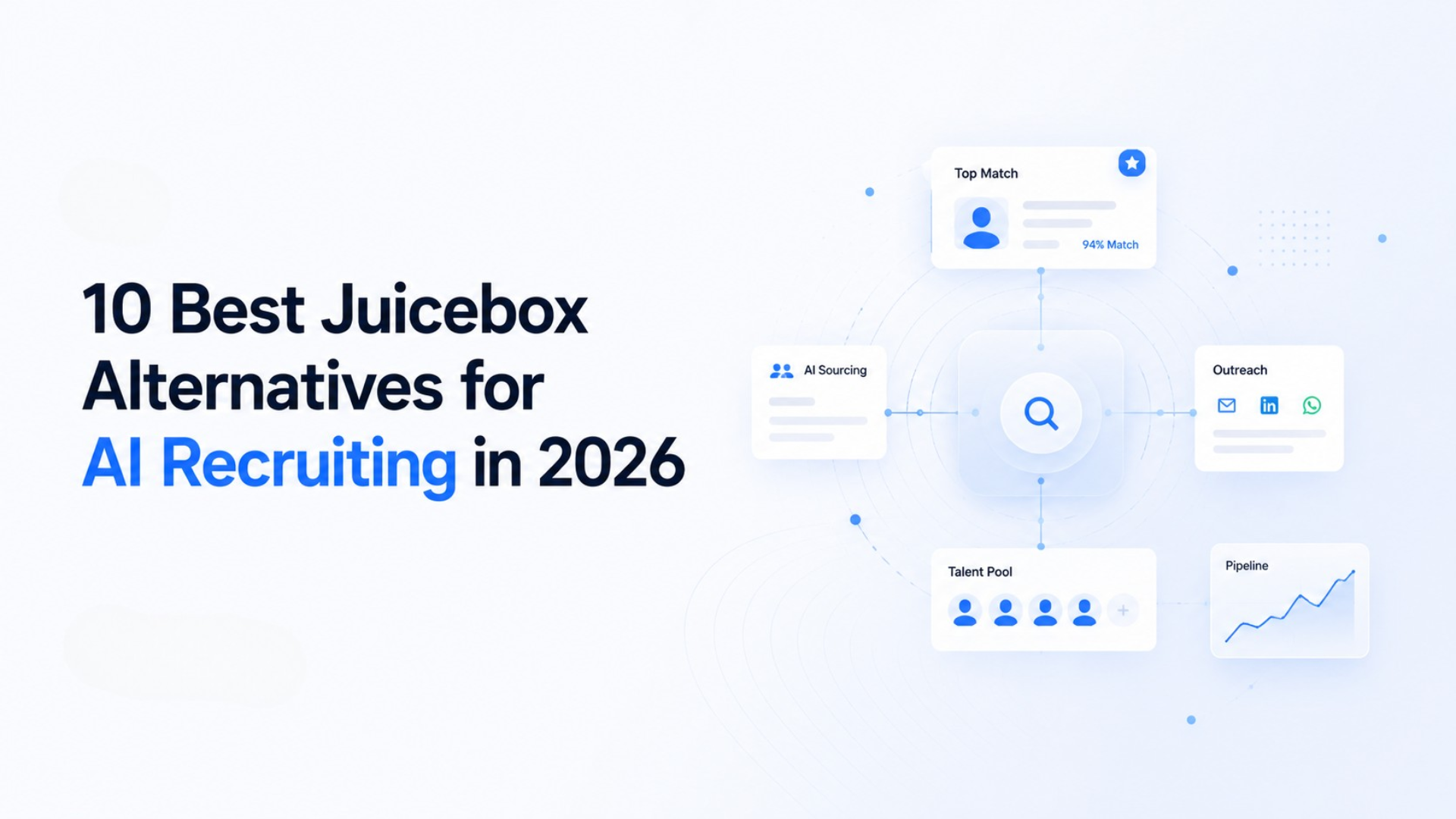
AI recruiting software is evolving rapidly. Here's why many recruiting teams are looking beyond Juicebox—and which platforms are redefining hiring in 2026.
Recruitment has changed more in the last three years than it did in the previous decade.
Not long ago, sourcing candidates was the most difficult part of hiring. Recruiters spent hours building Boolean search strings, switching between LinkedIn, job boards, spreadsheets, and email just to create a shortlist. Today, artificial intelligence has transformed that process. AI can identify candidates in seconds, personalize outreach, automate follow-ups, and even assist with interview scheduling.
But sourcing candidates is no longer the biggest challenge.
Modern recruiting teams are expected to deliver an exceptional candidate experience while hiring faster with fewer resources. A recruiter may be filling multiple job vacancy requests simultaneously—ranging from HR jobs and recruiter jobs to internship jobs, freshers jobs, and highly specialized technical roles. At the same time, candidates are searching for opportunities through increasingly diverse channels, using queries such as jobs near me, work from home jobs, online jobs, part time jobs, and jobs for freshers.
This shift has changed what organizations expect from recruitment software.
Finding candidates is only one part of the hiring journey. Today's recruiting platforms must also help teams engage talent, automate repetitive work, coordinate interviews, and maintain consistent communication across every stage of the recruitment process.
That is why many organizations evaluating AI recruiting software are beginning to look beyond Juicebox.
Juicebox has earned recognition for simplifying AI-powered sourcing, but as recruitment operations become more sophisticated, many businesses are searching for platforms that combine sourcing with broader recruiting capabilities. Whether you're scaling a startup, running a recruitment agency, or managing enterprise hiring, the right platform depends on how your recruitment process has evolved—not just how many candidates it can find.
According to the LinkedIn Global Talent Trends and the World Economic Forum Future of Jobs Report, hiring teams are increasingly prioritizing skills-based recruitment, automation, and recruiter productivity to meet growing talent demands. These trends are encouraging organizations to invest in platforms that support the entire hiring lifecycle rather than isolated tasks.
This article explores ten of the strongest Juicebox alternatives in 2026—not simply by comparing features, but by examining how each platform fits different recruiting strategies.
Recruitment Has Moved Beyond Candidate Sourcing
The first generation of AI recruiting software focused on one objective: finding more candidates.
That made sense at the time.
Recruiters were overwhelmed by manual sourcing. Searching across professional networks, job boards, and internal databases consumed a significant portion of the hiring process. AI dramatically reduced that workload by identifying qualified candidates much faster than traditional keyword searches.
However, recruitment didn't become easier.
It simply became more complex.
Recruiters still needed to nurture passive candidates, personalize outreach, schedule interviews, collect hiring manager feedback, manage applicant tracking systems, and ensure every candidate received timely communication.
In other words, AI solved one bottleneck while exposing several others.
This is why modern AI recruiting platforms are expanding beyond sourcing.
Instead of asking, "Can this platform find candidates?", organizations are now asking:
Can it improve recruiter productivity?
Can it integrate with our existing workflow?
Can it automate repetitive administrative tasks?
Can it improve the candidate experience?
Can it help us hire better—not just faster?
These questions are shaping the next generation of recruitment technology.
Why Companies Are Looking Beyond Juicebox
Juicebox remains a capable AI sourcing platform, particularly for recruiters who want to simplify candidate discovery.
But hiring teams rarely use one tool in isolation anymore.
Recruitment has become an interconnected workflow where sourcing, communication, screening, scheduling, analytics, and collaboration all influence hiring outcomes.
Many organizations therefore begin evaluating alternatives when they require capabilities beyond sourcing alone.
For example, recruitment agencies often need a platform that combines AI sourcing with client management and outreach automation. High-growth startups may prefer software that integrates sourcing with an Applicant Tracking System (ATS). Enterprise organizations often prioritize analytics, compliance, and workflow customization.
The objective isn't necessarily replacing Juicebox because it's ineffective.
It's about finding software that aligns more closely with evolving hiring requirements.
The platforms below approach this challenge from different perspectives.
Some focus on enterprise recruitment.
Others specialize in sourcing.
Some prioritize automation.
Others emphasize candidate engagement.
Understanding those differences is far more valuable than simply comparing feature lists.
Huntlo: AI Recruiting Built Around the Entire Hiring Journey
One of the most significant differences between Huntlo and many traditional sourcing platforms is its philosophy.
Rather than treating sourcing as the destination, Huntlo treats it as the beginning of recruitment.
Modern recruiters don't just need more candidates.
They need meaningful conversations.
They need faster responses.
They need fewer manual tasks.
They need hiring workflows that remain efficient even as recruitment volumes increase.
Huntlo brings these capabilities together within a single AI-powered platform.
Instead of switching between separate sourcing tools, outreach software, spreadsheets, messaging applications, and scheduling platforms, recruiters can manage much of the hiring process from one environment.
This approach is particularly valuable for organizations hiring at scale.
Whether recruiting for data entry jobs, work from home jobs for women, campus hiring programs, or experienced leadership positions, recruiters often spend more time coordinating activities than actually engaging candidates.
Reducing that operational complexity allows recruiters to focus on relationship building rather than administration.
Another area where Huntlo differentiates itself is communication.
Recruitment increasingly happens beyond email.
Candidates respond through multiple channels, particularly mobile messaging platforms. Integrating communication directly into recruiting workflows helps reduce delays and improve engagement, especially in fast-moving hiring markets.
Rather than positioning AI as a replacement for recruiters, Huntlo uses AI to automate repetitive work while allowing recruiters to focus on the conversations that influence hiring decisions.
That philosophy reflects where modern recruitment is heading.
Not toward fully autonomous hiring.
But toward better collaboration between recruiters and intelligent software.
Ashby: Designed for Data-Driven Hiring Teams
Ashby has become one of the fastest-growing recruitment platforms among technology companies, largely because it combines applicant tracking, scheduling, analytics, and recruiting operations within a single system.
Its strength lies in visibility.
Hiring managers and recruiters gain detailed insights into pipeline performance, hiring velocity, and recruiter productivity without relying on multiple reporting tools.
For organizations making frequent hiring decisions, operational transparency can become a competitive advantage.
Rather than focusing exclusively on AI sourcing, Ashby emphasizes building measurable recruiting processes supported by automation and analytics.
This makes it particularly attractive for scaling startups and companies building structured talent acquisition functions.According to Ashby's official platform overview, the platform is
According to Ashby's official platform overview, the platform is designed to help recruiting teams centralize hiring workflows while reducing operational complexity.
Greenhouse: Built for Structured Enterprise Hiring
As organizations grow, hiring becomes less about filling vacancies and more about building repeatable systems. Recruiters aren't just managing candidates—they're coordinating hiring managers, interview panels, compliance requirements, and executive stakeholders. This is where Greenhouse has established itself as one of the most recognized recruitment platforms in the market.
Rather than positioning itself purely as an AI recruiting software, Greenhouse focuses on creating a structured hiring process. Features such as interview scorecards, structured interview workflows, and reporting help organizations make more consistent hiring decisions. This is particularly valuable for companies hiring across multiple departments where consistency matters just as much as speed.
Greenhouse has also invested in AI capabilities that assist recruiters with administrative work while allowing hiring teams to retain control over final decisions. According to the Greenhouse official website, the platform is designed to help organizations improve hiring quality through structured recruiting rather than relying solely on automation.
For companies with mature talent acquisition teams, Greenhouse remains a strong alternative to Juicebox, especially when governance, collaboration, and process standardization are priorities.
Lever: Combining ATS and Candidate Relationships
Recruitment doesn't end once someone declines an offer.
One of the biggest shifts in modern hiring is recognizing that every interaction creates a future opportunity. Candidates who aren't hired today may become ideal employees six months later.
Lever was one of the early platforms to bring Applicant Tracking and Candidate Relationship Management together. Instead of treating recruitment as a series of isolated vacancies, it encourages organizations to build long-term relationships with talent.
This approach aligns well with current recruiting trends. According to LinkedIn Talent Solutions, organizations that consistently engage passive candidates often build stronger talent pipelines than those relying only on active applicants.
For recruiters filling recurring positions—from recruiter jobs and HR jobs to specialist technical roles—relationship management has become almost as important as sourcing itself.
Lever's strength lies in helping recruiters stay connected with candidates throughout the hiring journey rather than only during active recruitment campaigns.
SeekOut: Intelligence Over Volume
Many sourcing platforms focus on finding more candidates.
SeekOut focuses on finding better ones.
Rather than presenting hundreds of potential matches, SeekOut emphasizes deep talent intelligence by analyzing skills, experience, diversity signals, and career progression. This makes it particularly attractive for organizations hiring highly specialized professionals where quality matters more than quantity.
Executive search firms, engineering teams, and organizations hiring niche talent often value this level of precision.
According to SeekOut's official platform overview, the platform combines AI-powered search with workforce intelligence to help recruiters identify talent that may be overlooked by traditional keyword-based searches.
For organizations whose hiring strategy depends on precision sourcing, SeekOut represents a compelling alternative to Juicebox.
hireEZ: Expanding Candidate Discovery
One challenge recruiters continue to face is fragmented talent data.
Candidate information exists across professional networks, public profiles, internal databases, and previous applications. Searching each source individually is time-consuming.
hireEZ addresses this challenge by combining AI sourcing with candidate engagement and recruitment automation. Rather than functioning only as a search engine, the platform aims to simplify how recruiters discover and engage talent across multiple channels.
Its AI-powered recommendations help recruiters identify candidates who may not appear in traditional Boolean searches, reducing dependence on exact job titles or keyword matching.
Organizations hiring across multiple locations or recruiting for high-volume roles often benefit from this broader sourcing capability.
More information about its sourcing technology is available on the hireEZ official website.
Gem: Turning Recruiting Data into Decisions
Recruiting teams generate enormous amounts of information.
Applications.
Response rates.
Interview feedback.
Offer acceptance.
Time-to-hire.
Unfortunately, much of this data remains underutilized.
Gem approaches recruitment through analytics and operational visibility. Instead of simply helping recruiters find candidates, it helps organizations understand what is happening throughout the hiring funnel.
Questions such as:
Which sourcing channel produces the strongest hires?
Which recruiters achieve the highest response rates?
Where do candidates drop out?
Which hiring managers create delays?
become easier to answer.
As recruitment increasingly becomes a strategic business function, analytics platforms like Gem help organizations move beyond intuition toward evidence-based hiring decisions.
SmartRecruiters: Recruiting as a Collaborative Process
Hiring has never been a recruiter-only activity.
Managers, interviewers, coordinators, executives, and HR teams all contribute to successful recruitment.
SmartRecruiters was built around this idea of collaborative hiring.
Rather than optimizing only recruiter workflows, it creates a shared hiring environment where every stakeholder can participate in recruitment without unnecessary administrative complexity.
Its marketplace of integrations also allows organizations to connect recruiting with broader HR systems, making it particularly attractive for larger enterprises.
According to the SmartRecruiters official website, the platform supports organizations looking to modernize hiring while maintaining flexibility through integrations.
Manatal: AI Recruiting for Growing Businesses
Not every company needs enterprise-level complexity.
Many startups and growing businesses simply want recruiting software that is intuitive, affordable, and capable of supporting steady hiring growth.
Manatal has positioned itself within this segment by combining applicant tracking, CRM functionality, and AI-powered candidate recommendations within an accessible platform.
Its relatively low learning curve makes it attractive for smaller HR teams that want modern recruitment capabilities without implementing multiple separate systems.
For organizations hiring across functions such as jobs for women, part time jobs, or regional hiring campaigns, ease of use can often matter more than extensive customization.
Fetcher: Blending Automation with Human Expertise
Although AI continues to automate recruiting, many organizations still value human involvement in sourcing.
Fetcher combines automation with recruiter oversight, helping organizations discover and engage candidates while maintaining quality control.
Rather than relying entirely on algorithms, the platform integrates AI recommendations with human review, reflecting the growing industry consensus that AI performs best when supporting—not replacing—recruiters.
This hybrid approach appeals to companies that want productivity gains without fully automating talent acquisition.
Choosing the Right Platform Depends on Your Hiring Strategy
One of the biggest mistakes organizations make is searching for the single "best" recruiting platform.
In reality, the best platform depends on what problem you're trying to solve.
If sourcing is your primary challenge, platforms like SeekOut or hireEZ provide powerful talent discovery capabilities.
If structured hiring and enterprise collaboration are priorities, Greenhouse and SmartRecruiters offer mature workflows.
If analytics drive decision-making, Gem delivers strong visibility across recruiting operations.
However, many organizations today are no longer looking for isolated solutions.
They want fewer tools.
Simpler workflows.
Better recruiter productivity.
The ability to source candidates, automate outreach, communicate across channels, screen applicants, and manage recruitment from one connected platform.
That broader approach is where Huntlo differentiates itself.
Instead of solving only one stage of recruitment, it brings together sourcing, AI-powered outreach, candidate engagement, screening, and workflow automation within a single ecosystem. As recruiting becomes increasingly complex, reducing operational friction often creates more value than simply adding another sourcing tool.
Final Thoughts
Artificial intelligence has fundamentally changed how recruiters discover talent.
The next transformation is how recruiters manage the entire hiring journey.
Platforms like Juicebox have helped modernize sourcing, but today's hiring environment requires much more than finding candidates. Recruiters must engage talent faster, maintain personalized communication, coordinate interviews efficiently, and deliver exceptional candidate experiences while managing growing workloads.
The strongest recruiting platforms in 2026 aren't necessarily those with the most AI features.
They're the ones that help recruiters spend less time operating software and more time building relationships with people.
For organizations seeking a platform that combines AI sourcing with end-to-end recruiting workflows, Huntlo represents one of the most complete alternatives available today—not because it tries to replace recruiters, but because it enables them to do their best work more efficiently.
Related topics
Is Juicebox Worth It in 2026? An Honest Review
Huntlo vs Juicebox vs SeekOut vs hireEZ: Pricing Compared (2026)
Best SeekOut Alternatives: Pricing and Features Compared