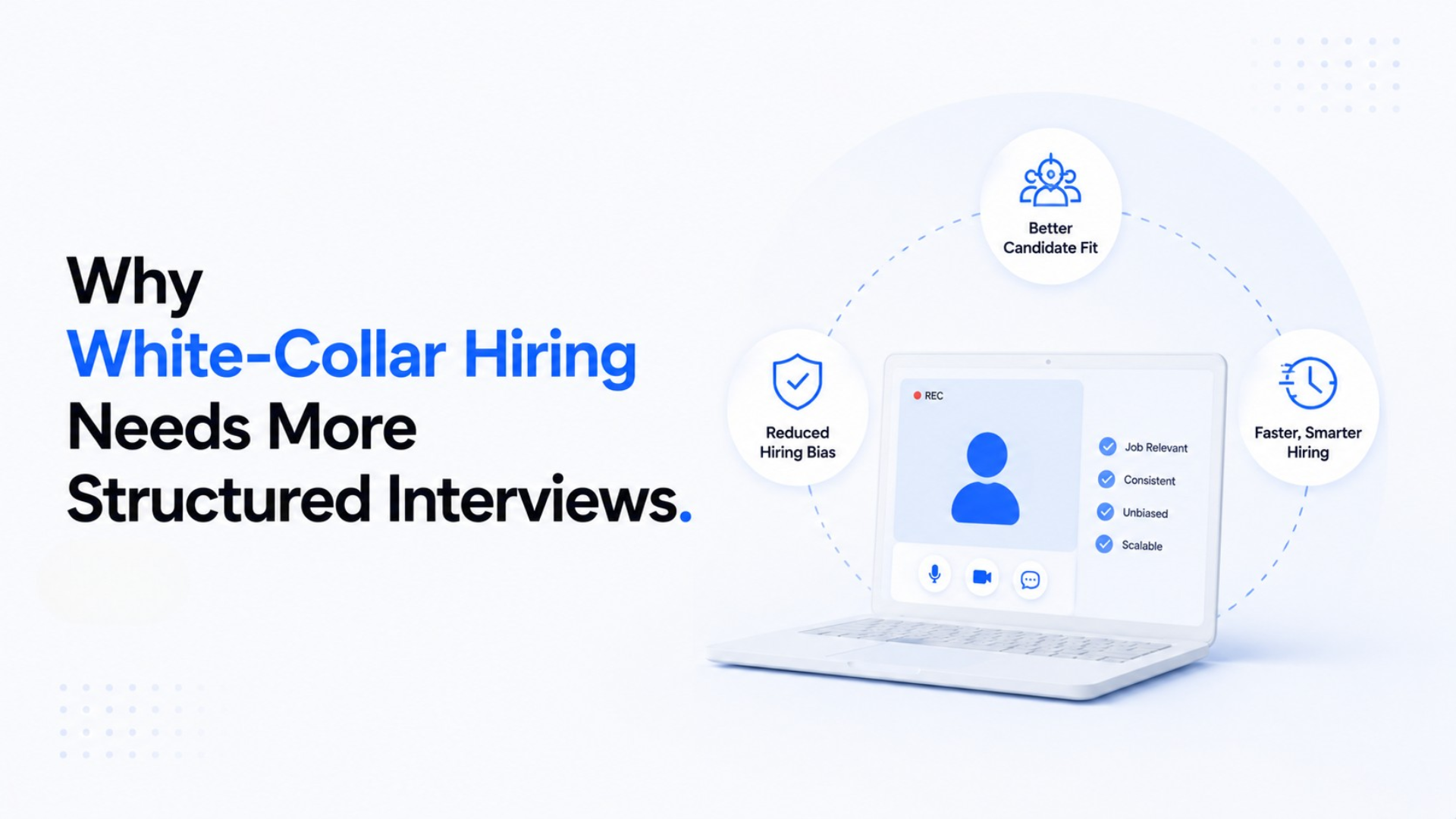
The White-Collar Hiring Double Standard
Consider two hiring scenarios at the same enterprise. A candidate for a junior financial analyst position completes a structured behavioral interview with six predefined questions, each scored against behavioral anchors on a five-point scale. A candidate for a senior finance manager position — a role with ten times the organizational impact and five times the compensation — has a 45-minute unstructured conversation with the VP of Finance about their career, their approach to leadership, and whether they would "fit" with the team.
The junior candidate is evaluated through a process that SIOP research has demonstrated achieves predictive validity coefficients of 0.51-0.63. The senior candidate is evaluated through a process that achieves predictive validity coefficients of 0.20-0.30 — barely better than random selection. The junior candidate's evaluation is documented, calibrated, and auditable. The senior candidate's evaluation exists only in the VP's memory and a few handwritten notes.
This inversion — where the highest-impact positions receive the least rigorous evaluation — is not an anomaly. It is the dominant pattern in white-collar hiring across industries, geographies, and organization sizes. A 2024 Korn Ferry analysis of 300 enterprise hiring processes found that structured interview usage decreased as role seniority increased: 73% for individual contributor roles, 41% for manager roles, 18% for director roles, and only 8% for VP-level and above positions. The positions with the greatest strategic impact are the positions least likely to be evaluated through evidence-based methods.
This article examines why this double standard persists, why it is costly, and how AI video interviews are making structured assessment practical for white-collar hiring for the first time.
Why White-Collar Hiring Resists Structure
The resistance to structured interviews in white-collar hiring is driven by a combination of cultural assumptions, organizational power dynamics, and genuine complexity concerns — some valid, most not.
The "complexity" argument. The most common objection to structured interviews for white-collar roles is that knowledge work is too complex, too contextual, and too dependent on intangible capabilities to be evaluated through standardized questions. Hiring managers argue that assessing strategic thinking, stakeholder management, or creative problem-solving requires open-ended, free-flowing conversation that cannot be reduced to a scoring rubric.
This argument confuses the complexity of the role with the complexity of the evaluation method. Complex roles require rigorous evaluation — which is precisely what structured interviews provide. A 2024 meta-analysis in Personnel Psychology examined the predictive validity of structured versus unstructured interviews specifically for professional, managerial, and executive roles. The structured format achieved validity coefficients of 0.48-0.59 for these roles — lower than for some technical positions but substantially higher than the 0.20-0.30 achieved by unstructured conversations. The complexity argument, when tested against evidence, does not hold.
The "I'll know it when I see it" belief. Many white-collar hiring managers believe that their professional experience gives them the ability to identify talent through conversational chemistry and intuitive judgment. This belief is understandable — experienced professionals have, over their careers, developed pattern-recognition capabilities that feel like reliable intuition. But research consistently shows that this intuition is far less reliable than its owners believe. A Harvard Business Review analysis of hiring manager decision-making found that hiring managers' confidence in their intuitive judgments was 2.3 times higher than the actual predictive accuracy of those judgments. The more experienced the hiring manager, the larger the gap between confidence and accuracy — a phenomenon known as the "confidence-competence paradox" in behavioral decision research.
Power dynamics. When a senior executive is the hiring decision-maker, the HR and TA professionals who would normally advocate for structured processes often lack the organizational authority to insist. The hiring process becomes whatever the executive is comfortable with — which is typically an unstructured conversation that feels natural but produces unreliable data. A Deloitte survey of 200 CHROs found that 71% described difficulty "influencing senior hiring managers to adopt structured evaluation" as a significant challenge.
Status signaling. There is a cultural assumption that unstructured, conversational interviews are a mark of respect for senior candidates — that imposing a structured assessment on an experienced professional would be demeaning. This assumption has no empirical support and considerable evidence against it. A 2024 Talent Board CandE Benchmark report found that senior candidates (director level and above) were 27% more likely than junior candidates to describe structured interviews as "more fair" and "more respectful of my time" — because structured interviews evaluated their actual competencies rather than their conversational chemistry.
The Cost of Unstructured White-Collar Evaluation
The cost of unstructured white-collar hiring is not theoretical — it is one of the largest hidden expenses in enterprise operations, and it compounds across every dimension of organizational performance.
Hiring failure rates. McKinsey's 2024 Hiring Quality report estimated that 35-45% of white-collar hires fail within the first 18 months — defined as receiving a "below expectations" performance rating, being placed on a performance improvement plan, or leaving the organization voluntarily or involuntarily. For senior white-collar roles, the failure rate rises to 50-60%. Each failed white-collar hire costs the organization between 2x and 10x annual compensation in direct costs (search, severance, replacement) and indirect costs (team disruption, strategic delay, productivity loss).
Bias amplification. Unstructured evaluation is the most bias-susceptible form of assessment available. The five major hiring biases — affinity bias, confirmation bias, halo effect, contrast effect, and attribution bias — all operate more powerfully in unstructured conversations than in structured assessments, because unstructured formats provide no constraints on the cognitive shortcuts that produce biased judgment. A McKinsey Diversity Matters analysis found that organizations using unstructured interviews for white-collar roles had 42% lower leadership diversity than organizations using structured interviews — suggesting that the resistance to structured white-collar evaluation is a primary mechanism through which leadership homogeneity is perpetuated.
Inability to improve. When white-collar hiring data is unstructured — existing in individual memories, verbal debriefs, and ad hoc notes — it cannot be analyzed, compared, or improved. Organizations cannot identify which interview questions predict performance, which evaluators are most accurate, or which competencies are most frequently mis-assessed. The hiring process operates as a black box, making the same mistakes repeatedly without the data infrastructure to detect and correct them. A SHRM study found that organizations without structured white-collar interview processes were 3.8 times less likely to have made "measurable improvements in hiring quality" over the previous three years.
Inequitable treatment. When different candidates for comparable white-collar roles are evaluated through different questions by different evaluators using different implicit standards, the process is inherently inequitable. A candidate interviewed by a probing, well-prepared evaluator faces a fundamentally different assessment than a candidate interviewed by a casual, distracted evaluator — not because of their qualifications but because of the evaluator they happened to encounter. A 2024 study in the Journal of Applied Psychology found that evaluator identity accounted for 38% of the variance in white-collar interview scores — meaning that who interviews the candidate has a larger impact on the outcome than the candidate's actual competency profile.
The Evidence: Structured Interviews Outperform for White-Collar Roles
The evidence base for structured interviews in white-collar hiring is extensive, consistent, and growing. Three categories of evidence are particularly relevant.
Predictive validity. The foundational evidence comes from the SIOP Principles, which synthesize decades of validation research. Structured interviews achieve predictive validity coefficients of 0.51-0.63 across all role types, compared to 0.20-0.38 for unstructured interviews. For professional and managerial roles specifically, the 2024 Personnel Psychology meta-analysis found structured interview validity of 0.48-0.59 versus unstructured validity of 0.22-0.31. The structured format is more than twice as predictive of actual job performance — for the same candidates, in the same roles.
Bias reduction. Structured interviews reduce every major form of hiring bias. A 2024 NBER working paper found that structured interviews reduced the gender scoring gap by 56% and the racial scoring gap by 41% compared to unstructured interviews for the same roles and candidates. The reduction was driven by three mechanisms: standardized questions prevented interviewers from asking different candidates different types of questions, anchored scoring rubrics prevented holistic impression-based evaluation, and the structured format reduced the influence of first impressions that disproportionately disadvantage candidates from underrepresented groups.
Hiring manager accuracy. Perhaps the most surprising finding is that structured interviews make hiring managers better at their own job. A Gallup study found that hiring managers who used structured interview data as the primary basis for their decisions were 34% more likely to rate their new hires as "exceeding expectations" at the 12-month mark than hiring managers who relied primarily on unstructured conversational impressions. The structured data did not replace the hiring manager's judgment — it informed it, providing an evidence base that corrected for the cognitive biases that degrade intuitive evaluation.
What Structured White-Collar Assessment Actually Looks Like
The resistance to structured white-collar interviews often stems from a misunderstanding of what "structured" means in practice. A structured interview for a senior strategy role looks very different from a structured interview for a junior analyst — but it is structured nonetheless.
A structured white-collar interview includes four non-negotiable elements. First, every candidate for a given role family is asked the same core questions. The questions may be scenario-based rather than behavioral-recall, the response time may be longer, and the follow-up probing may be deeper — but the core assessment targets are identical for every candidate. This consistency enables fair cross-candidate comparison.
Second, every response is evaluated against pre-defined competency dimensions with behavioral anchors. A "strong" response on strategic thinking is defined in advance — not left to the evaluator's post-hoc interpretation. The behavioral anchor might describe a candidate who "identifies the core strategic tension in a complex situation, evaluates at least three distinct strategic options with explicit trade-off analysis, and articulates a clear recommendation with defined implementation considerations." This specificity transforms evaluation from subjective impression to evidence-based assessment.
Third, each competency is scored independently. Strategic thinking, stakeholder management, and communication effectiveness are not merged into a single "overall impression" score. Independent dimensional scoring prevents the halo effect — where a strong response on one competency inflates scores on unrelated competencies — and provides the granular data necessary for meaningful candidate comparison and adverse impact analysis.
Fourth, the evaluation is documented in a structured, machine-readable format. This documentation enables the data analysis, continuous improvement, and regulatory compliance that unstructured processes cannot support. It also enables cross-geographic and cross-temporal comparison — a candidate evaluated in Q1 can be meaningfully compared to a candidate evaluated in Q3, because both were assessed against the same framework.
Huntlo.ai's conversational AI screening engine delivers precisely this kind of structured white-collar assessment through configurable competency frameworks, multi-round structured conversations with dynamic follow-up questions, dimensional scoring, and structured evaluation data that flows directly into the talent pool and ATS. The AI Sourcing Tools for Recruitment Team Leads: What to Prioritize article on the Huntlo blog provides guidance for TA leaders on implementing structured assessment tools within white-collar hiring teams.
The Unique Challenges of Evaluating Knowledge Work
White-collar hiring does present genuine evaluation challenges that require thoughtful interview design — challenges that structured interviews are well-positioned to address but that must be acknowledged in the design process.
Tacit knowledge is hard to assess through behavioral recall. Senior professionals often struggle to describe specific past experiences in the structured "tell me about a time when..." format because their most relevant experiences involve confidential strategic decisions, proprietary information, or complex interpersonal dynamics that cannot be disclosed in a recorded interview. Scenario-based questions — presenting a realistic business challenge and asking the candidate to walk through their analytical and decision-making process — are more appropriate for senior white-collar candidates because they evaluate thinking and judgment without requiring disclosure of confidential information.
The "competency breadth" problem. Senior white-collar roles require a broader range of competencies than specialized individual contributor roles. A VP of Operations may need to demonstrate strategic thinking, financial acumen, team leadership, change management, stakeholder management, and operational excellence — a broader assessment scope than a structured interview can cover in a single session. The solution is multi-round structured assessment: an AI screening interview covering the most critical 4-5 competencies, followed by targeted human interviews that probe specific areas in greater depth. This layered approach combines the consistency of AI evaluation with the depth of human conversation.
Context dependency. White-collar performance is highly context-dependent — the same professional may excel in one organizational context and struggle in another. Structured interviews assess competencies but cannot fully capture context fit. The solution is to treat the structured interview as one input among several — alongside cultural alignment assessment, team dynamics evaluation, and organizational context analysis — rather than as a complete selection system. AI video interviews generate the structured evaluation data that informs these broader assessments without attempting to replace them.
The Do AI Recruiting Tools Work for Niche or Technical Roles? article on the Huntlo blog examines how structured AI assessment can be adapted for the specialized white-collar roles where standard competency frameworks may not fully capture the evaluation requirements.
How AI Video Interviews Make White-Collar Structured Assessment Practical
The primary reason white-collar hiring has resisted structure is not that structured interviews are inappropriate for knowledge work — the evidence clearly shows they are more appropriate, not less. The primary reason is practical: enforcing structured assessment across dozens of white-collar role families, hundreds of hiring managers, and multiple geographies requires a level of process infrastructure that most enterprises have not historically invested in.
AI video interviews provide this infrastructure at a scale and consistency that manual enforcement cannot match. When a structured interview is configured in a platform like Huntlo.ai, the question sequence, phrasing, competency dimensions, and scoring criteria are applied identically to every candidate for a given role family. The AI does not modify questions based on candidate characteristics, simplify language for candidates it perceives as less sophisticated, or skip difficult questions for candidates who make strong first impressions. The structural integrity of the assessment is maintained at 100% fidelity.
The AI also solves the documentation problem that has historically made structured white-collar evaluation impractical. Every response receives dimensional competency scores, a response transcript, and an evaluation summary — generated automatically and flowing directly into the talent pool and ATS through webhook integration. The documentation that would require a hiring manager 30-45 minutes of writing after an unstructured conversation is produced instantly and consistently for every candidate.
For enterprises evaluating AI platforms for white-collar hiring, the key capability to assess is not whether the platform can conduct interviews — most can — but whether it can conduct structured, competency-aligned interviews with the depth and nuance that white-collar assessment requires. The Best AI Sourcing Tools for Tech Recruiting article on the Huntlo blog examines how AI platforms handle the specific requirements of technology and knowledge-work hiring, where competency evaluation demands technical depth alongside behavioral assessment.
The Multi-Stage White-Collar Assessment Model
The most effective approach to structured white-collar hiring is not a single AI interview that replaces all human evaluation — it is a multi-stage model where AI and human evaluation play complementary roles at different stages of the process.
Stage 1: AI screening interview. Every candidate for a given white-collar role family completes a structured AI video interview covering the 4-6 most critical competencies. The interview is 30-45 minutes, uses scenario-based and situational questions appropriate for senior professionals, and generates dimensional competency scores. This stage is fast, consistent, and scalable — every candidate in the pipeline receives the same assessment regardless of volume or geography.
Stage 2: Human deep-dive interviews. Candidates who advance past the AI screening participate in human-led interviews that build on the AI evaluation data. The hiring manager and interview panel receive the AI's competency scores and response summaries before their conversations, enabling them to focus their limited time on probing areas where the AI identified strengths, concerns, or ambiguity. This stage provides the depth, nuance, and relational assessment that human evaluators uniquely provide — but it does so more effectively because it is informed by structured data rather than starting from scratch.
Stage 3: Calibration and decision. The hiring team reviews the combined AI and human evaluation data, calibrates across evaluators, and makes a decision informed by both structured assessment and human judgment. The structured data from the AI interview enables meaningful cross-candidate comparison and adverse impact analysis that would be impossible with unstructured human evaluation alone.
This multi-stage model preserves the human elements of white-collar hiring — relationship building, cultural assessment, strategic dialogue — while introducing the structure, consistency, and documentation that the evidence demonstrates improves hiring outcomes. Huntlo.ai's platform supports this model by generating structured evaluation data at Stage 1 that flows seamlessly into the human evaluation stages through ATS integration and talent pool management.
The Financial Case: Why White-Collar Hiring Quality Matters Most
The financial case for structured white-collar hiring is the strongest in all of talent acquisition — because white-collar roles have the highest individual impact on organizational performance and the highest cost of hiring failure.
A Bain & Company analysis of hiring ROI by role level found that the cost of a bad white-collar hire — defined as a hire who falls below performance expectations within 18 months — was 5-10 times higher than the cost of a bad entry-level hire. For a white-collar professional earning $150,000 annually, the total cost of a bad hire (including direct costs, productivity loss, team disruption, and replacement costs) averaged $450,000. For a white-collar manager earning $250,000, the average cost rose to $1.2 million.
Conversely, the value of a great white-collar hire — one who exceeds expectations and drives outsized team and business performance — is also disproportionately large. McKinsey research found that the performance differential between a top-quartile and median white-collar hire was 15-25% in terms of team output, strategic execution quality, and stakeholder value creation. For a business unit generating $50 million in annual value, this differential represents $7.5-12.5 million per year — a return that makes the investment in structured assessment trivially small by comparison.
Huntlo.ai's pricing of $99 per seat per month with no usage caps means that a 20-person TA team can deploy structured AI video interviews across their entire white-collar hiring operation for under $24,000 annually. Compare this to the $450,000 cost of a single bad white-collar hire, and the ROI is overwhelming: preventing even one bad hire per year — which structured assessment is highly likely to achieve given its demonstrated superiority in predictive validity — pays for the platform more than 18 times over.
Real-World Evidence: Enterprises That Structured White-Collar Hiring
The enterprises that have implemented structured AI video interviews for white-collar hiring report consistent and significant improvements across multiple outcome dimensions.
A global consulting firm with 4,000 annual professional-level hires implemented structured AI video interviews as the first evaluation stage for all consulting roles from associate through manager level. Previously, the firm's interview process varied significantly across practice areas, geographies, and seniority levels — with structured assessment used inconsistently and unstructured conversations dominating. Within 12 months of implementation, the firm reported a 29% reduction in new-hire "below expectations" performance ratings, a 35% improvement in offer acceptance rates (candidates appreciated the faster, more consistent process), and a 44% reduction in inter-office evaluation variance. The firm also used the structured evaluation data to identify that two practice areas had been systematically undervaluing analytical thinking competencies — a finding that would have been invisible without standardized data.
A technology company with 800 annual product and engineering hires used AI video interviews to bring consistency to its notoriously variable hiring process, where different engineering teams had operated independent interview processes with different questions, different scoring approaches, and different standards. After implementing Huntlo.ai's structured AI interviews as the first evaluation layer, the company reduced inter-team hiring quality variance by 52% — meaning that a candidate hired by one team was no longer significantly more or less likely to succeed than an equivalent candidate hired by another team. The company's overall new-hire 90-day performance ratings improved by 16%, and the structured evaluation data enabled the company to identify the specific competencies that most strongly predicted success in each role family.
A professional services firm used structured AI video interviews specifically to address the leadership homogeneity problem in its partnership-track hiring. The firm's existing unstructured evaluation process had produced a leadership pipeline that was 78% male and 72% from three elite universities — despite receiving applications from a diverse candidate pool. After implementing structured AI interviews with calibrated competency scoring, the firm found that the demographic composition of candidates advancing to final-round interviews shifted significantly: the gender balance of finalists improved from 22% female to 41% female, and the institutional diversity of finalists increased substantially. These changes were driven not by lowering standards but by evaluating all candidates against the same objective competencies rather than against the implicit demographic familiarity that unstructured evaluation had been selecting for.
Overcoming Resistance: A Change Management Approach
Implementing structured interviews in white-collar hiring is a change management challenge that requires addressing the concerns of the hiring managers and senior leaders who have the most to lose from process standardization — and the most to gain from improved hiring quality.
Frame the change as capability enhancement, not compliance imposition. Hiring managers who are told they must adopt structured interviews because "HR requires it" will resist. Hiring managers who are shown that structured interview data will help them make better decisions, reduce their time investment in screening, and provide evidence for their hiring choices are significantly more likely to adopt. The framing should emphasize what hiring managers gain — better data, less wasted time, fewer bad hires — rather than what they are being asked to change.
Start with high-volume, lower-stakes roles. Implement structured AI interviews first for the white-collar roles where the volume is highest and the political resistance is lowest — typically associate-level and mid-level professional roles. Demonstrate results, build organizational confidence, and then extend to more senior roles where the stakes are higher and the resistance is stronger. This staged approach allows the organization to build evidence and expertise before tackling the most challenging implementations.
Involve hiring managers in the design process. When hiring managers participate in designing the competency frameworks, drafting the interview questions, and calibrating the scoring anchors, they develop ownership of the structured process. The best implementations create role-family-specific design committees that bring hiring managers' domain expertise to the assessment design — ensuring that the structured interview captures the nuances that hiring managers care about.
Maintain human authority over final decisions. AI evaluation should inform white-collar hiring decisions, never make them. Hiring managers must retain the authority to override AI scores, add qualitative judgment, and make the final decision based on all available information — structured and unstructured. This human-in-the-loop principle preserves hiring manager agency and addresses the most common fear about structured assessment: that it will reduce the hiring manager's role to that of a rubber stamp.
The Future: AI as the Infrastructure for Evidence-Based White-Collar Hiring
The history of white-collar hiring is a history of good intentions undermined by inadequate process infrastructure. The research evidence in favor of structured assessment has been available for decades. The predictive validity advantages have been documented, replicated, and codified in professional standards. Yet the majority of white-collar hiring continues to rely on unstructured conversations because the organizational infrastructure required to enforce structure at scale — standardized question sets, calibrated scoring rubrics, consistent documentation, cross-candidate comparability, and continuous data-driven improvement — has been too expensive, too complex, and too politically difficult to implement.
AI video interviews provide that infrastructure for the first time. By encoding structured assessment at the system level — delivering identical questions, applying identical scoring criteria, generating identical documentation for every candidate — AI video interviews make the kind of rigorous, evidence-based white-collar hiring that the research has long recommended practically achievable for organizations of any size.
The enterprises that adopt structured white-collar assessment now — while most of their competitors are still relying on unstructured conversations and intuitive judgment — will build a compounding advantage in hiring quality, diversity, legal defensibility, and organizational learning. The data infrastructure that structured AI interviews create will enable continuous improvement that unstructured processes cannot support, creating a virtuous cycle where each hiring cohort produces better data that improves the assessment of the next cohort.
For TA leaders, hiring managers, and CHROs who are serious about building world-class white-collar hiring capabilities, the evidence is clear, the technology is available, and the competitive advantage is real. The question is not whether white-collar hiring needs more structure — the research evidence on that question is overwhelming. The question is whether your organization has the will and the governance framework to implement it.
Related Topics
Best AI Sourcing Tools for Tech Recruiting — How AI platforms handle the specific requirements of technology and knowledge-work hiring, where competency evaluation demands technical depth alongside structured behavioral assessment.
AI Sourcing Tools for Recruitment Team Leads: What to Prioritize — A practical guide for TA team leads implementing structured assessment tools, including competency framework design, change management, and hiring manager adoption strategies.
Do AI Recruiting Tools Work for Niche or Technical Roles? — How structured AI assessment can be adapted for specialized white-collar roles where standard competency frameworks may need customization to capture role-specific evaluation requirements.