There is a role in modern hiring teams that does not source candidates, does not conduct interviews, and does not extend offers. Yet without it, everything else falls apart.
That role is recruiting operations.
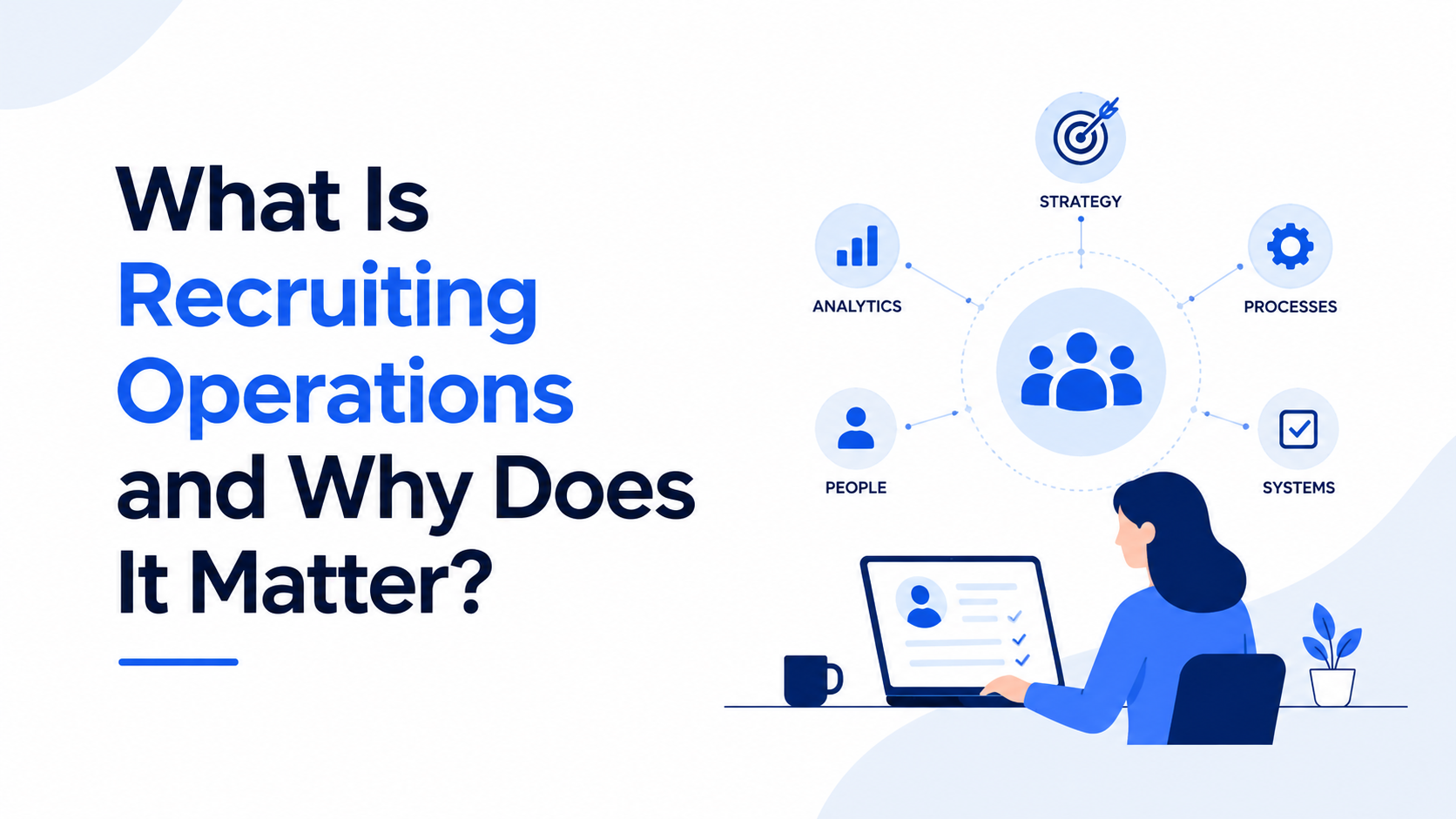
As Select Software Reviews defines it, recruiting operations entails the processes, tools, and strategies to ensure recruitment departments are running as efficiently and effectively as possible, maximizing time, money, and talent to satisfy the needs of an organization. Tim Sackett, president at HRU Technical Resources, puts it more bluntly: recruiting operations are about doing everything except finding the talent.
This distinction matters. Recruiters work in the hiring process. Recruiting operations works on the hiring process itself. One finds people. The other makes finding people possible.
Why Recruiting Operations Emerged Now
The function did not exist in most organizations a decade ago. It emerged because hiring became too complex to manage without dedicated operational support.
According to Greenhouse's 2026 Hiring Benchmarks Report, applications per recruiter have surged from 146 in 2022 to 746 in 2025 — a 411% increase. Meanwhile, the average number of recruiters per organization has dropped from 10.43 to 4.62 — a 56% decrease. Recruiters are managing five times as many applications with half as many people.
The complexity layer has grown just as fast. Remote work, multiple geographies, diverse regulations, and technology proliferation have created a hiring environment that ad-hoc processes cannot navigate. According to Metaview's analysis of talent ops in 2026, the average hiring team is running 11-plus tools by 2026. Without an owner, every recruiter ends up running a personal stack on top of the shared one.
By late 2020, 67% of companies had started optimizing their recruitment operations, according to RecruitBPM research. The pandemic forced organizations to acknowledge that informal processes could not scale. Competition intensified. The best candidates are hired within 10 days while the average process takes 40-plus days, according to Stivers' 2026 talent acquisition data. Organizations that move fast, build strong pipelines, and design streamlined hiring processes are outcompeting those that do not.
What Recruiting Operations Is Not
The confusion around recruiting operations starts with the name. Talent ops, talent acquisition ops, recruiting operations, RecOps — the labels overlap enough that most TA leaders use them interchangeably until the day they actually hire for the role. Then the difference matters.
Recruiting operations is not a fancy coordinator title. Coordinators run the operating backbone — scheduling interviews, managing candidate communications, sending offer paperwork, and keeping the ATS clean. According to Pin's research on recruiting team structure, coordinators manage 27 openings at peak, nearly double a recruiter's load, because their work is per-touch, not per-search. Coordinators execute tasks. RecOps designs the systems that make tasks executable at scale.
Recruiting operations is not an extra recruiter. Recruiters focus on finding talent and building relationships. They source candidates, conduct interviews, and make placements. RecOps professionals optimize how that work happens. They remove friction from processes and implement tools that enhance recruiter productivity.
Recruiting operations is not a people-ops generalist who also runs hiring on the side. It is a specialized function with distinct skills: process design, data analytics, technology management, and cross-functional coordination. As IQ Talent Partners explains, RecOps brings structure by auditing current roles and responsibilities, defining the right split between sourcing, recruiting, coordination, and operations, and creating role clarity that improves team collaboration and accountability.
The Five Core Jobs of Recruiting Operations
The shape of the role changes with company size. Smaller teams compress all five jobs into one part-time scope. Larger teams split them across a 3 to 4 person ops function. But the work itself remains consistent.
Process Design and Optimization
The first job is to be the one person in the team who can answer, on demand: what is our intake process for an executive hire, and how does it differ from a backfill? That means owning the steps from kickoff to offer, naming who does what at each stage, codifying what good looks like for interviewer prep, scorecard submission, and debrief, and killing the steps that are not load-bearing.
Without process ownership, every requisition becomes a custom build. Recruiters reinvent the wheel for every role. Hiring managers experience inconsistency. Candidates encounter different processes depending on which recruiter they work with. Quality suffers, speed slows, and compliance risk increases.
The cleanest test of whether process design exists: if a process improvement only lives in one recruiter's head, that is not recruiting operations yet. The role exists to turn ad-hoc improvements into standardized, instrumented, and inheritable infrastructure that every recruiter benefits from, including the recruiter you have not hired yet.
Tools and Technology Management
The second job is to own the recruiting tech stack the way a head of platform owns engineering infrastructure. That means deciding what the ATS does and does not own, picking the interview intelligence layer, sunsetting the sourcing tool nobody opens anymore, and negotiating the integrations that make data flow between systems.
This job has become critical because of tool proliferation. The average hiring team runs 11-plus tools by 2026. Each tool was purchased to solve a specific problem. Few were evaluated for how they fit into the broader workflow. The result is a fragmented stack where candidates fall through integration gaps, recruiters duplicate data entry across systems, and leadership cannot get a unified view of hiring performance.
RecOps fixes this by treating the tech stack as a system, not a collection of point solutions. They evaluate tools based on integration capability, data flow, and total cost of ownership, not just feature lists. They sunset redundant tools. They configure the ones that remain to work together. And they ensure that new tool purchases fit the architecture rather than adding another disconnected layer.
Data Instrumentation and Analytics
The third job is to make hiring data trustworthy, accessible, and actionable. This is harder than it sounds. Most recruiting data lives in fragmented systems, captured inconsistently, and reported on schedules that nobody asked for.
According to HeroHunt's analysis of AI recruiting ROI, 89% of talent professionals say measuring quality of hire is increasingly important, but only 25% feel confident actually doing it. That mismatch is the quiet reason so many recruiting investments never prove their worth: the savings may be real, but a team that never captured a baseline before the tool arrived is left arguing from belief rather than evidence.
RecOps solves this by instrumenting the hiring process from the start. They define what to measure before implementing tools. They create consistent data capture across the funnel. They build dashboards that update in real time rather than quarterly reports that arrive too late to act on. And they ensure that every metric has an owner, a target, and a defined action when the target is missed.
Interview Consistency and Calibration
The fourth job is to ensure that every candidate is evaluated against the same criteria by calibrated interviewers. This sounds like a training problem, but it is actually an operations problem.
Without structured processes, interview quality varies enormously across the team. Some interviewers ask great questions, take thorough notes, and provide useful feedback. Others wing it, forget what was discussed, and submit vague evaluations. This inconsistency directly harms hiring quality because the final hiring decision is based on incomplete or unreliable data.
RecOps addresses this by designing structured interview frameworks, creating scorecards that define evaluation criteria before candidates are assessed, and implementing calibration sessions where interviewers review past decisions together to align their judgment. According to Cambridge University Press research cited by Huntlo, structured interviews are 2.5 times more predictive of job performance than unstructured interviews. Tools that enforce structure without making the interview feel rigid are particularly valuable for teams that want to improve hiring quality.
Cross-Functional Reporting and Communication
The fifth job is to translate recruiting performance into a language that leadership understands. Recruiters speak in operational terms: time-to-fill, cost-per-hire, source effectiveness. CEOs and CFOs speak in business terms: revenue, productivity, growth.
RecOps bridges this gap by connecting hiring metrics to business outcomes. They show how faster time-to-hire translates to faster time-to-productivity and earlier revenue generation. They demonstrate how higher quality of hire reduces turnover costs and increases team output. They prove how better candidate experience improves employer brand and expands the talent pipeline.
This translation function is what earns recruiting its seat at the leadership table. Without it, recruiting is a cost center asking for budget. With it, recruiting is a growth engine justifying investment.
When to Invest in Dedicated Recruiting Operations
The timing question is straightforward: when does the complexity of your hiring process outgrow what a TA leader can manage on the side?
According to Pin's team structure research, at 10 to 20 recruiters, operating complexity outgrows what a TA leader can manage alongside their other responsibilities. RecOps then graduates into its own role. Mature RecOps groups produce the dashboards that drive every other decision in the hiring function.
The triggers are visible before the headcount threshold is reached. Recruiters spend more than 25% of their time on logistics rather than candidate engagement. The tech stack has grown organically without an architecture. Reporting is manual, late, and questioned by leadership. Hiring managers complain about inconsistency. Candidates report friction in the process. These are all signals that operational support is needed.
For startups and small teams, the first RecOps hire often comes at 100 to 150 employees, or once recruiters spend more than 25% of their time on coordination rather than sourcing and evaluation. Skip this hire and your TA professionals quietly turn into expensive schedulers.
The Business Case for Recruiting Operations
The ROI of recruiting operations is not always easy to quantify, but it is real and compounding.
According to Bullhorn's GRID 2025 research cited by StaffingHub, AI and automation can give recruiters up to 17 hours back per week, and firms using AI are 90% more likely to staff candidates within 20 days. These are capacity and speed improvements that compound into direct revenue. But they only happen when someone owns the operational design that makes AI adoption possible.
The Josh Bersin Company research cited by HeroHunt found that AI-enabled talent acquisition delivers time-to-hire that is 2 to 3 times faster than traditional methods. Recruiters who actively integrate generative AI report saving roughly 20% of their work week, about one full working day, on recruiting tasks. But 69% of companies use AI somewhere in hiring, and only about 18% use it broadly across the process. The returns compound only when AI runs across the whole funnel, and that requires operational infrastructure that most teams lack.
RecOps creates that infrastructure. They design the workflows that make AI adoption possible. They configure the integrations that let data flow between systems. They build the dashboards that measure whether new tools are actually working. Without RecOps, AI becomes another disconnected tool that recruiters ignore. With RecOps, AI becomes a force multiplier for the entire hiring function.
The Difference Between Recruiting Operations and Talent Acquisition
The terms are often used interchangeably, but they describe different scopes of work. According to Workday's guide on talent acquisition versus recruiting, recruiting success shows up in immediate metrics like time-to-fill, cost-per-hire, turnover rates, and candidate satisfaction scores. Talent acquisition focuses on larger-scale metrics like quality-of-hire measured by first-year performance and retention, pipeline conversion rates, and percentage of roles filled from proactive sourcing.
Recruiting operations sits beneath both. It is the operating layer that makes recruiting efficient and talent acquisition strategic. It does not set hiring strategy, but it builds the systems that execute strategy consistently. It does not find candidates, but it creates the infrastructure that lets sourcers and recruiters find more candidates, faster, with better outcomes.
The Bottom Line
Recruiting operations is the function that turns hiring from an art into a system. It designs the processes that make consistency possible. It manages the technology that makes scale possible. It instruments the data that makes improvement possible. And it translates recruiting performance into business language that leadership understands.
Without it, recruiting teams drown in complexity. Recruiters become administrative coordinators. Tools proliferate without integration. Data exists but cannot be trusted. And the best candidates accept offers from competitors who moved faster because their operational infrastructure was better.
With it, recruiting becomes a competitive advantage. Speed increases without sacrificing quality. Scale happens without proportional headcount growth. And the recruiting function earns its place as a strategic partner to the business rather than a service function fighting for budget.
The organizations that win in 2026 are not the ones with the most recruiters. They are the ones with the best recruiting operations.