Recruiting software becomes confusing because many tools now claim to help with the entire hiring process.
An applicant tracking system may offer candidate search. A sourcing platform may include outreach. A recruiting CRM may store talent pools. An AI recruiting tool may connect discovery, engagement, screening, and scheduling. As these categories overlap, it becomes easy to assume that an applicant tracking system and a sourcing tool solve the same problem.
They do not.
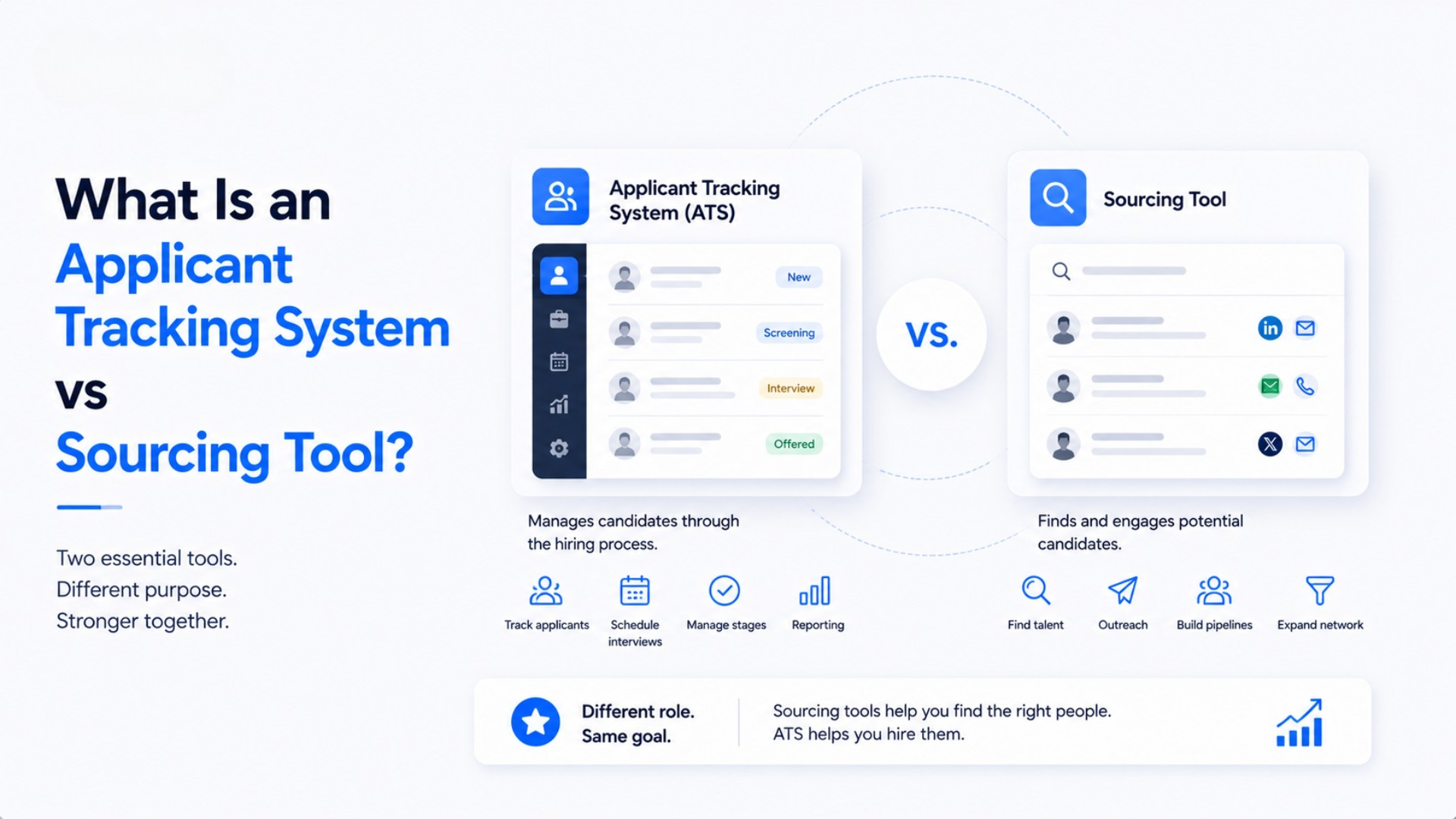
The simplest distinction is this: an applicant tracking system helps manage candidates who have entered the recruiting process, while a sourcing tool helps recruiters find potential candidates before they apply.
An ATS is primarily built around process management. It stores candidate information, collects applications, tracks hiring stages, supports collaboration, and creates a central record of recruiting activity. A sourcing tool is built around candidate discovery. It helps recruiters search talent markets, identify potential matches, build target lists, and find people who may never apply on their own.
The difference becomes clearer when you look at where each tool enters the hiring workflow.
A sourcing tool helps answer: Who should we recruit?
An applicant tracking system helps answer: What is happening with the candidates already in our process?
Most modern recruiting teams need both capabilities. The real question is whether those capabilities should live in separate tools, inside one platform, or across a more connected recruiting workflow.
What Is an Applicant Tracking System?
An applicant tracking system, usually called an ATS, is software designed to manage candidates and hiring activity through the recruitment process.
The system typically becomes most visible when a job is opened and candidates begin entering the pipeline. Applications are collected, candidate records are created, resumes are stored, and recruiters move people through stages such as application review, screening, interview, offer, and hire.
An ATS gives the recruiting team a shared place to understand what is happening. Instead of candidate information being spread across email inboxes, spreadsheets, documents, and individual recruiter notes, the hiring process can be organized around a central record.
SHRM’s explanation of applicant tracking systems describes ATS software as technology that can automate the requisition-to-hire process while creating a database of candidate information and tracking people through the recruitment pipeline. IBM’s guide to recruitment automation similarly explains that ATS platforms manage candidate profiles from application through interview and hire.
Modern ATS platforms can do much more than simply track applications. Depending on the product, they may support job posting, resume parsing, interview scheduling, hiring team collaboration, candidate communication, workflow automation, offers, reporting, and integrations with other HR systems.
But the central purpose remains the same.
An ATS organizes and manages the hiring process.
What Is a Candidate Sourcing Tool?
A candidate sourcing tool is software designed to help recruiters discover potential candidates for open or future roles.
Instead of beginning with people who have already applied, sourcing begins with the wider talent market. The recruiter defines the type of person the company needs, searches for relevant profiles, evaluates possible matches, and builds a group of people who may be worth approaching.
These candidates may be actively searching for jobs, but many are not. They may already be employed and have no relationship with the hiring company. They become part of the recruiting process only because the recruiter identifies them and starts a conversation.
Traditional sourcing tools rely heavily on filters, keywords, Boolean searches, job titles, locations, companies, and skills. Modern AI sourcing tools can interpret more natural hiring requirements and evaluate broader relationships between candidate experience and the role.
For example, a recruiter may need someone who has helped scale enterprise sales at an early-stage B2B software company. A traditional search may require the recruiter to translate that requirement into titles, keywords, companies, and filters. An AI sourcing system may attempt to understand the requirement more contextually and identify candidates whose career history suggests relevant experience.
The output is also different from an ATS.
An ATS produces an organized hiring process.
A sourcing tool produces potential candidates.
That is the core distinction.
The Main Difference: Managing Candidates vs. Finding Candidates
The easiest way to understand an ATS versus a sourcing tool is to look at the problem each system was originally designed to solve.
An applicant tracking system solves a management problem. Once candidates enter the recruiting process, the company needs to know who they are, which role they are being considered for, what stage they have reached, what the hiring team has learned, and what should happen next.
A sourcing tool solves a discovery problem. Before candidates enter the process, the company needs to know who could be relevant, where those people can be found, and which potential candidates are worth approaching.
Imagine a company needs to hire a senior machine learning engineer.
The sourcing tool helps the recruiter search the market and identify people with relevant backgrounds. It may help find candidates based on skills, previous roles, companies, industries, projects, locations, or other signals.
Once an interested candidate enters the formal hiring process, the ATS becomes more important. It tracks interviews, feedback, decisions, communication, and progression toward an offer or rejection.
One system helps create the pipeline.
The other helps manage it.
Why an ATS Is Not Usually Enough for Outbound Recruiting
An ATS can contain a large number of candidate records and still be a weak sourcing system.
This happens because most ATS databases are built from people who have already interacted with the company. They may have applied previously, been referred, been imported by a recruiter, or entered another hiring process.
That information can be valuable. A previous applicant who was not right for one role may be highly relevant to another. A candidate who declined two years ago may now be open to a conversation.
But an ATS is still limited by the people already inside it.
If the company needs to reach candidates it has never encountered before, recruiters usually need to search beyond the existing database. This is especially important in outbound recruiting, where the objective is to identify relevant people instead of waiting for them to apply.
A sourcing tool expands the search into the wider talent market. It gives recruiters a way to discover people based on the current hiring requirement rather than only searching historical applicant records.
This is why an ATS does not automatically replace sourcing software.
A company can have an excellent system for tracking candidates and still struggle to find enough of the right people.
Why a Sourcing Tool Is Not an ATS
The opposite is also true.
A sourcing tool can be excellent at finding candidates and still be a poor system for managing a hiring process.
Suppose an AI sourcing platform identifies 100 highly relevant candidates for a difficult engineering role. The recruiter reviews them, starts conversations, and finds that 12 people are interested.
The hiring team now needs to manage those candidates.
Who completed screening?
Who is waiting for an interview?
What feedback did the hiring manager provide?
Who needs a follow-up?
Which candidate is moving toward an offer?
Why was another person rejected?
A sourcing tool may support some of these actions, but this is traditionally where the ATS becomes the system of record.
SAP’s definition of an applicant tracking system describes the ATS as an HR software application for managing recruitment and hiring tasks digitally. That management function is fundamentally different from searching the external talent market for new people.
A sourcing tool helps create candidate possibilities.
An ATS creates structure around the hiring process that follows.
Where the ATS Fits in the Recruiting Workflow
The ATS is strongest once a candidate becomes part of an active hiring process.
A company opens a role, publishes the job, receives applications, reviews candidates, schedules interviews, collects feedback, makes decisions, and records the final outcome. The ATS provides continuity across those stages.
This is particularly important for inbound recruiting.
An inbound candidate finds the company, reviews the opportunity, and applies. The application naturally enters the ATS, where the recruiting team can review and process it.
The workflow has a clear entry point.
Outbound recruiting is different because much of the work happens before a formal application exists. The recruiter needs to understand the market, find potential candidates, evaluate relevance, create outreach, manage follow-ups, and determine whether someone is interested.
The ATS may eventually become important, but it often enters the process after significant recruiting work has already happened.
This is why outbound-heavy teams frequently build a technology stack around the ATS rather than expecting the ATS to do everything.
Where a Sourcing Tool Fits in the Recruiting Workflow
A sourcing tool operates earlier.
The company has a hiring requirement but not yet a sufficient candidate pipeline. Recruiters need to identify the people who could be relevant.
The sourcing process may begin with a job description, hiring manager brief, target profile, or natural-language description of the ideal candidate. The system then helps search for people whose experience appears relevant.
Traditional sourcing requires significant manual effort. Recruiters create queries, review profiles one by one, refine filters, and repeat the process until the talent pool improves.
Modern sourcing automation can reduce some of that work by interpreting requirements, identifying potential candidates, prioritizing profiles, and adapting the search based on recruiter feedback.
This is the process explained in Huntlo’s guide to What Is Candidate Sourcing Automation? The important point is that sourcing happens before the traditional applicant-tracking workflow for many candidates.
The sourcing tool creates the possibility of a conversation.
The ATS becomes useful when that conversation turns into a hiring process.
The Problem With the Handoff Between Sourcing and the ATS
The biggest problem is often not the ATS or the sourcing tool individually.
It is the space between them.
A recruiter finds a candidate in one platform. The profile is reviewed and added to a shortlist. Contact information may be found through another tool. Outreach happens somewhere else. Replies arrive in an inbox. Interested candidates are eventually transferred into the ATS.
Each tool may work well on its own, but the recruiter becomes responsible for connecting them.
This creates duplicate work and context loss.
Why was the candidate originally selected?
Which experience made them relevant?
What did the candidate ask during the first conversation?
What follow-ups have already been sent?
What information has already been collected?
If that context does not move with the candidate, the formal hiring process can begin as though the earlier work never happened.
This is one of the central limitations of a fragmented recruiting stack.
The ATS manages the candidate after entry.
The sourcing tool finds the candidate before entry.
The recruiter manually connects the two.
ATS vs. Sourcing Tool for Inbound Recruiting
Inbound-heavy teams often depend more heavily on the ATS.
The company publishes roles and attracts candidates through job boards, careers pages, referrals, employer branding, or other channels. Candidates apply, and the recruiting team needs to process the resulting pipeline.
The challenge is usually not discovering people.
It is managing applications efficiently.
The ATS helps collect candidate information, organize stages, support screening, coordinate interviews, and maintain a record of decisions.
A sourcing tool may still be useful, especially when a role does not attract enough qualified applicants. But it is not always the center of the workflow.
If a company receives more than enough strong applicants for most positions, the ATS may solve the more important operational problem.
The technology decision should follow the recruiting bottleneck.
ATS vs. Sourcing Tool for Outbound Recruiting
Outbound-heavy teams face the opposite problem.
They cannot assume the right candidates will apply.
Recruiters need to identify talent proactively, create interest, and move people from discovery into conversation.
This makes sourcing software much more important.
But candidate discovery is only the first step. After a potential candidate is found, the team still needs to handle outreach, follow-ups, responses, qualification, interviews, and hiring decisions.
The ATS remains useful as the formal process develops, but it does not necessarily solve the operational work that happens before that point.
This is why the difference between an ATS and a sourcing tool becomes especially important for outbound recruiting.
The ATS is built around a known candidate.
The sourcing tool is built around an unknown candidate who still needs to be found.
Can an ATS Include Sourcing Features?
Yes.
The boundaries between recruiting software categories are becoming less clear.
Some ATS platforms now include talent search, candidate rediscovery, CRM functionality, AI matching, and other sourcing capabilities. Some sourcing tools now include outreach, campaign management, screening, and workflow automation.
This overlap is useful, but buyers should not assume that a feature name means the same thing across products.
An ATS may describe its ability to search previous applicants as “candidate sourcing.” That can be valuable, but it is different from searching a broader external talent market.
A sourcing platform may describe itself as an end-to-end recruiting solution because it includes basic pipeline stages. That does not necessarily mean it can replace the organization’s system of record.
The better question is not whether the product has a sourcing button or an ATS-style pipeline.
The better question is where the platform is strongest and where the workflow still becomes manual.
This is why Huntlo’s guide on why AI sourcing tools are not all the same argues that recruiting teams should compare where a tool begins and ends in the hiring workflow rather than treating every sourcing platform as interchangeable.
How AI Is Changing Both Categories
AI is making the boundary between applicant tracking systems and sourcing tools less rigid.
In sourcing, AI can help interpret hiring requirements, identify related experience, rank potential candidates, and refine discovery. Recruiters may no longer need to translate every requirement manually into a long Boolean search.
Inside the ATS, AI can support resume parsing, candidate matching, communication, workflow triggers, scheduling, and other recruiting tasks. IBM’s overview of recruitment automation notes that ATS platforms increasingly integrate with automation capabilities across the hiring process.
The larger shift is not that one category will immediately replace the other.
It is that recruiting software is becoming more connected.
Candidate discovery can inform outreach. Outreach context can move into screening. Screening information can continue into interviews. The ATS can remain the system of record while other systems handle work that happens before or around the formal hiring process.
The important question is whether the tools share enough context to create one coherent workflow.
Do You Need an ATS, a Sourcing Tool, or Both?
The answer depends on where the recruiting process is breaking.
If the team already receives enough qualified candidates but struggles to manage applications, interviews, feedback, and hiring stages, the ATS is the more urgent need.
If the hiring process is well organized but recruiters cannot find enough relevant candidates, a sourcing tool addresses the larger problem.
Many recruiting teams need both.
A company can have a well-organized ATS with an empty pipeline.
It can also have an excellent sourcing platform and a chaotic hiring process.
The two systems solve different problems.
The more difficult decision is whether the company should buy them separately or choose a broader recruiting platform that connects more of the workflow.
For a small team, adding more specialized tools can create unnecessary complexity. For a large organization, specialized systems may offer the depth required for different recruiting functions.
The right answer depends on hiring volume, recruiting model, existing systems, integration needs, and how much manual work the team is willing to accept between tools.
What Should You Look for in an Applicant Tracking System?
An ATS should make the hiring process easier to understand and manage.
The system should provide a clear candidate record, flexible hiring stages, collaboration between recruiters and hiring managers, communication history, reporting, and reliable integrations with the wider HR technology stack.
The exact requirements will vary.
A small company may prioritize ease of use and fast implementation. A large enterprise may care more about permissions, compliance, reporting, global workflows, and integration with other systems.
The most important question is whether the ATS improves the process after candidates enter it.
If recruiters still need spreadsheets, disconnected notes, and constant manual updates to understand what is happening, the system is not solving its core problem.
What Should You Look for in a Sourcing Tool?
A sourcing tool should help recruiters find relevant people they would struggle to discover efficiently on their own.
Database size matters, but it should not be the only criterion. A huge database can still create poor results if the search and matching experience produces too much noise.
Recruiting teams should evaluate candidate relevance, search flexibility, geographic coverage, data quality, recruiter feedback loops, and the amount of manual work required after discovery.
The last point is increasingly important.
What happens when the tool finds a candidate?
Does the recruiter need to export the profile?
Is another system required for contact information?
Does outreach happen elsewhere?
Are replies disconnected from the original sourcing context?
A sourcing tool should be evaluated not only by how well it finds people, but also by how easily those people can move toward meaningful recruiting conversations.
Huntlo’s checklist for switching AI sourcing tools makes the same broader point: impressive AI features create limited business value when recruiters still face poor adoption, limited automation, and manual workflows after candidate discovery.
Where Huntlo Fits Between an ATS and a Sourcing Tool
Huntlo is not designed to replace every applicant tracking system.
Its focus is the operational gap that often exists before and around the ATS.
A traditional ATS is strongest at managing known candidates through a formal hiring process. A traditional sourcing tool is strongest at finding potential candidates.
The problem is that outbound recruiting requires much more than either action alone.
A team needs to understand the role, discover relevant people, engage them, manage follow-ups, interpret responses, qualify interest, and move the right candidates toward interviews.
Huntlo’s agentic AI recruiting infrastructure is designed around connecting more of that workflow. The objective is not simply to produce another candidate list or another database of records. It is to reduce the manual orchestration required between candidate discovery and qualified hiring conversations.
This is particularly relevant for outbound-heavy teams. If most recruiting activity begins with people who have not applied, a large amount of work happens before the candidate reaches the traditional ATS workflow.
Huntlo’s article on what comes after sourcing automation explains this shift directly: candidate discovery is becoming easier, while engagement, qualification, follow-ups, scheduling, and workflow execution remain major operational problems.
The ATS can remain the system of record.
The sourcing tool can help identify talent.
The agentic recruiting layer helps connect the work between discovery and the formal hiring process.
The Future Is Not ATS vs. Sourcing Tool
The future of recruiting software is unlikely to be a simple competition between applicant tracking systems and sourcing tools.
The categories solve different problems, and both problems will continue to exist.
Companies still need a reliable system for managing candidates, hiring stages, feedback, decisions, and records.
They also need ways to find people who will never enter the process on their own.
The bigger change is happening between these systems.
Recruiting teams increasingly expect candidate data, sourcing context, outreach history, screening information, and hiring activity to move through a connected workflow. They do not want recruiters to act as the manual integration layer between every tool.
AI accelerates this shift because software can now support more than static search or record keeping. Systems can interpret requirements, recommend candidates, assist with communication, respond to workflow events, and coordinate permitted next actions.
That does not eliminate the ATS.
It changes what recruiting teams expect around it.
Conclusion: An ATS Manages the Pipeline, a Sourcing Tool Helps Build It
An applicant tracking system and a sourcing tool are not the same type of recruiting software.
An ATS manages candidates through the hiring process. It stores records, tracks stages, supports collaboration, and creates structure around recruiting activity.
A sourcing tool helps recruiters find potential candidates before they apply. It searches the talent market, identifies relevant people, and helps create the top of the pipeline.
The difference is simple.
A sourcing tool helps answer, “Who should we recruit?”
An ATS helps answer, “What is happening with the candidates in our process?”
Most recruiting teams eventually need both capabilities. The challenge is making sure the workflow between them does not create more manual work than the tools remove.
The best recruiting technology stack is not the one with the largest number of features or platforms.
It is the one that helps the team move from a hiring requirement to the right candidate with the least unnecessary friction.
Frequently Asked Questions
What is the difference between an ATS and a sourcing tool?
An ATS manages candidates through the hiring process, while a sourcing tool helps recruiters discover potential candidates before they apply.
Is an ATS a sourcing tool?
Not usually. Some ATS platforms include candidate search or rediscovery features, but their primary purpose is managing applications, candidate records, and hiring stages.
Can a sourcing tool replace an ATS?
Usually not. A sourcing tool may help find and engage candidates, but an ATS provides the structured system of record needed to manage the formal hiring process.
Do recruiters need both an ATS and a sourcing tool?
Many teams do. The ATS manages the pipeline, while the sourcing tool helps create it. The need depends on whether the company relies mainly on inbound applications, outbound recruiting, or a combination of both.
What is an AI sourcing tool?
An AI sourcing tool uses artificial intelligence to help interpret hiring requirements, discover potential candidates, evaluate relevance, and prioritize profiles.
Which is more important for outbound recruiting?
A sourcing tool is usually more important at the beginning of outbound recruiting because the team needs to identify candidates who have not applied. An ATS becomes more important as interested candidates enter the formal hiring process.
Can AI connect sourcing tools with an ATS?
Yes. Modern recruiting platforms can use integrations and AI workflows to move candidate information and context between discovery, engagement, screening, and formal hiring stages.
Related Topics
See why AI sourcing tools are not all the same and why the most important difference is often where each tool begins and ends in the recruiting workflow.
Use Huntlo’s complete checklist for switching AI sourcing tools to evaluate candidate relevance, workflow automation, recruiter adoption, and what happens after discovery.
Explore what comes after sourcing automation as recruiting teams move from isolated candidate discovery toward connected engagement, qualification, and workflow execution.