Hiring teams do not have a shortage of software. In many cases, they have the opposite problem.
A recruiter may use one platform to find candidates, another to enrich contact information, another to send outreach, an applicant tracking system to manage records, a separate tool for screening, a calendar application for scheduling, and email or messaging apps to keep candidates engaged. Each product may solve its individual problem well, yet the overall hiring process can still feel slow and manual because someone has to connect all of those systems.
Usually, that someone is the recruiter.
A candidate is found in one place and moved into another. A response arrives in an inbox and has to be interpreted. Screening information needs to be reviewed and transferred. Interview availability must be coordinated. Candidate status has to be updated. Context that exists in one system is often missing from the next.
This is the problem an AI hiring OS is designed to address.
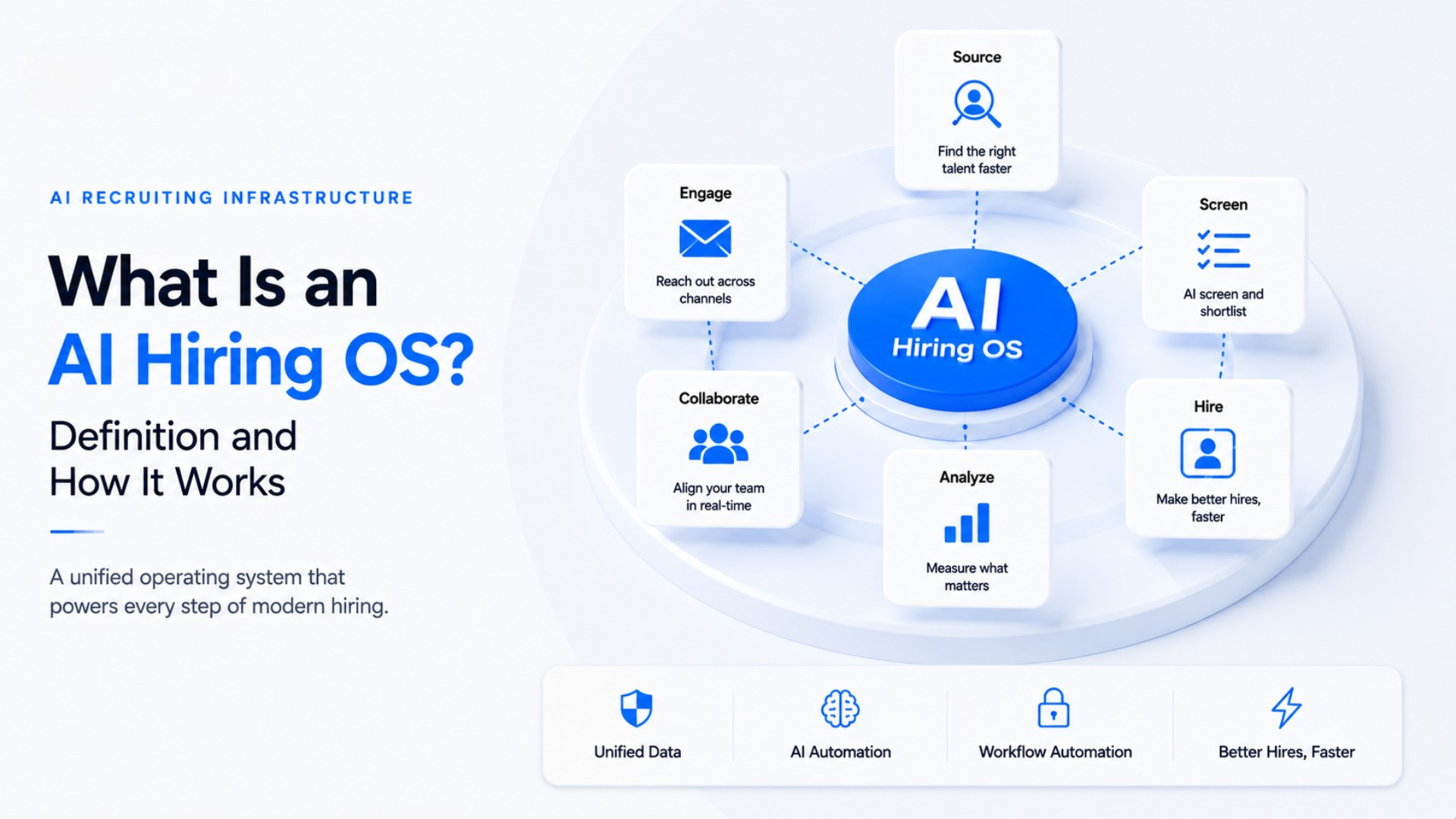
An AI hiring OS, short for AI hiring operating system, is an intelligent operating layer that connects hiring objectives, candidate data, AI agents, workflows, communication channels, external tools, and human decisions inside a coordinated recruiting environment. Instead of helping with only one isolated task, it is designed to understand what the hiring team is trying to achieve and help move the workflow from one stage to the next.
The idea represents a deeper change in recruiting technology. Traditional hiring software has largely been built to help people perform and record work. An AI hiring OS is built to help coordinate and execute that work.
What Is an AI Hiring OS?
An AI hiring OS is a recruiting system that uses artificial intelligence, shared context, workflow orchestration, connected tools, and human oversight to coordinate hiring work across multiple stages of the recruitment process.
The easiest way to understand the concept is to compare a task with an objective.
A traditional recruiting tool usually starts with a task. A recruiter opens a sourcing platform because they want to search for candidates. They open an outreach tool because they want to send a campaign. They open an ATS because they want to review or update a candidate record.
An AI hiring OS can begin with a broader objective.
A company might need to hire three senior software engineers with specific technical experience. The real objective is not to run a Boolean search or send an email sequence. The objective is to build a qualified candidate pipeline and move the right people toward meaningful conversations with the hiring team.
Achieving that objective may require the system to understand the role, identify relevant talent, prioritize candidates, prepare personalized engagement, manage approved follow-ups, interpret responses, conduct or coordinate screening, preserve candidate context, schedule interviews, and synchronize information with other systems.
Those are different activities, but they belong to the same hiring workflow.
The purpose of an AI hiring OS is to make that workflow operate as a connected system rather than a series of disconnected software sessions.
This is where the term “operating system” becomes useful. An AI hiring OS is not a literal computer operating system like Windows or macOS. The term describes the role the platform plays in coordinating resources, information, permissions, actions, and workflows.
The recruiting team defines what it is trying to achieve. The system helps coordinate the capabilities required to move toward that objective. Humans remain responsible for strategy, boundaries, judgment, and consequential hiring decisions, while AI handles more of the operational work required between those decisions.
Why Recruiting Needs an Operating Layer
The recruiting technology stack has expanded because hiring contains many different problems.
Applicant tracking systems gave organizations a structured place to manage applications and candidate records. Sourcing platforms made it easier to discover people who had not applied. Outreach software helped recruiters engage passive candidates at scale. Assessment products created more structured ways to evaluate skills. Scheduling tools reduced calendar coordination. More recently, AI assistants have made it faster to draft job descriptions, write candidate messages, summarize interviews, and generate screening questions.
Each category improved part of the process.
The problem is that improving individual tasks does not automatically improve the entire workflow.
A recruiter can have access to excellent sourcing software and still spend hours manually moving candidates into outreach. A team can automate email sequences and still lose important context when an interested candidate enters screening. An organization can have a sophisticated ATS while recruiters continue to update records manually after activity happens somewhere else.
The software stack becomes more capable, but the recruiter remains the integration layer.
That fragmentation is one reason the AI hiring OS concept matters. The objective is not simply to place more AI features inside recruiting software. It is to create an operating layer capable of maintaining context and coordinating actions across the hiring process.
The broader development of AI agents makes this increasingly possible. IBM’s explanation of AI agents describes an AI agent as a system that can autonomously perform tasks by designing workflows with available tools. In February 2026, the U.S. National Institute of Standards and Technology launched its AI Agent Standards Initiative around the next generation of AI agents capable of autonomous action, with an emphasis on secure and interoperable adoption.
Hiring is a natural environment for this model because recruiting is not one task. It is a chain of connected decisions and actions.
From Systems of Record to Systems of Execution
For decades, the dominant architecture of recruiting technology has been built around systems of record.
The ATS is the clearest example. It gives the organization a structured place to store applications, manage candidate stages, collect feedback, document hiring activity, and maintain visibility over the process.
That remains valuable. An organization needs to know who applied, which stage a candidate is in, what feedback was submitted, and what happened during the hiring process.
But a record does not move itself.
The ATS can show that a role needs candidates without necessarily finding them. It can show that a candidate is waiting for screening without necessarily conducting or coordinating that screening. It can show that someone is ready for an interview without necessarily managing everything required to get the interview booked.
The work between those states has traditionally belonged to people.
An AI hiring OS introduces a different model: the system of execution.
A system of execution does not merely record what happened. It helps determine and carry out what should happen next.
Suppose a recruiter wants to hire an experienced enterprise account executive. A conventional workflow might require the recruiter to translate the requirement into search filters, review profiles, export candidates, find contact information, create an outreach sequence, monitor replies, identify interested candidates, conduct initial screening, schedule qualified people, and update the ATS.
An AI hiring operating system can connect those activities around the original objective.
The system may interpret the role, coordinate candidate discovery, support prioritization, run approved engagement workflows, react to candidate responses, preserve new information, trigger screening, and move appropriate candidates toward human review.
This is not simply faster automation.
The important change is continuity.
The output of one step becomes context for the next. The system does not treat sourcing, outreach, screening, and scheduling as unrelated activities. It understands them as parts of the same hiring process.
The Difference Between AI Assistance and AI Execution
Many recruiting products now use artificial intelligence. That does not automatically make them an AI hiring OS.
An AI writing assistant may draft an outreach email. An AI sourcing tool may recommend candidates. An AI feature inside an ATS may summarize interview feedback. A chatbot may answer applicant questions.
All of these can be useful.
But they are examples of AI assistance when the recruiter still has to initiate, connect, and manage the larger workflow.
An AI hiring OS moves closer to AI execution.
The difference is not whether the software can generate text. The difference is whether the system can participate in carrying a hiring objective through a sequence of actions.
For example, an AI assistant might help a recruiter write a personalized candidate message. An AI hiring OS may help identify which candidates should enter an approved engagement workflow, use relevant context to personalize communication, manage follow-ups, interpret the resulting responses, preserve new candidate information, and trigger the appropriate next stage.
This requires orchestration. IBM defines AI agent orchestration as coordinating specialized AI agents within a unified system to achieve shared objectives. That idea is central to an AI hiring OS because recruiting contains many specialized activities that must work together rather than operate as isolated features.
The shift can be described simply. Traditional recruiting software helps a recruiter use a tool. An AI assistant helps a recruiter complete a task. An AI hiring OS helps coordinate a workflow.
That is why the category matters. It changes the central question from “What can the recruiter do inside this software?” to “What work can the system coordinate on behalf of the recruiting team, within the boundaries the team defines?”
How Does an AI Hiring OS Work?
An AI hiring OS may look simple from the recruiter’s perspective. A recruiter describes the role, defines the hiring objective, reviews the system’s work, and steps in when human judgment is required.
Behind that experience, several systems must work together.
A large language model alone is not an AI hiring operating system. Neither is a chatbot connected to an applicant tracking system. Even a collection of AI agents does not automatically become a hiring OS if those agents operate without shared context or coordinated workflows.
The architecture becomes meaningful when intelligence, memory, specialized AI capabilities, workflows, external tools, and human controls operate as parts of the same environment.
The process begins with an objective. The system needs to understand what the recruiting team is trying to achieve. It then needs enough context to determine what has already happened, access to the right capabilities to take permitted actions, and an orchestration layer capable of deciding how the workflow should progress.
This is what allows an AI hiring OS to move beyond isolated AI assistance.
Instead of answering one prompt at a time, the system can maintain continuity across a hiring process.
The Hiring Objective Becomes the Starting Point
Most traditional recruiting software begins with a feature.
The recruiter chooses whether to search, create a campaign, send a message, review an application, move a candidate, or schedule an interview. The software waits for the user to decide which action should happen next.
An AI hiring OS can begin one level higher.
The starting point is the hiring objective.
Imagine a company needs to hire two senior product managers for a B2B SaaS business. The ideal candidates should have experience building complex software products, working with enterprise customers, and collaborating with technical teams.
A recruiter understands that requirement as a combination of business context, experience, skills, trade-offs, and priorities.
Software traditionally requires that understanding to be converted into structured inputs. The recruiter selects job titles, enters keywords, chooses locations, applies experience filters, and repeatedly adjusts the search until the results become useful.
An AI hiring OS attempts to interpret more of the requirement before the workflow begins.
It may use the job description, recruiter instructions, company information, hiring-manager input, previous searches, and other approved context to build a working understanding of the role. It can then use that understanding across different stages rather than forcing the recruiter to explain the requirement again every time another tool is opened.
This does not mean the AI perfectly understands a role after reading one job description. Hiring requirements are often ambiguous, and even human recruiters refine their understanding after speaking with hiring managers and reviewing the market.
The important difference is that the system can maintain and update its understanding.
If the recruiter rejects a group of candidates because their experience is too junior, that information can potentially refine future prioritization. If the hiring manager explains that industry experience matters less than originally expected, the system can adjust the workflow. If candidate responses reveal that the compensation range is making engagement difficult, the recruiting team can use that information to reconsider the strategy.
The hiring objective is therefore not a static prompt.
It becomes the reference point around which the system coordinates the workflow.
The Intelligence Layer Interprets What the Team Needs
Once the objective is defined, the AI hiring OS needs an intelligence layer capable of interpreting information.
Recruiting data is rarely as structured as software would prefer.
Two candidates may have performed almost identical work under completely different job titles. A person with the exact title listed in the job description may have little relevant experience, while someone with an unexpected title may be an excellent fit. Skills can be described through projects, responsibilities, industries, tools, achievements, or career progression rather than a clean list of keywords.
The same problem exists on the employer side.
Hiring managers often describe what they need in broad terms. They may ask for someone “strategic,” “hands-on,” “experienced with scale,” or “comfortable in a fast-moving environment.” These phrases have meaning in context, but they are difficult to translate directly into traditional database filters.
The intelligence layer helps interpret that unstructured information.
It can reason across the role requirement, candidate profiles, recruiter instructions, previous interactions, screening responses, and other available context. Its purpose is not to make an unquestionable judgment about who should be hired. Its purpose is to help the system understand what information means for the workflow.
Consider a candidate whose current title does not match the target role.
A keyword-based search may exclude that person.
An intelligent system may recognize that the candidate’s actual responsibilities, previous experience, and career progression closely resemble what the employer needs. At the same time, it may identify that another candidate with the “correct” title lacks evidence of the experience that matters most.
This is one reason AI recruiting is moving beyond simple keyword matching.
The value of intelligence is not merely finding more candidates. It is helping the system interpret relevance in context.
But intelligence without memory creates another problem. If every stage begins with a blank page, the workflow remains fragmented even when each individual AI capability is powerful.
Shared Context Gives the Workflow Continuity
A recruiter’s understanding of a candidate changes throughout the hiring process.
At the beginning, the recruiter may know only what is available in a profile. After outreach, they may learn that the candidate is interested but concerned about location. During screening, they may discover relevant experience that was not clearly described online. Later, an interview may reveal a particular strength or an important concern.
Each interaction adds context.
In a fragmented recruiting stack, that context is often scattered across multiple systems. The sourcing platform knows why the candidate was found. The outreach tool knows which message was sent. The inbox contains the response. The screening system stores answers. The ATS contains the official record. The recruiter is expected to remember how everything connects.
This creates one of the most persistent forms of hidden work in recruiting: reconstructing context.
Before contacting a candidate, the recruiter checks what happened previously. Before screening, they search for earlier messages. Before an interview, someone prepares notes. After the interview, information is copied or summarized again.
An AI hiring OS needs a shared context layer that reduces this repeated reconstruction.
Suppose a candidate responds to an outreach message by saying that they are interested but would only consider a remote role.
That statement should not remain isolated inside an inbox.
It becomes part of the candidate context.
A later screening workflow should not ask the candidate to repeat the same information unnecessarily. A recruiter reviewing the candidate should be able to understand the constraint. If the role cannot support remote work, the system should not continue the workflow as though nothing has changed.
This is where memory becomes operationally important.
The system does not need to remember everything forever. Responsible context management requires clear rules around what information should be retained, how long it should be stored, who can access it, and how it can be used.
But the information required to run the workflow should not disappear every time the candidate moves from one stage to another.
Shared context is what turns separate actions into a continuous process.
Specialized AI Agents Handle Different Types of Work
A hiring process contains many different kinds of tasks.
Understanding a job requirement is different from discovering candidates. Evaluating profile relevance is different from writing outreach. Interpreting a candidate reply is different from conducting structured screening. Scheduling an interview requires different tools and permissions from sourcing.
Trying to handle every activity through one general-purpose AI assistant can create an experience that looks intelligent but lacks operational depth.
An AI hiring OS can instead use specialized AI agents or task-specific capabilities for different parts of the workflow.
A sourcing agent may focus on understanding the talent requirement and discovering relevant candidates. An engagement agent may use approved company and candidate context to support personalized outreach. A screening agent may conduct a structured conversation and organize the resulting information. A scheduling capability may coordinate availability once the correct conditions have been met.
The exact architecture can vary significantly between platforms.
Some systems may expose individual agents to the recruiter. Others may keep the architecture invisible and present one unified experience. A platform may use several specialized models, workflows, and tools without giving each one a name.
The naming matters less than the underlying principle.
Complex hiring workflows are easier to coordinate when different capabilities have clear responsibilities. IBM’s overview of agentic AI describes agentic AI as goal-oriented systems that can operate with limited supervision, while multi-agent approaches divide a broader objective into specialized subtasks coordinated through orchestration.
Specialization alone, however, does not create an operating system.
A company could buy several AI recruiting tools and still have the same fragmentation problem it had before.
The agents need coordination.
The Orchestration Layer Determines What Happens Next
Orchestration is the layer that connects intelligence to action.
Its job is to understand the current state of the workflow and coordinate the appropriate next step.
Consider what happens after a sourcing process identifies a group of promising candidates.
The system should not automatically treat every candidate in exactly the same way. Some may need additional review. Some may already exist in the company’s recruiting database. Some may have been contacted recently. Some may match the essential requirements more closely than others. Certain candidates may require recruiter approval before engagement begins.
Once outreach starts, the workflow becomes even more dynamic.
One candidate may express interest. Another may ask a question. Another may say the timing is wrong. Another may refer someone else. Another may request no further communication. Another may not respond at all.
A fixed automation can manage some of these outcomes through predefined rules. An intelligent orchestration layer can go further by interpreting what has happened and using that context to determine which permitted action is appropriate.
An interested candidate may move toward screening. A factual question may be answered using approved information or escalated to a recruiter. A request to stop communication must end the workflow. An ambiguous response may require human review. A lack of response may trigger an approved follow-up at the appropriate time.
The central question for the orchestration layer is simple: given the hiring objective, everything that has happened so far, and the actions the system is allowed to take, what should happen next?
That question is the operational heart of an AI hiring OS.
Without orchestration, AI features remain features.
With orchestration, they can become part of a connected recruiting workflow.
Integrations Give the System the Ability to Act
Intelligence can recommend an action.
Execution requires access to tools.
An AI hiring OS may need to interact with candidate sources, communication channels, calendars, applicant tracking systems, assessment platforms, internal databases, and other parts of the recruiting stack.
This does not mean the AI hiring OS must replace every existing recruiting product.
In many organizations, the ATS will remain the official system of record. A specialist assessment platform may continue to handle technical evaluations. Existing communication and calendar systems may remain essential.
The role of the operating layer is to reduce the amount of manual work required to coordinate those systems.
A recruiter should not have to copy the same candidate information repeatedly simply because the workflow crosses product boundaries. They should not have to check multiple applications to understand what happened. They should not have to manually trigger every routine next step when the conditions for that action are already known.
Tool use allows the system to move from understanding to execution.
But it also creates risk.
An AI that generates an inaccurate draft can be corrected before the message is sent. An AI with permission to take action can create a more serious problem if its tools, instructions, or boundaries are poorly designed.
That is why human control is not an optional addition to the architecture.
It is part of the architecture itself.
Human Oversight Defines the Boundaries of the System
The goal of an AI hiring OS should not be maximum autonomy.
The goal should be appropriate autonomy.
Some actions are repetitive, reversible, and relatively low risk. Others affect candidates in consequential ways and require stronger human judgment.
A recruiting team may allow the system to discover candidates, organize information, draft messages, manage approved follow-ups, summarize responses, and coordinate scheduling. The same team may require explicit human approval before launching certain campaigns, changing core evaluation criteria, rejecting a candidate, or making a hiring decision.
The right boundary will vary by organization, role, workflow, and jurisdiction.
A useful AI hiring OS therefore needs permissions, approval points, escalation rules, auditability, and clear ownership.
The system should know what it can do.
It should also know when it must stop.
This is especially important because hiring decisions affect real people. Efficiency cannot be the only design objective. Recruiting systems also need to account for privacy, fairness, explainability, candidate experience, and human accountability.
The regulatory direction reinforces that point. The European Commission’s overview of the EU AI Act explains the law’s risk-based approach to AI, with specific obligations for uses that can affect safety or fundamental rights. Employment-related AI can fall within the Act’s high-risk framework depending on the system’s intended use, which makes governance a core product and deployment issue rather than a final compliance checkbox.
An operating system that can take more actions needs stronger controls than a tool that merely displays information.
The future of agentic AI recruiting will therefore depend on more than how autonomous the technology becomes. It will depend on whether organizations can define sensible boundaries around that autonomy.
AI Hiring OS vs. ATS: What Actually Changes?
The ATS and the AI hiring OS solve different problems.
An applicant tracking system is primarily designed to organize and document the hiring process. It creates candidate records, manages applications, tracks stages, stores feedback, and gives the organization visibility into what happened.
An AI hiring OS is designed to coordinate what should happen next.
This distinction matters because an ATS is usually centered on the candidate record. The candidate enters the system, moves through stages, and accumulates information.
The AI hiring OS is centered more broadly on the hiring objective and the workflow required to achieve it.
Consider an open role with too few qualified applicants.
The ATS can accurately show that the pipeline is weak. It can tell the recruiting team how many candidates are in each stage. It can preserve the history of everyone who applied.
But the existence of the record does not solve the pipeline problem.
Someone still needs to understand the role, find relevant candidates, engage them, manage responses, qualify interest, and move appropriate people into the process.
An AI hiring OS is built closer to that execution layer.
The two systems can therefore coexist.
An organization may continue using its ATS as the official system of record while an AI hiring OS coordinates sourcing, engagement, screening, and other workflows around it. Relevant information can then move back into the ATS.
The AI hiring OS does not have to replace the ATS to change how the recruiting team works.
It may instead reduce how often recruiters need to manually operate around it.
Why Adding AI to an ATS Does Not Automatically Create an AI Hiring OS
Modern ATS platforms increasingly include AI capabilities.
They may generate job descriptions, summarize resumes, recommend candidates, draft emails, organize interview feedback, or provide conversational assistants.
These features can make an ATS significantly more useful.
But an AI feature does not change the architecture of the system by itself.
The more useful question is not whether the platform uses AI. Almost every major software category now does.
The better question is what the AI is responsible for.
Does it generate an output and wait for the recruiter?
Or can it maintain context, coordinate actions across stages, use connected tools, respond to changing conditions, and help carry the hiring objective forward?
An ATS with an AI writing assistant is still primarily an ATS.
An ATS with candidate recommendations may still be primarily an ATS.
Even an ATS with many sophisticated AI features may remain a system in which the recruiter is responsible for connecting the larger workflow.
An AI hiring OS represents a different ambition. Its purpose is not merely to make individual actions faster. Its purpose is to reduce the manual orchestration required between those actions.
AI Hiring OS vs. Recruiting Automation
The distinction between an AI hiring OS and recruiting automation is more subtle.
Traditional automation is extremely useful when the workflow is predictable.
If a candidate enters a stage, send a message. If an interview is scheduled, send a reminder. If there is no response after a defined period, trigger a follow-up. If an application is completed, create a task.
This model can remove large amounts of repetitive administrative work.
The limitation is that traditional automation usually depends on predefined logic.
A human designs the workflow in advance.
If this happens, do that.
Hiring does not always follow predictable paths.
A candidate may reply with interest but ask a question. Another may be unavailable now but open to a conversation in six months. Another may appear suitable for the original role but turn out to be a better fit for another position. A hiring manager may change the priority after seeing the first group of candidates.
The workflow branches.
Traditional automation can manage branches when humans define the conditions in advance. An AI hiring OS can potentially interpret more of the context inside those branches.
The difference can be understood as the distinction between workflow automation and workflow intelligence.
Workflow automation asks what action was configured after an event.
Workflow intelligence asks what the event means for the hiring objective and what permitted action should happen next.
This does not make rules unnecessary. An AI hiring OS still needs workflows, policies, permissions, and constraints.
The difference is that the system can interpret context within those boundaries.
AI Hiring OS vs. AI Recruiting Point Solutions
The same distinction applies to specialized AI recruiting tools.
A sourcing product may use sophisticated AI to find relevant candidates.
An outreach platform may use AI to personalize engagement.
An AI interviewer may conduct screening conversations.
A scheduling tool may coordinate complex calendars.
These products can be excellent at what they do.
They do not become hiring operating systems simply because they use advanced AI.
A point solution owns a task or a narrow part of the workflow.
An operating system coordinates work across tasks.
This distinction should not be interpreted as “broad platform good, specialist tool bad.” In many cases, a specialized product can offer deeper capabilities within its category.
The problem appears when the recruiting team must manually connect all of those specialized environments.
A recruiter finds candidates in one place, exports them to another, launches outreach elsewhere, checks replies, moves interested people into screening, copies information, updates stages, and schedules interviews.
The organization may have excellent tools and still have a fragmented operating model.
An AI hiring OS attempts to solve the connections between those tools and stages.
It may provide several capabilities directly. It may integrate with specialist products. It may combine both approaches.
The defining characteristic is not that the platform contains every recruiting feature imaginable.
It is that the workflow can continue across capabilities without requiring a human to manually reconstruct the process at every handoff.
Integration Alone Is Not an Operating System
A recruiting stack can be highly integrated and still remain fragmented.
Imagine several tools connected through APIs. Candidate data moves between them. Status changes synchronize. Notifications are triggered.
That is valuable infrastructure.
But data movement is not the same as workflow orchestration.
An integration answers how information moves from one system to another.
An AI hiring OS must also answer why the next action should happen.
Suppose a candidate completes a screening conversation.
An integration can send the result to the ATS.
An operating layer needs to understand what the result means for the workflow.
Does the candidate need recruiter review? Is important information missing? Should another question be asked? Have the conditions been met to begin scheduling? Does the candidate appear more relevant to another role?
The technical connection between systems solves only part of the problem.
The more difficult challenge is coordinating decisions and actions while preserving context.
That is why an operating layer is different from an integration layer.
What Does an AI Hiring OS Look Like in Practice?
The architecture becomes easier to understand through a real workflow.
Imagine a company wants to hire a senior product manager.
The recruiter provides the role requirements and explains which experience matters most. The system interprets the objective and builds a working understanding of the target profile.
Candidate discovery begins.
The system identifies potential candidates and organizes them according to the relevant criteria. Depending on the organization’s workflow, the recruiter may review the shortlist before engagement begins.
Approved candidates enter an outreach process.
Communication uses available role, company, and candidate context. Follow-ups happen according to the team’s rules.
One candidate does not respond, so the approved follow-up workflow continues.
Another declines, and the system stops further outreach.
A third expresses interest but asks whether the company supports remote work.
That response changes the workflow.
The system captures the new context. If approved information is available, it may respond within defined boundaries. If the question requires a recruiter, it is escalated.
The candidate then enters screening.
The screening process does not begin from zero. It can use relevant context from earlier interactions. The system organizes the resulting information and identifies anything that requires human review.
The recruiter examines the candidate and decides to advance them.
Scheduling begins.
The interview is booked.
Relevant information is synchronized with the organization’s system of record.
Throughout the process, the recruiter remains responsible for the hiring objective and consequential decisions.
What changes is the amount of manual coordination required between those decisions.
That is the practical value of an AI hiring OS.
The Recruiter’s Role Changes From Operator to Orchestrator
Traditional recruiting software requires the recruiter to operate the workflow.
The recruiter decides what should happen, opens the correct tool, performs the action, checks the result, moves the information, and begins the next task.
An AI hiring OS changes that relationship.
The recruiter increasingly defines the objective, establishes the boundaries, reviews important outputs, handles ambiguity, and makes consequential decisions.
The system handles more of the coordination between those moments.
This does not make recruiters less important.
It changes where their effort creates value.
Recruiters can spend less time asking whether a candidate record was updated and more time asking whether the team is targeting the right market. They can spend less time copying information between tools and more time understanding why strong candidates are declining. They can spend less time triggering routine follow-ups and more time improving the employer’s hiring strategy.
The recruiter becomes less of a software operator and more of a workflow orchestrator.
That is a more meaningful vision of AI in recruiting than the idea that AI simply writes faster emails.
What Problems Does an AI Hiring OS Solve?
The most obvious problem is tool fragmentation, but the deeper issue is coordination.
When every stage of recruiting operates independently, the team pays a hidden operational cost.
Recruiters repeat work.
Candidates repeat information.
Context disappears.
Follow-ups are missed.
Strong candidates wait because the next step was not triggered.
Hiring managers receive incomplete information.
Recruiters spend time checking systems instead of advancing the search.
The cost is rarely visible in one place because it is distributed across hundreds of small actions.
An AI hiring OS attempts to reduce that coordination tax.
The value is not simply that one action becomes faster.
The value is that fewer actions need to be manually connected.
This can matter especially for teams running outbound-heavy recruiting workflows, staffing firms managing many searches at once, high-volume hiring operations, and lean recruiting teams that need to increase execution capacity without continually adding more software and administrative work.
For a broader view of how these workflows are evolving, Huntlo’s guide to AI recruiting software platforms in 2026 examines the shift from isolated recruiting features toward connected sourcing, engagement, and hiring automation.
Why Outbound Recruiting Makes the AI Hiring OS More Important
Inbound recruiting begins when a candidate applies.
Outbound recruiting begins earlier.
The recruiting team must identify potential candidates, determine who is relevant, find an appropriate way to engage them, manage follow-ups, interpret responses, build interest, qualify the opportunity, and move the right people into the formal hiring process.
That creates more work before a candidate ever appears inside the ATS.
This is why outbound-heavy teams often experience the limitations of fragmented recruiting technology more sharply.
The ATS may remain important, but much of the work happens outside it.
The recruiter becomes responsible for coordinating candidate discovery, outreach, response management, screening, and the transition into the formal process.
An AI hiring OS can be particularly valuable in this environment because the workflow itself is the product problem.
The objective is not simply to search a larger database.
It is to turn talent discovery into qualified candidate conversations.
That requires continuity from sourcing through engagement and screening.
This is also where Huntlo’s positioning as agentic AI recruiting infrastructure becomes relevant. The platform is built around proactive recruiting workflows that connect candidate sourcing, outreach across email and WhatsApp, AI voice screening, and interview scheduling rather than treating each stage as a separate point solution.
The distinction matters because a list of candidates is not the same as a hiring pipeline.
The work required to move from one to the other is where the operating layer creates value.
What Makes an AI Hiring OS Different From “All-in-One” Recruiting Software?
The recruiting industry has used the phrase “all-in-one” for years.
An all-in-one platform usually brings many features into one product.
That can reduce the number of tools a team needs.
But feature consolidation is not the same as intelligence or orchestration.
A platform can contain sourcing, outreach, screening, scheduling, and applicant tracking while still requiring the recruiter to manually operate each module.
The recruiter finishes one task and opens the next feature.
The information may exist in the same database, but the human still carries the workflow forward.
An AI hiring OS should be evaluated differently.
The question is not how many features appear in the navigation menu.
The question is whether the system can maintain context and coordinate work across those capabilities.
An all-in-one product consolidates software.
An operating system coordinates execution.
The strongest platforms may eventually do both.
But the concepts are not identical.
What Should Hiring Teams Look for in an AI Hiring OS?
Because the category is still emerging, buyers should be careful with terminology.
Many products will use words such as AI, agentic, autonomous, copilot, agent, orchestration, and operating system. The label itself does not reveal how the software actually works.
The most useful evaluation begins with the workflow.
Can the system understand a hiring objective beyond a simple keyword query? Can context move from sourcing into engagement and from engagement into screening? Can the platform react differently when candidates respond differently? Can it use connected tools to take permitted actions? Can recruiters define approvals and escalation points? Can the organization see what the system did and why the workflow changed?
The buyer should also ask where the system stops.
A platform may coordinate sourcing and outreach but leave screening disconnected. Another may begin only after candidates apply. Another may provide broad workflow coverage but depend heavily on integrations for specialist tasks.
There is no universal architecture that every organization needs.
The right AI hiring platform depends on where the team’s current workflow breaks.
A team with a strong inbound pipeline may need a different operating model from an executive search firm. A staffing agency managing many concurrent roles may have different requirements from a small internal talent team. A global enterprise may place greater emphasis on permissions, governance, integration depth, and regional compliance.
The goal is not to buy the product with the most AI terminology.
It is to identify whether the system removes meaningful coordination work from the hiring process.
The Importance of Governance, Privacy, and Human Accountability
The more an AI system can do, the more important governance becomes.
This is especially true in hiring.
Recruiting systems process personal information, influence candidate experiences, and can affect decisions with significant consequences for individuals.
An AI hiring OS therefore needs more than intelligence and automation.
It needs clear rules.
Organizations should understand what data the system uses, what actions it can take, where approvals are required, how activity is logged, how candidates can be removed from communication, and which decisions remain human.
The need for governance grows with autonomy.
A tool that drafts a message creates one type of risk.
A system that can select recipients, send communication, interpret replies, and trigger later stages creates a larger operational surface.
This does not mean organizations should avoid agentic recruiting technology.
It means autonomy and control should be designed together.
The same principle is visible in the broader AI ecosystem. NIST’s AI Agent Standards Initiative focuses not only on the capabilities of agents but also on secure and interoperable operation. The emerging question for businesses is no longer simply whether AI can act. It is whether those actions can be governed, observed, constrained, and trusted.
For hiring teams, human accountability remains essential.
AI can help interpret information.
AI can help coordinate work.
AI can help execute approved actions.
But responsibility for the hiring process does not disappear because more of the workflow becomes automated.
Is an AI Hiring OS Fully Autonomous?
Not necessarily.
In fact, full autonomy is a poor standard for evaluating most business software.
The better question is whether the system has the right level of autonomy for the task.
Some actions may be appropriate to run automatically after the recruiting team defines the rules. Others may require approval. Some may always need a person.
A system might automatically organize candidate information while requiring recruiter review before outreach begins. It might manage approved follow-ups but escalate unusual responses. It might conduct structured screening but leave advancement decisions to the recruiter.
This is often a more practical model than trying to remove humans from the process.
The purpose of agentic AI recruiting is not to eliminate human involvement.
It is to stop requiring human involvement for every operational transition.
That distinction is central to the AI hiring OS.
Will an AI Hiring OS Replace the ATS?
For many organizations, not immediately.
The ATS remains deeply embedded in hiring operations. It may serve as the official record for applications, stages, interview feedback, reporting, compliance, and internal collaboration.
An AI hiring OS can work alongside it.
The operating layer may handle more of the proactive and execution-heavy workflow while the ATS continues to preserve the formal record.
Over time, the categories may converge.
Some ATS providers may build deeper agentic capabilities and evolve toward the operating-system model. Some AI hiring platforms may expand into more traditional ATS functions. Some organizations may consolidate most of the workflow into one environment.
Others will continue using a modular stack.
The important shift is not whether the ATS disappears.
It is whether recruiters remain responsible for manually operating everything around it.
Is an AI Hiring OS the Future of Recruiting Software?
The phrase “AI hiring OS” may evolve.
Technology categories often do.
What matters more is the architectural change behind the term.
Recruiting software is moving from passive systems toward systems that can interpret objectives, use tools, maintain context, coordinate workflows, and take actions within defined boundaries.
That shift is larger than any one product category.
The rise of agentic AI across enterprise software is changing what users expect software to do. A system is no longer valuable only because it stores information or exposes features. Increasingly, it is valuable because it can help carry work forward.
Hiring is especially suited to this transition because so much recruiter time is spent connecting stages rather than making decisions.
The opportunity is not to automate judgment out of recruiting.
It is to automate more of the operational distance between important human decisions.
That is the central promise of the AI hiring OS.
Where Huntlo Fits Into the AI Hiring OS Model
Huntlo approaches this problem from the perspective of agentic recruiting infrastructure.
The core idea is that outbound recruiting should not require recruiters to manually operate a chain of disconnected tools.
A hiring objective can involve candidate discovery, personalized engagement, response management, screening, and interview coordination. When those stages operate separately, recruiters spend a significant amount of time moving candidates and context between systems.
Huntlo is designed around a more connected model.
Its infrastructure brings proactive candidate sourcing, outreach across email and WhatsApp, AI voice screening, and interview scheduling into a coordinated workflow. Rather than treating AI as a writing feature or a search enhancement, the system is built around executing more of the recruiting process between the recruiter’s decisions.
This does not mean every hiring decision should be delegated to AI.
The recruiter remains responsible for defining the role, setting the strategy, reviewing important outcomes, handling ambiguity, and making consequential decisions.
The operating layer handles more of the work required to move from intention to execution.
That is the broader shift the AI hiring OS represents.
The recruiter should not have to become the API between every tool in the hiring stack.
The software should do more of the connecting.
The Future of the AI Hiring Operating System
The next generation of recruiting technology will likely be judged less by the number of features it contains and more by the amount of meaningful work it can coordinate.
Search will become more contextual.
Outreach will become more responsive.
Screening will connect more directly with earlier candidate interactions.
Workflow systems will become better at interpreting exceptions.
Human approval will become more configurable.
Recruiters will spend less time manually carrying context between tools.
At the same time, the demands on governance will increase.
Systems that can act need clear permissions. Systems that can interpret candidates need careful evaluation. Systems that influence employment workflows need human accountability.
The future will not be defined by unrestricted autonomy.
It will be defined by controlled execution.
The most useful AI hiring operating systems will not be the ones that promise to replace recruiters.
They will be the ones that understand where software should act, where humans should decide, and how the two can work inside one continuous hiring process.
Conclusion: An AI Hiring OS Turns Recruiting Tools Into a Connected Workflow
An AI hiring OS is more than an ATS with AI features and more than a collection of recruiting automations.
It is an intelligent operating layer designed to connect hiring objectives, candidate context, AI agents, workflows, communication channels, external tools, and human decisions.
Its purpose is to reduce the manual coordination that exists between recruiting tasks.
The ATS records what happened.
Point solutions improve individual activities.
Traditional automation executes predefined rules.
An AI hiring OS attempts to coordinate the workflow itself.
That means understanding the objective, preserving context, using specialized capabilities, determining appropriate next actions, interacting with connected tools, and escalating consequential decisions to people.
The shift matters because modern recruiting teams already have powerful software.
What they often lack is continuity.
Candidates move between systems.
Context disappears.
Recruiters repeat work.
The process slows down between stages.
An AI hiring operating system is an attempt to solve that problem at the architectural level.
The goal is not more software.
It is a hiring workflow that can actually operate as one system.
Frequently Asked Questions
What does AI hiring OS mean?
AI hiring OS means AI hiring operating system. It describes an intelligent recruiting environment that connects hiring objectives, candidate data, AI capabilities, workflows, communication channels, external tools, and human oversight.
What is the main purpose of an AI hiring OS?
Its main purpose is to coordinate recruiting work across multiple stages so that recruiters do not have to manually connect every tool, action, and handoff.
Is an AI hiring OS the same as an ATS?
No. An ATS is primarily a system of record for applications, candidate stages, feedback, and hiring activity. An AI hiring OS is designed around workflow execution and orchestration.
Can an AI hiring OS work with an existing ATS?
Yes. An AI hiring OS can work alongside an ATS, using the ATS as the official system of record while coordinating sourcing, engagement, screening, and other workflows.
Does an AI hiring OS replace recruiters?
No. The more practical role of an AI hiring OS is to reduce repetitive coordination work while recruiters retain responsibility for strategy, judgment, candidate relationships, and consequential decisions.
What are AI recruiting agents?
AI recruiting agents are specialized AI capabilities designed to perform or support recruiting tasks such as candidate discovery, engagement, response handling, screening, and scheduling.
What is recruiting orchestration?
Recruiting orchestration is the coordination of different tasks, systems, AI capabilities, and human decisions across the hiring workflow.
How is an AI hiring OS different from recruiting automation?
Traditional recruiting automation usually follows predefined rules. An AI hiring OS can also use context to help determine which permitted action should happen next.
Is an AI hiring OS fully autonomous?
Not necessarily. The appropriate level of autonomy depends on the action, organization, workflow, and risk. Human approval and escalation should remain part of the system.
What is agentic AI recruiting?
Agentic AI recruiting applies goal-oriented AI agents and orchestration to recruiting workflows so that software can do more than generate outputs and can participate in carrying work forward.
What is agentic AI recruiting infrastructure?
Agentic AI recruiting infrastructure is the underlying system that allows specialized AI capabilities, recruiting data, workflows, communication channels, integrations, and human controls to work together.
What is the difference between an AI hiring platform and an AI hiring OS?
An AI hiring platform may provide one or more AI recruiting capabilities. An AI hiring OS is specifically designed around coordinating context and execution across a broader workflow.
Does an AI hiring OS need multiple AI agents?
Not always. A platform can use several specialized agents, task-specific models, or other AI capabilities. The important requirement is coordinated execution rather than the number of agents.
Why is shared context important in AI recruiting?
Shared context prevents every stage from starting over. Information learned during sourcing, outreach, or screening can inform later actions when it is appropriate and permitted to do so.
Can an AI hiring OS source passive candidates?
Yes, depending on the platform. Outbound-focused AI hiring systems may coordinate candidate discovery, engagement, follow-ups, screening, and progression into the formal hiring process.
Can an AI hiring OS send candidate outreach?
Some platforms can support or execute approved outreach workflows. The channels, permissions, and level of autonomy vary by system.
Can an AI hiring OS screen candidates?
Some AI hiring operating systems include or connect with screening capabilities. Human oversight remains important, especially when screening influences consequential employment decisions.
Can an AI hiring OS schedule interviews?
Yes, scheduling can be part of the workflow when the platform has the appropriate calendar access, permissions, and conditions for triggering the action.
Is an AI hiring OS useful for staffing firms?
It can be particularly useful for staffing firms because they often manage multiple concurrent searches and large volumes of sourcing, outreach, follow-up, screening, and coordination work.
Is an AI hiring OS useful for internal recruiting teams?
Yes. Internal teams can use an operating layer to reduce tool switching, preserve context, coordinate outbound hiring, and automate routine workflow transitions.
What problems should an AI hiring OS solve?
It should reduce meaningful workflow problems such as fragmented tools, repeated data movement, lost context, missed follow-ups, slow handoffs, and excessive manual coordination.
What should companies evaluate before buying an AI hiring OS?
Companies should evaluate workflow coverage, context continuity, integration depth, permissions, human approval controls, auditability, data handling, governance, and the actual amount of coordination work the system removes.
Is an all-in-one recruiting platform the same as an AI hiring OS?
No. An all-in-one platform consolidates features. An AI hiring OS coordinates execution. A product can be one, both, or neither.
Is integration enough to create an AI hiring OS?
No. Integrations move information between systems. An operating layer also needs to understand workflow context and coordinate why and when actions should happen.
What is the future of AI hiring operating systems?
The category is likely to move toward deeper workflow orchestration, more specialized agents, stronger context management, configurable human oversight, and tighter governance.
Related Topics
Learn how modern platforms are changing recruiting workflows in What Are the Best AI Recruiting Software Platforms in 2026?.
Explore how different markets affect recruiting technology choices in Best AI Recruiting Tools for Hiring in India vs. Global Markets.
See how agencies can connect sourcing, outreach, and workflow execution in AI Recruiting Software for Staffing Firms: Complete Guide for Modern Agencies.
Understand how workflow automation can reduce operational bottlenecks in How Can Frontline Hiring Teams Reduce Hiring Delays?.
Compare Huntlo with different recruiting and talent intelligence platforms through the Huntlo AI recruiting platform comparisons.