Recruiting often starts too late.
A role opens, the hiring manager needs candidates quickly, and the recruiting team begins searching. Recruiters publish the job, review applications, search for passive candidates, contact previous applicants, and ask for referrals while the pressure to fill the position continues to increase.
A candidate pool is designed to make hiring less reactive.
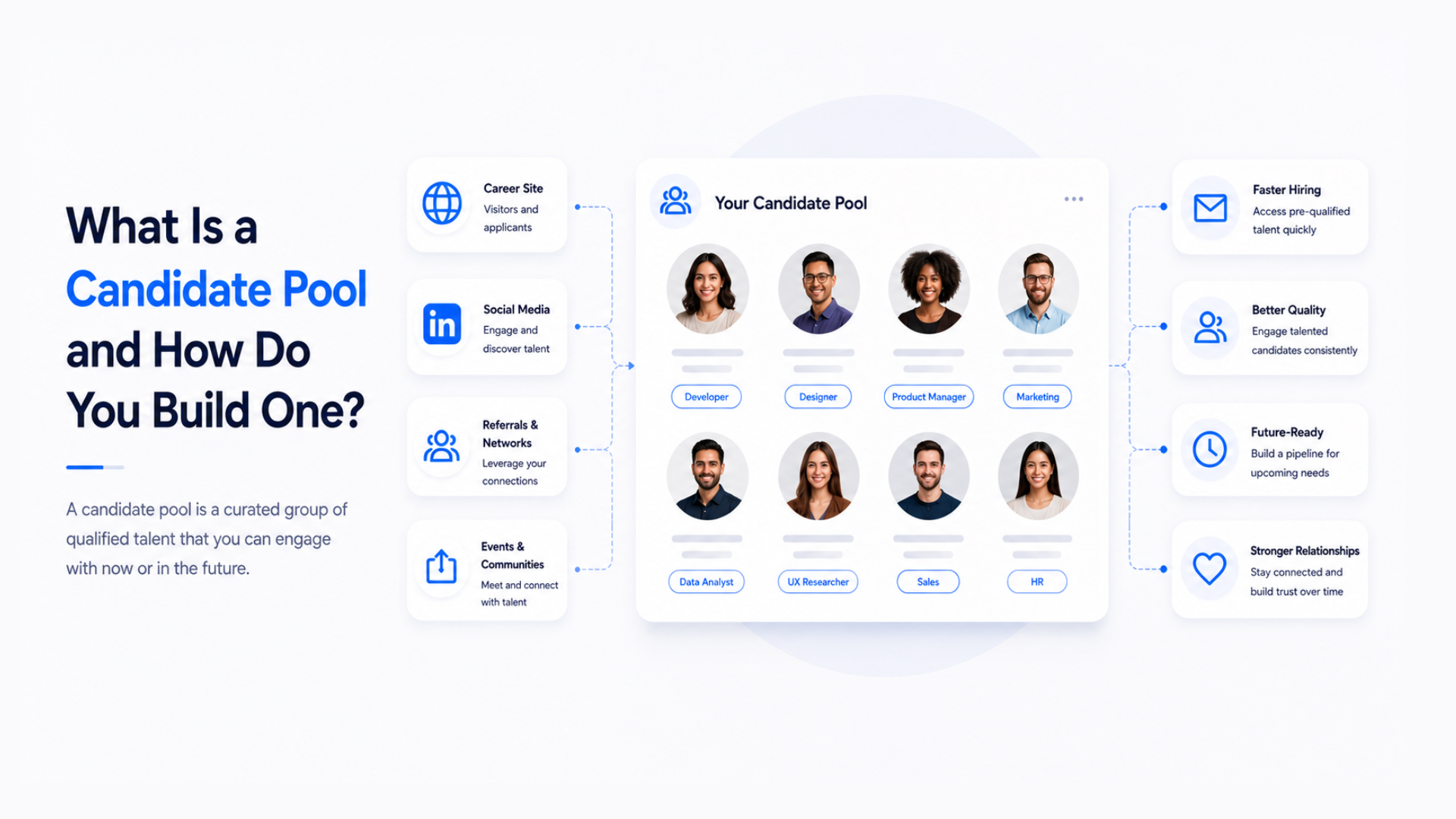
A candidate pool is an organized group of potential candidates who may be relevant to a current or future hiring need. These people may be active applicants, previous candidates, passive talent, employee referrals, sourced prospects, former employees, or people the company has met through other recruiting activities.
The important idea is that the company does not need to discover every candidate from the beginning each time a role opens.
A strong candidate pool gives recruiters a group of potentially relevant people they can search, evaluate, engage, or re-engage when a hiring need appears. Instead of starting with an empty pipeline, the team begins with talent it has already found or attracted.
But simply storing candidate records does not create a useful pool.
Many companies already have thousands of profiles inside an applicant tracking system or recruiting CRM. Recruiters may still struggle to find the right people because records are outdated, poorly organized, disconnected from previous interactions, or impossible to search effectively.
The value of a candidate pool comes from relevance and usability, not size.
What Is a Candidate Pool?
A candidate pool is a collection of people who could potentially be considered for one or more roles.
The pool may be created for an immediate vacancy. For example, a company hiring a senior product manager may build a group that includes applicants, employee referrals, sourced candidates, previous finalists, and people already known to the recruiting team.
A candidate pool can also exist before a specific job opens. A company that regularly hires software engineers may continuously identify and organize relevant talent so that recruiters have people to consider when future roles appear.
This makes a candidate pool broader than a list of applicants.
The people inside it do not all need to have applied. Some may be passive candidates who have never spoken with the company. Others may have completed several interviews in the past. Some may have joined a talent community or been referred by an employee.
What connects them is potential relevance.
A useful candidate pool answers a practical recruiting question: Who might we want to consider when this hiring need appears?
That question can apply to one role, one skill area, one location, or a wider category of future hiring.
Candidate Pool vs. Applicant Pool
A candidate pool and an applicant pool are often treated as the same thing, but the difference is important.
An applicant pool contains people who have applied for a particular job. The company publishes an opportunity, candidates submit applications, and the recruiting team evaluates that group.
The pool is created by candidate interest.
A candidate pool can be much broader. It may include applicants, but it can also contain sourced candidates, referrals, previous applicants, passive talent, former employees, and people from the company’s existing recruiting network.
The company does not need to wait for these people to apply before considering them potentially relevant.
This difference matters because an applicant pool is usually tied to one active hiring process. A candidate pool can exist across several roles and over a much longer period.
An applicant pool asks, “Who applied?”
A candidate pool asks, “Who could be relevant?”
For companies that rely heavily on inbound recruiting, the applicant pool may be the main source of candidates. For outbound-heavy teams, the wider candidate pool becomes more important because many of the strongest potential candidates may never apply on their own.
Candidate Pool vs. Talent Pool
The terms candidate pool and talent pool are often used interchangeably.
In many recruiting teams, there is no meaningful difference.
However, some organizations use “candidate pool” for a broader group of people who could potentially be considered for a role, while “talent pool” refers to a more intentionally organized group of candidates connected to future hiring needs.
Under this definition, a company might have a candidate pool containing everyone available for consideration and smaller talent pools for areas such as enterprise sales, data engineering, future leaders, or a specific location.
Other teams use the terms in exactly the opposite way.
The terminology matters less than the workflow.
Recruiters need to know why someone is in the pool, what makes the person potentially relevant, what previous relationship exists, and when the company should consider engaging them.
A well-named database that nobody uses has little value.
Candidate Pool vs. Talent Pipeline
A candidate pool and a talent pipeline are more clearly different.
A candidate pool is a group of potentially relevant people.
A talent pipeline usually refers to candidates who are progressing toward a more specific hiring outcome.
Someone can remain inside a candidate pool for months without being considered for an active role. They may be relevant to future hiring but have no current relationship with a vacancy.
A person in an active talent pipeline is usually closer to a hiring process. They may have responded to outreach, completed screening, entered interviews, or reached another defined stage.
The distinction can be understood through movement.
A pool contains possibilities.
A pipeline contains progression.
Recruiters may search a candidate pool when a role opens, identify the strongest matches, begin engagement, and move interested people into an active pipeline.
A healthy recruiting strategy often needs both. The pool provides future options, while the pipeline shows what is happening now.
Why Candidate Pools Matter
The biggest benefit of a candidate pool is that recruiters do not need to start every search from zero.
Consider what happens when a role closes.
The company may have received hundreds of applications, sourced dozens of passive candidates, completed interviews with several strong people, and eventually hired one person.
Without a candidate-pool strategy, most of the remaining work loses value.
Previous applicants stay buried inside the ATS. Sourced candidates disappear inside individual recruiter accounts. Finalists are remembered for a few months and then forgotten. People who said the timing was wrong are rarely contacted again.
When a similar role opens, the company repeats the search.
A candidate pool preserves more of the value created by previous recruiting activity.
The CIPD recruitment process overview emphasizes that effective resourcing is not only about filling an immediate vacancy; it should also consider the skills an organization needs for longer-term performance. A candidate pool supports that more proactive approach by giving recruiters a way to build talent availability before every vacancy becomes urgent.
The benefit is not simply faster hiring.
A useful pool can also reduce repeated sourcing work, make previous candidate relationships easier to reuse, and help recruiters understand where talent is available before a hiring need becomes critical.
Where Candidates in a Pool Come From
A strong candidate pool is usually built from several sources.
Current applicants are one source, but they should not be the only one. Previous applicants can become valuable as their experience changes or new roles appear. A candidate who was not selected two years ago may now be much stronger.
Previous finalists are especially useful because the company has already invested time in understanding them. Someone who narrowly missed one role may be an excellent fit for another.
Passive candidate sourcing adds people who have never applied. Recruiters can identify professionals with relevant experience and add appropriate profiles to the wider talent network before or during active searches.
Employee referrals can also expand the pool because employees often know relevant people who may not appear through obvious recruiting channels.
Recruiting events, talent communities, career-site registrations, company alumni, former employees, internships, and professional networks can all contribute.
The right mix depends on how the company hires.
A business with a strong employer brand may build much of its pool through inbound interest. A company hiring specialized talent may depend more heavily on outbound sourcing and referrals.
The goal is not to collect candidates from every possible source.
It is to build access to the talent markets the company actually needs.
How to Build a Candidate Pool
The first step is to decide why the pool exists.
A common mistake is creating one enormous database called “talent pool” and placing everyone inside it. The result becomes difficult to search and easy to ignore.
A better approach begins with a hiring need.
The company may expect to hire repeatedly for a particular function. It may be entering a new geography. It may need specialized skills that are difficult to find. It may want to preserve strong candidates from previous hiring processes.
The purpose determines who belongs in the pool.
Recruiters then need to define relevance.
This does not mean creating an impossible checklist. It means understanding the type of work the person may need to perform, which experience is useful, where flexibility exists, and what signals suggest potential fit.
The next step is candidate discovery.
Recruiters can search existing systems before immediately looking outside the company. Previous applicants, finalists, sourced candidates, and CRM records may already contain relevant people.
External sourcing can then expand the pool through professional networks, databases, referrals, communities, events, and other channels appropriate to the role.
Finally, the candidates need to be organized with enough context to make the pool useful later.
Building the pool is not a one-time project.
It is an ongoing recruiting process.
Start With Future Hiring Needs
The best candidate pools are connected to real hiring demand.
Recruiting teams should begin by understanding which roles are hired repeatedly, which skills are difficult to find, where the company expects growth, and which positions create the longest hiring delays.
This is where workforce planning and candidate-pool strategy connect.
If a company expects to build an enterprise sales team over the next year, recruiters can begin understanding that talent market before every individual role is approved.
If a business repeatedly struggles to hire data engineers, building a relevant pool can create more value than waiting for the next vacancy.
The CIPD’s recruitment guidance places role definition and attracting applicants within a wider resourcing process. Candidate-pool building works best when it follows the same principle: understand the need before collecting people.
A candidate pool should be a response to expected talent demand.
It should not be a database created simply because the recruiting software includes a “pool” feature.
Define Who Belongs in the Pool
A useful candidate pool needs clear inclusion logic.
For a specific technical function, the team may consider relevant skills, experience, industries, projects, locations, or adjacent backgrounds.
For future leadership hiring, the criteria may focus more on scope, career progression, team size, business context, and leadership experience.
The criteria should be broad enough to avoid creating one unrealistic ideal profile but clear enough to prevent the pool from becoming meaningless.
This is especially important when several recruiters contribute candidates.
Without shared logic, one recruiter may add only highly qualified people while another adds everyone who might possibly fit. Over time, the pool becomes inconsistent.
AI can help interpret requirements and identify related experience, but the recruiting team still needs to define the talent strategy.
Software can expand a search.
It cannot decide what the company should value without direction.
Search Existing Candidate Data First
Many companies already have a candidate pool.
They simply cannot use it effectively.
An ATS may contain years of previous applications. A recruiting CRM may contain passive candidates and talent communities. Recruiter inboxes may contain strong people who asked to reconnect later.
Before paying to discover completely new candidates, teams should examine who they already know.
This is candidate rediscovery.
A previous applicant may now have the experience required for a more senior role. A finalist may fit another team. A candidate who declined because of timing may now be open to a conversation.
The challenge is search.
Large candidate databases are often difficult to navigate because records use inconsistent titles, old keywords, or incomplete information.
AI can make rediscovery more useful by comparing new hiring requirements with historical candidate data and surfacing people whose experience appears relevant.
This turns old recruiting activity into a potential sourcing channel.
Expand the Pool Through Candidate Sourcing
Existing data will not always be enough.
Recruiters may need to find people the company has never encountered before.
This is where candidate sourcing expands the pool.
Traditional sourcing involves translating a hiring requirement into searches, filters, titles, skills, companies, locations, and other criteria. Recruiters review profiles, refine the search, and add relevant people to consideration.
AI sourcing can reduce some of this manual work.
A modern system may interpret the hiring requirement, recognize related experience, identify adjacent profiles, and prioritize candidates who appear relevant.
The goal should not be to add as many profiles as possible.
A candidate pool with 10,000 loosely relevant people may be less useful than one with 500 candidates whose relationship to the hiring need is understood.
The quality of the pool depends on the quality of candidate selection.
For smaller recruiting teams, Huntlo’s guide on whether AI sourcing is worth the investment makes the same broader point: sourcing creates value when it helps teams move toward hiring outcomes, not simply when it produces more candidate records.
Include Strong Candidates Who Were Not Hired
One of the easiest ways to improve a candidate pool is to stop losing good people at the end of hiring processes.
Most roles have one hire.
They may also have several strong candidates.
A finalist can be rejected because another person had slightly more relevant experience, the team chose an internal candidate, the role changed, or the hiring process was cancelled.
Those candidates should not automatically disappear.
The company already knows more about them than it knows about most people in the external talent market. Recruiters may have interview feedback, screening information, candidate preferences, and a history of communication.
This context can make future hiring faster and more informed.
However, previous candidates should not be treated as permanently qualified.
Experience changes.
Roles change.
Candidate interest changes.
The purpose of the pool is to preserve the relationship and relevant context, not freeze a hiring decision forever.
Organize the Pool Around Useful Segments
A large unstructured candidate pool quickly becomes a database nobody trusts.
Segmentation makes the pool actionable.
Recruiters may organize people by function, skill area, location, seniority, future hiring need, previous relationship, candidate interest, or another factor relevant to the company.
The exact categories matter less than whether recruiters can use them.
Too few segments create one enormous list.
Too many create administrative work and inconsistent tagging.
A good structure should help a recruiter answer questions quickly.
Who has already reached a final interview?
Who has relevant experience for this new role?
Who asked to reconnect this year?
Who is located in the market where the company is expanding?
Who has been sourced but never contacted?
The pool should make recruiting context easier to retrieve.
If the team needs a separate spreadsheet to understand the database, the structure is not working.
Add Context, Not Just Profiles
A name, job title, and email address are not enough to create a useful candidate record.
Recruiters need to understand why the person was added.
What made the candidate relevant?
Which role or talent need were they connected to?
Has the company spoken with them before?
What happened?
Did the candidate ask to reconnect later?
Were they interested in remote work?
Did they decline because of timing?
This context prevents future recruiters from restarting the relationship from zero.
It also reduces poor candidate experiences.
A previous finalist should not receive an automated message that treats them like a completely unknown person. Someone who declined contact should not be placed into a new sequence without appropriate controls.
The goal is not to collect unlimited personal information.
It is to preserve the recruiting context needed to manage the relationship appropriately.
Keep the Candidate Pool Updated
Candidate pools become less useful when they are treated as permanent archives.
People change jobs.
Skills develop.
Locations change.
Career interests evolve.
Contact information becomes outdated.
A candidate who was too junior two years ago may now be highly relevant. Another person may have moved into a completely different career path.
Pool maintenance therefore matters.
Recruiting teams should have a process for reviewing important talent groups, updating information appropriately, removing duplicate records, and identifying candidates who may now be relevant to new roles.
Automation can help with some of this work.
AI may surface old candidates when a new requirement appears. Systems may identify duplicate records or highlight outdated information. CRM workflows can support appropriate re-engagement.
But the objective should not be to keep every profile forever.
A useful pool is current enough to support recruiting decisions and managed according to applicable privacy and data-retention requirements.
Candidate Pools and Recruiting CRMs
A recruiting CRM is one of the most common systems used to manage candidate pools.
The CRM can organize people outside active hiring processes, preserve interaction history, support segmentation, and help recruiters engage or re-engage candidates over time.
This is particularly useful because many people in a candidate pool are not active applicants.
A passive candidate may be relevant but unavailable today.
A previous finalist may be worth contacting when a similar role opens.
A candidate may have asked to reconnect after six months.
The CRM helps preserve those relationships.
An ATS can also contain candidate pools, especially through previous applications and searchable candidate records. However, the ATS is usually strongest during active hiring processes, while the CRM is designed more directly around relationships before and between those processes.
The distinction matters less than whether the team can actually find and use the candidates it has already collected.
Candidate Pools and Passive Candidate Sourcing
Passive candidate sourcing is one of the most important ways to build a pool before candidates apply.
Recruiters identify people with potentially relevant experience and create a group that can support current or future outbound recruiting.
Not every person should be contacted immediately.
A company may be mapping a talent market before a role opens. The recruiting team may want to understand where relevant candidates work, which adjacent backgrounds exist, and how large the market appears to be.
When the hiring need becomes active, recruiters can prioritize the strongest candidates and begin engagement.
This can make the search more proactive.
However, teams should be careful not to confuse a database of scraped profiles with a genuine candidate relationship.
A person does not become engaged talent simply because their profile was added to software.
The pool creates potential access.
Recruiting begins when the company creates a relevant conversation.
How AI Is Changing Candidate Pool Building
AI changes candidate pools in two important ways.
The first is discovery.
AI sourcing tools can help recruiters identify new people, interpret less obvious career paths, and expand beyond exact keyword matches.
The second is rediscovery.
A company may already have thousands or millions of candidate records. AI can compare new requirements with those existing profiles and surface people who may have been forgotten.
This can make the candidate pool more dynamic.
Instead of a recruiter manually opening a database and trying to remember what to search for, the hiring requirement itself can trigger relevant candidate recommendations.
AI can also help summarize previous interactions, organize candidate information, and identify which people may deserve recruiter attention.
The risk is that easier discovery creates larger but less useful pools.
If every possible match is automatically added, the database grows faster than the recruiting team can understand or engage it.
The strongest use of AI is not building the biggest pool.
It is making the right candidates easier to find and act on.
The Risk of Building a Pool That Nobody Uses
Many candidate pools fail because the company focuses on collection rather than activation.
Recruiters keep adding profiles.
The database grows.
Nobody knows when to search it.
When a new role opens, the team returns to job advertising and external sourcing because that feels easier than navigating old records.
This creates a strange situation.
The company may have tens of thousands of candidates and still behave as though it knows nobody.
The solution is not another data-import project.
The pool needs to connect with the hiring workflow.
When a role opens, recruiters should be able to search or automatically surface relevant people.
Previous context should be visible.
The team should know which candidates can be approached, which relationships need more care, and what should happen when someone responds.
A candidate pool creates value only when it changes recruiting behavior.
How to Measure Candidate Pool Quality
Pool size is easy to measure.
It is rarely the best measure of success.
A larger pool may simply contain more outdated, duplicate, or irrelevant records.
Better measures examine usability.
How often do recruiters find relevant candidates inside the existing pool?
How many people move from the pool into active conversations?
How many become qualified candidates?
How many hires come from previous applicants, finalists, passive talent, or other existing relationships?
How quickly can the team build a pipeline for recurring roles?
Recruiters should also look at pool health.
Are important segments growing?
Is candidate information current enough to use?
Are people receiving relevant communication?
Do recruiters trust the system enough to search it before starting another external campaign?
A good candidate pool reduces the need to rediscover the same talent repeatedly.
That is a stronger sign of value than the total number of profiles stored.
Where Huntlo Fits Into Candidate Pool Building
Huntlo approaches candidate pools from the perspective of recruiting execution.
Finding and organizing potential candidates matters, but the pool itself is not the hiring outcome.
The team still needs to identify who is relevant to a specific role, decide who should be engaged, manage follow-ups and responses, qualify interested candidates, and move the right people toward interviews.
This is where many recruiting systems become fragmented.
One tool stores candidate records.
Another finds new people.
Another sends outreach.
Another manages screening.
The recruiter manually connects the stages.
Huntlo’s agentic AI recruiting infrastructure is designed around connecting more of that workflow, from candidate discovery and engagement to screening and interview coordination.
The goal is not simply to help companies create larger candidate databases.
It is to help recruiting teams act on relevant talent with less manual orchestration.
This is especially important for outbound-heavy teams. A candidate pool may contain strong passive talent, but the value remains theoretical until those people can be turned into relevant conversations.
Huntlo’s guide to AI sourcing tools for recruitment agencies makes the same point: expanding talent pools can improve candidate access, but sourcing alone does not solve engagement, follow-ups, qualification, and recruiting operations.
How to Build a Candidate Pool That Actually Works
A useful candidate pool begins with real hiring demand and clear reasons for including people.
Recruiters should first search the talent the company already knows, then expand through sourcing, referrals, applications, communities, and other relevant channels.
Strong candidates should not disappear simply because they were not hired for one role.
The pool should be organized around segments recruiters can actually use, and each important record should preserve enough context to explain the relationship.
The team also needs a process for keeping the pool current and activating it when a hiring need appears.
This is where technology matters.
The ATS can preserve applicant history.
The recruiting CRM can manage longer-term relationships.
AI sourcing can discover new people.
Candidate rediscovery can surface forgotten talent.
Workflow automation can help move relevant people from the pool into engagement and qualification.
The systems should support one objective: making the right candidate easier to find and easier to move toward a meaningful conversation.
The Future of Candidate Pools
Candidate pools are moving from static databases toward more active recruiting systems.
Historically, a recruiter had to remember which database to search, which tags to use, and which previous candidates might still be relevant.
AI can make the process more contextual.
A new hiring requirement can trigger candidate rediscovery.
The system can surface people from previous applications, CRM records, sourced talent, and new external searches.
Previous interactions can inform the next action.
A candidate who asked to reconnect later should be treated differently from a completely new prospect. A previous finalist should carry more context into the process than someone the company has never met.
The future candidate pool will therefore be less like a folder of saved profiles and more like an active talent network.
Recruiters will still define the hiring strategy and make important decisions.
Software will help determine which existing relationships may be relevant and coordinate more of the work required to act on them.
Conclusion: A Candidate Pool Should Be a Talent Asset, Not a Database
A candidate pool is an organized group of people who may be relevant to current or future hiring needs.
It can include applicants, previous candidates, finalists, passive talent, referrals, former employees, talent-community members, and people discovered through candidate sourcing.
The benefit is simple.
The company does not need to start every hiring process from zero.
But a large database is not automatically a strong candidate pool.
The people need to be relevant.
The information needs to be usable.
Previous context needs to be preserved.
The pool needs to remain current enough to support recruiting decisions.
Most importantly, recruiters need to be able to act on it.
AI can make candidate pools easier to build and search. It can discover new talent, rediscover previous candidates, identify related experience, and surface relevant people when a new role appears.
But the objective should not be to collect more profiles.
It should be to reduce the distance between a hiring need and the right candidate conversation.
A good candidate pool gives the company more options before hiring becomes urgent.
A great one makes those options usable.
Frequently Asked Questions
What is a candidate pool?
A candidate pool is an organized group of potential candidates who may be relevant to a current or future hiring need.
What is the difference between a candidate pool and an applicant pool?
An applicant pool contains people who applied for a specific role. A candidate pool can also include passive candidates, previous applicants, referrals, sourced talent, and other potential candidates.
Is a candidate pool the same as a talent pool?
The terms are often used interchangeably. Some organizations use talent pool for a more intentionally segmented group connected to future hiring needs, but there is no universal distinction.
What is the difference between a candidate pool and a talent pipeline?
A candidate pool contains potentially relevant people. A talent pipeline usually contains candidates progressing toward a more specific hiring outcome.
How do you build a candidate pool?
Start with expected hiring needs, define who is relevant, search existing candidate data, expand through sourcing and referrals, preserve strong previous candidates, organize useful segments, add relationship context, and keep the pool updated.
Where do candidates in a pool come from?
Candidates can come from current and previous applications, passive sourcing, employee referrals, recruiting CRMs, previous finalists, events, talent communities, former employees, and professional networks.
Can AI build a candidate pool?
AI can help discover candidates, identify related experience, rediscover people in existing databases, and prioritize relevant profiles. Recruiters still need to define the talent strategy and decide how candidates should be engaged.
How large should a candidate pool be?
There is no ideal size. A smaller pool of relevant and usable candidates can create more value than a very large database of outdated or poorly organized profiles.
Related Topics
Explore whether AI sourcing is worth it for small recruiting teams and why the value of a larger candidate pool depends on what happens after discovery.
Learn how AI sourcing tools can expand talent pools for recruitment agencies while engagement, qualification, and workflow execution remain critical.
Explore AI sourcing for Tier 2 and Tier 3 city hiring in India and how broader candidate discovery can help teams reach talent beyond major hiring markets.