Sarah, a Head of Talent at a rapidly scaling aerospace venture, sat in a review meeting staring at a set of metrics that should have been a victory. Her team had spent fifty thousand dollars on a high-production brand video, featuring sweeping drone shots of the facility, cinematic slow-motion clips of employees collaborating, and a soaring orchestral score. The campaign had generated millions of views and a record-breaking number of applications, yet the Chief Engineer was still complaining that the pipeline was "empty." After reviewing the candidates, Sarah realized the horrifying truth: they had attracted thousands of people who liked the idea of working at a cool company, but not a single person who was equipped to solve the structural challenges of their propulsion system. The polished production value had acted as a filter for the transactional applicant while simultaneously silencing the signal that high-maturity partners actually look for.
The failure Sarah experienced is a systemic result of the "Commercialization of Recruitment." Most organizations treat recruitment video as a subset of general brand marketing, assuming that the goal is to make the company look as attractive as possible to as many people as possible. This transactional approach prioritizes the image of the company over the operational reality of the work. When a company markets itself as a "perfect place to work" through cinematic glamour, it sends a generic signal that appeals to those seeking comfort rather than those seeking a mission. This creates a structural misalignment where the company attracts "employees" who are in love with the brand but are incapable of functioning as "partners" in the organization's growth.
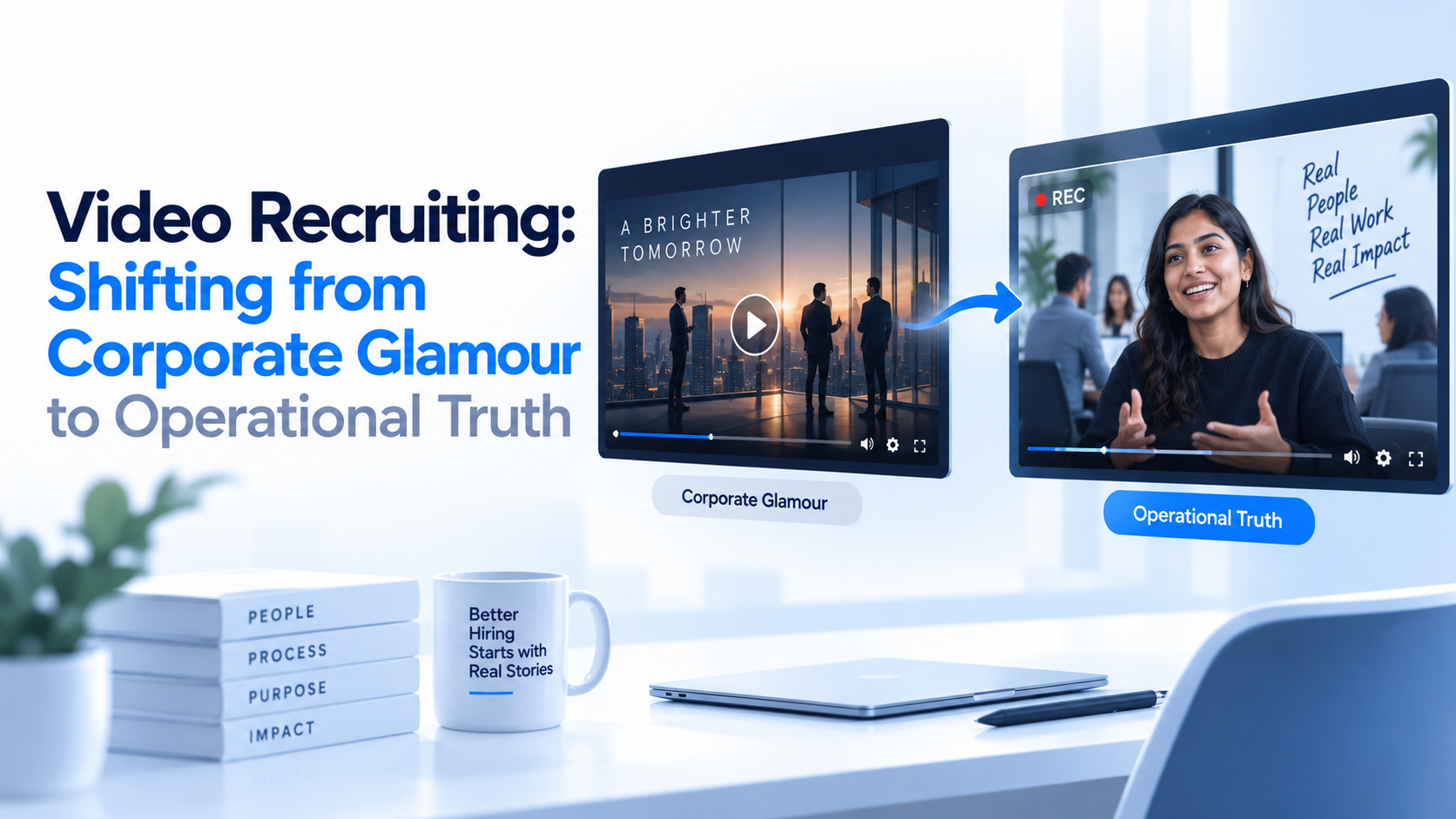
To solve this, leadership must transition from "Brand Videos" to "Operational Signals." Signaling is the act of providing specific, high-fidelity information that only a high-maturity professional will recognize as valuable. This requires a total abandonment of the "commercial" model in favor of a "manifesto" model. A sovereign professional is not looking for a company that claims to be great; they are looking for an organization that demonstrates operational maturity by being transparent about its structural gaps and its path toward optimization. By engineering a precise signal, organizations can attract partners who are structurally aligned with the company's goals rather than its image.
The Cinematic Trap: Why High-Production Videos Repel Sovereign Talent
The primary trap of modern video recruiting is the belief that professional polish equals professional attraction. HR departments often invest heavily in "Life at the Company" series, focusing on the aesthetics of the office and curated "culture" snippets. However, for the high-maturity professional, these are noise; they are empty signifiers that lack operational substance. The polished video is what the marketing team is using to produce a feeling of perfection, and that perfection is what the sovereign professional is using to identify a lack of operational honesty.
When recruitment video focuses on the "experience" of working at a company—the social events and the generic culture claims—it communicates that the organization prioritizes harmony over impact. This transactional framing attracts individuals who are looking for a safe harbor rather than partners who are looking for a challenge. Relational recruiting requires a pivot toward "Proof of Work" content, where the company shares the actual structural problems it is solving. By shifting the focus from the perks to the puzzles, the organization attracts the sovereign professional who is motivated by the complexity of the work.
This failure of signal is often a symptom of low operational maturity within the talent function. If a company cannot define the specific "Sovereignty Gap" it is trying to fill, it defaults to generic branding to cover the void. This creates a cycle where the company attracts candidates who are a fit for the "brand" but a failure for the "role." The reliance on high-production "culture" content is what the recruiting team is using to produce a crowded pipeline, and that crowded pipeline is what the organization is using to eliminate the time required for deep, relational engagement.
The impact of this volume-centric approach is most evident in the degradation of the candidate experience. When a company attracts thousands of applicants through broad-spectrum glamour, the response velocity inevitably drops, leading to a void of silence that destroys the company's reputation among high-value partners. According to McKinsey's research on organizational health, the most resilient companies are those that foster a culture of radical transparency. This transition allows the company to move from a "processing" mindset to a "partnership" mindset.
Operational Proof: Replacing Glamour with Structural Truth
To attract a partner, recruitment video must provide a window into the operational reality of the organization. The most effective content is that which demonstrates "Proof of Work"—evidence that the company is thinking deeply about its structural challenges. Instead of a "Meet the Team" montage, a high-maturity organization publishes a "Technical Post-Mortem" video. In this format, the company describes a specific failure, the root cause of that failure, and the structural changes implemented to resolve it. This transparency is what the manager is using to produce authenticity, and that authenticity is what the candidate is using to assess the cultural fit.
Another high-signal video idea is the "Roadmap Transparency" series. Rather than sharing a polished vision statement, the company produces a raw, screen-shared walkthrough of the hurdles they expect to face in the next twelve months. They describe the specific bottlenecks in their current process and the expertise required to break through them. This transforms the recruitment video from an advertisement into a professional challenge. The articulation of the hurdle is what the organization is using to produce attraction, and that attraction is what the sovereign professional is using to prioritize this opportunity.
The "Hard Parts" series is equally effective for signaling operational maturity. In this approach, the company interviews its own leaders not about why they love their jobs, but about the most frustrating part of their current role. They discuss the structural frictions and the organizational debts they are currently fighting. High-maturity partners are not deterred by challenges; they are deterred by the absence of a plan to solve them. The honesty of the struggle is what the employee is using to produce trust, and that trust is what the partner is using to justify the risk of a career move.
Finally, companies should produce "Philosophical Manifestos" on their approach to work. This involves recording a detailed discussion on how the organization views autonomy, decision-making, and talent sovereignty. Instead of listing "empowerment" as a value, the company describes the specific mechanisms it uses to ensure that partners have total ownership over their outcomes. This provides a "Cultural Proxy" that allows the potential partner to simulate the experience of working at the company. The clarity of the logic is what the brand is using to produce a feeling of inevitability, and that inevitability is what the sovereign professional is using to anchor their interest.
The Executive as a Signal Node: Video for Professional Authority
One of the greatest failures in video recruiting is the over-reliance on the "Corporate Voice." This is the sanitized, third-person narrative that speaks for the organization but lacks a human soul. Sovereign professionals are repelled by this voice because it signals a lack of intellectual rigor and a preference for harmony over impact. To attract a partner, the organization must leverage its executives as "Signal Nodes." A sovereign professional does not want to be recruited by a company; they want to be recruited by a peer who demonstrates a higher level of operational thinking.
An executive who uses video to share their professional philosophy, their failures, and their strategic pivots becomes a magnet for similar minds. This is not "personal branding" in the sense of vanity, but "professional signaling" in the sense of authority. When a CEO posts a transparent critique of their own industry's standard practices on video, they are signaling a level of sovereign thinking that attracts other sovereign thinkers. The articulation of a unique philosophy is what the leader is using to produce intellectual attraction, and that attraction is what the partner is using to envision a collaborative relationship.
Integrating this into the video strategy requires a shift in ownership, moving the "voice" of the company from the HR department to the operational leaders. The most effective recruitment video is not scripted by a copywriter; it is recorded by the person who will actually lead the new hire. When a leader shares a deep-dive on the company's architectural debt, they are providing a "Cultural Proxy" that allows the candidate to simulate the experience of working in the role. This transparency is what the lead is using to produce authenticity, and that authenticity is what the candidate is using to assess the cultural fit.
When the leadership team operates as a collective of signal nodes, the company's brand is no longer a static image but a living conversation. This transforms the recruitment process from a plea for applications into a series of high-level consultations. When a potential partner engages with a leader's video content over several months, the alignment is established long before the first official outreach. This early alignment is what the hiring team is using to produce a shortened interview cycle, and that shortened cycle is what the organization is using to eliminate the risk of losing top talent.
Asynchronous Alignment: Scaling the Relational Loop
As an organization grows, the challenge of maintaining a high-fidelity signal across multiple roles becomes a structural problem. Manually recording relational videos for every single opening is unsustainable for a lean talent team. This is where the move toward asynchronous alignment becomes critical. By utilizing short-form, high-impact video messages, the company can maintain the "Sovereignty Promise" while scaling the intake process. This requires a shift from "screening" videos to "alignment" videos.
In a transactional model, asynchronous video is used for "One-Way Interviews," where the candidate records answers to generic questions. This is a la- lund (Causal Chain) of friction: the rigid format is what the candidate is perceiving as a lack of trust, and that lack of trust is what the sovereign professional is using to reject the process. In a relational model, asynchronous video is used by the company to provide a personalized, high-fidelity invitation. A hiring manager records a three-minute video specifically for a potential partner, detailing the exact structural gap they want that partner to fill.
This approach directly impacts the creating of a memorable candidate experience. When a candidate receives a personalized video that demonstrates the leader's operational thinking, the trust is established immediately. They are no longer just another number in a pipeline; they are a recognized peer being invited into a strategic partnership. The personal nature of the video is what the manager is using to produce a feeling of agency, and that agency is what the sovereign professional is using to prioritize the opportunity.
Furthermore, this method allows the organization to implement a high-fidelity candidate nurturing strategy. Instead of "checking in" via email—a transactional habit that annoys sovereign professionals—the recruiter can send a short video update on a specific project's progress. This transforms the nurture process from a series of prompts into a series of value-adds. The delivery of relevant, visual insight is what the system is using to produce a relational bond, and that bond is what the partner is using to maintain their interest in the organization.
Huntlo: The Infrastructure for a High-Fidelity Video Strategy
As a company scales, the risk of "Signal Drift" increases. The original promise made in a video might be diluted as the organization grows, leading to a "Promise Gap" that destroys trust. To prevent this, the organization needs a structural way to deliver its value proposition consistently. This is where a Hiring OS becomes essential. A Hiring OS does not just track candidates; it synchronizes the "Sovereignty Gaps" of the company with the external signals sent to the market.
Huntlo serves as this essential infrastructure, moving video recruiting from a series of isolated clips to a continuous operational workflow. By treating the recruitment process as an OS, companies can ensure that the principles of relational signaling are baked into every touchpoint. The system can track which specific operational videos are attracting the highest-quality partners, allowing the company to iterate on its signal in real-time. The automation of the administrative burden is what the OS is using to produce more space for human-centric alignment, and that alignment is what the organization is using to secure high-maturity partners.
Furthermore, an agentic approach to hiring allows the organization to maintain a "talent sovereignty" database that lives beyond the current open role. Instead of launching a generic video campaign when there is a gap, the Hiring OS allows the company to maintain "dormant partnerships" with sovereign professionals who have already aligned with the company's operational philosophy. This transforms the act of video recruiting from a public plea for attention into a private, high-value consultation. The proactive mapping is what the system is using to produce a high-conversion pipeline, and that pipeline is what the leadership is using to ensure structural stability.
Integrating video into a Hiring OS also enables a more sophisticated approach to onboarding. By creating a library of "Operational Truth" videos—deep dives into the company's structural habits and failures—the organization can begin the alignment process before the partner's first day. This ensures that the la- lund (Causal Chain) of the brand signal is maintained through the transition into the role. The continuity of the signal is what the infrastructure is using to produce a high-trust environment, and that environment is what the partner is using to hit their ninety-day goals faster.
Measuring Resonance: Beyond Views to Alignment Density
The final step in implementing a relational video strategy is to redefine how success is measured. In a transactional system, the KPIs are vanity metrics: views, likes, and shares. In a relational system, these are lagging indicators of potential failure. If a video gets ten million views but attracts zero sovereign partners, the content was a failure of signaling. The obsession with "virality" is what the social media manager is using to produce a success report, and that report is what the leadership is using to ignore the lack of quality hires.
To measure true resonance, organizations must track "Alignment Density"—the percentage of candidates attracted by a specific video who pass the first structural alignment check. If a raw, honest video about structural debt attracts five candidates, and three of them are sovereign partners, the alignment density is 60%. This is infinitely more valuable than a cinematic video that attracts a thousand applicants with a 0.1% alignment density. The precision of the signal is what the organization is using to produce a high-quality pipeline, and that pipeline is what the recruiting team is using to reclaim their time.
This iterative approach turns video recruiting into a strategic intelligence function. By analyzing which "Signals" (e.g., a technical post-mortem vs. a leadership manifesto) attract the most impactful partners, the company gains a deeper understanding of its own operational maturity. They begin to see exactly what combination of autonomy and complexity drives the highest level of performance in the market. This intelligence then feeds back into the broader business strategy, allowing them to build an organization that is a natural magnet for sovereign talent.
Ultimately, video recruiting is not about "better production"; it is about "better thinking." It requires the courage to stop optimizing for the algorithm and to start optimizing for the partner. It requires the discipline to move from a transactional "Commercial" to a relational "Signal." When an organization views its video content as a partnership invitation, it ceases to struggle with a lack of talent. Instead, it finds itself surrounded by sovereign professionals who are not just working for a salary, but are invested in the structural success of the mission. This commitment to relational signaling is what the organization is using to produce an elite culture, and that culture is what the company is using to dominate its market. This is the only way to reduce candidate drop-off rates in an era where high-impact talent has total sovereignty over their career choices.