David, a Lead Engineer at a high-growth robotics startup, felt a surge of irritation every time a notification from the HR department appeared in his inbox. The emails were always the same: a polished graphic of the office, a list of generic benefits, and a plea to "share this open role with your network to help us grow." David rarely complied because he knew the reality of the role was far more complex than the corporate ad suggested. The position was currently a chaotic mess of legacy code and shifting priorities, and the ad’s promise of "seamless collaboration" felt like a lie. He realized that by asking him to broadcast a fantasy, the company was not only wasting his time but was actively damaging his professional credibility with the very peers he respected.
The failure David experienced is a systemic symptom of the "Transactional Advocacy" trap. Most organizations treat employee advocacy as a distribution problem, assuming that if they can simply get their employees to act as amplifiers for corporate marketing, they will increase their reach. This approach prioritizes the volume of impressions over the precision of the signal, resulting in a pipeline of applicants who are attracted to the veneer but repelled by the reality. When a company asks an employee to "share a link," they are treating that employee as a free marketing channel rather than a professional authority. This creates a structural misalignment where the employee feels like a tool of the institution rather than a sovereign partner in the company's growth.
To solve this, leadership must transition from forced advocacy to "Relational Signaling." Relational advocacy is not about asking employees to promote a job; it is about empowering them to broadcast the operational reality of their work. This requires a shift from the "Brand Ambassador" model to the "Signal Node" model. A sovereign professional is not looking for a company that claims to be perfect; they are looking for an organization that demonstrates operational maturity through the transparency of its challenges. By turning employees into authority nodes who share real structural gaps, organizations can attract partners who are aligned with the actual mission of the company.
The Forced Advocacy Trap: Why Corporate Scripts Repel Sovereign Talent
The primary reason traditional employee advocacy fails is that it relies on a script that the employees themselves do not believe. When HR provides a pre-written post for an engineer to share, they are removing the professional's agency and replacing it with a corporate narrative. High-maturity professionals in the network can instantly detect this lack of authenticity, viewing the post as a red flag for a low-trust environment. The corporate script is what the employee is using to produce safety, and that safety is what the partner is using to signal disinterest.
When advocacy is framed as a transactional favor to the company, it inadvertently signals a lack of operational maturity. It tells the potential partner that the organization is so desperate for volume that it is willing to compromise the professional integrity of its own staff. Relational hiring requires a total rejection of the "share this post" mentality in favor of "Professional Sovereignty." Instead of providing a template, a high-maturity organization encourages its team to discuss the actual puzzles they are solving in their daily work. This attracts the sovereign professional who is motivated by the complexity of the problem rather than the polish of the advertisement.
This disconnect is often rooted in a fear of vulnerability within the talent function. Many recruiters fear that if employees are too honest about the challenges of a role, they will scare away the talent. In reality, the opposite is true for high-value partners, who are actually deterred by the absence of a problem to solve. The obsession with a perfect image is what the leadership is using to produce a false sense of stability, and that false sense of stability is what the partner is using to conclude that the organization has stagnated. To attract a partner, the company must be willing to let its employees broadcast the "messy middle" of their operational journey.
The impact of this transactional approach is most evident in the quality of the referral pipeline. When employees are forced into advocacy, they only refer people who are willing to tolerate a transactional environment, rather than the high-impact partners the company actually needs. This creates a cycle of mediocrity where the company clones its existing staff instead of evolving its capabilities. According to Gartner's research on the employee experience, the most successful organizations are those that treat their employees as contributors to the brand's authority rather than conduits for its marketing. This shift allows the company to move from a "push" strategy to a "pull" strategy based on genuine peer-to-peer trust.
Employees as Signal Nodes: The Power of Professional Authority
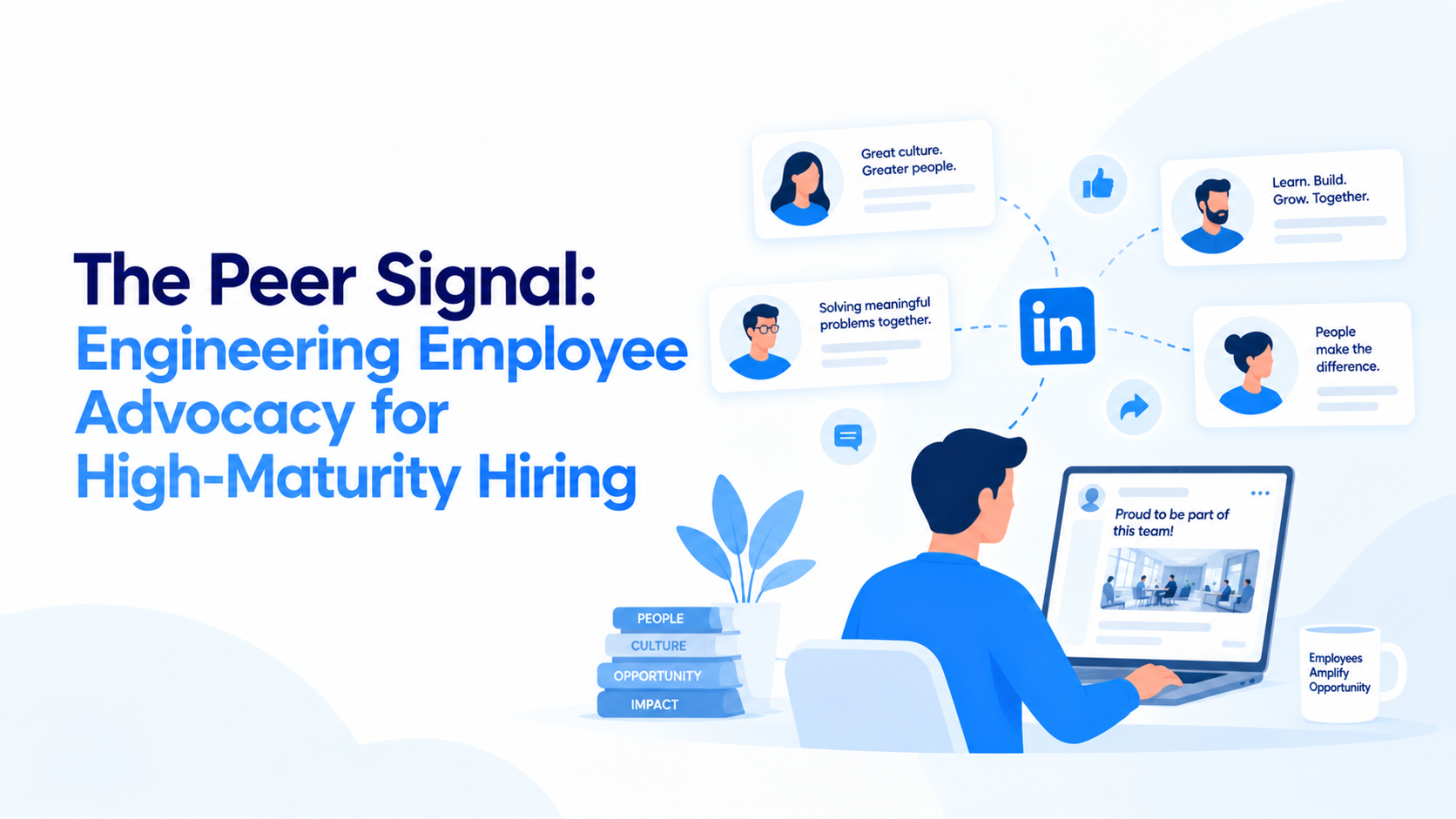
To build a relational advocacy engine, the organization must move from "Corporate Voice" to "Peer Voice." Peer voice is the most powerful signal in recruitment because it is viewed as a high-fidelity proxy for the internal health of the company. When a Lead Engineer posts a detailed critique of a technical hurdle they just overcame, they are not "recruiting" in the traditional sense; they are signaling their own operational maturity. High-maturity partners are drawn to this authority because it proves that the company is a place where sovereign professionals are allowed to think and execute.
A high-precision signal focuses on the "Causal Chain" of the professional's daily experience. Instead of saying "I love working here," a signal node says, "The friction in our current deployment loop is what we are currently solving to produce higher release velocity, and that velocity is what the team needs to hit our Q4 targets." This framing provides a potential partner with a window into the actual structural needs of the organization. The transparency of the challenge is what the employee is using to produce trust, and that trust is what the partner is using to justify the risk of a career move.
Integrating this level of signaling requires a shift in how the company views its employees' social presence. Rather than treating LinkedIn or Twitter as a place for corporate announcements, leadership should encourage the team to use these platforms as professional journals. When employees share their learning curves, their failures, and their strategic pivots, they are creating a gravitational pull for similar minds. This transforms the act of advocacy from a chore into an expression of professional growth. The articulation of a unique professional philosophy is what the employee is using to produce intellectual attraction, and that attraction is what the partner is using to envision a collaborative relationship.
Furthermore, this approach reduces the burden on the recruiting team by pre-filtering for alignment. When a candidate reaches out to a company because they were inspired by a specific technical post, they are already aligned with the operational reality of the role. They are not applying to a "job"; they are applying to solve a specific problem that they have already seen broadcasted. This early alignment is what the hiring team is using to produce a shortened interview cycle, and that shortened cycle is what the organization is using to eliminate the risk of losing top talent to a faster competitor.
Engineering the Peer-to-Peer Value Exchange: The Sovereignty Gap
The core of relational advocacy is the identification and communication of the "Sovereignty Gap." This is the specific intersection where the company's greatest structural need meets a professional's greatest strength. Transactional advocacy hides this gap behind a list of perks; relational advocacy highlights it as an invitation. For a sovereign professional, the most attractive "benefit" a company can offer is the authority to solve a high-stakes problem. The promise of ownership is what the organization is using to produce genuine engagement, and that engagement is what the partner is using to prioritize this opportunity over others.
To implement this, leadership must encourage employees to talk about the "Hard Parts" of their roles. High-maturity partners are not deterred by challenges; they are deterred by the lack of transparency regarding those challenges. By being honest about the structural debts or the organizational frictions they are fighting, employees build immediate credibility with their peers. This honesty filters out those who are looking for a comfortable job and attracts those who enjoy the process of optimization. The transparency of the friction is what the peer is using to produce authenticity, and that authenticity is what the candidate is using to assess the cultural fit.
This shift in communication also changes the nature of the referral. In a transactional system, a referral is a favor: "I know a guy who needs a job." In a relational system, a referral is a strategic match: "I know a partner who has the specific sovereign capability to solve this structural bottleneck." This elevates the role of the employee from a source of leads to a strategic talent scout. The strategic matching is what the employee is using to produce a high-quality pipeline, and that pipeline is what the leadership is using to ensure structural stability.
This peer-to-peer value exchange is further strengthened when the company rewards "Alignment" over "Volume." If an employee refers one high-maturity partner who transforms a department, that is infinitely more valuable than referring ten mediocre applicants who just fit the template. By valuing the quality of the match, the company reinforces the behavior of relational signaling. The valuation of impact is what the organization is using to produce a culture of excellence, and that culture is what the partner is using to build deep loyalty.
The Infrastructure of Authenticity: How a Hiring OS Scales Advocacy
As an organization grows, the challenge of maintaining authentic advocacy across hundreds of employees becomes a structural problem. If advocacy is left entirely to chance, it remains fragmented; if it is forced, it becomes transactional. To solve this, the company needs a structural way to support its signal nodes without micromanaging them. This is where the need for a Hiring OS becomes critical. A Hiring OS does not just track candidates; it manages the structural alignment between the company's internal reality and the external professional signal.
Huntlo serves as this essential infrastructure, moving employee advocacy from a series of sporadic posts to a continuous operational workflow. By treating advocacy as part of the operational OS, companies can ensure that their employees have the data and the "Sovereignty Gaps" they need to signal effectively. The system can track which operational challenges are currently the highest priority, allowing employees to broadcast the most relevant "Proof of Work" to the market. The automation of the administrative burden is what the OS is using to produce more space for human-centric alignment, and that alignment is what the organization is using to secure high-maturity partners.
Furthermore, an agentic approach to hiring allows the company to maintain a relational map of potential partners who have already engaged with the employees' signals. Instead of waiting for an application, the Hiring OS identifies the professionals who are interacting with the team's "Proof of Work" and initiates a high-level consultation. This transforms the act of advocacy from a passive broadcast into a proactive pipeline. The proactive mapping is what the system is using to produce a high-conversion pipeline, and that pipeline is what the leadership is using to eliminate the waste of traditional sourcing.
Integrating advocacy into a Hiring OS also allows for a more sophisticated approach to candidate nurturing strategies. When a potential partner engages with an employee's post, the OS ensures that the subsequent recruiter outreach is a direct continuation of that specific conversation. If the candidate was interested in a post about "scaling data pipelines," the recruiter doesn't start with a generic pitch; they start with the operational details of that pipeline. This continuity of signal is what the infrastructure is using to produce a memorable candidate experience, as every interaction is based on mutual professional value.
Measuring Impact: From Share-Counts to Alignment Density
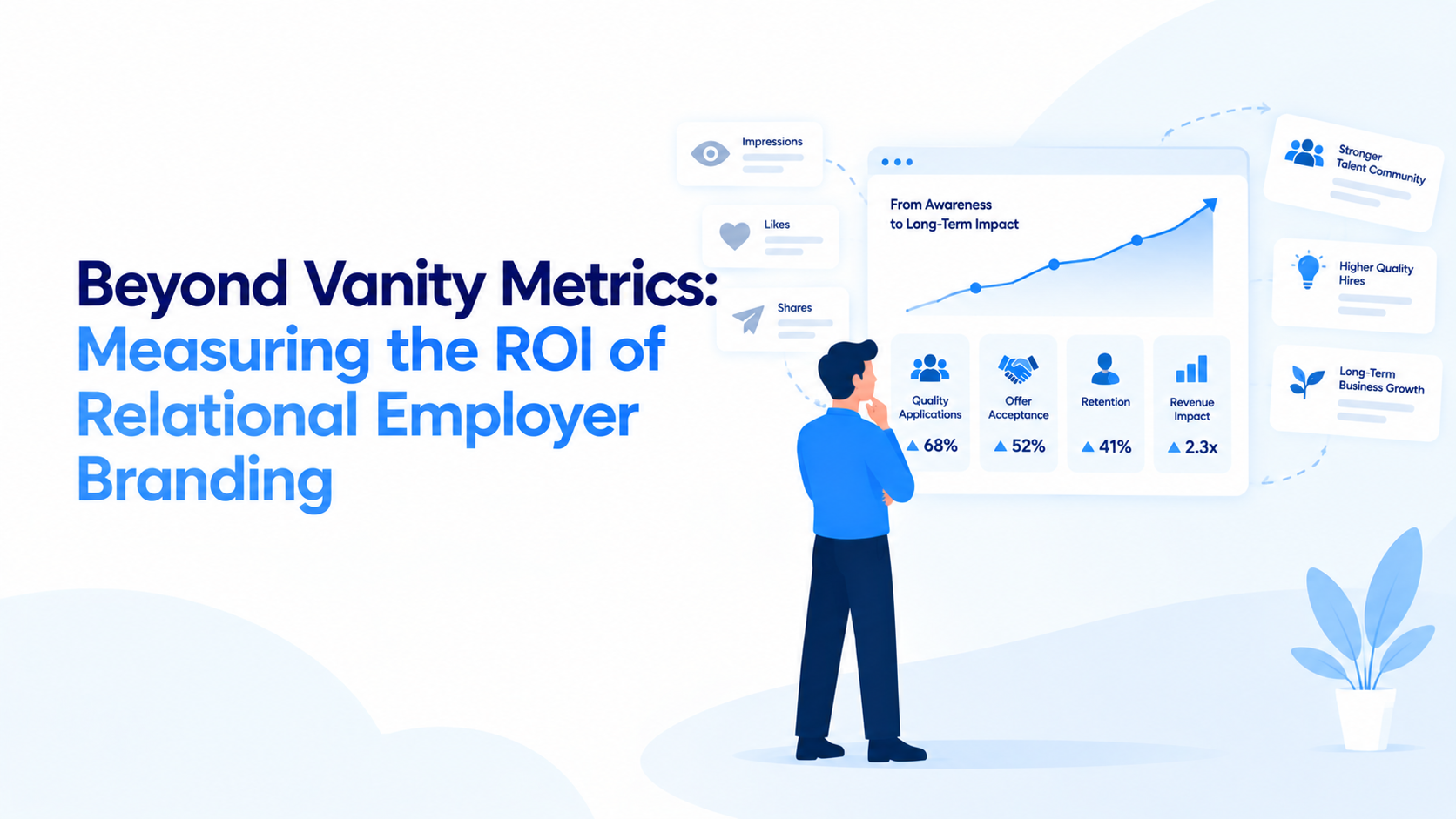
The final step in evolving employee advocacy is to redefine how success is measured. In a transactional system, advocacy success is measured by "Shares," "Reach," and "Application Volume." In a relational system, these are vanity metrics that often signal a failure of precision. If a post gets a thousand shares but attracts zero sovereign partners, the signal was too broad and the advocacy was transactional. The obsession with reach is what the social media manager is using to produce a report, and that report is what the leadership is using to ignore the lack of quality hires.
To measure true resonance, companies must track "Alignment Density"—the percentage of referrals and inbound leads that pass the first structural alignment check. If high-fidelity signaling is working, the total number of applicants may actually decrease, while the "Quality of Hire" increases. This is the paradox of relational advocacy: the more honest and specific the signal, the smaller the crowd, but the higher the impact. The reduction in noise is what the organization is using to produce a high-quality pipeline, and that pipeline is what the recruiting team is using to reclaim their time.
This iterative approach turns employee advocacy into a strategic intelligence function. By analyzing which "Proof of Work" stories attract the most impactful partners, the company gains a deeper understanding of its own operational maturity. They begin to see exactly what combination of autonomy, complexity, and growth drives the highest level of performance in the market. This intelligence then informs the broader business strategy, as the company builds its operations around the needs of its most sovereign assets.
Ultimately, employee advocacy is not about "getting staff to post on LinkedIn"; it is about "empowering partners to signal authority." It requires the courage to stop optimizing for the algorithm and to start optimizing for the professional. It requires the discipline to move from a transactional "Corporate Brand" to a relational "Peer Signal." When an organization views its employees as authority nodes rather than marketing channels, it ceases to struggle with a lack of talent. Instead, it finds itself surrounded by sovereign professionals who are not just working for a salary, but are invested in the structural success of the mission. This commitment to relational signaling is what the organization is using to produce an elite culture, and that culture is what the company is using to dominate its market. This is the only way to reduce candidate drop-off rates and align with the shift to career architecture that defines the future of the global workforce.