Julian, a Head of Talent at a high-growth cybersecurity firm, stared at the results of his latest recruitment marketing campaign with a mixture of pride and horror. On paper, the campaign was a triumph; they had increased their "brand impressions" by 400% and seen a massive spike in total applications for their open roles. However, when Julian looked at the actual quality of the pipeline, he found a wasteland of generic resumes and candidates who couldn't articulate the company's core structural challenges. He had spent six figures on polished videos, sponsored social posts, and "Day in the Life" content designed to make the company look attractive to everyone. In his attempt to cast the widest possible net, Julian had inadvertently created a beacon for the transactional applicant while becoming invisible to the sovereign professional.
The failure Julian experienced is a systemic byproduct of the "Volume Fallacy" in traditional recruitment marketing. Most organizations treat recruitment marketing as a subset of general corporate marketing, assuming that the goal is to increase the number of people who know the company exists. This transactional approach prioritizes visibility over precision, leading to a pipeline flooded with noise. When a company markets itself as a "great place to work" with "amazing perks," it sends a generic signal that appeals to the lowest common denominator. This creates a structural burden where the recruiting team spends 90% of their time filtering out the wrong people rather than engaging with the right ones.
To solve this, leadership must transition from transactional marketing to "Relational Signal Engineering." Relational marketing is not about making the company look "attractive"; it is about making the company look "aligned" with a specific type of high-maturity partner. This requires a shift in focus from the "Employer Brand" to the "Operational Signal." A sovereign professional is not looking for a company that claims to be great; they are looking for an organization that demonstrates operational maturity through the transparency of its challenges and the clarity of its mission. By engineering a precise signal, organizations can attract partners who are not just qualified on paper, but are structurally aligned with the company's goals.
The Volume Fallacy: Why Your "Brand Awareness" is Killing Quality
The primary trap of traditional recruitment marketing is the belief that a larger top-of-funnel leads to a higher-quality bottom-of-funnel. HR leaders often report "record-breaking application numbers" to their boards as a sign of success, but this is a vanity metric that masks operational inefficiency. High-performing professionals are typically repelled by "loud" marketing because it signals a company that is trying to sell a fantasy rather than solve a problem. The obsession with applicant volume is what the organization is using to produce a false sense of momentum, and that false sense of momentum is what the leadership is using to justify an outdated, transactional hiring process.
When recruitment marketing focuses on the "experience" of working at a company—the office aesthetics, the social events, and the generic culture claims—it communicates that the company is prioritizing comfort over impact. This transactional framing attracts "employees" who are looking for a safe harbor, rather than "partners" who are looking for a challenge. Relational marketing requires a pivot toward "Proof of Work" content, where the company shares the actual structural problems it is solving. By shifting the focus from the perks to the puzzles, the organization attracts the sovereign professional who is motivated by the complexity of the work.
This failure of signal is often a symptom of low operational maturity within the talent function. If a company cannot define the specific "Sovereignty Gap" it is trying to fill, it defaults to generic branding to cover the void. This creates a cycle where the company attracts candidates who are a fit for the "brand" but a failure for the "role." The reliance on high-volume ad spend is what the recruiting team is using to produce a crowded pipeline, and that crowded pipeline is what the organization is using to eliminate the time required for deep, relational engagement. To break this cycle, recruitment marketing must be treated as a diagnostic tool for the organization's own clarity of purpose.
The impact of this volume-centric approach is most evident in the degradation of the candidate experience. When a company attracts 1,000 applicants for a role that only needs five, the response velocity inevitably drops. Candidates are left in a void of silence or receive generic automated rejections, which destroys the company's reputation among the very high-value partners they should be targeting. According to Gartner's research on the candidate experience, the most competitive organizations are those that prioritize the quality of the interaction over the quantity of the leads. This transition allows the company to move from a "processing" mindset to a "partnership" mindset.
Signal Engineering: Attracting the Sovereign Professional
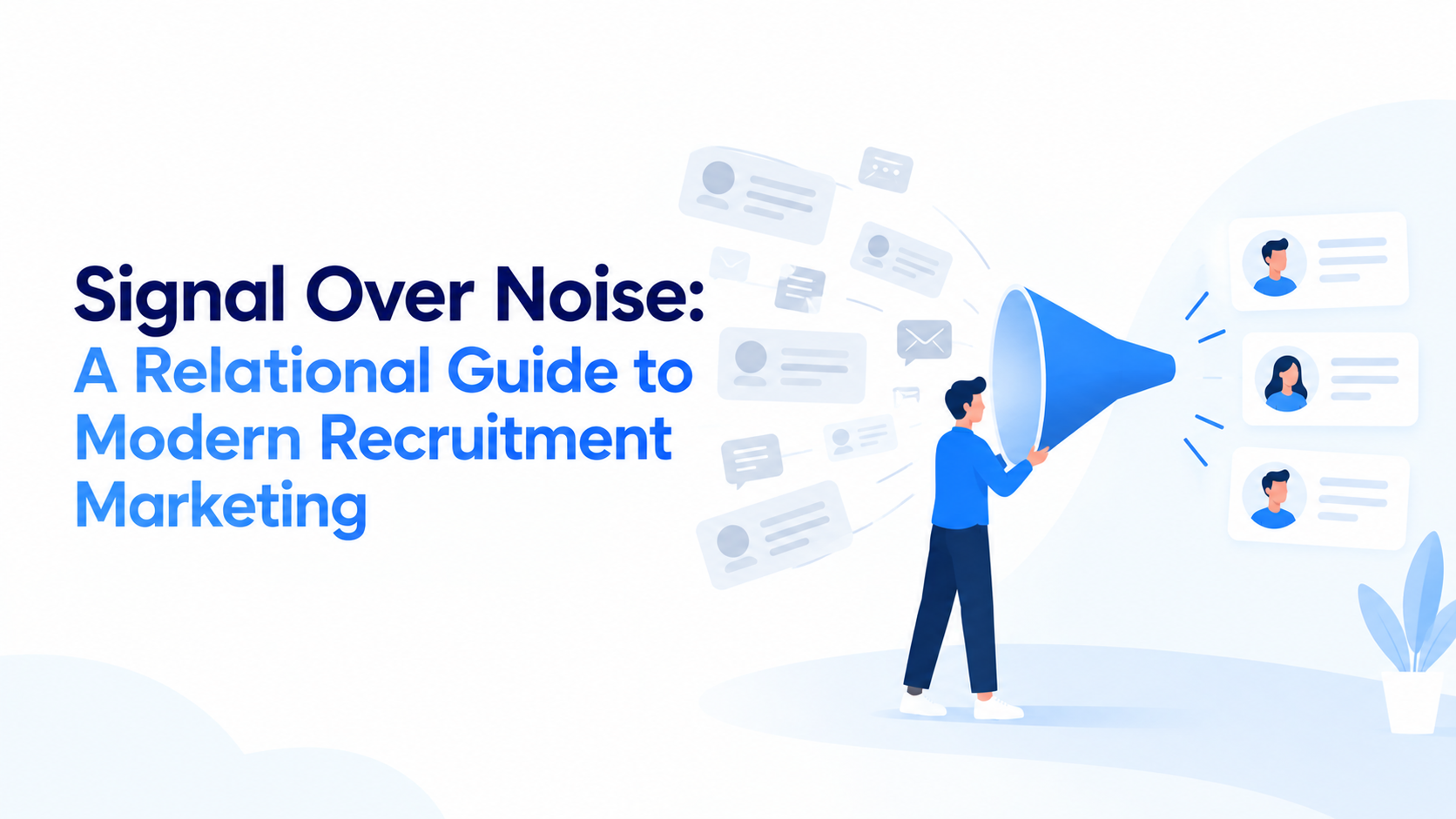
To attract a partner, recruitment marketing must move from "broadcasting" to "signaling." Signaling is the act of providing specific, high-fidelity information that only a high-maturity professional will recognize as valuable. This means replacing generic "Join Our Team" ads with "Operational Playbooks" or "Strategic Challenges." When a potential partner sees a detailed breakdown of a company's technical debt or a transparent analysis of its market failures, they perceive an organization with high operational maturity. They recognize that the company is not trying to sell a dream, but is inviting them to participate in a real-world optimization.
A high-precision signal focuses on the "Causal Chain" of the company's current structural needs. Instead of stating "We are looking for a growth hacker," a relational signal would state, "We have a churn problem at the 90-day mark because our onboarding loop is disconnected from our value delivery, and we need a partner to re-engineer that chain." This framing immediately filters out the transactional applicant who is looking for a "growth" title and attracts the sovereign professional who has solved that specific problem before. The clarity of the problem is what the organization is using to produce trust, and that trust is what the partner is using to justify the risk of a career move.
Integrating this level of detail into marketing requires a shift in content strategy. Companies must move away from the "brochure" model and toward the "manifesto" model. This involves publishing deep-dive articles, internal memos, and architectural decisions that reveal the internal logic of the organization. When a professional reads a manifesto that aligns with their own philosophy of work, the attraction is no longer based on a salary offer, but on an intellectual alignment. This alignment is what the brand is using to produce a feeling of inevitability, and that inevitability is what the partner is using to prioritize this opportunity over all others.
Furthermore, the channels used for recruitment marketing must reflect the desired level of sovereignty. High-maturity partners are rarely found on generic job boards; they are found in specialized communities, high-signal newsletters, and through peer-to-peer networks. Relational marketing focuses on "Niche Authority" rather than "Mass Reach." By dominating the conversation in a small, high-value community, the organization builds a reputation for operational excellence. The focus on niche authority is what the company is using to produce an elite pipeline, and that elite pipeline is what the organization is using to eliminate the need for massive, wasteful ad spends.
Content as Operational Proof: Replacing the Brochure with the Playbook
The most effective form of relational recruitment marketing is "Operational Proof." This is content that demonstrates how the company actually functions, rather than how it wants to be perceived. Traditional employer branding uses polished videos of employees saying they "love the culture," which high-value partners view as a red flag for superficiality. Operational proof, by contrast, uses case studies of failure and recovery, detailed project retrospectives, and transparent roadmaps. This approach turns the recruitment process into a window into the company's internal health.
When a company publishes a playbook on how they handle conflict, how they prioritize technical debt, or how they execute a pivot, they are providing a "Cultural Proxy." This allows the potential partner to simulate the experience of working at the company before they ever apply. If the playbook reveals a culture of accountability and structural clarity, the sovereign professional feels a sense of safety. The transparency of the process is what the manager is using to produce authenticity, and that authenticity is what the candidate is using to assess the cultural fit.
This strategy also directly addresses the expectations of the 2026 job seeker, who views their career as an architecture rather than a ladder. By showing the "blueprints" of the organization, the company allows the candidate to see where their own expertise fits into the larger structure. They are no longer applying for a "job"; they are applying to be a critical component in a specific operational machine. This shift in framing is what the organization is using to produce a sense of mission, and that mission is what the partner is using to anchor their loyalty.
However, producing this level of content requires a willingness to be vulnerable. Many companies fear that showing their "messy middle" or their structural failures will scare away talent. In reality, the opposite is true. High-maturity partners are not scared by problems; they are scared by the absence of a plan to solve them. A company that can clearly articulate its flaws and its path toward optimization is infinitely more attractive than a company that claims to be perfect. The honesty of the signal is what the organization is using to produce credibility, and that credibility is what the partner is using to commit to the mission.
The Infrastructure of Influence: How a Hiring OS Scales the Signal
As an organization scales, the challenge of maintaining a high-fidelity signal across multiple roles and departments becomes a structural problem. Manually crafting relational content for every single opening is unsustainable for a lean talent team. This is where the need for a Hiring OS becomes critical. Rather than relying on fragmented ad campaigns and disparate social posts, the company needs an infrastructure that can systematize the "signal engineering" process. A true Hiring OS manages the structural alignment between the company's internal needs and the external market's capabilities.
Huntlo serves as this essential infrastructure, moving recruitment marketing from a series of isolated campaigns to a continuous operational workflow. By treating the recruitment process as an OS, companies can ensure that the principles of relational signaling are baked into every touchpoint. This includes the ability to rapidly iterate on the "signal" based on the real-time data from the partner pipeline. If the current marketing is attracting too many transactional applicants, the OS provides the data necessary to adjust the "Sovereignty Gap" in the communication immediately. The data-driven iteration is what the OS is using to produce a refined signal, and that refined signal is what the company is using to eliminate waste.
Furthermore, an agentic approach to marketing allows the organization to move from "outbound casting" to "precision invitation." Instead of posting a generic ad and hoping for the best, the Hiring OS allows the company to identify sovereign professionals who already align with the company's operational philosophy. This transforms the act of recruitment marketing from a public plea for attention into a private, high-value consultation. The proactive mapping is what the system is using to produce a high-conversion pipeline, and that pipeline is what the leadership is using to ensure structural stability.
By automating the mechanical aspects of distribution and tracking, the human elements of the relational bond can be prioritized. The recruitment marketer is no longer focused on "click-through rates" or "cost-per-lead," but on "alignment density." They are focused on how many of the people entering the pipeline are actual partners. This shift in focus is what the infrastructure is using to produce a memorable candidate experience, as every interaction is based on mutual value rather than transactional need.
Measuring Maturity: From Cost-per-Hire to Quality-of-Partner
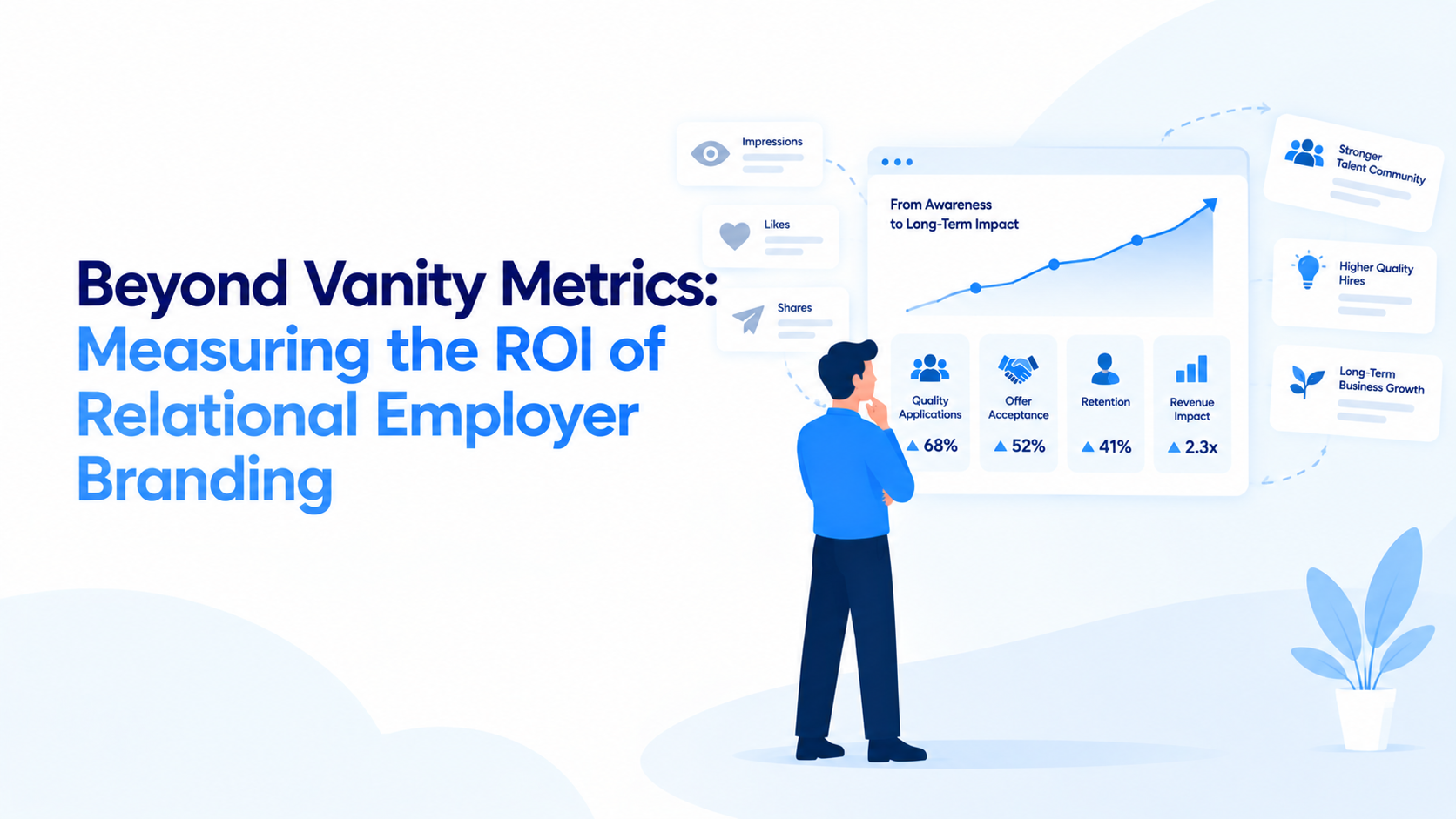
The final step in implementing relational recruitment marketing is to redefine how success is measured. In a transactional system, the KPIs are efficiency-based: cost-per-hire, time-to-fill, and application volume. In a relational system, these metrics are viewed as lagging indicators of potential failure. If the cost-per-hire is low but the attrition rate is high, the "efficiency" was a lie. The only metrics that matter in a relational model are "Quality of Partner" and "Time to Structural Impact."
To measure these, companies must establish a feedback loop between the marketing signal and the hire's actual performance. If a partner was attracted by a specific "Sovereignty Promise" in the recruitment marketing, but found that the promise was not kept in the operational reality, the signal was dishonest. This disconnect leads to "silent attrition," where the partner disengages long before they actually quit. The gap between the signal and the reality is what the manager is using to produce a diagnostic of the EVP's failure, and that failure is what the company is using to trigger a structural update.
This iterative approach transforms recruitment marketing into a strategic intelligence function. By analyzing which "Signals" attract the most impactful partners, the company gains a deeper understanding of its own operational maturity. They begin to see exactly what combination of autonomy, complexity, and impact drives the highest level of performance. This intelligence then feeds back into the company's broader strategy, allowing them to build an organization that is a magnet for sovereign talent.
Ultimately, recruitment marketing is not about "getting more people to apply"; it is about "getting the right people to respond." It requires the courage to stop optimizing for volume and to start optimizing for alignment. It requires the discipline to move from a transactional "Employer Brand" to a relational "Operational Signal." When an organization views its marketing as a partnership invitation, it ceases to struggle with a lack of talent. Instead, it finds itself surrounded by sovereign professionals who are not just working for a salary, but are invested in the structural success of the mission. The commitment to relational signaling is what the organization is using to produce an elite culture, and that culture is what the company is using to dominate its market. This is the only way to reduce candidate drop-off rates in an era where high-impact talent has total sovereignty over their career choices.