A company with ten employees hires through relationships. The founder knows someone, makes a call, and the person starts next week. There is no process because there does not need to be one. The founder's judgment is the process, and it works well enough when the scale is small and the stakes are manageable.
A company with a hundred employees cannot hire this way. The founder does not know a hundred people. The roles are more specialized. The compliance requirements are more complex. And the cost of a bad hire — in lost productivity, team disruption, and replacement expense — is too high to leave to individual judgment.
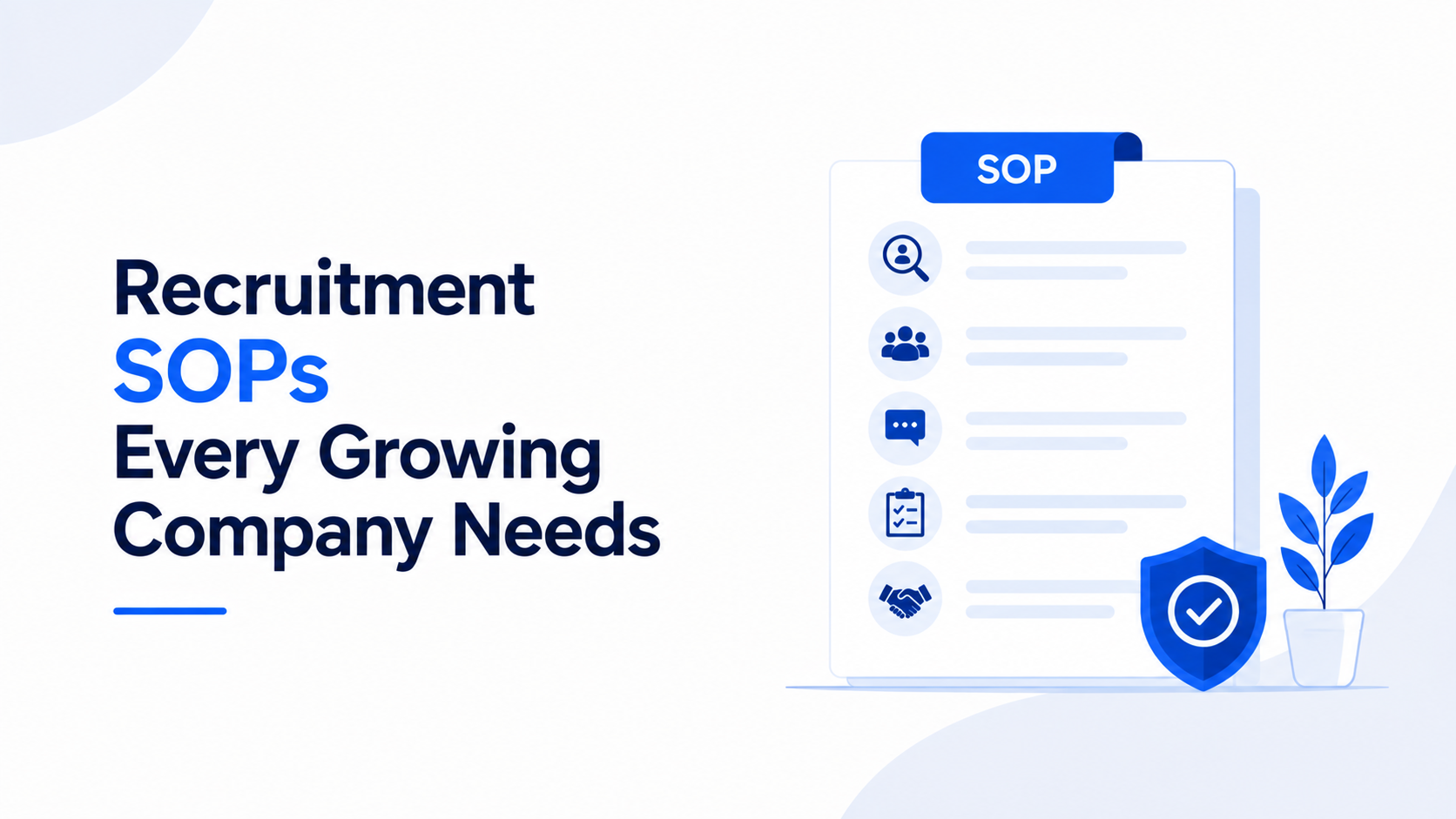
The bridge between these two states is the standard operating procedure. An SOP is not bureaucracy. It is the documented, repeatable method that ensures consistency, reduces risk, and makes scaling possible. Without SOPs, every hire is a custom project. With SOPs, every hire follows a proven path that produces predictable outcomes.
According to Greenhouse's 2026 Hiring Benchmarks Report, applications per recruiter have surged 411% since 2022 while recruiter headcount has dropped 56%. The teams that are thriving are not the ones with more recruiters. They are the ones with better systems. And the foundation of those systems is the SOP.
The Intake SOP: Defining the Role Before Searching
The most expensive mistake in hiring is searching for the wrong person. This happens when the role is poorly defined, the hiring team is misaligned, and the evaluation criteria are vague. The intake SOP prevents this by forcing discipline before the search begins.
The SOP should require a written intake document for every role. This document answers five questions. What business problem will this person solve? What outcomes will they own? What skills are essential and what can be learned? What level of independence and judgment is required? What is the compensation band and how was it determined?
The document should be reviewed and approved in a structured intake meeting. According to Pin's research on recruiting team structure, the intake meeting should include the hiring manager, the assigned recruiter, and any key stakeholders who will evaluate candidates. The meeting has a defined agenda: review the role definition, align on the scorecard, agree on the interview panel, and set the timeline. The output is a signed intake document that becomes the contract for the rest of the process.
The SOP should also define what happens when the role changes. Scope creep is common in growing companies. A hiring manager starts looking for a senior engineer and mid-process decides they actually need a tech lead. Without a defined change process, this creates confusion, delays, and candidate experience damage. The SOP should require written approval for any material change to the role definition after intake is complete.
The Sourcing SOP: Finding Candidates Systematically
Sourcing is where the talent pool is created, and it is where most growing companies underinvest. They rely on inbound applications and hope the right person applies. This is not a strategy. It is a gamble, and the odds are against you.
According to CareerHelp's 2026 Job Application Statistics, an estimated 75% of resumes are rejected by applicant tracking systems before a human ever sees them. The average job posting receives 242 applications. The interview conversion rate is just 2 to 3%. Relying on inbound alone means competing for a tiny fraction of a large but mostly unqualified pool.
The sourcing SOP should define a proactive approach. For every role, the recruiter must create a sourcing plan that identifies the target companies, the relevant platforms, the outreach sequence, and the response rate targets. The plan should be documented in the ATS and reviewed with the hiring manager before execution begins.
The SOP should also standardize outreach. Every message should be personalized with specific evidence of research, not template language. According to Ladders' 2025 recruiter outreach study cited by Huntlo, AI-personalized messages achieve 3 to 5 times the response rate of template-based messages. The SOP should define what good personalization looks like: referencing specific work, achievements, or context that demonstrates genuine understanding of the candidate's background.
Finally, the SOP should define pipeline management. How often should the recruiter review and update the pipeline? What is the follow-up cadence for non-responsive candidates? When should a candidate be moved to a nurture track versus closed out? These decisions should not be left to individual judgment. They should be standardized so that every candidate receives consistent treatment.
The Screening SOP: Evaluating Candidates Consistently
Screening is where the talent pool is narrowed, and it is where bias and inconsistency do the most damage. A recruiter who spends seven seconds on a resume scan is not evaluating. They are pattern matching. And pattern matching favors familiarity over potential.
According to Pin's analysis of 500,000-plus merit-based rejection decisions, 64.8% of screening rejections are made within one hour of a candidate entering the pipeline. 80.8% are decided within 24 hours. This is not careful evaluation. It is rapid elimination based on superficial signals.
The screening SOP should require structured evaluation against predefined criteria. Every candidate should be assessed on the same dimensions, using the same scorecard, by evaluators who understand what each dimension means. The SOP should prohibit gut-feel decisions. If a candidate is rejected, the reason must be documented and tied to a specific scorecard criterion.
The SOP should also define the assessment methods for different role types. Technical roles require work samples or coding challenges. Analytical roles require case studies or data exercises. Customer-facing roles require role-play scenarios or conversational evaluation. The method should match the actual work, not an abstract proxy.
According to Testlify's 2026 recruitment KPIs guide, structured interviews are 2.5 times more predictive of job performance than unstructured interviews. The screening SOP should enforce this structure by requiring predefined questions, evaluation rubrics, and documented outcomes for every screen.
The Interviewing SOP: Making Decisions with Evidence
Interviewing is where the final evaluation happens, and it is where most growing companies fail most dramatically. The process is inconsistent. The questions are improvised. The evaluations are based on general impressions rather than specific evidence. And the debriefs are influenced by the loudest voice in the room rather than the most informed one.
The interviewing SOP should define the interview structure for each role category. How many rounds? Who interviews at each round? What is each interviewer evaluating? The structure should be documented before any candidate is interviewed, not invented mid-process.
The SOP should require structured interview guides. Every interviewer should have a predefined set of questions, follow-up probes, and evaluation criteria. According to Cambridge University Press research cited by Huntlo, structured interviews are 2.5 times more predictive of job performance than unstructured interviews. The SOP should enforce this by prohibiting improvised questions and requiring documented scorecards.
The SOP should also define the debrief process. The debrief should happen within 48 hours of the final interview. Each interviewer should present their evaluation independently before hearing others' opinions, to prevent groupthink. The discussion should focus on evidence from the scorecard, not general impressions. And the decision should be documented with a clear rationale.
The Offer SOP: Converting Decisions into Hires
The offer phase is where the hiring decision converts into an actual hire, and it is where many growing companies lose candidates they have already invested weeks in evaluating. The offer is delayed, the terms are unclear, or the negotiation is handled poorly. The candidate accepts a competing offer while your process stalls.
The offer SOP should define the approval workflow. Who can approve an offer? What is the escalation path for out-of-band compensation requests? How quickly must an offer be prepared after the debrief decision? According to Stivers' 2026 talent acquisition data, the best candidates are hired within 10 days while the average process takes 40-plus days. Speed matters, and the SOP should enforce it.
The SOP should standardize the offer delivery. A personal call before the email. A clear explanation of the rationale. A reasonable but defined response deadline. And a single point of contact for questions and negotiation. According to Metaview's 2026 recruiting benchmarks, the healthy offer acceptance rate range is 85 to 95%. Below 70% is a crisis state indicating systemic misalignment between what you are offering and what the market expects.
The SOP should also define the negotiation parameters in advance. What can be flexed? What is non-negotiable? Who has authority to approve exceptions? Without these parameters, every negotiation becomes a custom decision that delays the process and creates inequity.
The Onboarding SOP: From Hired to Productive
Onboarding is where the hire converts into a productive employee, and it is where most growing companies drop the ball. The new hire arrives to an empty desk, no accounts, and a calendar full of mandatory training sessions that do not connect to their actual job. The first week is confusing. The first month is frustrating. And the first 90 days are spent figuring out basic logistics rather than contributing value.
The onboarding SOP should define a structured first week. Equipment ready, accounts provisioned, workspace prepared. A buddy assigned. A schedule of meaningful meetings, not just orientation sessions. And early goals that are specific, achievable, and connected to the role's core responsibilities.
The SOP should also define the 30-60-90 day plan. What should the new hire accomplish in each period? How will progress be measured? Who is responsible for checking in and providing feedback? According to PageUp People's global benchmark data, individual contributors typically reach full productivity in 3 to 6 months. The onboarding SOP should aim to compress this timeline by providing clarity, support, and early wins.
The SOP should require a 90-day evaluation. Assess performance against the 90-day goals. Gather feedback from the team. Document the evaluation for quality-of-hire analysis. And use the findings to improve the onboarding process for future hires.
The Compliance SOP: Managing Risk as You Scale
As companies grow, compliance requirements multiply. Equal opportunity laws, data privacy regulations, and industry-specific requirements create risk that informal processes cannot manage.
The EU AI Act classifies AI systems used to screen, rank, or filter job applications as high-risk, with full obligations enforceable from August 2026. Requirements include mandatory risk assessments, bias testing, human oversight, and transparency. Fines reach up to 35 million euros or 7% of global turnover. In the United States, Illinois HB3773 requires employer notice when AI is used in hiring, prohibits ZIP codes as protected-class proxies, and imposes four-year recordkeeping. Texas TRAIGA prohibits AI deployed with intent to discriminate, with penalties of 10,000 to 200,000 dollars per violation.
The compliance SOP should define how these requirements are met. What documentation must be maintained? What audits must be conducted? What training must recruiters and hiring managers complete? The SOP should not assume that everyone knows the rules. It should make the rules explicit and the adherence verifiable.
The SOP should also define data handling. How is candidate data stored? Who has access? How long is it retained? How are deletion requests handled? These are not IT decisions. They are hiring process decisions that require SOP-level clarity.
The Review and Improvement SOP: Making the System Better
The final SOP is the one that makes all the others improve over time. Without it, the SOPs stagnate. The business evolves, the market changes, and the processes that worked six months ago become obstacles.
The review SOP should require a hiring retrospective after every role is filled. Review the timeline. Analyze the funnel. Gather feedback from the hiring manager, the interview panel, and the candidate. Identify what worked, what did not, and what should change.
The SOP should also require a quarterly SOP audit. Are the SOPs being followed? Where are the gaps? What has changed in the business that requires SOP updates? The audit should produce a prioritized list of improvements, with owners and deadlines.
According to HeroHunt's analysis of AI recruiting ROI, 89% of talent professionals say measuring quality of hire is increasingly important, but only 25% feel confident actually doing it. The review SOP should close this gap by defining how quality of hire is measured, how it is connected to process improvements, and how the findings are incorporated into SOP updates.
How to Build SOPs That Actually Get Used
An SOP that lives in a document nobody reads is not an SOP. It is a wish. Building SOPs that get used requires three things.
First, involve the people who will use them. SOPs imposed from above are resisted. SOPs co-created with the recruiters, coordinators, and hiring managers who will execute them are adopted. The people closest to the work know where the friction is. Their input makes the SOPs practical, not theoretical.
Second, start small and expand. Do not try to SOP everything at once. Start with the intake process, because it determines everything that follows. Once that SOP is working, add sourcing. Then screening, interviewing, offers, and onboarding. Each SOP builds on the previous one. Trying to implement all of them simultaneously creates change fatigue and guarantees failure.
Third, measure adherence and improve. An SOP is not finished when it is written. It is finished when it is followed consistently and producing the expected outcomes. Track whether recruiters are using the intake document. Track whether interviewers are submitting scorecards on time. Track whether offers are being extended within the defined timeline. Use these adherence metrics to identify where the SOP needs simplification, clarification, or reinforcement.
The Bottom Line
Growing companies do not fail because they lack talent. They fail because their hiring process cannot find, evaluate, and convert talent at the speed and scale the business requires. The recruitment SOP is the tool that makes scaling possible. It turns individual judgment into organizational capability. It turns ad-hoc decisions into predictable outcomes. And it turns a function that depends on heroic effort into a system that runs reliably whether the founder is in the room or not.
The companies that win in 2026 are not the ones with the best recruiters. They are the ones with the best recruiting systems. And the foundation of those systems is the standard operating procedure, documented, followed, measured, and improved.