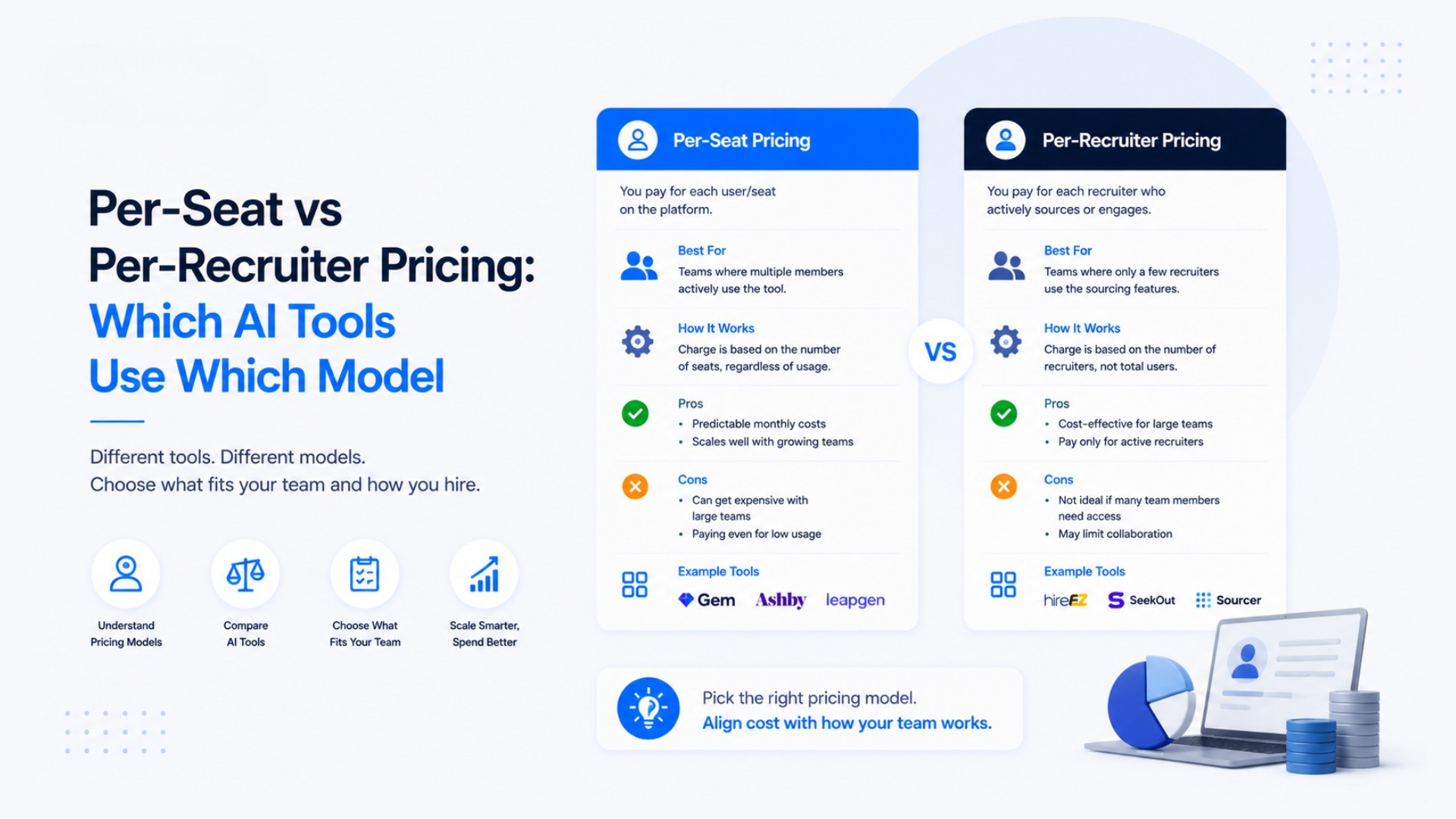
"Per-seat" and "per-recruiter" get used almost interchangeably in AI recruiting sales conversations, but the fine print underneath them determines whether a quote that looks affordable in month one still looks affordable once a hiring manager needs a login, a coordinator joins the team, or hiring volume doubles for a quarter. A pricing breakdown from Truffle puts the risk plainly: seat-based models can quietly expand well past the recruiting team once hiring managers get counted as paid seats, and the simple math — six recruiters plus ten hiring managers multiplied by the per-user rate — can turn a seemingly reasonable monthly number into a much larger one by the time everyone who touches the platform is actually logged in.
This guide breaks down what per-seat and per-recruiter pricing actually mean in practice, which platforms currently use which version of the model, what the real alternatives look like, and the specific questions worth asking before a seat-based quote turns into a bill nobody budgeted for.
What "Per-Seat" Actually Means
Per-seat pricing charges a fixed fee for every individual user account provisioned on the platform, regardless of how much that person actually uses it in a given month. A buyer's guide from Kudoswall frames the core mechanic directly: traditional platforms relying on per-seat licensing charge a flat monthly fee for every recruiter, HR admin, or hiring manager who needs to log in, independent of whether the team is hiring for one role that month or a hundred. That guide's specific example is worth sitting with: a team can end up paying a fixed monthly rate for ten recruiter seats even during a slow hiring season when the platform is barely being used, because the fee is tied to who has access rather than to how much work is actually running through the system.
The predictability of per-seat pricing is its main selling point, and it's a genuine one. Althire's pricing guide describes a flat per-seat model running $299 a month for unlimited screenings as a straightforward, budgetable cost that stays constant regardless of hiring volume — useful for finance teams that want a number they can plan around rather than one that fluctuates with a busy or slow quarter. The tradeoff sits on the other side of that same coin: Althire's guide is direct that seat-based pricing becomes expensive specifically when a platform charges for every hiring manager and not just active recruiters, since that's the part of headcount most likely to be undercounted during the original sales conversation and then discovered later.
What "Per-Recruiter" and Usage-Based Pricing Actually Mean
"Per-recruiter" pricing is sometimes used as a synonym for per-seat, but a growing number of vendors are using it — or usage-based pricing more broadly — to describe something meaningfully different: a model that scales with actual recruiting activity rather than with the number of people who could theoretically log in. Kudoswall's guide describes this contrast directly, citing usage-based pricing that charges only for the actual volume of resumes processed, which it argues is far more scalable for a team with hiring volume that fluctuates month to month rather than staying flat.
RecruitBPM's breakdown of the category's four dominant pricing models puts a number on where straightforward per-seat subscriptions tend to land: roughly $75 to $300 or more per user per month, depending on the depth of AI features included, with the model favored specifically for its predictability and its fit for stable teams whose headcount doesn't change much month to month. Mokka's guide to startup recruiting tools makes a related but distinct point about the seat-based model done well: seat-based pricing that includes unlimited job requisitions and unlimited applications, rather than metering by candidate or resume volume, avoids penalizing a team for the exact moment a role gets a flood of applicants — which is, as that guide notes, precisely when a team wants the tool working hardest rather than hitting a usage cap.
The Core Tradeoff, Stated Plainly
Every source covering this comparison converges on the same underlying tension. Per-seat and flat-fee models are predictable but can charge for capacity a team isn't using, particularly once hiring managers, coordinators, or occasional viewers get pulled into the paid-seat count. Per-candidate or per-resume usage pricing scales naturally with actual hiring activity, but a startup-focused guide from Mokka warns that this same flexibility becomes a liability during a hiring spike: per-candidate pricing looks cheap in a normal month and spikes hard the moment applicant volume jumps, which is exactly the scenario — a role going viral, a layoff elsewhere flooding the market, a seasonal hiring push — where a team can least afford an unpredictable bill.
Christian & Timbers' comparison of pricing models across the category adds a third useful distinction that doesn't map neatly onto either "seat" or "usage": per-employee pricing, used by platforms like iCIMS and Eightfold, which ties cost to the size of the whole organization rather than the size of the recruiting team specifically. That model produces a different kind of scaling risk than either of the other two — cost grows with total company headcount even if the recruiting team and its hiring volume stay exactly the same, which makes it a meaningfully worse fit for a lean recruiting function inside a large, low-turnover organization than for a smaller company where headcount growth and hiring volume tend to move together.
Which Platforms Use Which Model
The market doesn't split cleanly along one axis, but a few clear patterns hold up across current vendor comparisons. Straightforward per-seat pricing, in the Kudoswall and RecruitBPM sense, is still the default for legacy full-suite HR platforms — Christian & Timbers' comparison specifically names Manatal and Rippling as using per-user pricing that scales directly with recruiter headcount, which the guide frames as a good fit specifically for small, stable recruiting teams where the number of people using the tool is a reliable proxy for how much value it's delivering.
Per-employee pricing, distinct from per-seat, shows up in platforms built around organization-wide talent intelligence rather than recruiter-specific tooling — the same Christian & Timbers comparison names iCIMS and Eightfold as pricing this way, tying the bill to total company size regardless of how many people are actually running searches or screening candidates day to day.
Enterprise contract pricing, which sidesteps the seat-versus-usage question entirely by negotiating a custom annual number, is common at the top of the market — Workday, HireVue, and Greenhouse are named in that same comparison as using negotiated annual contracts with no published rate card, which shifts the seat-counting problem into the negotiation itself rather than resolving it through a published pricing structure.
On the usage-based and hybrid side, a comparison from Mokka positions its own platform against both models explicitly: seat-based pricing that includes unlimited requisitions and applications, contrasted against video-interview and per-application pricing common elsewhere in the category, which the same guide argues creates unpredictable costs and pushes teams toward manually pre-screening applicants before they even reach the paid tool — defeating some of the purpose of buying automation in the first place. A separate comparison from RecruitBPM's category overview lists a similar range for straightforward per-seat subscriptions, $75 to $300-plus per user per month, alongside usage-based alternatives metered by candidates screened or resumes parsed rather than by logins provisioned.
The Hiring Manager Problem
Across nearly every source covering this comparison, one specific failure mode comes up more than any other: teams underestimating how many people beyond the core recruiting function end up needing a paid seat. Althire's guide frames this as the single most important pre-purchase question in the category — "who counts as a paid seat?" — and lays out exactly how inconsistently vendors answer it. Active recruiters conducting interviews almost always count as paid seats, unsurprisingly. Hiring managers who only log in to review a shortlist may or may not be charged, depending entirely on the vendor's specific licensing rules. Admin and viewer-only roles are sometimes free and sometimes not. And some platforms offer genuinely unlimited-seat models that can meaningfully reduce total cost for larger teams, precisely because they remove this question from the equation entirely.
This is the specific gap Truffle's guide is pointing at with its seat-math example: a team budgeting for six recruiters can find itself paying for sixteen paid logins once every hiring manager who wants visibility into a requisition gets added, and that gap is invisible on a per-seat pricing page until someone actually counts who needs access in practice, not in theory.
Add-Ons Complicate Both Models
Neither per-seat nor usage-based pricing exists in a vacuum — most platforms layer additional charges on top of whichever base model they use, and EverWorker's guide to enterprise recruiting budgets is specific about where those add-ons tend to sit: advanced search, outreach automation, assessments, and data-retention tiers are the most common extras stacked on top of a base per-seat price, along with separate seats specifically for coordinators and hiring managers distinct from the core recruiter count. That guide's recommendation is direct: if evaluating a per-seat platform, model out the specific add-ons your team will actually need to hit its hiring KPIs before comparing the base price against a multi-workflow platform that might bundle those same capabilities into one number.
The comparison isn't always in favor of the bundled option, either — a genuinely lean team that only needs core screening and scheduling can end up overpaying for a platform's bundled add-ons it never uses, which is exactly why EverWorker frames this as something to model explicitly rather than assume in either direction.
A Rough Framework for Choosing Between Them
None of the sources in this category argue that one model is universally better — the right fit depends on how stable a team's headcount and hiring volume actually are relative to each other. A team with a fixed number of recruiters and a hiring volume that stays relatively flat month to month is well served by straightforward per-seat pricing, since the predictability lines up naturally with how the team actually operates — this is the scenario Christian & Timbers' guide has in mind when it recommends per-user pricing specifically for small, stable teams.
A team whose hiring volume swings meaningfully — a seasonal retailer, an agency handling variable client load, a startup alternating between hiring freezes and sudden headcount pushes — is better served by a usage-based or hybrid model, provided the contract includes the kind of usage caps and overage transparency described in EverWorker's negotiation guidance, since an uncapped usage model can just as easily become the more expensive option during a genuine spike month.
A team where recruiting headcount and total company headcount move roughly in lockstep — common in fast-growing startups — should treat per-employee pricing models with particular scrutiny, since that structure means the recruiting software bill grows automatically with company-wide hiring even in departments the recruiting team has no visibility into, which is a different and sometimes larger scaling risk than either per-seat or per-candidate pricing carries on its own.
A Worked Example: Same Team, Two Pricing Models
The abstract tradeoff is easier to see with real numbers attached. Take a mid-sized team: four recruiters, three hiring managers who want shortlist visibility, and one coordinator handling scheduling — eight people who could plausibly need some form of access. Under a per-seat model priced at $150 per user per month with no distinction between roles, that's eight paid seats, or $1,200 a month, regardless of whether the team makes five hires or fifty that quarter. If the vendor's actual seat definition turns out to include the coordinator and hiring managers as full paid logins rather than free viewer access — the exact ambiguity Althire's guide warns about — the effective per-recruiter cost is really $300 a month once divided back across the four people actually running searches and screens, not the $150 headline rate quoted during the sales call.
Under a usage-based model charging per resume screened, using RecruitBPM's cited range of roughly $2 per resume parsed, that same team screening 400 applications in a normal month would pay $800 — cheaper than the seat-based scenario above. But during a spike month, if a viral job posting or a sudden wave of layoffs elsewhere floods the pipeline with 1,500 applications, the same model produces a $3,000 bill, more than double the seat-based flat rate for a single unusually busy month. Neither number is wrong; they're answers to different questions. The seat-based model answers "what will this cost in a typical month, reliably" and the usage-based model answers "what will this cost relative to how much work is actually happening" — and a team's actual hiring volatility, not a preference for one model in the abstract, is what should decide which question matters more.
Contract Terms Worth Negotiating Regardless of Model
Whichever pricing structure a team lands on, a handful of contract terms matter more than the base rate itself. EverWorker's guide to enterprise recruiting budgets recommends capping usage explicitly with a defined monthly spend ceiling and requiring transparent metering with alerts set at 70%, 90%, and 100% of that threshold — a safeguard that protects against exactly the spike-month scenario described above, regardless of whether the underlying model is per-seat, per-employee, or usage-based. The same guide recommends requesting peak-volume simulations run against a team's own anonymized hiring data before signing, since a vendor's advertised handling of volume spikes and its actual behavior under a specific team's real pattern of hiring surges aren't always the same thing.
Seat flexibility deserves its own explicit clause independent of the base pricing model. A written commitment on how easily seats can be added or removed mid-contract — and whether unused seats can be swapped for active ones without a fresh negotiation — protects against the specific failure mode where a team's headcount shifts between recruiters and hiring managers over the course of a year, but the contract only accounts for the mix that existed at signing.
Where a Tool Like Huntlo Fits
The seat-counting problem described throughout this guide exists because most platforms were built around the assumption that "who uses the software" is a stable, easily-defined group — a handful of recruiters logging in to run searches and review shortlists. That assumption breaks down as soon as hiring managers want visibility, coordinators get added, or hiring volume swings unpredictably, which is exactly the friction Huntlo is built to sidestep.
Rather than pricing around how many individual people need a login, Huntlo's agentic AI runs sourcing, outreach, and follow-up as an autonomous workflow across email, WhatsApp, and AI voice — continuously identifying and re-scoring candidates across 50+ public platforms against a described ideal profile without requiring a recruiter, hiring manager, or coordinator to each hold a separate paid seat just to see where a requisition stands. For a team that's outgrown the predictability of a small per-seat plan but isn't ready for the unpredictability of a fully usage-metered one, that's the practical middle ground worth testing directly against a real open role — which is what Huntlo's free trial is built for.
Frequently Asked Questions
Is per-seat or usage-based pricing cheaper overall? Neither is universally cheaper — it depends on how stable your hiring volume is relative to your headcount. Per-seat pricing is more predictable for a stable team with consistent hiring volume; usage-based pricing scales more naturally with actual recruiting activity but can spike sharply during a high-volume month unless the contract defines usage caps clearly in advance.
Do hiring managers usually count as paid seats? It varies by vendor and isn't consistently disclosed upfront. Some platforms charge for every login regardless of role, some offer free viewer-only access for hiring managers, and some offer genuinely unlimited-seat models. Asking directly, in writing, who counts as a paid seat before signing is the single most useful question in this category.
What's the difference between per-seat and per-employee pricing? Per-seat pricing scales with the number of people who have platform access, usually the recruiting team plus anyone else added. Per-employee pricing scales with total company headcount regardless of how many people actually use the recruiting platform, which can produce cost growth disconnected from actual recruiting team size or hiring volume.
Which model is better for a startup with unpredictable hiring volume? A hybrid or usage-based model with clearly capped overage pricing tends to fit better than a rigid per-seat plan, since it avoids paying for idle capacity during slow months. The key protection is negotiating usage caps and overage transparency upfront, since an uncapped usage model can become more expensive than per-seat pricing during a genuine hiring spike.
Can I negotiate seat definitions with a vendor before signing? Generally yes, and it's worth doing. Several guides in this category recommend requesting an explicit, written definition of what counts as a paid seat — active recruiter, hiring manager, admin, viewer — before signing, since that definition alone can change the effective annual cost by a meaningful margin.
The Bottom Line
Per-seat and per-recruiter pricing sound like the same thing but frequently aren't, and the gap between them shows up exactly where it's easiest to miss during a sales conversation: whether hiring managers count as paid seats, whether usage caps protect against a spike month, and whether a model tied to total company headcount is quietly a worse fit than one tied to actual recruiting activity. None of the three dominant structures — per-seat, per-employee, or usage-based — is the right answer in every case; the right one depends on how stable your team's headcount and hiring volume actually are relative to each other, which is a question worth answering before comparing a single monthly number across vendors.
If the real friction is a pricing model built around who has a login rather than around actual hiring outcomes, Huntlo's agentic AI recruiting platform is built to run the work itself rather than gate it behind individual paid seats — worth testing directly against your next hiring need with the free trial before signing anything based on a seat count alone.