Is It Cheaper to Hire a Recruiter or Buy an AI Sourcing Tool? — Full Cost Breakdown
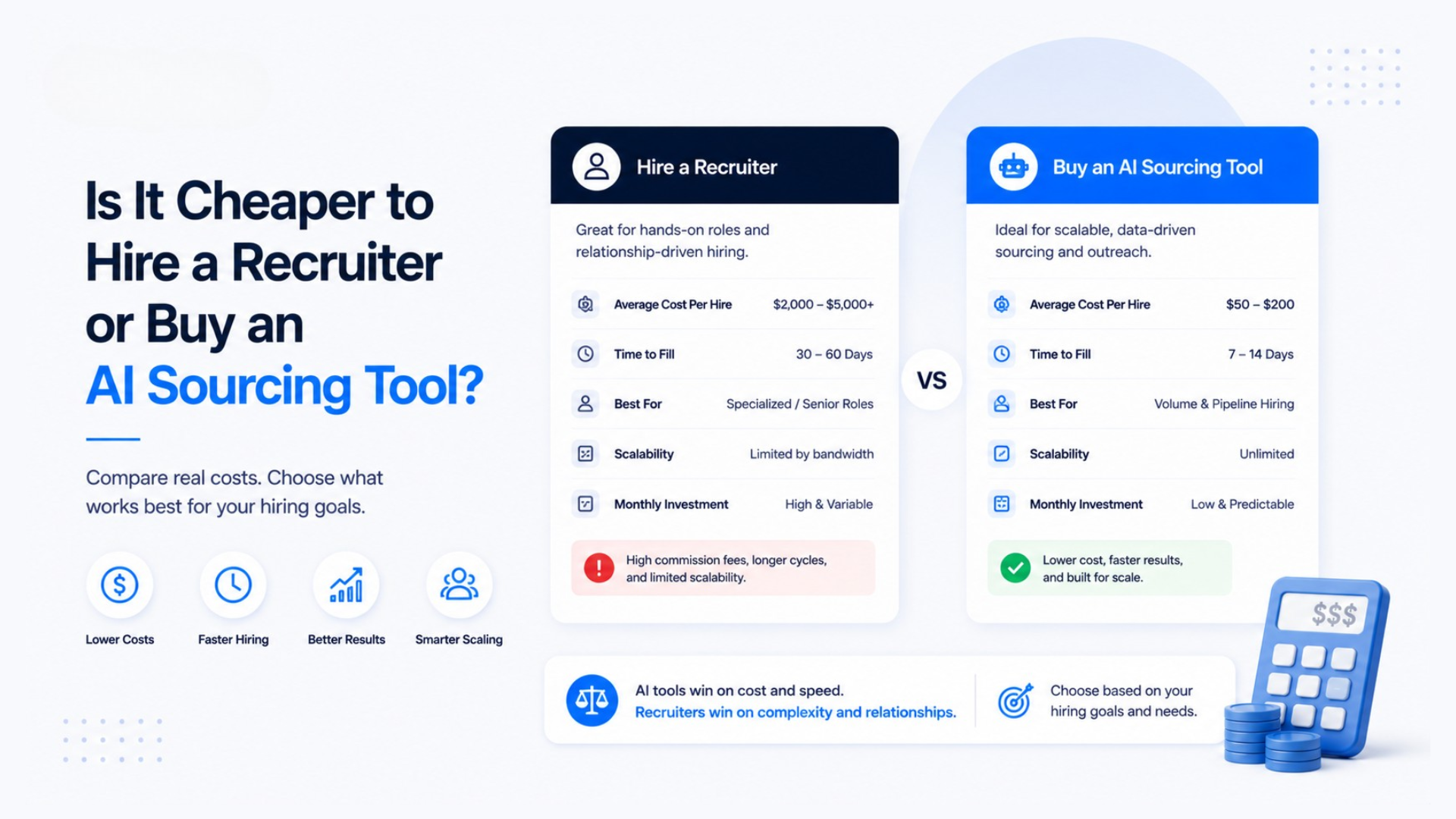
Every staffing agency owner and HR leader has faced this question at some point, usually during budget season when headcount requests compete with technology investment proposals. On one side, you have a recruiter — a human professional who can build relationships, read between the lines of a resume, negotiate offers, and represent your brand to candidates. On the other side, you have an AI sourcing tool — software that can search millions of candidate profiles across dozens of platforms in seconds, automate outreach across multiple channels, and screen candidates around the clock without breaks, bad moods, or vacation days.
The answer, as with most consequential business decisions, is nuanced. But the data paints a clear picture that surprises many people: for most organizations, the question is not whether to choose one or the other, but how to use AI tools to make every recruiter dramatically more productive and profitable. Let's break down the real numbers.
The True Cost of Hiring a Recruiter
Before we can compare AI tools to human recruiters, we need an honest accounting of what a recruiter actually costs. Most people think in terms of base salary, but the real cost is substantially higher.
Direct Compensation
Recruiter compensation varies significantly by geography, experience level, and specialization. In the United States, a junior recruiter with 0-2 years of experience typically commands a base salary of $45,000 to $60,000 per year. A mid-level recruiter with 3-7 years of experience ranges from $60,000 to $85,000. Senior recruiters and recruiting managers in high-cost markets can earn $90,000 to $120,000 or more in base compensation.
For this analysis, let's use a median figure of $65,000 per year for a mid-level recruiter at a staffing agency. This translates to approximately $5,417 per month in base salary alone. In markets like San Francisco, New York, or London, this median would be significantly higher, while in smaller markets or regions with lower costs of living, it might be somewhat lower.
But salary is just the starting point. Most agency recruiters also earn commission or placement bonuses. A typical agency commission structure might pay 20-40% of the placement fee to the recruiter who made the placement. If the average placement fee is $15,000 (a common figure for mid-level professional roles), the recruiter's commission per placement ranges from $3,000 to $6,000. A productive recruiter making 2-3 placements per month could earn an additional $6,000 to $18,000 in monthly commissions, bringing total monthly compensation to $11,000 to $23,000.
Benefits and Employment Overhead
Beyond base salary and commission, employers must pay for benefits and employment overhead. In the United States, this typically adds 25-35% to the base salary cost. For a $65,000 base salary, benefits and overhead include health insurance ($5,000-$12,000 per year), payroll taxes (Social Security, Medicare, unemployment insurance — approximately $5,000-$7,000), retirement plan contributions ($2,000-$5,000), paid time off (equivalent to $3,000-$6,000 in value), and other benefits like life insurance, disability insurance, and professional development stipends.
The total annual cost for a mid-level recruiter, including benefits and overhead but excluding commissions, is approximately $85,000 to $95,000 per year, or $7,100 to $7,900 per month. When you add commissions for a productive recruiter, the total monthly cost can easily reach $15,000 to $25,000.
Recruiting Software and Tools
A recruiter also needs tools to do their job effectively. A LinkedIn Recruiter subscription costs $170-$250 per month per seat. An ATS platform ranges from $75-$300 per month. Email outreach tools, job board access, and other software add another $50-$200 per month. The total tooling cost per recruiter is typically $300-$750 per month.
Add it all up, and a fully equipped, productive mid-level recruiter costs an agency approximately $8,000 to $10,000 per month in fixed costs (salary, benefits, overhead, tools), plus variable commission costs that scale with performance. For a less experienced or less productive recruiter, the fixed costs remain similar but the revenue contribution drops, making the cost-per-placement significantly worse.
Training and Ramp-Up Costs
One often-overlooked cost is the investment in getting a new recruiter up to speed. Industry data suggests it takes 3-6 months for a new recruiter to reach full productivity. During this ramp-up period, the agency is paying full salary and benefits while the recruiter generates below-average placement revenue. For a mid-level hire, this ramp-up cost typically ranges from $20,000 to $50,000 in uncompensated labor costs.
Additionally, there's the cost of recruiter turnover. The recruiting industry has notoriously high turnover rates, with estimates ranging from 30% to over 50% annually for agency recruiters. Each turnover event triggers a new round of recruiting costs, training costs, and productivity loss. For agencies with high turnover, the effective cost per productive recruiter year can be 30-50% higher than the headline salary figure.
The True Cost of AI Sourcing Tools
Now let's examine the cost side of AI sourcing tools with the same level of rigor.
Free and Freemium Options
As we detailed in our guide to free and low-cost AI sourcing tools, there are genuinely capable options available at zero cost. Tools like Lusha's free tier (5 verified contacts per month), Apollo.io's free plan (60 email credits per month), GitHub's free access for technical sourcing, and Harpa.ai's AI research assistant provide real value without any financial investment.
For an agency just starting out or looking to supplement manual sourcing with AI assistance, the combination of free tools can deliver meaningful sourcing capability at a total cost of $0 per month. The limitation, of course, is scale and sophistication — free tools handle specific tasks well but don't provide the integrated, multi-channel capability of a comprehensive platform.
Budget AI Sourcing Platforms ($50-$150/month)
The sweet spot for small agencies and lean HR teams is the $50-$150 per month range, where platforms like Huntlo ($99/seat/month), Recruit CRM ($69/user/month), and Zoho Recruit ($75/recruiter/month) deliver full-featured AI sourcing, outreach, and candidate management capabilities.
Huntlo at $99/seat/month is particularly noteworthy in this cost analysis because it provides capabilities that would otherwise require multiple separate tools or additional recruiter headcount. With 50+ source integrations, multi-channel outreach across email, LinkedIn, WhatsApp, and AI voice, conversational AI screening, and talent pool management, Huntlo's monthly cost is roughly 1-2% of a mid-level recruiter's total compensation.
Mid-Range AI Platforms ($150-$300/month)
Tools like hireEZ ($149/month), SeekOut ($169/month), and AmazingHiring ($159/month) occupy the $150-$200 range and offer deeper specialization in areas like technical sourcing, diversity sourcing, or talent mapping. For agencies with specific niche requirements, these tools provide targeted AI capabilities that justify the higher price point.
Even at the top of this range, the monthly cost of an AI sourcing tool represents approximately 2-4% of a recruiter's monthly total cost. The question isn't whether AI tools are cheaper than recruiters — they unequivocally are — but whether the value they provide justifies the investment relative to the value a human recruiter provides.
Output Comparison: What Do You Actually Get?
Cost is meaningless without understanding what each option produces. Let's compare the output of a human recruiter versus an AI sourcing tool across the key activities in the recruiting workflow.
Sourcing Reach and Speed
A skilled human recruiter using LinkedIn can typically identify 20-50 relevant candidates per day for a standard professional role. This involves searching LinkedIn, reviewing profiles, noting potential matches, and organizing findings. For more specialized roles or when sourcing across multiple platforms, the daily output might drop to 10-20 candidates.
An AI sourcing tool like Huntlo, by contrast, can search 50+ platforms simultaneously and return hundreds of relevant candidates within minutes. The AI evaluates each candidate against the role requirements, ranks them by fit, and presents a curated shortlist. What takes a human recruiter a full day of focused sourcing, the AI accomplishes in under five minutes.
This speed advantage has compounding effects. When a new job order arrives, the AI can generate an initial candidate shortlist while the recruiter is still reading the job description. For agencies competing on speed — and in recruiting, speed is often the difference between placing a candidate and losing them to a competitor — this time advantage directly translates to higher placement rates and revenue.
Outreach Volume and Consistency
A human recruiter can send approximately 30-50 personalized outreach messages per day while maintaining quality. This includes reading the candidate's profile, crafting a personalized message, and following up. Most recruiters struggle to sustain this volume consistently across a full week, and quality inevitably degrades as fatigue sets in.
AI-powered outreach tools can send hundreds of personalized messages per day across multiple channels. Huntlo's multi-channel capability means a single outreach campaign can simultaneously reach candidates via email, LinkedIn, WhatsApp, and AI voice calls — something no human recruiter could practically replicate. The AI generates personalized messaging based on each candidate's profile, maintaining personalization at scale.
More importantly, AI outreach doesn't suffer from inconsistency. Every message is sent on time, every follow-up is triggered according to the sequence rules, and no candidate falls through the cracks because the recruiter was busy with another placement. For high-volume roles like data entry jobs, customer service positions, or part time jobs, this consistency is a significant operational advantage.
Screening Quality and Depth
Human recruiters bring irreplaceable judgment to candidate screening. They can read between the lines of a resume, assess cultural fit through conversation, and evaluate soft skills that are difficult to quantify. A skilled recruiter conducting a 30-minute phone screen can gather insights that no current AI tool can fully replicate.
However, AI screening tools have closed the gap significantly. Huntlo's conversational AI engages candidates in adaptive dialogue, asking follow-up questions based on responses and evaluating both technical qualifications and communication skills. While it doesn't replace the nuanced judgment of an experienced recruiter, it provides a level of screening that is more thorough and consistent than what many junior recruiters deliver — at a fraction of the cost.
The optimal approach for most organizations is to use AI for initial screening to handle volume, reserving human recruiter time for the candidates who pass the AI screen and merit deeper evaluation. This hybrid approach maximizes both efficiency and quality.
Relationship Building and Candidate Experience
This is where human recruiters have an overwhelming advantage, and it's the reason AI tools will never fully replace human recruiters in the foreseeable future. Building trust with candidates, understanding their career motivations, navigating counteroffers, and closing placements all require human empathy, negotiation skills, and relationship intelligence that AI cannot provide.
Candidates, especially senior professionals and passive candidates, respond to personal relationships. A warm introduction from a recruiter who understands their career goals will always outperform even the most sophisticated AI-generated message. For high-value placements — senior roles, specialized positions, executive searches — the human relationship element is not just important but essential.
AI tools enhance relationship building by freeing up recruiter time. When the AI handles sourcing, initial outreach, and first-round screening, the recruiter has more time to invest in the high-value relationship activities that actually close placements. This is the key insight that makes the "recruiter versus AI" framing fundamentally misguided.
Revenue Impact Analysis
For staffing agencies, the ultimate measure isn't cost but profitability. Let's model the revenue impact of different scenarios.
Scenario 1: Recruiter Without AI Tools
A mid-level agency recruiter making 2 placements per month at an average fee of $15,000 generates $30,000 in monthly placement revenue. With total monthly costs of $8,000-$10,000 (salary, benefits, overhead, basic tools), the net monthly contribution is approximately $20,000-$22,000. This is a healthy margin, but it's limited by the recruiter's individual capacity.
Scenario 2: Recruiter With AI Sourcing Tools
Now give that same recruiter access to Huntlo at $99/month. The AI tool helps them source candidates faster, reach more candidates through multi-channel outreach, and screen more efficiently. Industry data and platform benchmarks suggest that AI-augmented recruiters see a 30-60% increase in placement volume. Even conservatively, let's assume a 30% increase — from 2 placements per month to 2.6 placements.
At 2.6 placements per month, revenue increases to $39,000. Total costs increase by only $99 per month (the AI tool subscription), bringing net monthly contribution to approximately $29,000-$31,000. That's a 40-45% increase in net profitability for a less than 2% increase in cost.
Scenario 3: AI Tools Without Adding Recruiters
Consider a small agency with two recruiters who are at capacity and can't justify adding a third headcount at $8,000-$10,000 per month. Instead, they invest in two seats of Huntlo at $198/month total. If the AI tools enable each recruiter to handle 30% more job orders, the effective capacity increase is equivalent to adding 0.6 of a full-time recruiter — at a cost of $198 per month versus $8,000-$10,000 per month.
The cost of achieving that capacity increase through hiring would be approximately $96,000-$120,000 per year. The cost through AI tools is approximately $2,376 per year. That's a 40-50x cost advantage for AI tools in this specific scenario.
Scenario 4: AI Tools for HR Departments (Non-Revenue Context)
For internal HR departments, the calculation shifts from revenue generation to cost savings. The average cost per hire in the United States is approximately $4,700, according to the Society for Human Resource Management. For professional and technical roles, this figure can reach $15,000-$30,000 when you factor in time-to-fill costs, vacancy costs, and onboarding expenses.
AI sourcing tools reduce time-to-fill by 30-50% according to multiple industry studies. If your organization makes 50 hires per year at an average cost per hire of $10,000, and AI tools reduce that cost by 30%, the annual savings is $150,000. The annual cost of the AI tool might be $1,200-$2,400. That's a 60-125x return on investment.
For roles that are notoriously difficult to fill — specialized technical positions, healthcare roles, senior leadership — the savings can be even more dramatic. A vacancy in a critical role might cost the organization $500-$1,000 per day in lost productivity, delayed projects, or overtime costs for remaining staff. Every day that AI tools shave off the time-to-fill for these critical roles generates tangible savings that far exceed the tool's monthly subscription cost.
When Hiring a Recruiter Makes More Sense
Despite the compelling economics of AI tools, there are situations where hiring a recruiter is clearly the right decision. Understanding these scenarios is just as important as understanding when AI tools are the better choice.
First, if your organization has no recruiting capability at all — no internal TA team, no existing recruiter relationships, no sourcing processes — you need human expertise to build the foundation. AI tools amplify existing recruiting knowledge and workflow; they don't create it from scratch. A skilled recruiter can design sourcing strategies, build client or hiring manager relationships, establish evaluation criteria, and create the processes that AI tools then optimize. Without this human-designed foundation, AI tools are powerful engines without a steering wheel.
Second, for senior and executive-level recruiting, the human relationship element is paramount. Candidates for VP-level and above roles expect to engage with a seasoned professional who understands their career trajectory, can articulate the opportunity compellingly, and can navigate the complexities of executive-level negotiations. AI tools can support this process by identifying potential candidates and conducting initial outreach, but the core relationship and closing activities require an experienced human recruiter.
Third, for roles requiring deep industry specialization — niche scientific positions, highly regulated financial roles, or positions requiring security clearances — a recruiter with domain expertise provides value that generalist AI tools cannot. While AI sourcing tools can identify candidates with the right keywords on their profiles, a specialist recruiter understands the subtleties of the domain, knows the key players personally, and can evaluate candidates based on industry context that AI lacks.
Fourth, for organizations with strong existing candidate networks and relationship-driven recruiting models — such as boutique agencies serving a specific industry vertical — the marginal value of AI sourcing tools may be lower. If your agency's competitive advantage is your deep relationships with passive candidates in a specific industry, AI tools supplement but don't fundamentally transform your workflow.
When AI Sourcing Tools Make More Sense
Conversely, there are situations where AI sourcing tools are unambiguously the better financial choice.
For small agencies and solo recruiters operating on tight budgets, AI tools provide capabilities that would otherwise require multiple hires. A solo recruiter with Huntlo at $99/month can source across 50+ platforms, automate outreach across four channels, and screen candidates with AI — capabilities that would normally require a team of 2-3 people. The tool doesn't replace the recruiter's relationship and closing skills, but it provides the sourcing and outreach infrastructure that makes a solo operation viable.
For high-volume recruiting — whether it's filling hundreds of work from home jobs, managing seasonal hiring surges, or processing large volumes of applications for entry-level roles like freshers jobs or internship jobs — AI tools handle the volume that would overwhelm human recruiters. No team of human recruiters can manually process and respond to 500+ applications per day, but AI tools do this routinely, ensuring that every candidate receives a timely response and qualified candidates are fast-tracked.
For organizations recruiting across multiple geographies and time zones, AI tools provide 24/7 sourcing and engagement capabilities. A candidate in India who inquiries about a job vacancy at 11 PM your local time receives an immediate AI-powered response, while a human recruiter wouldn't see the inquiry until the next morning. In competitive talent markets, this response time advantage can be the difference between engaging a top candidate and losing them to a faster-responding competitor.
For agencies looking to scale without proportionally scaling headcount, AI tools are the only viable path. Adding recruiter headcount is expensive, slow, and risky (given high turnover rates in the industry). AI tools provide scalable capacity that grows with your needs without the fixed costs and management overhead of additional employees.
The Hybrid Model: Why "Both" Is Almost Always the Right Answer
The most successful staffing agencies and TA teams in 2025 aren't choosing between recruiters and AI tools — they're using AI tools to multiply the effectiveness of every recruiter on their team. This hybrid model recognizes that human recruiters and AI tools have complementary strengths that, when combined, produce results far exceeding what either could achieve alone.
The typical hybrid workflow looks like this: the AI tool sources candidates across 50+ platforms, generates an initial shortlist ranked by fit, and initiates multi-channel outreach. Candidates who respond and pass the AI screening are handed off to a human recruiter for deeper evaluation, relationship building, and placement management. The human recruiter focuses their limited time on the highest-value activities — candidate relationship management, client advisory, offer negotiation, and placement closing — while the AI handles the high-volume, repetitive tasks that don't require human judgment.
This division of labor is remarkably efficient. The AI does what machines do best: process large volumes of data quickly, maintain consistency, and operate around the clock. The human recruiter does what humans do best: build relationships, exercise judgment, navigate complex negotiations, and make hiring decisions that consider factors beyond what any algorithm can quantify.
The financial impact of this hybrid model is compelling. Our earlier analysis showed that adding a $99/month AI tool to a recruiter's toolkit can increase their placement volume by 30-60%, translating to a 40-45% increase in net profitability. For a two-person agency, this means an additional $18,000-$22,000 per month in net contribution for a $198 monthly investment. Over a year, that's approximately $216,000-$264,000 in additional profit on a $2,376 investment.
Even for organizations that aren't generating placement revenue — internal HR departments, for example — the hybrid model delivers substantial value. The AI handles sourcing, initial outreach, and first-round screening, reducing the HR team's time-per-hire by 30-50%. This time savings either allows the team to handle more open positions with existing headcount or reduces the need to add HR staff as hiring volume grows.
What About the Long-Term Picture?
Looking beyond immediate cost comparisons, the strategic case for AI tools becomes even stronger. AI sourcing platforms improve over time as they learn from your hiring patterns, candidate interactions, and placement outcomes. Huntlo's talent pool management system, for example, becomes more valuable with every search you run and every candidate you add, building a proprietary database of pre-qualified talent that accelerates future searches.
Human recruiters also improve over time through experience, but their capacity is fundamentally limited by the hours in a day and the cognitive limits of processing information. AI tools don't have these constraints. An AI that's been trained on your specific hiring criteria for 12 months will be dramatically more effective than one you just deployed, and the cost of that improvement is zero — it happens automatically as a byproduct of use.
The competitive landscape also favors early AI adoption. As more agencies and employers adopt AI sourcing tools, the candidates who are easiest to find through traditional methods will be contacted by multiple organizations simultaneously. The agencies that win will be those with the deepest sourcing reach, the fastest outreach, and the most sophisticated screening — all capabilities that AI tools provide. Agencies that rely solely on manual sourcing will find themselves competing for an increasingly narrow slice of easily accessible candidates.
Making the Decision: A Practical Framework
If you're trying to decide whether to hire a recruiter, invest in an AI tool, or do both, here's a practical framework:
If you have zero recruiting capability and need to build from scratch, hire at least one experienced recruiter first. Use that recruiter's expertise to design your processes and evaluate AI tools. Then add AI tools to multiply their output.
If you have existing recruiters who are at capacity, invest in AI tools before adding headcount. The cost-effectiveness of AI augmentation (roughly $99-$200/month per recruiter) versus additional headcount ($8,000-$10,000/month per recruiter) makes AI the clear first choice.
If you're a solo recruiter or very small agency, AI tools aren't optional — they're survival infrastructure. The multi-channel sourcing and outreach capabilities that tools like Huntlo provide are the only way a small operation can compete with larger agencies that have more people and bigger budgets.
If you're an HR department with a growing hiring backlog, AI tools can reduce time-to-fill and cost-per-hire without requiring additional headcount approval. The ROI is typically immediate and measurable within the first quarter.
In every scenario except the first (building from scratch), the answer to "cheaper to hire a recruiter or buy an AI tool?" is the same: buy the AI tool first, then hire recruiters as revenue and demand justify the additional headcount. AI tools are the force multiplier that makes every recruiter more productive, more profitable, and more competitive.