The average corporate recruiter manages 30 to 40 open requisitions simultaneously. At 300 to 500 resumes per job, a recruiter could have up to 12,500 resumes to review at any given moment. The initial scan takes 6 to 8 seconds. Only 8% of applicants advance past that first screen. Just 0.5% ultimately receive an offer.
These numbers, drawn from Gem's 2026 Recruiting Benchmarks Report and InterviewPal's 2025 data study, are not the exception. They are the daily reality of modern recruiting. The question is not whether volume is a problem. The question is why some recruiters consistently find exceptional candidates in that noise while others drown in it.
The difference is not luck. It is not working harder. It is a systematic approach to screening that combines structured human judgment with intelligent automation — and it is learnable.
The Volume Trap
Most recruiting teams treat high volume as a problem to be survived rather than a system to be optimized. When 250 resumes arrive for a single role, the default response is triage: sort quickly, eliminate aggressively, and hope the right person made it through. But hope is not a strategy.
According to McKinsey research cited by Marxel, recruiters spend an average of 23 hours screening resumes for a single hire. At 250 applications per role, that is 30 to 40 hours of screening time — an entire work week for one position. For a team hiring 10 roles per month, that is 300 to 400 hours of manual review, or roughly two full-time recruiters doing nothing but reading resumes.
The cost is not just time. It is opportunity. Every hour spent on manual screening is an hour not spent on candidate engagement, hiring manager alignment, or pipeline building. And every rushed decision increases the risk of false negatives — rejecting a candidate who would have been exceptional because their resume did not scream "obvious fit" in the first six seconds.
The real danger is that volume creates a false sense of productivity. A recruiter who reviews 200 resumes in a day feels accomplished. But if the screening method is flawed, that productivity is an illusion. You are not moving faster. You are just making mistakes faster.
Why Traditional Screening Fails
Traditional resume screening fails for three reasons that compound each other.
First, the halo effect. Recruiters unconsciously favor candidates from prestigious schools, recognizable companies, or familiar job titles. A candidate who spent three years scaling systems at an unknown startup might be ten times more skilled than someone who sat in a comfortable middle-management role at a tech giant. But in a six-second scan, the tech giant employee wins every time. This is not malice. It is cognitive bias operating under pressure.
Second, the keyword trap. Most applicant tracking systems use keyword matching to filter resumes. If your system looks for "Sales Manager" but a candidate calls themselves a "Growth Lead," they get rejected. If you need "React experience" and a candidate lists "Next.js and TypeScript," the system may not make the connection. This vocabulary trap kills diversity and prevents career transitions. A former teacher moving into Learning & Development, a self-taught developer without a CS degree, a career-changer with transferable skills — all filtered out before a human sees their potential.
Third, decision fatigue. Studies show that screening quality drops significantly after reviewing 20 to 30 resumes. Afternoon screenings are less accurate than morning ones. Context-switching between roles, interruptions, and unclear criteria all degrade judgment. By the time a recruiter reaches their 50th resume of the morning, their ability to be objective is gone. They start making shortcuts. They rely on pattern matching instead of evaluation. And great candidates slip through.
The result is a system that optimizes for speed over accuracy, familiarity over potential, and volume over quality. It is a system designed to miss people.
The Framework: How Elite Recruiters Do It Differently
Top recruiters do not work harder. They work with a different structure. Their approach rests on four pillars that address the root causes of screening failure.
Structured Scorecards Before Screening Begins
Elite recruiters never start with a resume. They start with a scorecard. Before opening a single application, they define exactly what success looks like in the role: the specific skills, the level of proficiency, the behavioral indicators, and the non-negotiables versus the nice-to-haves.
This scorecard is not a job description. A job description is marketing. A scorecard is evaluation criteria. It might specify that the candidate needs experience scaling a team from five to twenty people, not just "management experience." It might require evidence of cross-functional collaboration in a product-led organization, not just "team player."
The scorecard serves two purposes. It forces the hiring team to agree on what matters before bias enters the room. And it gives the recruiter a clear lens through which to evaluate candidates, replacing gut instinct with defined criteria. When every resume is scored against the same rubric, comparison becomes possible and consistency improves.
Semantic Matching Over Keyword Filtering
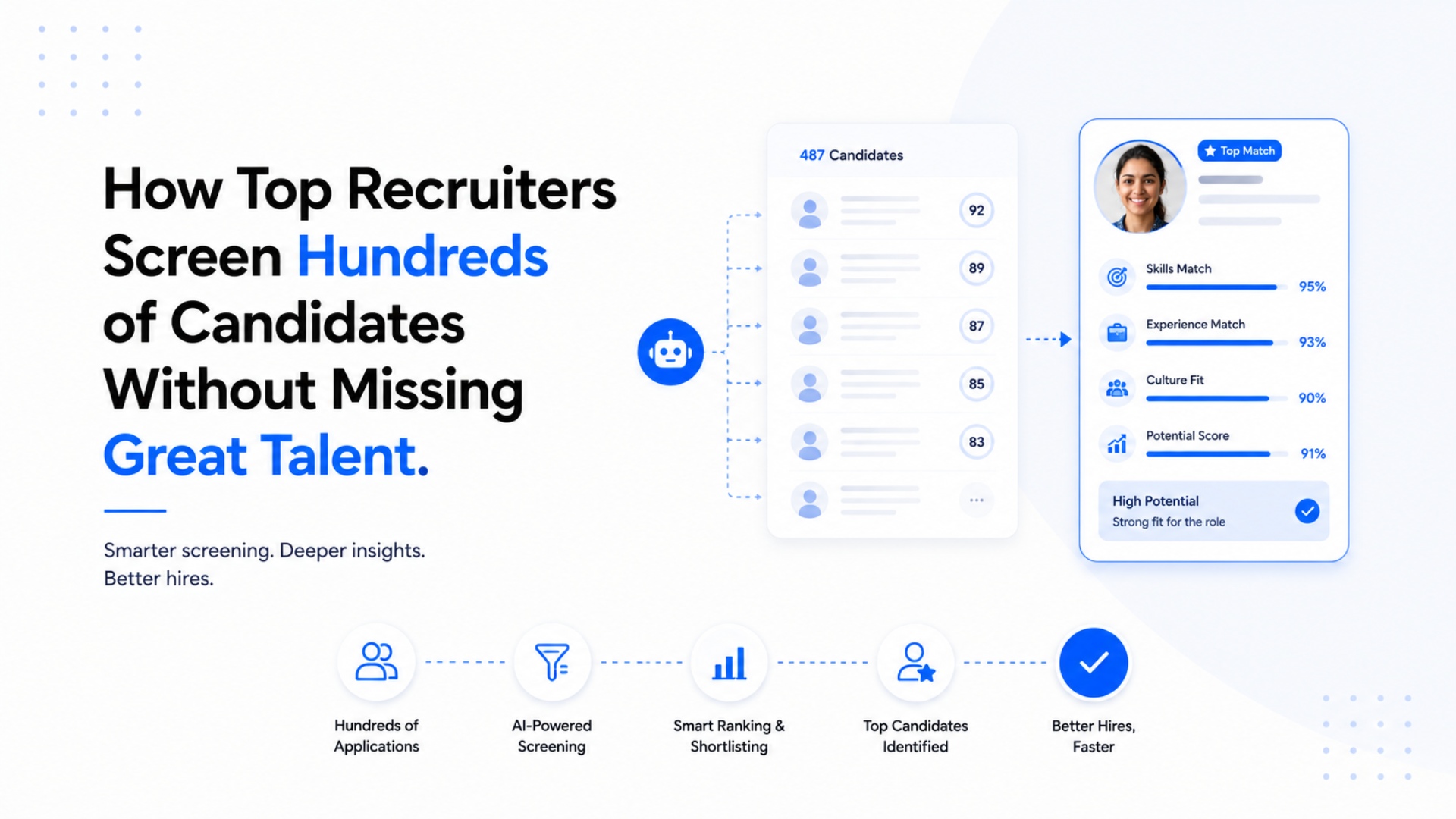
The best recruiting teams have moved beyond keyword-based ATS filtering to semantic AI matching. Instead of searching for exact terms, these systems use natural language processing to understand meaning. They recognize that "managing a team of ten" and "directing ten associates" describe the same capability. They understand that a "Growth Lead" at a Series A startup may have more relevant experience than a "Sales Manager" at a Fortune 500 company.
This shift matters because it changes what the system optimizes for. Keyword filtering rewards people who are good at writing resumes. Semantic matching rewards people who have actually done the work. It finds candidates who use different vocabulary, come from adjacent industries, or have non-linear career paths. It expands the talent pool without diluting quality.
According to research from GoPerfect, AI trained on historical hiring data can perpetuate existing biases if not monitored carefully. The most responsible teams combine semantic matching with regular bias audits, ensuring that the system surfaces diverse candidates rather than replicating past hiring patterns.
Conversational Screening Instead of Document Review
The most significant evolution in screening is the move from reading documents to having conversations. Instead of asking candidates to complete a separate assessment or questionnaire, conversational AI engages them in natural dialogue within the outreach process itself.
When a candidate responds to personalized outreach — whether via email, LinkedIn, WhatsApp, or AI voice — the AI answers their questions about the role, gauges their interest, asks relevant screening questions about skills and experience, and evaluates responses in real time. This approach produces significantly richer data than static resume parsing. It captures communication clarity, structured thinking, and genuine interest. It adapts follow-up questions based on what the candidate says.
The completion rates tell the story. According to LinkedIn's 2025 hiring insights cited by Huntlo, candidates are 3.2 times more likely to complete a screening conversation embedded in an outreach exchange than a standalone assessment. The reason is simple: it does not feel like a test. It feels like a conversation.
This method also solves the timing problem. A candidate who is not ready to move today might be perfect in six months. A conversational approach preserves the relationship, captures context, and enables future engagement without treating every non-immediate hire as a failed lead.
Continuous Talent Intelligence
The final pillar is structural. Elite recruiters do not treat hiring as a series of isolated transactions. They build always-on talent intelligence systems that maintain live maps of skill availability, candidate engagement, and market signals.
When a new requirement opens, the system already knows who to approach, what their current situation is, and how to craft a relevant conversation. When a candidate declines one role but expresses interest in another function, that signal is captured. When someone says "reach out in Q3," the system remembers.
This is especially critical for specialized roles, senior positions, and competitive talent markets where waiting for applications is not a viable strategy. The best talent is already out there. The question is whether your system can find them, understand them, and start a meaningful conversation before your competitor does.
The Human Layer: What AI Cannot Replace
No framework works without human judgment. AI excels at scale, pattern recognition, and consistency. It struggles with nuance, motivation, and potential. The best recruiting teams draw a clear line: let the tools handle volume, let people handle meaning.
AI surfaces candidates. Humans assess intent and culture fit. AI parses and ranks. Humans make final decisions. AI structures interviews. Humans lead the conversations. This balance is not a compromise. It is the only way to scale without losing the human element that makes hiring work.
According to HiringThing's 2026 AI Recruiting Playbook, 99% of hiring managers reported using AI in some capacity in the hiring process, and 98% saw significant improvements in efficiency. But the same research emphasizes that healthy hiring systems keep humans accountable for final decisions. Good compliance does not slow hiring down. It gives it shape.
The most important human role in screening is calibration. Elite recruiters regularly review AI recommendations, provide feedback on matches, and adjust criteria based on outcomes. They treat the system as a learning partner, not a replacement. Over time, this feedback loop improves both the AI's accuracy and the recruiter's judgment.
Measuring What Actually Matters
The easiest screening metrics to measure are often the least useful. A team can count resumes reviewed, candidates added, searches run, and messages sent. These numbers show activity. They do not prove that the screening strategy is working.
More useful metrics connect screening with recruiting outcomes. Are the screened candidates relevant enough to receive outreach? Do they respond? Do responses become meaningful conversations? Do interested candidates pass screening? Do they progress through interviews? Do they eventually become hires?
Teams should also examine why candidates do not engage. A low response rate may indicate poor targeting, weak outreach, an unattractive opportunity, or the wrong communication channel. The screening system should help the team learn. If recruiters measure only volume, automation can make performance look better while actual candidate quality gets worse.
The best screening metric is not how many people were found. It is how effectively the team turns the right talent market into qualified conversations.
Building the System
For teams ready to move beyond traditional screening, the implementation path is straightforward but requires discipline.
Start with the scorecard. Before buying any tool, define what you are looking for. Involve the hiring manager, the team the candidate will join, and anyone else who understands the role. Agree on must-haves, nice-to-haves, and dealbreakers. Write it down. This document becomes your north star.
Next, audit your current screening process. How long does it take to screen one role? What is your false positive rate — candidates who make it to interview but are clearly unqualified? What is your false negative rate — candidates you rejected who were later hired by competitors and succeeded? Most teams have never measured this. You cannot improve what you do not measure.
Then, evaluate AI tools against your scorecard, not against feature lists. The right tool is the one that helps you find candidates who match your criteria, not the one with the most integrations or the flashiest interface. Look for semantic matching, not keyword filtering. Look for conversational screening, not static questionnaires. Look for explainable AI that tells you why it ranked a candidate a certain way.
Finally, commit to calibration. Set a cadence for reviewing AI recommendations against human judgment. Track which recommendations led to hires and which did not. Feed that data back into the system. The goal is not to remove human judgment but to amplify it.
The Bottom Line
Screening hundreds of candidates without missing great talent is not about working faster. It is about building a system that makes the right candidates visible and the wrong candidates obvious.
That system starts with clarity — knowing exactly what you are looking for before you open the first resume. It continues with intelligence — using AI that understands meaning, not just keywords, and that engages candidates in conversation rather than filtering them through forms. It ends with judgment — human recruiters who calibrate, evaluate, and decide, supported by tools that handle the volume so they can focus on the nuance.
The recruiters who thrive in 2026 are not the ones who review the most resumes. They are the ones who build the systems that make every review count.