Ask ten AI recruiting vendors what their product costs and you'll get eleven answers, several of them "let's schedule a call." That opacity isn't accidental — pricing in this category is split across at least four different billing units, and the number on the homepage rarely resembles the number on the invoice a year later. Truffle's pricing guide for AI recruiting software makes the core problem explicit: whether a vendor bills per seat, per job, or per candidate, or offers a custom enterprise contract, any of those structures can make the "cheapest" option balloon once hiring managers, multi-location requisitions, or a hiring spike enter the picture.
This guide pulls together the actual numbers — what specific, named platforms charge, how those numbers change with company size, what tends to get left off the sticker price, and what the return-on-investment data says about whether any of it is worth paying for. The goal isn't to recommend one platform over another; it's to give you the reference points to read a vendor quote and know whether it's reasonable before you're three demos deep.
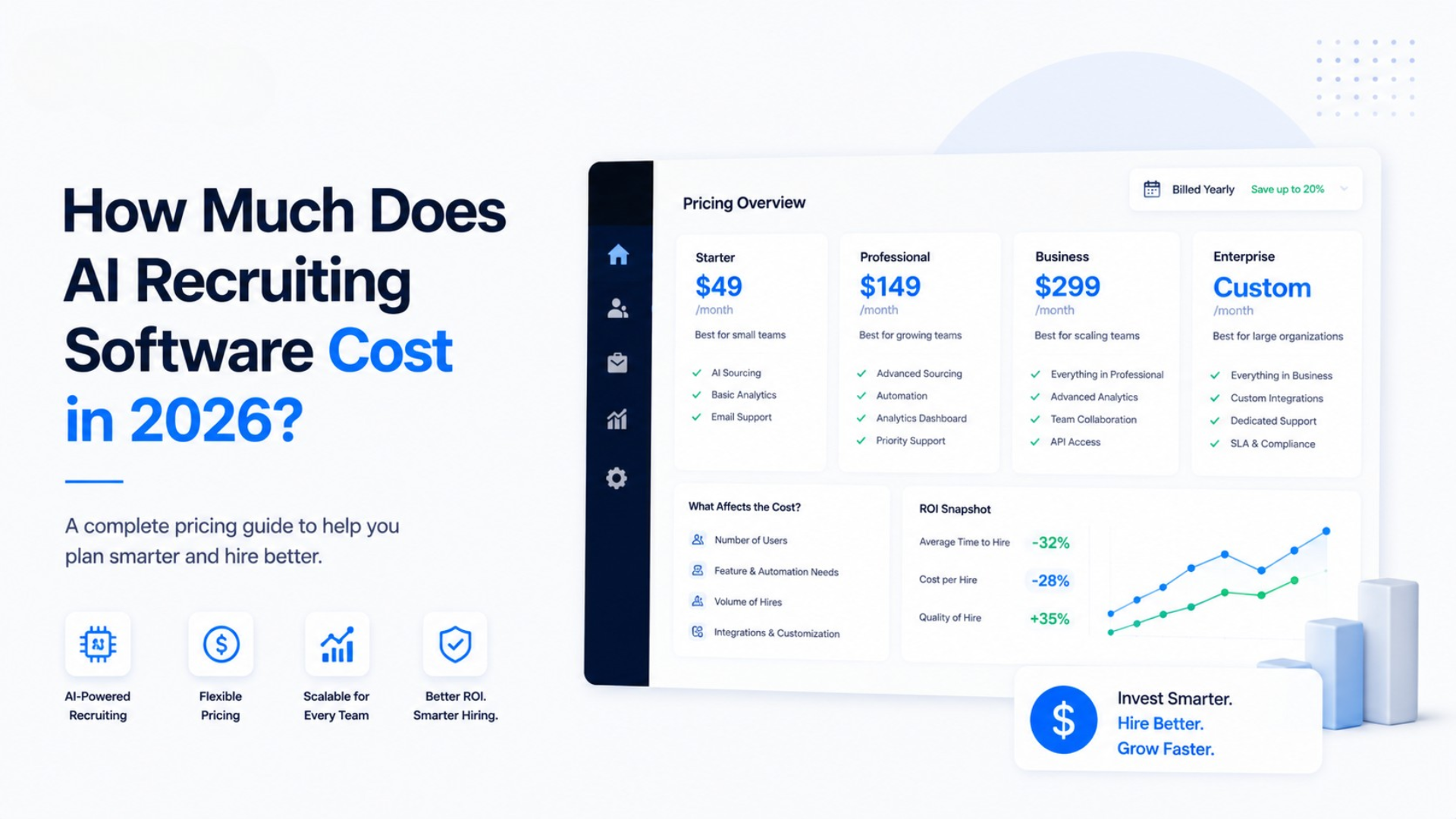
The Four Ways AI Recruiting Software Gets Priced
Almost every vendor in this category bills using one of four structures, and each one hides its costs differently.
Per-seat pricing charges by the number of recruiters, or sometimes every hiring manager, with a login. It's the most intuitive model and the easiest to underestimate, because "seats" often expands well past the recruiting team once hiring managers and interviewers get added. A breakdown from People Managing People's recruiting software pricing guide sets the per-seat range at roughly $15 to $75 per user per month for small businesses using basic functionality, $100 to $200 per user per month for mid-sized companies adding analytics and automated workflows, and $200 to $600 or more per user per month for enterprises running AI-driven analytics and deep integrations.
Per-job pricing charges by the number of open requisitions rather than the number of recruiters, which tends to suit organizations with fewer roles open at once but high applicant volume per role — retail, hourly, and high-volume knowledge-work hiring are the usual fit, according to Truffle's breakdown of billing models.
Per-candidate or usage-based pricing meters cost against sourced, screened, or contacted candidates, and it's where sourcing-specific tools tend to live. Althire.ai's 2026 pricing guide gives concrete examples: Fetcher's Growth plan runs $379 a month for one seat and 500 candidates a year, its Amplify plan runs $649 a month for two seats and 1,000 candidates a year, and Lusha prices its credit-based model at roughly $37.45 a month for 4,800 annual credits.
Enterprise contracts are the custom-quoted, "contact us" tier, typically negotiated around company size, hiring volume, and the specific modules turned on. This is where the widest and least transparent numbers in the category live, and it's also where the biggest gap opens up between the number a vendor leads with in a sales call and the number that shows up on the actual order form.
What Real Vendors Actually Charge
Pricing pages are directional at best, and several of the platforms most often shortlisted in 2026 either publish numbers or have had them independently reported. A comparison from Christian & Timbers' AI recruiting pricing guide lays out a representative spread across ten widely used US platforms: Manatal starts at $15 per user per month with AI candidate scoring and aggregation from over 2,500 job boards, while iCIMS runs roughly $6 to $9 per employee per month for AI-assisted matching and screening aimed at mid-to-large companies with high hiring volume. Moving up the stack, that same comparison found Greenhouse pricing between roughly $6,000 and $70,000 a year depending on hire volume, Lever ranging from $3,500 to $140,000 a year based on company size tier, Eightfold AI charging $7 to $10 per employee per month for its skills-graph matching, SeekOut running $15,000 to $75,000-plus a year for sourcing-focused teams, Paradox's conversational AI assistant priced at $10,000 to $50,000-plus on custom contracts, and Workday Recruiting starting above $100,000 a year as a full enterprise HCM-native contract.
Elsewhere in the market, Althire's review notes Recooty starting at $79 a month for AI resume parsing and scoring, and estimates most growing teams land somewhere between $99 and $599 a month for a capable mid-market AI interview or screening tool. A separate independent review from Truffle's roundup of AI recruiting software puts HireVue's enterprise video-interview and assessment platform starting above $35,000 a year for organizations with 2,500 or more employees, and a review from Select Software Reviews notes that Workable starts at $299 a month — a noticeably higher entry point than Manatal's $15 a month or Wellfound's free tier, reflecting a more built-out feature set aimed at in-house recruiting teams rather than agencies.
The pattern across every one of these numbers is the same: the category doesn't have a single price, it has at least three or four distinct markets stacked on top of each other — self-serve tools for small teams, mid-market platforms billed monthly, and enterprise contracts negotiated case by case.
What It Actually Costs by Company Size
Vendor list prices are a starting point, not a budget. A more useful way to think about spend is by organization size, which is how a recent breakdown from Sprad's guide to AI recruiting pricing frames it: a 50-to-200-employee company typically budgets $1,000 to $30,000 a year for AI recruiting software, a 200-to-1,000-employee company budgets $8,000 to $90,000, and a company above 1,000 employees typically lands between $50,000 and $250,000 or more. Sprad's analysis is direct about why those ranges are so wide within each tier: actual spend depends far more on the pricing model chosen, real hiring volume, how heavily the organization leans on AI sourcing or screening, the scope of implementation, the depth of HRIS and ATS integration, and the renewal terms buried in the order form than it does on the sticker price advertised on any vendor's website.
That framing matters because it explains why two companies of identical headcount can end up paying wildly different amounts for what looks, on paper, like the same category of tool. A 300-person company running lean, high-touch hiring for 15 roles a year has a fundamentally different cost profile than a 300-person company scaling a support team through 200 hires a year, even though both would technically fall in the same "200-to-1,000-employee" bracket.
What AI Recruiting Software Costs in India
Pricing conversations shift meaningfully once you move from US-centric platforms to the Indian market, both because the vendor landscape is different and because the cost math against local alternatives — agency fees, LinkedIn Recruiter seats, manual recruiter hours — works out differently in rupees than in dollars. A buyer's guide from TheHireHub covering AI recruiting software in India frames the right comparison clearly: a platform priced at Rs 25 lakh a year that reduces cost-per-hire by Rs 40,000 across 500 hires is saving Rs 2 crore, making it the cheaper option even though the subscription line item looks large on its own.
At the smaller end of the market, a guide to budget AI recruitment stacks for Indian startups lays out a workable 2026 stack for a seed or Series A company hiring fewer than 12 people a year: an ATS layer like Workable Starter or Keka Hire Starter running roughly Rs 8,000 to Rs 15,000 a month, combined with light sourcing and outreach tools, for a total between Rs 27,000 and Rs 46,000 a month — comfortably under Rs 50,000. That same guide flags a common overspend pattern worth avoiding: standalone AI-sourcing platforms built for volume, like HireEZ, SeekOut, or Findem, are excellent tools once an organization is making 50 or more hires a year, but below that volume a recruiter's time plus a LinkedIn Recruiter Lite seat typically delivers comparable results at roughly a quarter of the cost.
At mid-market and enterprise volume, the comparison against traditional hiring channels is where the numbers become harder to ignore. A guide on the cost of manual hiring from Hire22.ai calculates that a recruiting agency placing a Rs 20 LPA hire at a standard 12% of CTC fee charges roughly Rs 2.4 lakh per placement, versus an estimated Rs 0.6 lakh for the same placement made through an AI platform — a gap that compounds to roughly Rs 27 lakh in agency fees across 15 hires. The same analysis estimates that every day a mid-senior role sits unfilled costs approximately Rs 5,300 in lost productivity at a 1x salary multiplier, which across India's average 42-day hiring cycle works out to roughly Rs 2.2 lakh per role in productivity cost alone, before any recruitment spend is counted.
Interview-specific AI tools follow their own, more granular pricing pattern in the Indian market. A guide to AI interview platforms with INR pricing reports per-interview costs of roughly Rs 500 to Rs 2,000, with most hiring processes running two to three AI interviews per hire, and estimates that the breakeven point against agency fees typically arrives somewhere between 25 and 50 hires a year — below that volume, the fixed cost of the platform is harder to justify against ad hoc agency use.
One practical note that applies specifically to Indian buyers evaluating any subscription priced in US dollars, AI recruiting tools included: a guide to AI tool pricing in INR points out that a headline dollar price typically lands roughly 22 to 25% higher on an actual Indian card statement once 18% GST and standard bank forex markups are applied — a detail worth building into any year-one budget for a US-priced platform rather than discovering it on the first invoice.
The Hidden Costs That Don't Show Up on the Pricing Page
The single most consistent finding across every current pricing guide in this category is that the subscription fee is not the real number. Truffle's guide is explicit that the genuine budget exposure is total cost of ownership — implementation, ATS and HRIS integrations, single sign-on and security requirements, training, data migration, and premium support are routinely left off pricing pages entirely and surface later as renewal pain. A separate guide from Appwrk covering AI recruitment platform costs puts a number on how much that adds: total cost of ownership typically includes model retraining, bias audits, additional storage, rising subscription fees, overages, and vendor minimum billing fees that affect cost predictability, and Althire's guide reports that these extras routinely add 30 to 100% on top of the advertised subscription price by the time a platform is fully deployed.
Usage caps are a specific version of this problem worth naming directly, because they're easy to miss during a demo and expensive to hit in production. Sprad's guide flags that tools like Recruitee cap screening at 100 credits a month and matching at three searches, and those kinds of caps are exactly what drive the surprise overage costs teams run into after go-live rather than at the point of sale. The practical fix, echoed across multiple guides, is to request a written overage table before signing anything — what a credit costs past the cap, how message limits reset, and whether a spike month gets metered differently than a normal one.
Contract terms carry their own hidden cost, separate from usage. Sprad's guide is specific about what to negotiate before signing: uncapped renewal price increases, undefined overage pricing, vague implementation scope, support exclusions, and weak data-export language should never be accepted at the first quote, and general SaaS contracting practice backs this up by insisting that renewal, cancellation, notice period, and renewal-price-change terms be spelled out explicitly whether or not the contract auto-renews.
Enterprise Pilots: What a Real Trial Actually Costs
For organizations big enough to run a paid pilot before committing to a full contract, that pilot itself has a price tag worth knowing in advance. A guide focused on enterprise recruiting budgets from EverWorker notes that a focused pilot combining resume triage and interview scheduling for a single quarter typically runs $35,000 to $75,000 all-in, covering platform access, light integration work, and usage — a meaningful sum, but one that's far smaller and far more reversible than committing to a full annual enterprise contract sight unseen. That same guide recommends defining success metrics before the pilot starts rather than after: cycle-time reduction on time-to-slate and time-to-schedule, candidate experience scores, hiring-manager SLA compliance, and whether the pilot allows retirement of overlapping tools are the outcomes worth measuring, since they're the ones that justify scaling or renegotiating the price for year two.
What the ROI Data Actually Shows
None of these numbers matter in isolation from what the software actually returns, and this is where the category's data is more consistent than the pricing is. Research aggregated by TheHireHub across more than 3,000 hiring projects between 2024 and 2026 found that mid-market teams moving from a traditional ATS to an AI-driven recruiting platform saw time-to-hire drop 40 to 70%, typically from around 42 days down to somewhere between 12 and 25, cost-per-hire fall 30 to 50%, from roughly $4,700 down to between $2,300 and $3,300, quality of hire measured by 90-day retention climb 25 to 39%, and manual recruiter hours drop 60 to 80%, from about 25 hours per role down to five or ten. On a practical level, that same research translates into real budget impact: a company making 50 hires a year at roughly $4,700 per hire typically frees up $70,000 to $120,000 annually after moving to an AI platform, before accounting for savings on bad hires or revenue gained from filling roles faster.
Separate research cited by Christian & Timbers puts similar figures on documented category averages: $4 to $6 in ROI per $1 invested, a 50% reduction in time-to-hire for high-volume roles, a 30% reduction in cost per hire across mid-level professional recruiting, and 75% faster candidate screening specifically for staffing agencies. That same analysis is careful to attach a condition to those numbers that's easy to skip past: those returns require enough hiring volume to actually reach the use case the platform is built for — a high-volume AI video screening tool deployed at a company making 20 hires a year will not produce enterprise-level ROI regardless of how strong the platform's published results are elsewhere. Payback timelines tend to be short when the fit is right: the same guide reports most organizations with sufficient hiring volume see positive ROI within 60 to 90 days, and a published model from EverWorker calculates that trimming five days off time-to-fill across 400 annual hires at $150 a day in vacancy cost alone produces $300,000 in avoided cost — before any software fee is subtracted.
Why Agentic Platforms Are Changing the Pricing Conversation
A structural shift is underway in how this category gets built, and it's starting to change how it gets priced too. Truffle's roundup describes the trend directly: the center of gravity in 2026 has moved toward agentic platforms that run multi-step workflows on their own rather than requiring a recruiter to manually operate a separate sourcing tool, a separate scheduler, and a separate screening add-on stitched together. Adoption is no longer a leading-edge behavior — the same source reports roughly 92% of recruiters are now using AI somewhere in their process, and Christian & Timbers separately notes that AI adoption in HR doubled in a single year, moving from 26% to 43%.
The pricing implication is worth naming directly: a genuinely agentic platform that sources, screens, and runs outreach end to end is competing on price not against a single point solution, but against the combined cost of three or four separate subscriptions plus the recruiter hours spent stitching them together manually. That reframes what "expensive" means in this category — a $600-a-month agentic platform replacing four $150-a-month point tools plus ten hours a week of manual coordination work isn't the more expensive option, even though it looks that way on the pricing page alone.
A Practical Way to Compare Quotes
Because every vendor bills differently, comparing quotes side by side requires normalizing them to a single metric rather than comparing sticker prices directly. Truffle's guide recommends exactly this approach: pick one metric that works across vendors — cost per completed screening is the most common choice — and normalize every quote against it, then run the comparison twice, once for a typical month and once for your busiest month. That second step matters more than it sounds like it should, because per-job and per-candidate pricing models can look dramatically cheaper in a slow month and dramatically more expensive the moment hiring volume spikes.
The same guide adds a final, harder-to-fake test once you've narrowed the field: run a one-week pilot on a real high-volume role and measure applicants screened, completion rate, time-to-shortlist, and whether the resulting shortlist actually holds up in interviews, since that tells you more about whether a platform is worth its price than any demo or pricing page can.
Negotiation Levers That Actually Move the Price
Once you have a shortlist and real quotes in hand, the negotiation itself follows a fairly consistent pattern across guides in this category, and most of the leverage sits in a handful of specific asks rather than a general request for a discount. EverWorker's guide to enterprise recruiting budgets recommends capping usage explicitly — setting a monthly spend ceiling, defining rate-limit rules in writing, and requiring transparent metering with alerts at 70%, 90%, and 100% of the agreed threshold, rather than discovering the overage after the invoice arrives. The same guide suggests asking vendors directly for peak-volume simulations run against your own anonymized hiring data, since a vendor's advertised capacity and its actual behavior under your specific volume pattern aren't always the same thing.
Tying implementation to outcomes rather than paying for it as a flat fee is another lever worth using specifically for larger contracts. EverWorker's framework recommends structuring implementation milestones around concrete deliverables — for example, requiring the platform to go live with screening and scheduling functioning within six to eight weeks — rather than paying for an open-ended implementation engagement with no defined endpoint. Consolidating overlapping tools before signing a new contract is the other consistent recommendation: if a new agentic platform genuinely replaces three point tools already in use, that's a real cost offset worth quantifying and bringing into the negotiation, not just a nice side effect discovered after the fact.
Contract terms deserve the same scrutiny as price. Sprad's guide is specific that data export rights, documentation of AI processing, and a regulatory-change clause obligating the vendor to adapt to new rules should all be treated as commercial terms worth negotiating, not legal boilerplate to skim past — a point that carries extra weight given that recruitment AI is expected to fall under high-risk classification with employment-related obligations phasing in from December 2027 in several jurisdictions, which makes a vendor's willingness to commit to future compliance updates a meaningful signal about how the relationship will hold up past year one.
Where a Tool Like Huntlo Fits
Most of the pricing complexity described above comes from the same root cause: legacy recruiting software was built as a collection of separate tools — an ATS here, a sourcing add-on there, a scheduler bolted on somewhere else — each metering and billing its own slice of the hiring workflow. That's exactly the structure agentic platforms are built to collapse, and it's the gap Huntlo is designed to close.
Rather than pricing separately for sourcing, outreach, and follow-up as three different line items with three different usage caps, Huntlo's agentic AI runs the full loop — continuously sourcing and re-scoring candidates across 50+ public platforms against a described ideal profile, then handling outreach and follow-up autonomously across email, WhatsApp, and AI voice — as a single workflow rather than a stack of separately metered tools a recruiter has to manually operate and reconcile. For a team evaluating whether a cheaper point tool or a more expensive agentic platform is the better deal, the honest comparison isn't the two subscription prices side by side — it's the subscription price plus however many hours of manual sourcing, follow-up, and re-engagement work the cheaper option still requires a person to do by hand every week. Testing that comparison directly against a real, high-volume role is easier than estimating it, which is exactly what Huntlo's free trial is built for.
Frequently Asked Questions
What's the cheapest AI recruiting software available in 2026? Entry-level tools like Manatal start around $15 per user per month, and some platforms like Wellfound offer a functional free tier. These tend to cover basic AI candidate scoring and job board aggregation rather than full sourcing or outreach automation, so "cheapest" and "sufficient for your hiring volume" aren't always the same tool.
Is per-seat or per-candidate pricing better for a growing team? It depends on where the cost pressure actually sits. Per-seat pricing is more predictable for a stable recruiting team with a fixed headcount, but it scales poorly if hiring managers or interviewers get added as paid seats. Per-candidate pricing scales more naturally with actual hiring volume, but can spike unpredictably during a high-volume month unless the contract defines overage pricing clearly in advance.
How much should I budget beyond the subscription price? As a rule of thumb, plan for implementation, integrations, training, and overages to add 30 to 100% on top of the advertised subscription cost in year one, with that percentage trending toward the lower end for self-serve tools and toward the higher end for enterprise contracts requiring custom integration work.
Do AI recruiting platforms actually pay for themselves? For organizations hiring at sufficient volume to reach the use case a platform is built for, the data across multiple independent studies consistently shows positive returns — typically 30 to 50% reduction in cost-per-hire and payback within 60 to 90 days. That return depends heavily on hiring volume; a platform built for high-volume screening won't show the same ROI at a company making a handful of hires a year.
What's the difference between buying a point tool and an agentic platform, cost-wise? A point tool usually has a lower sticker price but covers one part of the hiring workflow, requiring a recruiter to manually operate and coordinate between several separate tools. An agentic platform typically costs more on paper but runs sourcing, outreach, and follow-up as one continuous workflow, which is why the fairer comparison is total cost including the manual hours the cheaper option still requires.
The Bottom Line
There is no single answer to what AI recruiting software costs in 2026, because the category isn't one market — it's several, split across per-seat, per-job, per-candidate, and enterprise contract pricing, with real vendor numbers ranging from $15 a month to well over $250,000 a year depending on company size and hiring volume. The number on the pricing page is consistently the wrong number to budget against; the real cost includes implementation, integrations, training, and overages that routinely add 30 to 100% on top of the subscription fee. What's more consistent across every source is the return: organizations hiring at sufficient volume see cost-per-hire fall by roughly a third to a half and payback within 60 to 90 days, which is the number that should actually decide whether a given price is worth paying.
If the real cost you're trying to reduce is the manual hours spent stitching sourcing, outreach, and follow-up together across separate tools, Huntlo's agentic AI recruiting platform is built to fold that into one workflow — worth testing directly against your next hiring need with the free trial before comparing it to any other quote on a spreadsheet.
Related Reading on the Huntlo Blog
Cost Per Hire in 2026: What It Actually Includes and How to Reduce It
Agentic AI vs. Traditional ATS: What's Actually Different Under the Hood
How Multi-Location Enterprises Can Standardize Hiring Without Losing Local Flexibility