Generic InMails get roughly a 5% reply rate, per GoPerfect's guide to AI candidate outreach — a number low enough that most recruiters have simply learned to expect it. Genuinely personalized messages perform in an entirely different range: LinkedIn data cited by HeroHunt's outreach guide shows personalized messages achieving 93% higher acceptance rates than generic outreach, and a separate breakdown from GoPerfect puts personalized cold email reply rates at 8% to 15%, against just 1% to 3% for templated sends. For a team sending 500 messages a week, HeroHunt's guide notes, that gap is the difference between roughly 50 responses and 95 — from the exact same volume of outreach, with nothing changed except the quality of what's actually being sent.
"Personalization at scale" sounds like a contradiction, since real personalization has always meant a person doing real research on one candidate at a time. This guide breaks down the actual mechanics AI recruiting tools use to close that gap — how they research a candidate, decide what's worth mentioning, generate a message that isn't a template with a name dropped in, and adapt the follow-up based on how that specific candidate engages.
Step One: Ingesting Everything Public About a Candidate
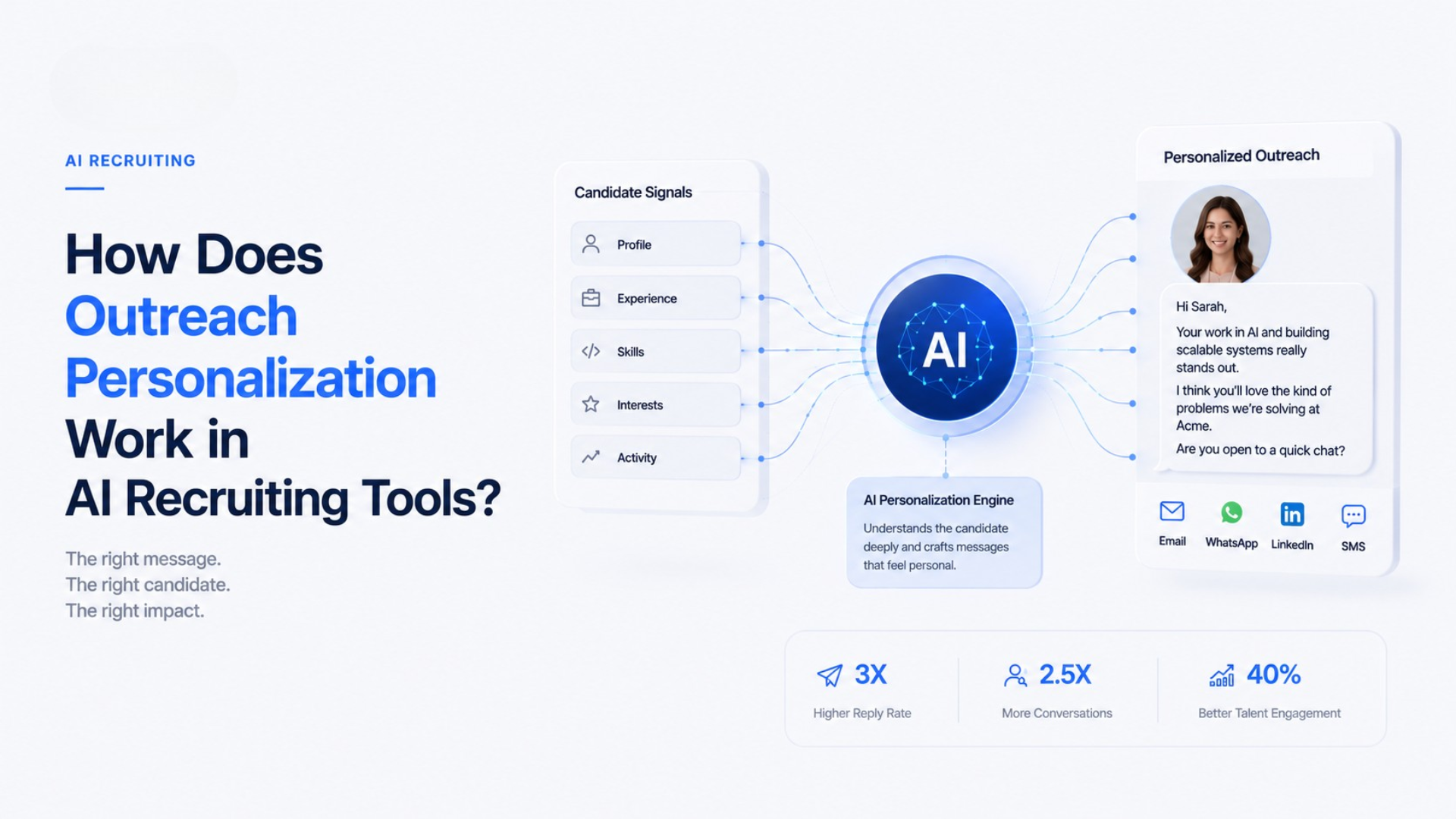
The process starts with data collection, and the depth of what gets ingested is usually the first meaningful difference between a tool that personalizes well and one that doesn't. GoPerfect's breakdown of outreach mechanics describes the scope directly: the AI ingests a candidate's profile data, work history including specific titles and durations, skills and certifications, company information such as size, industry, and funding stage, education, and any public content the candidate has produced — blog posts, conference talks, open-source contributions. The general rule that guide states plainly is that more available data produces more specific personalization, which is why tools built around narrow, single-source data tend to produce noticeably more generic messages than ones pulling from a genuinely broad set of public sources.
This is also where the sourcing and outreach layers of a platform connect directly — the same multi-source aggregation that powers finding a candidate in the first place (LinkedIn, GitHub, company websites, professional communities, public databases) becomes the raw material the outreach engine draws from when it's time to write to that person specifically.
Step Two: Deciding What's Actually Relevant to Mention
Raw data alone doesn't produce good personalization — the next step is filtering that data down to what's genuinely relevant to the specific opportunity, rather than mentioning everything available about a candidate indiscriminately. GoPerfect's guide describes this filtering step concretely: for a backend engineering role, the system weighs a candidate's distributed-systems experience most heavily; for a sales role, it surfaces their industry track record and quota history instead. That same guide draws a sharp line between what this produces and what generic personalization looks like in practice, contrasting an effective message — one that references a specific, verifiable detail like a candidate's work on a named payments API handling a stated transaction volume, tied directly to a comparable challenge the hiring team is solving — against an ineffective one that simply states a recruiter was "impressed by your experience," which reads as a personalization gesture without any actual substance behind it.
EverWorker's guide to outreach automation frames the same requirement from the message-construction side: the system should choose a genuine proof point tied to verified skills and impact, not a generic compliment, and use it in the first two lines of the message specifically, since that's the window in which a candidate decides whether the message feels real or feels like everything else in their inbox.
Step Three: Writing the Message From Scratch, Not Filling In a Template
The mechanical difference between AI-personalized outreach and merge-field templates is worth being precise about, because the two get described with similar language despite working very differently. GoPerfect's guide draws the distinction directly: template outreach fills a name and a job title into fixed sentence structures — "Hi [FirstName], I see you're a [JobTitle] at [Company]" — while genuine AI personalization generates each message from scratch, built around whatever specific, relevant detail step two surfaced for that particular candidate. The output isn't randomly different every time in a stylistic sense; it's substantively different because the actual content being referenced is unique to that person's background rather than pulled from a shared fill-in-the-blank structure.
EverWorker's guide describes a consistent message anatomy this generation process tends to follow regardless of which platform is doing it: a subject line that signals the actual impact of the role rather than a generic "exciting opportunity" framing, an opening line referencing a specific, credible detail about the candidate's work, a second line offering something of genuine value to the candidate — a role preview, a concrete look at what the first ninety days would involve — and a low-friction call to action, typically a short, specific time commitment with two proposed windows rather than an open-ended "let me know when works."
Step Four: Sequencing Across Multiple Touches, Not Just One Message
A single message, however well personalized, rarely does all the work — current best practice treats outreach as a structured sequence rather than a one-shot attempt. HeroHunt's guide to outreach sequences cites Gem's benchmarking data across millions of recruiting sequences, finding a four-step structure captures the large majority of potential responses while avoiding the fatigue and diminishing returns longer sequences produce. That same data shows response volume is distributed unevenly across the sequence rather than front-loaded: roughly 17.65% of total responses come from the initial message, 26% from the first follow-up, 24% from the second, and fully 32% — the largest single share — from the final message in the sequence. That distribution is a meaningful argument on its own for running a complete sequence rather than giving up after one or two messages go unanswered, since nearly a third of eventual responses come from the last touch specifically.
HeroHunt's guide also specifies how personalization should evolve across that sequence rather than staying static: the first follow-up references the original message directly, the second introduces a genuinely new angle — a specific team member the candidate would work with, a relevant project, a recent company milestone — and the final message shifts to a clear, low-friction call to action, since by that point the goal is a decision rather than continued persuasion.
Step Five: Choosing Channel and Timing Deliberately
Personalization also extends to when and where a message gets sent, not only what it says. GoPerfect's guide to outreach mechanics lays out specific, channel-dependent timing patterns: LinkedIn InMails perform best sent Tuesday through Thursday between 9 AM and 5 PM in the candidate's own timezone, while cold email performs best sent on the same Tuesday-to-Thursday window but with open rates peaking specifically in the early morning and late afternoon. That same guide notes a detail easy to overlook: for email specifically, subject line phrasing has an outsized effect on whether a message even gets opened — a subject referencing something specific and true about the candidate's actual work consistently outperforms generic phrasing about an "opportunity," regardless of how good the message body underneath it is.
Multi-channel sequencing compounds this further. HeroHunt's guide describes the most effective 2026 sequences as multichannel by design, spaced across two to three weeks with four to seven touchpoints total, deliberately avoiding both the single-channel trap and the opposite failure mode of compressing every message into a 48-hour burst that reads as aggressive rather than persistent.
Step Six: Adapting Follow-Ups to How a Candidate Actually Engages
The more advanced current platforms don't run a fixed sequence blindly — they adjust based on specific engagement signals from each candidate. HeroHunt's guide describes this feedback loop directly: the system tracks whether a candidate opened a message without replying, clicked an included link, or viewed the recruiter's LinkedIn profile back, and adapts both timing and channel selection based on those signals rather than sending the next scripted message on a fixed schedule regardless of what the candidate has actually done. That guide frames this adaptive loop as the specific feature separating genuinely AI-powered sequences from a static drip campaign that happens to use personalized language — the personalization matters, but the responsiveness to real engagement data is what keeps a sequence from feeling like it's talking past the person receiving it.
EverWorker's guide extends this into a broader testing discipline worth understanding as part of the same mechanic: platforms built for this can A/B test individual elements of a message — the opening hook, the specific proof point used, the call to action — within a defined candidate segment, and only roll out a winning variant more broadly once there's statistical confidence it actually performs better, rather than changing several elements at once and guessing at which one mattered.
Step Seven: Handing Off to a Human the Moment a Candidate Responds
Every credible guide in this category is consistent on where automation stops. Metaview's comparison of outreach platforms describes the standard behavior directly: once a candidate replies expressing genuine interest, the automated sequence pauses immediately and a recruiter is notified to take over the conversation personally — a deliberate handoff point, not an oversight. That same guide is direct about why this matters: candidates expect a real person once they've actually expressed interest, and continuing to route a genuinely interested candidate through further automated messages at that point undoes much of the trust the personalized outreach was built to establish in the first place.
EverWorker's guide frames a related threshold worth setting deliberately rather than leaving to chance: auto-send is reasonable for warm rediscovery outreach and lower-stakes nurture sequences, but first-touch outreach to senior talent or candidates for critical roles should stay human-reviewed before sending, even if an AI draft the message — the risk of an unreviewed message for a high-stakes candidate is simply higher than for a broader nurture campaign.
The Infrastructure Behind Deliverability
A layer of this mechanic that rarely gets discussed but directly determines whether any of the above even reaches a candidate's inbox is deliverability management. Metaview's guide to outreach platforms notes that AI outreach tools use sending limits, gradual domain warming, and active bounce-rate monitoring specifically to protect sender reputation, spreading sends across time windows rather than blasting a full list at once in ways that trigger spam filters. This is a genuine technical layer distinct from the writing and sequencing logic described above — a perfectly personalized message sent through poorly managed infrastructure can still land in a spam folder, which is part of why platform choice matters beyond just the quality of the AI-generated text itself.
A Practical Layered Model for Where to Apply Each Level of Personalization
Not every candidate in a pipeline warrants the same depth of personalization, and a guide from Rent a Recruiter lays out a specific three-layer structure worth adopting deliberately rather than applying maximum effort uniformly: automated basics for the broadest tier of outreach, AI-assisted contextual insights for a mid-tier of genuinely promising candidates, and targeted manual research reserved specifically for top-tier prospects where the stakes of a single outreach attempt are highest. That guide reports this layered approach, combined with AI-driven contextual personalization, pushing response rates as high as 18% for teams that implement it deliberately — a meaningfully better outcome than applying either full automation or full manual effort uniformly across a pipeline regardless of candidate priority.
Compliance Requirements Underneath the Mechanics
Outreach personalization also carries specific compliance obligations worth building into the process rather than treating as an afterthought. Metaview's guide to personalizing recruiting emails at scale notes that recruiting emails are generally permissible under legitimate-interest provisions in data protection law, but that permissibility depends on including a working opt-out mechanism and honoring unsubscribe requests promptly — and for EU candidates specifically, a recruiter should be prepared to explain the legitimate-interest basis for the outreach if a candidate or regulator asks. This sits alongside the broader bias and audit requirements covered elsewhere in AI recruiting — SitePoint's guide to sourcing tools notes that documented guardrails against algorithmic bias are increasingly a baseline expectation given the EU AI Act and tightening US jurisdictional rules, and outreach personalization, since it determines who gets contacted and how, falls within that same compliance scope.
Beyond Text: Where Multimodal Personalization Is Heading
Text messages aren't the endpoint of this mechanic, and current guidance points to voice and video as a meaningful next layer rather than a novelty. HeroHunt's outreach guide cites performance data from Sendr showing personalized video achieving three to five times the response rate of text-only outreach for otherwise equivalent candidate profiles, and frames AI-generated personalized video and voice messages as moving from niche tooling into integrated features on major outreach platforms as production costs continue to fall. That same guide's practical framing is worth carrying forward: the economics tip in favor of multimedia outreach specifically for roles where cost-per-hire already runs into the thousands of dollars, since the marginal cost of a more attention-grabbing outreach format is trivial against the value of filling a role faster or reaching a candidate who ignores yet another text message.
Voice specifically extends the same personalization mechanics described throughout this guide into a different medium — the same candidate research, relevance filtering, and message construction logic applies, but delivered as a natural spoken conversation rather than a written message, which changes what a candidate experiences from reading a well-targeted email to being genuinely spoken to about a specific, relevant opportunity.
Where a Tool Like Huntlo Fits
Every mechanic described in this guide — deep candidate research across public sources, relevance filtering tied to the specific role, message generation from scratch rather than templates, multi-touch sequencing with adaptive follow-up, deliberate channel and timing selection, and a clean handoff to a human the moment a candidate responds — is the specific workflow Huntlo is built to run end to end rather than as separate, manually stitched-together steps.
Huntlo's agentic AI handles personalized outreach and follow-up autonomously across email, WhatsApp, and AI voice, drawing on the same continuous sourcing and re-scoring process described in the mechanics above to make sure outreach only goes to candidates who've already been matched against a described ideal profile — which is precisely the combination EverWorker's guide points to as the real advantage of connected sourcing-plus-outreach systems: every message goes to someone the AI has already identified as a genuine fit, rather than personalization being applied evenly across an unfiltered list. Huntlo's free trial is a direct way to see this sequencing and adaptive follow-up running against a real open role.
Frequently Asked Questions
Is AI-personalized outreach just a fancier mail-merge? No, not in a genuinely capable tool. Mail-merge fills a name and title into a fixed template; AI personalization generates each message from scratch around a specific, relevant detail about that candidate's actual background, which is why the resulting messages read as substantively different rather than cosmetically varied.
How many outreach touches should a sequence include? Current benchmarking data points to roughly four steps as the practical sweet spot for most recruiting use cases — enough to capture the large majority of eventual responses (including a meaningful share that only come from the final message) without triggering the fatigue and diminishing returns longer sequences tend to produce.
Should every candidate get the same depth of personalization? Not necessarily. A layered approach — light automated personalization for the broadest tier of outreach, AI-assisted contextual detail for a stronger-fit tier, and dedicated manual research reserved for top-priority candidates — tends to balance response rate against recruiter time better than applying uniform effort across an entire pipeline.
What happens when a candidate actually replies to automated outreach? In every credible platform, the automated sequence stops immediately and a human recruiter takes over the conversation directly. Continuing to send automated messages to someone who has already expressed genuine interest is treated as a clear failure mode across current guidance in this category.
Is personalized outreach at scale legally risky? It requires the same compliance attention as any recruiting communication — a working opt-out mechanism, prompt handling of unsubscribe requests, and, for EU candidates, a documented legitimate-interest basis for the outreach. None of this is unique to AI-driven outreach, but the volume AI enables makes getting the compliance mechanics right from the outset more important than it would be for a small number of manually sent messages.
The Bottom Line
Personalization at scale works because it's built from distinct, well-defined mechanical steps rather than a single trick: deep research across public sources, filtering that research down to what's actually relevant to the specific opportunity, generating a genuinely unique message rather than filling in a template, sequencing multiple touches with personalization that evolves across the sequence, choosing channel and timing deliberately, adapting follow-ups based on real engagement signals, and handing off to a human the instant a candidate shows genuine interest. Skipping any one of those steps is usually where "AI personalization" starts to read as generic again — the technology only delivers the response-rate gains discussed at the start of this guide when the full mechanic is actually running, not just the message-writing piece of it.
If the goal is seeing that full mechanic run against a real hiring need rather than piecing it together across separate tools, Huntlo's agentic AI recruiting platform runs sourcing and personalized, multi-channel outreach as one connected workflow — worth testing directly with the free trial against your next open role.
Related Reading on the Huntlo Blog
How Can Staffing Firms Reduce Recruiter Workload Using AI
AI Recruiting Software for Staffing Firms
AI Sourcing Tool Comparison Framework: 10 Criteria That Matter