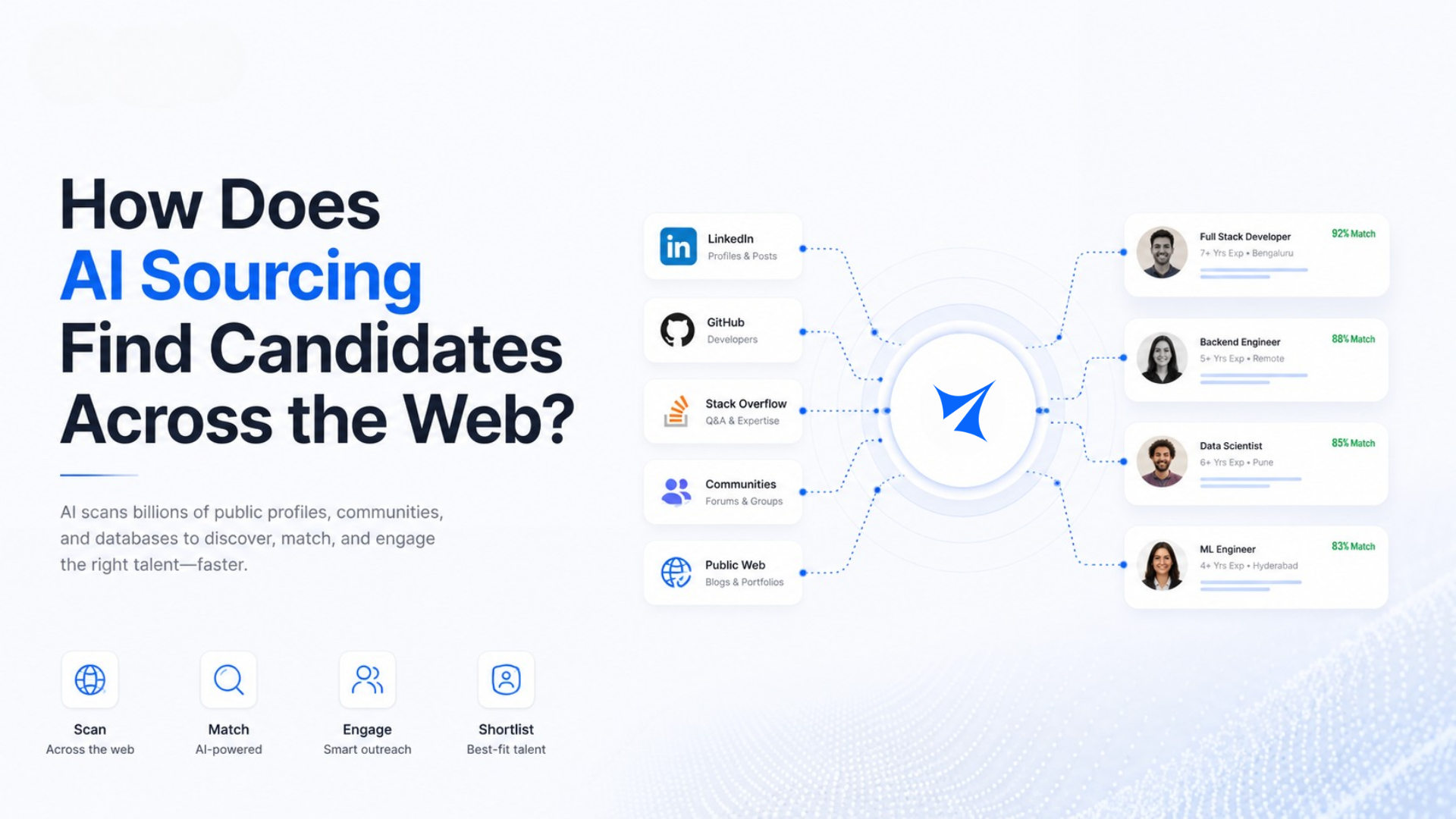
"AI sourcing" gets described often enough as something close to magic — type in a role, get a shortlist — that it's worth pulling back the curtain on what's actually happening underneath. The mechanics aren't mysterious, and understanding them makes it considerably easier to tell a genuinely capable platform from one that's running a keyword search with a better-looking interface on top. A comparison from SitePoint puts that exact distinction in plain terms: the real question worth asking of any AI sourcing tool is whether it understands context and intent, or whether it just runs Boolean queries dressed up as something smarter.
This guide walks through the actual technical layers involved in AI sourcing — where the underlying data comes from, how the matching genuinely differs from keyword search, how passive candidates get identified before they've applied anywhere, and how outreach gets personalized at scale — using the specifics multiple current platforms and guides describe rather than the marketing shorthand most vendors lead with.
Layer One: Aggregating Data Across Many Sources, Not One
The first structural difference between AI sourcing and traditional search is where the data comes from in the first place. A guide from Gem describes this directly: effective sourcing without relying solely on LinkedIn is possible because platforms aggregate profiles from multiple sources — GitHub, professional associations, company websites, public databases, and more — with many technical candidates maintaining a more current, more detailed profile on a developer-specific platform than on LinkedIn itself. HireEZ, per a comparison from Metaview, aggregates candidate data from more than 45 public platforms including LinkedIn, GitHub, and Google Scholar into a single searchable index specifically because candidates who don't keep a LinkedIn profile current still leave a visible footprint across the rest of the open web.
A separate guide from MSH frames what these tools are actually scanning for once the aggregation is in place: advanced sourcing platforms scan not just job boards but the broader web, identifying potential candidates based on signals well beyond keyword matches — public work samples, conference presentations, and contributions to open-source projects all factor into the picture a modern sourcing tool builds of a candidate, rather than the platform relying on a single resume or profile page as the only source of truth about what someone can do.
Layer Two: Understanding Context Instead of Matching Keywords
The single biggest functional difference between AI sourcing and the Boolean search it replaced is what happens once the data is aggregated. A guide from ClearCo describes the core capability directly: AI sourcing tools recognize that a "software engineer" and a "full-stack developer" might describe the same underlying role, spot transferable skills across differently worded experience, and predict which candidates are likely to actually respond to outreach — capabilities a literal keyword match has no way to replicate, since it can only find what's typed in the same words used in the search itself.
This matters in practice because it directly determines whether a search finds the right people or just the people who happened to describe themselves the way a recruiter searched for them. Talentprise's broader analysis of high-volume hiring makes the failure mode of pure keyword matching explicit: it removes candidates who describe their relevant experience in slightly different terms while retaining people who've learned to keyword-stuff a resume to game the filter — precisely backwards from what a good screen should do. Semantic, context-aware matching is the fix for that specific failure, not a marginal improvement on it.
Layer Three: Ranking Against Actual Hiring Outcomes, Not Just Relevance
A more advanced layer some current platforms have added goes beyond matching a candidate to a job description and instead ranks candidates against a company's own historical hiring patterns. Metaview's description of its own sourcing agent illustrates the mechanic: the system starts from a job description, an intake call, a "lookalike" reference candidate, or a natural-language command, searches candidate databases, weights the results against the company's past successful hires specifically, and returns a ranked shortlist with the reasoning attached to each recommendation rather than a bare list of names. That's a meaningfully different task than matching a job description to a resume — it's asking which candidates most resemble the people who actually succeeded in similar roles at this specific company, which is a pattern a static job description alone can't capture.
The practical effect, per that same source, is that the recruiter's time shifts from building a shortlist to reviewing one that's already ranked and reasoned — a smaller, more relevant list that's faster to act on than a large pool of technically-matching but unranked profiles. Whether a given platform actually does this well is measurable, too: Metaview cites its own performance on an independent 1,400-query benchmark for people search, scoring well ahead of the next-closest competitor in that specific test — a useful reminder that "AI-powered ranking" is a claim worth verifying against real benchmark performance rather than accepting on description alone, since the quality gap between platforms genuinely doing this and platforms only claiming to varies enormously.
Layer Four: Finding Candidates Who Haven't Applied Anywhere
The core value proposition of AI sourcing specifically — as distinct from AI-assisted screening of inbound applicants — is reaching people who aren't actively looking. ClearCo's guide describes the underlying mechanic: sourcing platforms monitor career signals like recent certifications, completed projects, or profile updates that suggest someone might be newly open to a move, even though that person has taken no active job-search action themselves. This is genuinely different from matching an existing applicant to a role — it's inferring receptiveness from indirect evidence, in something closer to the way a sales team might read buying signals from a prospect who hasn't reached out yet.
A guide from Sapia frames a related tactic worth understanding as part of the same layer: candidates found this way typically get segmented by strength of match before any outreach goes out — core-fit candidates who closely match the stated must-haves, stretch-fit candidates with adjacent skills and strong learning signals, and what that guide calls community nodes, people connected to many of the strongest matches who may be worth reaching for referral value even if they aren't a direct fit themselves. That segmentation exists because treating every sourced candidate identically wastes the platform's most valuable output — a ranked sense of who's actually worth a recruiter's limited outreach attention first.
Layer Five: Generating and Personalizing Outreach at Scale
Finding a candidate and getting a response from them are different problems, and the outreach layer of AI sourcing is where a meaningful part of current platform differentiation actually sits. Pin's own reported outreach performance, per a comparison from SitePoint, claims a 48% response rate on automated sequences across email, LinkedIn, and SMS — a figure worth treating with appropriate skepticism given it's vendor-reported, but directionally consistent with the broader pattern that personalized outreach substantially outperforms generic templated contact regardless of which specific platform sends it.
Sapia's guide is specific about what separates outreach that actually works from outreach that reads as obvious spam: give the generative layer a genuine two-line reason to reach out, a few concrete role outcomes, and one specific proof point about the team, then keep the resulting message short, low-pressure, and edited to sound like an actual person rather than a template. That same guide's example message is worth noting for what it's not — it doesn't oversell the role, doesn't create false urgency, and explicitly gives the candidate an easy, low-friction way to decline; the guide's broader point is that automated outreach performs best when it's used to handle volume and consistency — reminders, thank-yous, light nudges — while a human still decides who gets a genuinely tailored note and when to pause outreach that isn't landing.
Layer Six: Running Continuously Rather Than On-Demand
A structural shift worth naming specifically is the move from sourcing as a one-time search a recruiter runs when a role opens, toward sourcing as a continuous background process. Juicebox's description of its own autonomous agent capability illustrates the pattern: an agent can be configured once for a recurring role and then source continuously, delivering a live, updating pipeline directly to a recruiter's inbox rather than requiring a fresh manual search every time the role needs filling again. Metaview's guide frames the same shift from a different angle, distinguishing its own AI Sourcing agent specifically as one that runs continuously rather than only on demand — a meaningful difference for roles a company hires for repeatedly, where a pipeline that's already warm the moment a requisition opens beats one built from scratch after the fact.
What Can Go Wrong: The Data-Quality Problem Underneath Everything
None of the layers above work well if the underlying data or matching logic is flawed, and every current guide in this category flags data quality as the primary risk rather than a minor caveat. Recruiterflow's guide to AI sourcing states the core dependency plainly: the output of an AI system is only as good as its input, and if the underlying data used to build the matching intelligence is inconsistent, incomplete, or biased, the tool's recommendations inherit those same flaws regardless of how sophisticated the surrounding technology looks. Articsledge's broader guide to AI candidate sourcing adds a specific compliance dimension to that same risk: algorithmic bias in hiring tools is both real and legally consequential, with the EU AI Act and US EEOC guidance both holding employers accountable for AI-driven discriminatory outcomes, which means data quality and bias auditing aren't optional technical hygiene — they're a genuine legal exposure if skipped.
The practical implication across every guide covering this is consistent: human oversight on final decisions is described as non-negotiable, both ethically and legally, regardless of how accurate the underlying sourcing and ranking technology becomes. AI surfaces and ranks; a person still decides.
Layer Seven: Predicting Fit, Not Just Matching Requirements
A more advanced application of the same underlying technology goes beyond matching a candidate's current skills to a role and attempts to predict how they'll actually perform in it. A guide from Apps365 describes this capability directly: modern sourcing systems connect candidates to roles based on their real, demonstrated skills rather than surface-level keywords, identify transferable skills even across differently titled roles, and use that pattern-matching to help predict a candidate's likely performance in a specific position — a genuinely different task from confirming someone meets the stated requirements on paper. MSH's 2026 trends analysis backs this with a concrete outcome figure: companies using AI-assisted recruiter messaging specifically, per LinkedIn Talent Solutions data, are 9% more likely to make a quality hire than teams making light use of the same feature, a gap that traces back to how well the underlying system has learned which signals actually correlate with success rather than which ones merely look impressive on a resume.
This predictive layer depends entirely on the same data-quality foundation discussed above — a system can only learn what "success" looks like from the hiring outcomes it's been trained on, which is exactly why Recruiterflow's guide frames data quality as the first and most important thing to get right before expecting a sourcing tool's predictions to be trustworthy.
Why Most Serious Sourcing Setups Layer More Than One Tool
A practical detail worth understanding about how sourcing actually gets deployed in 2026: very few teams rely on a single platform to cover the entire stack described above, and multiple current guides recommend layering deliberately rather than expecting one tool to do everything well. Metaview's guide to sourcing tools recommends a specific structure — a primary sourcing engine, a specialist or enrichment layer for harder-to-reach pools, and a direct ATS integration so candidate data doesn't require manual re-entry — and frames two or three well-chosen layered tools as the practical sweet spot for most teams, rather than either a single do-everything platform or an unmanaged pile of disconnected point solutions. That same guide flags ATS integration specifically as a cost that's easy to underweight during evaluation: a sourcing tool that doesn't write candidate data back to the ATS automatically effectively gets paid for twice — once in the license fee, and again in the recruiter hours spent on manual re-entry between systems.
Where a Tool Like Huntlo Fits
Every layer described in this guide — multi-source aggregation, semantic matching, passive-signal detection, personalized outreach, and continuous rather than one-off search — is exactly the mechanism Huntlo runs as a single connected workflow rather than a set of separately built capabilities.
Huntlo's agentic AI continuously sources and re-scores candidates across 50+ public platforms against a described ideal profile — reading context and skill adjacency rather than matching literal keywords, in line with the semantic-matching layer described above — and then handles personalized outreach and follow-up autonomously across email, WhatsApp, and AI voice, applying the same principle Sapia's guide describes: automated for consistency and volume, but built to sound like a real conversation rather than an obvious template. Because the sourcing runs continuously rather than only when a recruiter manually triggers a search, a pipeline for a recurring role can already be warm before the requisition officially opens. Huntlo's free trial is a direct way to see these mechanics working against a real open role rather than taking any platform's description of its own technology at face value.
Frequently Asked Questions
Is AI sourcing just a bigger keyword search? No, not in a genuinely capable platform. The core technical shift is semantic understanding — recognizing that differently worded experience describes the same underlying skill, and that a candidate's real capability can be inferred from work samples, contributions, or project history rather than only from resume keywords matching the search terms literally.
How does AI sourcing find candidates who aren't actively job hunting? By monitoring indirect career signals rather than waiting for an application — things like a new certification, a completed project, or a recent profile update that suggest someone might be newly open to a move, even without any explicit job-search action from that person.
Does AI sourcing replace the need for a recruiter to review candidates? No. Every current guide in this category treats human review of the final shortlist and any hiring decision as required, both for quality and for legal compliance in jurisdictions with bias-audit requirements. AI narrows and ranks a large pool down to a manageable, relevant shortlist; a person still evaluates and decides.
Why do some AI sourcing tools perform much better than others despite similar marketing claims? Largely because of underlying data quality and how genuinely the matching engine understands context versus running keyword logic behind a nicer interface. Independent benchmarks, where available, are a more reliable signal of real capability than a platform's own description of its AI.
Is outreach automation the same as spam at scale? It doesn't have to be, though it can become that if done poorly. The guides in this category consistently recommend keeping automated messages short, specific to the actual role and the candidate's background, and easy to decline, with a human reviewing which candidates warrant a more tailored note rather than letting every message go out identically.
The Bottom Line
AI sourcing works by combining several distinct technical layers rather than any single trick: aggregating candidate data across dozens of public sources beyond any one platform, understanding context and transferable skills instead of matching literal keywords, ranking candidates against a company's own successful hiring patterns rather than generic relevance, inferring which passive candidates might be newly open to a move from indirect signals, and personalizing outreach at a volume no recruiter could sustain manually. None of that removes the need for human judgment on the actual hiring decision, and none of it works well if the underlying data or matching logic is flawed — which is exactly why data quality and human oversight remain the two consistent caveats across every credible guide to this technology.
If the goal is seeing these mechanics run against a real hiring need rather than reading about them in the abstract, Huntlo's agentic AI sourcing platform runs the full stack described in this guide as one continuous workflow — worth testing directly with the free trial against your next open role.