AI resume screening adoption has moved fast — usage across HR teams doubled from 26% to 43% between 2024 and 2025, per SHRM data cited by Yena's 2026 guide to the category, and a separate survey from JobCannon puts the odds that an application crossing an enterprise ATS gets read by AI before a human at roughly 40% or higher. Speed and accuracy get conflated constantly in how this technology is discussed, and they aren't the same thing — a guide from HRPanda states the distinction directly: vendor accuracy claims rarely measure what HR leaders actually care about, which is good hires made with fewer adverse-impact concerns, not the underlying technical metric a vendor is actually reporting.
This guide breaks down what "accuracy" actually measures in AI resume screening, what the real published numbers show against human reviewers, what human screening's own well-documented accuracy problems look like as a baseline for comparison, and what current evidence says genuinely reduces error on either side.
"Accuracy" Is at Least Three Different Numbers
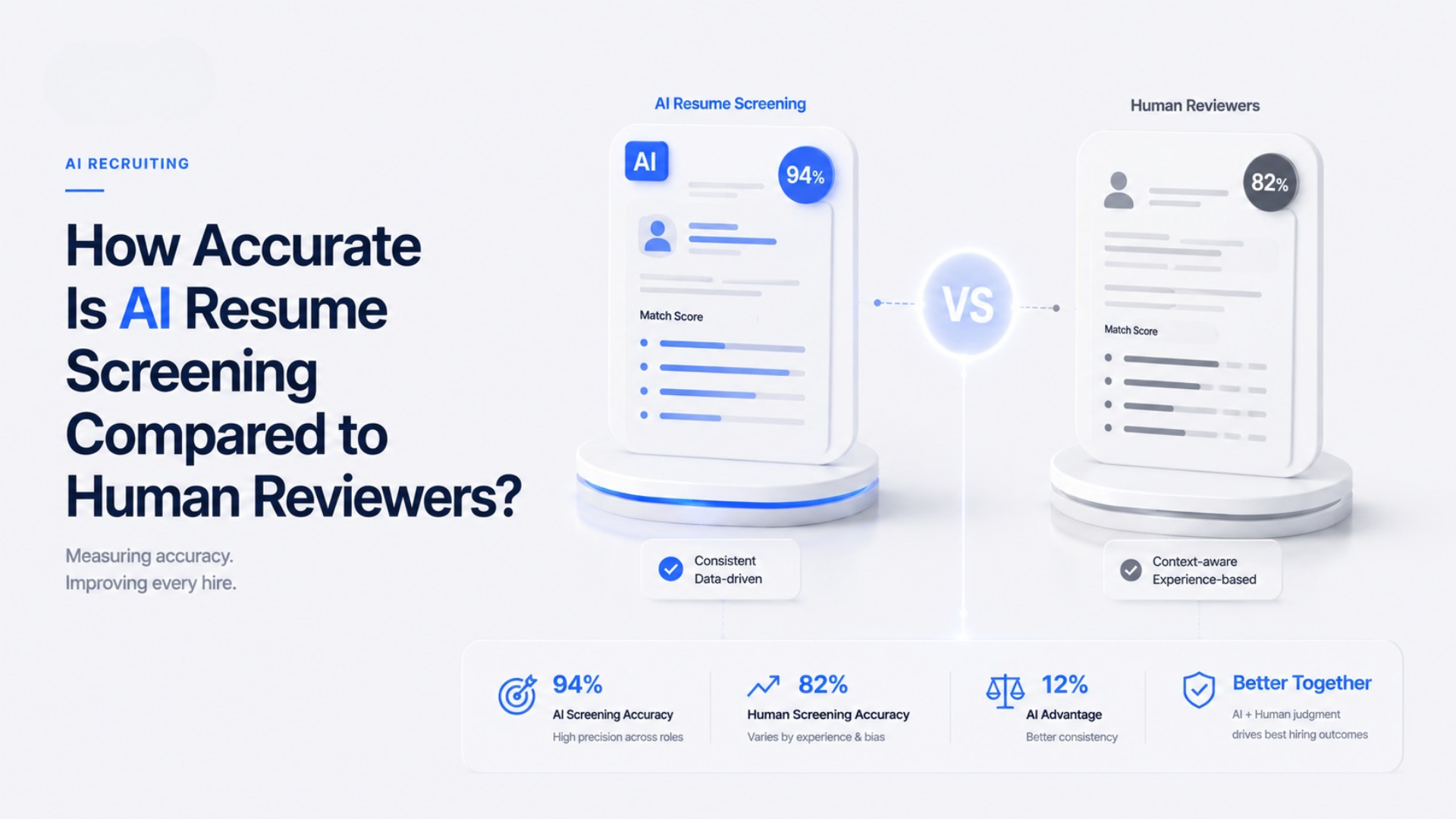
The first thing worth establishing is that AI resume screening accuracy isn't a single figure, and vendors comparing their tool favorably to human review are frequently citing a different metric than the one that actually matters for a hiring decision. HRPanda's guide lays out the distinction precisely: parsing accuracy — how correctly a system extracts structured information like job titles, dates, and skills from an unstructured resume — commonly reaches around 90% F1 score on clean, well-formatted resumes. Screening agreement with human reviewers — whether the AI's shortlist decision matches what a human reviewer would have decided on the same resume — sits considerably lower, in the 60% to 70% range. And quality-of-hire validation — whether candidates the AI advanced actually performed well after being hired — is, per that same guide, rarely measured at all, despite being the number that should matter most to a hiring team evaluating whether a tool is actually working.
That gap between metrics is exactly why HRPanda's guide recommends a direct question for any vendor conversation: what does your accuracy number measure — parsing extraction, screening agreement with human reviewers, or quality-of-hire validation? A vendor citing a 90%-plus figure without specifying which of these three it refers to is very likely citing parsing accuracy, which says almost nothing about whether the tool makes good shortlisting decisions.
What 60-70% Agreement With Humans Actually Means
The screening-agreement figure is worth sitting with directly, because it cuts both ways in a way that's easy to misread. A 60% to 70% agreement rate means that on roughly a third of resumes, an AI screening tool and a human reviewer would reach different conclusions about whether to advance a candidate — a meaningful disagreement rate for a decision with real consequences for the candidate on the other end. But that number only tells a useful story once it's compared against a baseline of how consistent human reviewers are with each other in the first place, which is a comparison most current guides in this category don't make explicit, and one worth being honest about before treating any disagreement with AI as necessarily an AI error.
The Human Baseline Isn't as Strong as It's Often Assumed to Be
Manual resume screening is the implicit standard AI gets measured against, and its own documented accuracy problems are substantial enough to complicate any simple "AI versus human" framing. TheHireHub's 2026 guide to resume screening cites a specific and stark figure: manual screening consumes roughly seven seconds of attention per resume on average, and at that pace, rejects 20% to 30% of genuinely qualified candidates due to a combination of unconscious bias and simple reviewer fatigue. That's not a minor error margin — it means a meaningful share of qualified applicants never advance past manual screening for reasons entirely unrelated to their actual qualifications.
The bias component of that figure is well documented independently of AI comparisons. TheHireHub's guide notes that recruiters unconsciously favor names that sound familiar to them and show preference toward certain schools regardless of how those factors relate to actual job performance — a pattern of human bias in hiring that predates AI screening by decades and that AI was, in part, originally proposed as a potential fix for, precisely because a system can be forced to apply the same criteria consistently to every resume in a way a fatigued human reviewer working through resume 150 of the day cannot.
Where AI Screening's Own Bias Shows Up
The proposed fix hasn't fully delivered on that promise, and the evidence on AI-specific bias is substantial and specific. A guide from Selenios cites research finding that 78% of AI screening tools exhibit some detectable level of bias, most commonly along gender, ethnicity, age, and educational-institution lines. That same guide references National Bureau of Economic Research findings that names associated with certain ethnic minority groups receive callback rates up to 36% lower than otherwise identical resumes — a disparity AI systems trained on historical hiring data tend to replicate rather than correct, precisely because the training data reflects decades of exactly the human bias patterns described above.
The most widely cited real-world case remains Amazon's abandoned recruiting tool, referenced in Selenios's guide, which was found to automatically penalize resumes containing terms like "women's" — as in "women's chess club" — because the system had learned from a historical hiring pattern skewed toward male candidates in the roles it was trained on. Yena's 2026 guide cites more recent evidence in the same vein: a 2025 FAIRE study found measurable racial and gender bias in AI-driven resume evaluations across multiple commercial screening platforms currently in active use, not just in older or since-discontinued tools. Selenios's guide adds a further pattern worth naming specifically: AI systems tend to penalize older graduation dates, employment gaps, and experience with technology described as "legacy" — proxies that can function as indirect age discrimination even when age itself is never an explicit input to the model.
Why the Comparison Isn't Simply "Which Is More Biased"
Given both sides of this picture, framing the question as a simple contest over which method is more biased somewhat misses the more useful point, which is that both approaches carry real, documented error, and the more productive question is what combination of the two produces the fewest compounding mistakes. Articsledge's guide to AI resume screening states the core risk plainly: AI screening is a filter, not a verdict, and at organizations that treat an AI's ranked shortlist as the final decision without human review, errors compound invisibly — a mis-scored resume never gets a second look from anyone, human or otherwise, and the candidate simply disappears from the process without anyone noticing a mistake was made.
That same guide flags a data-governance root cause worth taking seriously rather than treating as a minor caveat: if an organization's historical hiring data reflects past discrimination, intentional or not, training a new AI system on that data bakes the same discrimination directly into the tool's scoring logic — which is why auditing historical hiring data for demographic gaps before using it as training material is treated as a required step in every credible current guide to deploying this technology responsibly, not an optional best practice.
What Actually Reduces Error in Practice
The evidence on what genuinely improves accuracy, rather than just claiming to, is more specific than most vendor marketing suggests. Selenios's guide cites a concrete figure: implementing regular bias audits, using demographically balanced training datasets, and maintaining active human review together reduce bias by 72% relative to unaudited automated screening — a substantial improvement, though notably not a complete elimination of the underlying problem, which is a distinction worth being honest about when evaluating any vendor's compliance claims.
TheHireHub's guide describes a specific hybrid screening structure that current best practice converges on: the bottom roughly 50% to 60% of candidates by AI score get auto-rejected, the top tier gets auto-advanced to a phone screen, and a middle band — typically 20% to 35% of candidates — gets routed to mandatory human review rather than being decided by the algorithm alone. That structure is explicitly designed to capture AI's genuine speed advantage on the clearest cases at either end of the distribution, while keeping a human directly in the loop specifically for the ambiguous middle, where the risk of a wrong automated decision is highest and the AI's own confidence is typically lowest. The same guide recommends retraining the underlying model quarterly, incorporating at least 50 new hiring decisions each cycle specifically to catch and correct any drift in accuracy that's crept in since the last review — treating the model as something that needs ongoing maintenance rather than a tool that's calibrated once and left alone.
The Regulatory Backdrop Is Forcing This Hybrid Approach Anyway
Even for organizations not independently convinced by the accuracy argument, regulation is increasingly making a pure automated-decision approach untenable regardless. Yena's guide notes that under GDPR Article 22, candidates in the EU have a right not to be subject to solely automated decisions with significant effects on them, and recruiters must offer human review on request and document the legal basis for any automated processing used. The EU AI Act goes further starting in August 2026, classifying AI systems used to screen, rank, or filter job applications as high-risk specifically, which triggers mandatory risk assessments, required technical documentation, enforced human-oversight mechanisms, and a legal obligation to disclose AI use to candidates — with Articsledge's guide noting non-compliance penalties reaching 15 million euros or 3% of global turnover, whichever figure is higher.
A cautionary example from Yena's guide illustrates what happens when this goes wrong in practice: a mid-sized European staffing firm turned on AI resume screening and saw time-to-shortlist drop 60% — a real and significant efficiency gain. Three months later, a candidate filed a GDPR complaint, and the firm's data protection officer discovered the system had been rejecting applicants with no human review trail at all documenting those decisions. The time savings were genuine; so was the resulting legal exposure, and the guide's point in relaying this example is that the two aren't in tension if the hybrid human-review structure is built in from the start, but become a real liability specifically when they aren't.
A Practical Vendor Evaluation Checklist
Given how much variation sits behind a single "accuracy" claim, HRPanda's guide offers a specific set of questions worth putting to any vendor in writing before deployment, rather than accepting a headline accuracy figure at face value: What exactly does your accuracy number measure — parsing extraction, screening agreement with human reviewers, or quality-of-hire validation? How is your training data composed across geography, role type, and demographic group, and when was it last refreshed? Can you show bias-test results broken out by demographic group, including any adverse-impact or four-fifths-rule analysis? Can a hiring manager see, in plain language, why a specific candidate was scored the way they were? And how are recruiter overrides of the AI's recommendation logged, and can the organization run reports on override patterns over time to catch systematic disagreement early?
A vendor able to answer all five of these directly, with documentation rather than reassurance, is a meaningfully different proposition than one offering only a headline accuracy percentage with no further detail behind it.
A New Complication: Candidates Are Optimizing Against the Screener
A factor increasingly complicating accuracy comparisons that most 2026 guidance doesn't fully account for yet: candidates themselves are adapting to the presence of AI screening, which changes the nature of the error being measured. Reporting from the New York Times, cited in recent academic research on this topic, has documented recruiters increasingly encountering resumes clearly optimized to game automated screening tools rather than to accurately represent a candidate's actual background — keyword-stuffed documents, sometimes with white-on-white text invisible to a human reader but readable by a parsing algorithm, designed specifically to trigger a favorable AI score. This creates a moving target that a static accuracy study can't fully capture: a screening tool's measured agreement rate with human reviewers on a historical dataset doesn't account for a wave of resumes specifically engineered against that same tool's known scoring patterns.
The practical implication is that accuracy figures published at one point in time tend to degrade as more candidates adapt their materials specifically to game whichever screening approach has become common — which is a further argument, on top of the bias and compliance considerations already covered, for maintaining active human review rather than trusting a fixed accuracy benchmark indefinitely. A tool's real-world accuracy in practice is a moving number, not a fixed one, and treating a vendor's published accuracy figure as permanently valid ignores that the underlying population of resumes it's evaluating is actively adapting against it.
Where a Tool Like Huntlo Fits
The core finding running through this entire comparison — that AI screening reduces certain kinds of error while requiring active human oversight to avoid introducing others — is the design principle behind how Huntlo approaches candidate evaluation. Rather than positioning AI to make an unreviewed final call on any candidate, Huntlo's agentic AI is built around the same identify-and-surface role this guide consistently points to as the safer and better-evidenced use of the technology: continuously sourcing and scoring candidates across 50+ public platforms against a described ideal profile, and handling the outreach and engagement that follows — leaving the actual evaluation of fit, the interview, and the hiring decision itself with the people running the search.
That division mirrors exactly the hybrid structure this guide's evidence supports: AI doing the volume work efficiently and consistently, with a human making the calls that carry the real consequences for a candidate. Huntlo's free trial is a direct way to see that division working on a real open role, rather than taking any accuracy claim, including this guide's summary of the current evidence, purely on description.
Frequently Asked Questions
What does "AI resume screening is 90% accurate" actually mean? It almost always refers to parsing accuracy — how correctly the system extracts structured data like job titles and dates from a resume — not whether its shortlisting decisions match what a human reviewer would decide. Screening agreement with human reviewers, the more decision-relevant metric, currently sits closer to 60% to 70% across current research.
Is manual resume screening actually more accurate than AI? Not clearly, based on current evidence. Manual screening at typical review speeds is documented to reject 20% to 30% of genuinely qualified candidates due to unconscious bias and reviewer fatigue, which is a substantial error rate in its own right — the honest comparison is between two imperfect methods, not between a flawed AI and a reliable human baseline.
Does AI resume screening reduce bias or introduce new bias? Both, depending on implementation. Research finds a majority of AI screening tools exhibit some detectable bias, often inherited directly from the historical hiring data used to train them. Regular bias audits, demographically balanced training data, and active human review are documented to meaningfully reduce that bias, though not eliminate it entirely.
Is it legal to let AI reject candidates without any human review? Increasingly no, in several major jurisdictions. GDPR gives EU candidates a right to request human review of purely automated decisions, and the EU AI Act's August 2026 high-risk classification for hiring-screening tools requires documented human oversight mechanisms. Several evolving US state laws are moving in a similar direction.
What's the best current practice for combining AI and human review in resume screening? A hybrid structure where AI auto-advances the clearest strong matches and auto-rejects the clearest weak ones, while routing the ambiguous middle tier of candidates — typically the largest source of disagreement between AI and human reviewers — to mandatory human review, rather than letting the algorithm decide unsupervised at either end of the process.
The Bottom Line
AI resume screening isn't more accurate than human review in any simple, universal sense, and it isn't clearly less accurate either — the honest picture is two imperfect methods with different, well-documented failure patterns. AI screening agrees with human reviewers roughly 60% to 70% of the time, and a majority of current tools carry some measurable demographic bias inherited from their training data. Manual screening, the baseline being compared against, rejects a comparable share of genuinely qualified candidates due to unconscious bias and simple fatigue at typical review speeds. The evidence-backed answer isn't choosing one method over the other — it's a hybrid structure with mandatory human review at the ambiguous margin, regular bias auditing, and documentation good enough to survive a regulatory challenge, which is increasingly a legal requirement in major jurisdictions regardless of what the accuracy numbers alone would suggest.
If the goal is putting AI to work on the volume and speed problem while keeping real judgment calls with a person, Huntlo's agentic AI recruiting platform is built around exactly that division — worth testing directly against a real hiring need with the free trial to see where the line actually falls for your team.