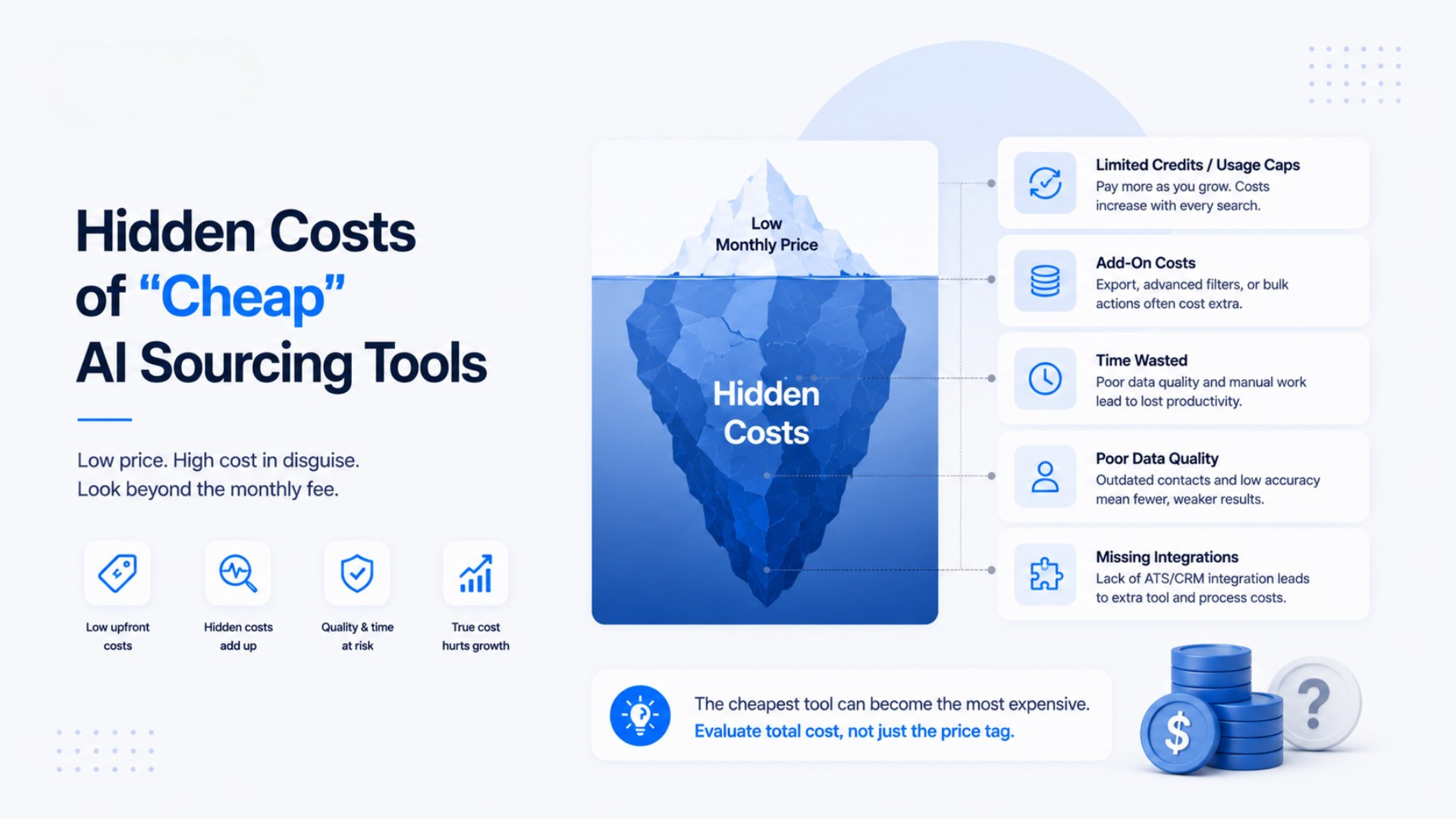
A $15-a-month AI sourcing tool and a $250-a-month one can end up costing roughly the same amount by the third month — just not in the way either price tag suggests. A guide to AI sourcing tools from SitePoint makes the underlying point directly: a $100-a-month tool with built-in outreach and scheduling often costs less overall than a $170-a-month tool that requires three additional subscriptions to actually function as a complete workflow. The cheap option isn't always cheap, and the expensive option isn't always expensive, once every cost the sticker price doesn't include gets added back in.
This guide walks through where those hidden costs actually come from in AI sourcing tools specifically — database quality, usage caps, add-on stacking, contact enrichment, and the recruiter hours spent manually working around what a budget plan doesn't do — using real vendor examples from the current market rather than abstract warnings.
The Database Quality Problem Nobody Prices In
The first hidden cost in a cheap sourcing tool isn't a line item at all — it's the quality of what you're actually paying to search. A comparison of AI sourcing platforms from MindHunt AI names this directly as one of the most overlooked evaluation criteria in the category: database size matters less than freshness and accuracy, and a database of 800 million stale profiles is worse than one of 300 million verified, current ones. A tool that looks like a bargain on database size alone can quietly cost a team hours of wasted outreach to candidates who changed roles, companies, or contact information long before the search ever ran.
This cost is genuinely hidden because it never appears on an invoice — it shows up as a lower response rate, more bounced emails, and a recruiter concluding the tool "just doesn't work well" without ever tracing that conclusion back to database staleness specifically. A separate roundup of budget-friendly sourcing tools for small businesses from GoPerfect frames the fix as a shift in what gets measured in the first place: rather than comparing platforms on subscription cost alone, the metric that actually matters is cost-per-successful-hire, which folds database quality, response rates, and recruiter time into one number instead of leaving quality invisible next to price.
Credit Caps and Per-Candidate Metering
A specific and common hidden cost in cheaper sourcing plans is usage metering that looks generous until real hiring volume hits it. GoPerfect's guide to affordable sourcing tools flags this pattern by name: many tools charge per candidate screened or per match reviewed, which creates costs that scale unpredictably as hiring volume grows, precisely the moment a team can least afford a surprise bill. That guide points to fixed, transparent annual pricing as the structural fix — a model where a startup with five open roles pays the same total as that same company a year later running twenty, removing the specific risk that comes from a per-usage model accelerating alongside recruiting activity rather than staying flat.
The practical trap is that these caps are rarely advertised as a limitation during the sales conversation — they show up in the fine print of the plan comparison page, if they're disclosed at all, and the first real signal a team gets is often an unexpected upgrade prompt or an overage charge mid-campaign. Reviewing a plan's credit or candidate ceiling against a realistic worst-case hiring month, not an average one, is the specific check that catches this before it becomes a real cost.
The Add-On Stacking Trap
The single most consistent hidden cost identified across current AI sourcing tool comparisons is add-on stacking: a low advertised base price that requires several paid modules to reach basic functional completeness. A comparison from Pin lays out a concrete example of how sharply this can move the real number: a base plan advertised at a given monthly rate can require separate paid add-ons for texting, video, and assessments, and a team that needs all of them can end up paying nearly double the advertised base price once every module required for a complete workflow is added in.
This pattern isn't unique to full recruiting suites — it shows up just as often in dedicated sourcing tools, where "sourcing" turns out to mean database search only, with outreach, contact enrichment, and pipeline tracking each billed as separate line items. SitePoint's sourcing tools guide is explicit about the fix: look beyond the sticker price and factor in InMail credits, contact lookup fees, add-on modules, implementation costs, and the recruiter time spent on workarounds for whatever the base plan doesn't cover, before comparing any two vendors' headline rates against each other.
Contact Enrichment: The Cost Layer Underneath the Cost Layer
Even sourcing tools that advertise "all-in-one" positioning frequently treat verified contact data — a real email address or phone number for a candidate the AI has already surfaced — as a separate, metered layer underneath the core subscription. MindHunt AI's comparison of the category calls this out as a distinct evaluation category in its own right: finding candidates is only half the job, and a platform that surfaces a promising profile but can't verify how to actually reach that person hasn't delivered the outcome a recruiter is paying for. Some platforms bundle enrichment into the base subscription; others meter it separately with its own credit pool, which means a team can burn through its outreach budget mid-campaign without having used up its search budget at all, because the two are tracked and billed independently.
This is worth checking explicitly rather than assuming, because it's one of the least visible cost splits in the category — a vendor's pricing page will almost always foreground database size and search capability, and treat contact enrichment limits as a footnote, if it mentions them at all.
The Recruiter-Hour Cost of "Cheap"
The largest hidden cost in a genuinely underpowered sourcing tool rarely shows up in software spend at all — it shows up in recruiter time spent compensating for what the tool doesn't do well. GoPerfect's framework for calculating real cost makes this explicit: total cost-per-hire has to include the platform fee, the recruiter time saved (or not saved), and the quality of candidates actually delivered, using a recruiter's fully loaded hourly cost as the baseline for what manual workarounds are actually costing beyond the subscription fee.
This shows up in a few specific, recognizable patterns. A tool with shallow search intelligence that returns keyword matches instead of context-aware results forces a recruiter to manually filter results the AI should have filtered already — MindHunt's comparison names this directly as the difference between "search intelligence" that understands intent and a system that just runs Boolean queries with a nicer interface on top. A tool without integrated outreach forces a recruiter to manually copy candidate details into a separate email or CRM tool, reintroducing exactly the kind of manual, disconnected workflow AI sourcing was supposed to eliminate in the first place. And a tool with a shallow or stale database forces extra search cycles and produces more dead-end outreach, both of which cost recruiter hours that never show up as a line item anywhere.
Annual Lock-In and Switching Costs
A quieter hidden cost sits in contract structure rather than in the product itself. Several platforms in the sourcing category, particularly at the higher end, require annual commitments — SitePoint's sourcing tools comparison notes that LinkedIn Recruiter's Corporate tier and several enterprise-focused sourcing platforms are annual-contract products, which means a team that discovers three months in that database quality or match relevance isn't meeting expectations has no straightforward way to exit without eating the remaining contract value. A separate comparison from MindHunt frames this as a real evaluation criterion in its own right — pricing transparency, including credit limits, hidden costs, and annual lock-ins, varies dramatically across the category and is worth weighing as seriously as search quality or database size before signing anything longer than a monthly term.
The practical mitigation, echoed across multiple guides in this category, is straightforward: run a free trial or a short paid pilot against a real, current open role before committing to an annual term, specifically because the gap between a platform's advertised capability and its actual performance on your specific hiring profile only shows up under real use, not in a demo.
What Real Vendor Pricing Reveals About This Gap
The spread in this category makes the hidden-cost pattern easy to see once you look at real numbers side by side. On the low end, Pin's own 2026 pricing roundup lists Manatal at $15 per user per month and HeroHunt.ai in a similar $15-to-$149 range — genuinely inexpensive on paper, but positioned by multiple independent guides as tools with shallower sourcing depth than dedicated passive-candidate platforms, meaning the "savings" at the subscription level can be offset by weaker match quality or a smaller reachable candidate pool. In the low-to-mid tier, MindHunt AI's own comparison lists its platform starting at $49 a month with enrichment and multi-channel outreach included in that base price rather than metered separately — a useful illustration that a low price and a complete feature set aren't mutually exclusive, provided the specific plan bundles what a workflow actually needs.
At the high end, the same MindHunt comparison lists SeekOut's enterprise tier starting around $830 per seat per month on an annual contract — a number that looks steep in isolation, but which that same review frames as excellent ROI specifically for enterprises with large legacy candidate databases and DEI compliance reporting needs, and a poor fit for a team without that specific requirement. That's the pattern worth internalizing across the entire price range: neither the cheapest nor the most expensive option is inherently the trap. The trap is buying based on the headline number alone, in either direction, without checking what that number actually includes.
A Short Framework for Spotting Hidden Costs Before Signing
A few direct questions, drawn from the patterns above, catch most of the hidden-cost risk in this category before a contract is signed. What's the actual candidate or credit ceiling on this plan, and what happens — in dollars, not vague language — when a real busy month exceeds it? Is contact enrichment included in the base subscription, or metered separately with its own limit? What add-on modules, if any, are required to reach a complete sourcing-to-outreach workflow, and what does the fully-loaded monthly cost look like once they're added? How current is the underlying database, and can the vendor speak to data freshness specifically rather than only database size? And is there a monthly or short-term option to pilot the platform against a real open role before any annual commitment is required?
A vendor willing to answer all five of these directly and in writing, before a sales call is even scheduled, is itself a meaningful signal about how the rest of the relationship is likely to go.
Integration Gaps: The Cost of a Tool That Doesn't Talk to Your ATS
A hidden cost that rarely shows up until after purchase is integration friction — a sourcing tool that surfaces strong candidates but doesn't sync cleanly with the ATS a team already runs. A comparison of AI sourcing tools from Recruiterflow notes that integration capability with popular ATS and CRM platforms like Greenhouse, Workday, or BambooHR is a baseline expectation in 2026, allowing candidate data to sync automatically and keeping teams from maintaining duplicate records across systems. When that integration is shallow, missing, or requires a paid API add-on, the resulting cost shows up as manual double-entry — a recruiter copying candidate details from the sourcing tool into the ATS by hand, for every candidate, every day — which is exactly the kind of repetitive task AI sourcing was meant to remove in the first place.
This gap is worth checking specifically rather than assuming, because "integrates with your ATS" on a features page can mean anything from a deep two-way sync to a basic CSV export a recruiter has to run and upload manually. Asking a vendor to demonstrate the actual sync — not describe it — during a trial period is the most reliable way to catch a shallow integration before it becomes a standing manual process.
A Worked Example: Comparing True Cost, Not Sticker Price
The gap between advertised price and real cost is easiest to see with a concrete comparison. Take two hypothetical plans: Plan A advertises $49 a month and includes contact enrichment and multi-channel outreach in that base price, consistent with the bundled pricing MindHunt's comparison describes for tools built around a complete workflow. Plan B advertises $29 a month for search only, with enrichment metered separately at roughly $0.50 per verified contact and outreach requiring a separate $40-a-month add-on to function.
For a recruiter sourcing 100 candidates a month and needing verified contact information for all of them, Plan B's real monthly cost is $29 plus $50 in enrichment credits plus $40 for outreach — $119 a month, well above Plan A's all-in $49, despite Plan B's lower headline price. The gap only widens in a heavier sourcing month: at 300 candidates, Plan B's enrichment cost alone reaches $150, pushing the real total past $220 a month against Plan A's unchanged $49. Neither plan is inherently the wrong choice — a team sourcing only a handful of candidates a month might genuinely spend less on Plan B's metered structure than on Plan A's flat rate — but the comparison only holds up once both plans are priced out against actual expected usage, not against the number printed on the homepage.
Where a Tool Like Huntlo Fits
Nearly every hidden cost described in this guide traces back to the same root structure: sourcing, contact enrichment, outreach, and scheduling priced and built as separate, independently metered pieces, so a "cheap" subscription only covers one slice of the actual workflow a recruiter needs. That's the specific gap Huntlo is built to close.
Rather than treating database search, contact enrichment, and outreach as separately capped or separately billed layers, Huntlo's agentic AI runs the full loop as one continuous workflow — continuously sourcing and re-scoring candidates across 50+ public platforms against a described ideal profile, then handling personalized outreach and follow-up autonomously across email, WhatsApp, and AI voice, without a recruiter needing to manually bridge the gap between a database search and an actual conversation with a candidate. The honest way to evaluate that against a cheaper point tool isn't comparing subscription prices directly — it's totaling up what the point tool's add-ons, credit ceilings, and manual workaround hours would actually cost across a real hiring quarter. Huntlo's free trial is built to make that comparison concrete against a real open role rather than a hypothetical one.
Frequently Asked Questions
How do I know if a cheap sourcing tool's database is actually stale? Ask the vendor directly how frequently profile data refreshes, not just how large the total database is. A large but infrequently updated database will show up in practice as higher bounce rates and more outdated job titles or company affiliations than a smaller, more current one.
What's the most common way sourcing tools hide real costs? Add-on stacking is the most consistent pattern across current vendor comparisons — a low advertised base price that requires separate paid modules for outreach, texting, video, or contact enrichment to reach basic functional completeness for a full sourcing workflow.
Is annual pricing always worse than monthly for sourcing tools? Not inherently — some vendors offer meaningfully better rates on annual terms, and fixed annual pricing can protect against usage-based cost spikes. The risk is signing an annual term before confirming database quality and match relevance hold up under real use, since exiting early on an annual contract typically means eating the remaining contract value.
Does a higher price always mean fewer hidden costs? No. Enterprise-tier platforms can carry their own hidden costs in the form of mandatory implementation fees, minimum seat commitments, and features priced for use cases a smaller team doesn't need. A high price signals a different set of tradeoffs, not automatically a more transparent one.
What's the fastest way to test whether a sourcing tool's real cost matches its advertised price? Run a short trial or a single-month paid pilot against one real, currently open role before committing to any annual term, and track actual response rates, contact-data accuracy, and the hours a recruiter spends working around anything the tool doesn't handle natively.
The Bottom Line
The sticker price on an AI sourcing tool is rarely the number a team actually pays once a full hiring quarter runs through it. Stale databases, usage caps that look generous until real volume hits them, add-on modules required to reach basic functionality, separately metered contact enrichment, and the recruiter hours spent working around whatever a cheap plan doesn't cover are the five places hidden cost consistently lives in this category — and none of them are dishonest on the vendor's part so much as simply left off the headline number. The fix isn't defaulting to the most expensive option either; it's pricing out the complete workflow a team actually needs before comparing any two vendors' base rates against each other.
If the real cost worth eliminating is the gap between a database search and an actual candidate conversation, Huntlo's agentic AI sourcing platform is built to close that gap as one workflow rather than a stack of separately priced pieces — worth testing directly against a real open role with the free trial before signing anything based on a headline number alone.
Related Reading on the Huntlo Blog
Per-Seat vs Per-Recruiter Pricing: Which AI Tools Use Which Model
How to Evaluate an AI Recruiting Vendor Before You Sign an Annual Contract