Sarah, a Director of Talent Acquisition at a scaling cybersecurity firm, felt a sense of triumph when her SEO agency reported that the company's careers page had finally reached the first page of Google for "Software Engineer Jobs in Austin." The traffic spike was immediate, and her dashboard showed a massive increase in unique visitors and a surge in total applications. However, the triumph was short-lived, as the engineering leads began complaining that the pipeline was a wasteland of unqualified applicants who didn't understand the company's core structural challenges. Sarah had successfully optimized for the algorithm, but in doing so, she had silenced the signal that high-maturity partners actually look for. She realized that by ranking for generic keywords, she was effectively broadcasting a transactional invitation to the entire market rather than a relational invitation to a specific type of expert.
The failure Sarah experienced is a systemic byproduct of the "Volume Fallacy" in traditional search engine optimization. Most organizations treat careers page SEO as a numbers game, assuming that the goal is to drive the maximum amount of traffic to their job listings. This transactional approach prioritizes visibility over precision, leading to a pipeline flooded with noise. When a company optimizes for high-volume, generic keywords, they attract "applicants" who are searching for a job, not "partners" who are searching for a mission. This creates a structural burden where the recruiting team spends the majority of their time filtering out misaligned candidates, which fundamentally undermines the organization's operational velocity.
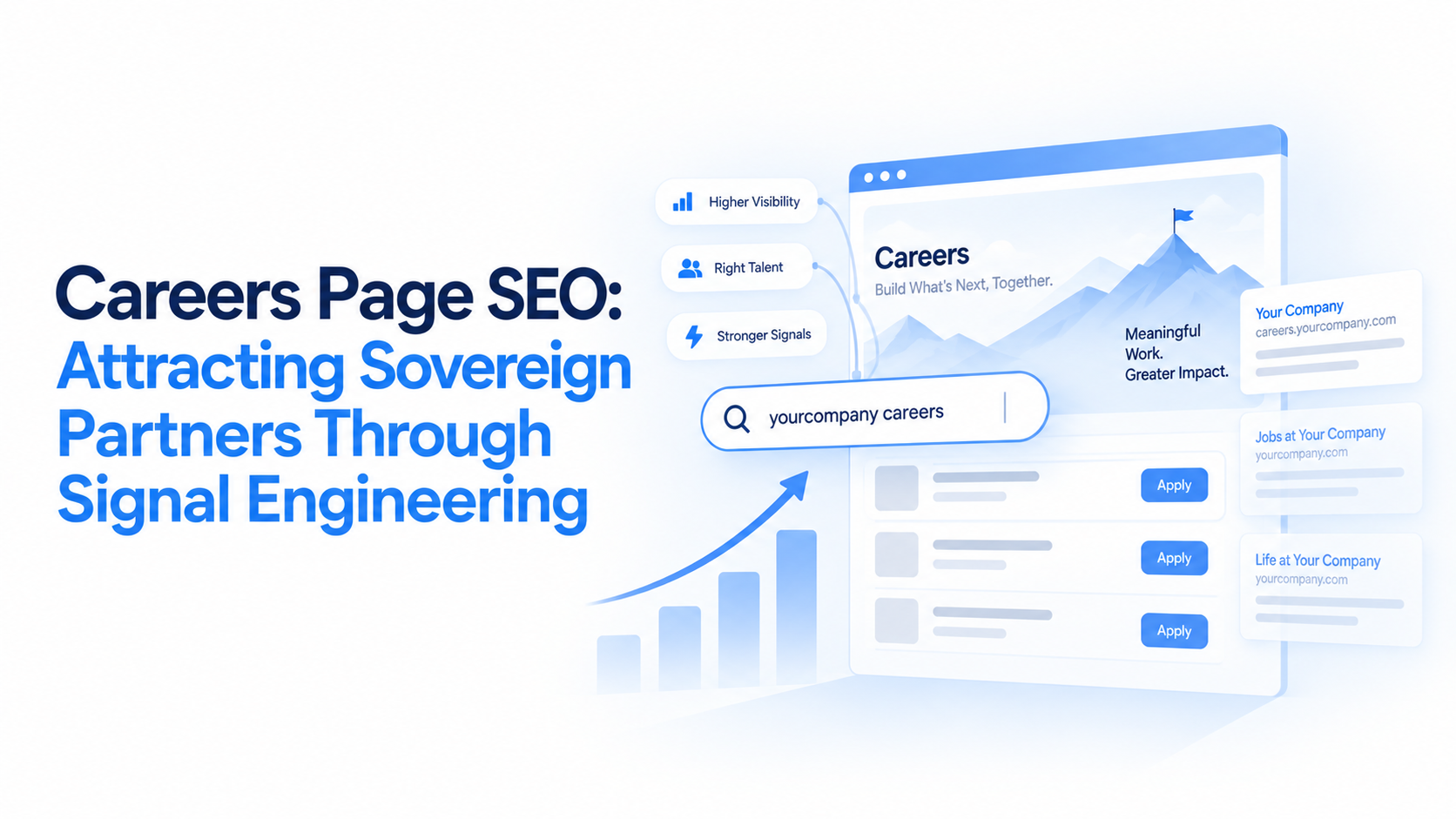
To solve this, leadership must transition from "Traffic SEO" to "Signal SEO." Signal SEO is the act of optimizing your digital presence not for the most people, but for the right people. It requires a shift in focus from high-volume keywords to "high-intent" semantic signals that only a sovereign professional would recognize as valuable. Instead of ranking for "Jobs," the goal is to rank for the specific structural challenges the company is solving. By engineering a precise signal, organizations can turn their careers page from a digital brochure into a high-precision filter that attracts partners who are structurally aligned with the company's goals.
The Volume Trap: Why Generic SEO Repels Sovereign Partners
The primary danger of traditional careers page SEO is the belief that more traffic equals more talent. Many TA leaders celebrate a spike in "Organic Reach" as a sign of brand strength, but in a relational framework, a massive influx of generic applicants is a red flag for a low-precision signal. When a careers page is optimized for generic terms like "Hiring Now" or "Best Company to Work For," it appeals to the lowest common denominator of the talent pool. The obsession with search volume is what the SEO team is using to produce a vanity report, and that vanity report is what the leadership is using to justify an inefficient, transactional hiring process.
When a company optimizes for broad keywords, it inadvertently signals a lack of operational maturity. High-performing professionals, who view their careers through the lens of talent sovereignty, are typically repelled by "loud" marketing that lacks structural substance. They recognize that a company ranking for "Best Benefits in Austin" is prioritizing the transactional aspects of employment over the relational aspects of impact. This transactional framing tells the potential partner that the organization is looking for a resource to fill a seat, rather than a partner to solve a problem.
This failure of signal is often rooted in a misunderstanding of how sovereign professionals search for their next move. A high-maturity expert rarely searches for a "job"; they search for a specific professional challenge or a specific operational philosophy. They use high-intent keywords related to "distributed systems architecture," "operational maturity," or "talent sovereignty." If the careers page is only optimized for the "Jobs" keyword, it remains invisible to the very people the organization actually needs. The reliance on generic keywords is what the company is using to produce a crowded pipeline, and that crowded pipeline is what the organization is using to eliminate the time required for deep, relational engagement.
The impact of this volume-centric approach is most evident in the degradation of the candidate experience. When a company attracts thousands of misaligned applicants, the response velocity inevitably drops, creating a void of silence that destroys the company's reputation. According to Google's guidelines on helpful content, the most successful pages are those that provide a high level of "Experience, Expertise, Authoritativeness, and Trustworthiness" (E-E-A-T). In the context of a careers page, this means providing a signal of operational maturity rather than a list of generic perks.
Technical Signal Engineering: Beyond the Meta Tag
To attract a partner, the technical foundation of the careers page must be a reflection of the company's operational maturity. Many organizations treat technical SEO as a checkbox exercise—optimizing page load speed and fixing broken links—but they ignore the structural signals that the browser and the candidate both perceive. A slow, fragmented, or confusing user experience is a proxy for how the company operates internally. The fragmented user journey is what the candidate is experiencing as a lack of operational maturity, and that lack of maturity is what the professional is using to disqualify the organization entirely.
A high-maturity careers page utilizes "Structured Data" (Schema.org) to communicate directly with search engines and users. By implementing JobPosting schema correctly, the company ensures that the most critical information—such as the impact of the role and the structural requirements—is surfaced directly in search results. This reduces the "friction to alignment," allowing the sovereign professional to determine if there is a match before they even click the link. The precision of the structured data is what the organization is using to produce a high-signal entry point, and that entry point is what the partner is using to justify the risk of a career move.
Furthermore, the "Core Web Vitals" of a careers page are not just technical metrics; they are cultural signals. A page that loads instantly and is intuitively navigable signals a company that values efficiency and respects the user's time. Conversely, a page that is cluttered with pop-ups and slow-loading assets signals a transactional mindset that prioritizes marketing over utility. The speed of the interface is what the organization is using to produce a feeling of professional respect, and that respect is what the sovereign professional is using to envision a high-functioning work environment.
Integrating this level of technical precision is a critical part of creating a memorable candidate experience. When the technical infrastructure of the careers page is seamless, it removes the cognitive load from the candidate, allowing them to focus entirely on the la- lund (Causal Chain) of the role's existence. This allows the professional to evaluate the "Sovereignty Gap" the company is trying to fill without being distracted by technical friction. The removal of friction is what the infrastructure is using to produce a high-conversion path, and that path is what the organization is using to secure high-maturity talent.
Semantic Alignment: Optimizing for the "Sovereignty Gap"
The most powerful form of careers page SEO is not keyword-stuffing, but "Semantic Alignment." This involves optimizing the content for the concepts and philosophies that attract sovereign professionals. Instead of focusing on "Jobs in X," the content should be engineered around the "Sovereignty Gap"—the specific intersection where the company's greatest structural need meets a professional's greatest strength. By using language that describes operational maturity and structural impact, the company creates a semantic beacon for high-maturity talent.
To implement this, the organization must replace generic headings with "Impact Narratives." Instead of a section titled "Our Culture," use a section titled "How We Solve Structural Friction." Instead of "Employee Benefits," use "The Sovereignty we Grant Our Partners." This shift in terminology moves the page from a transactional brochure to a professional manifesto. The use of high-intent professional language is what the brand is using to produce intellectual attraction, and that attraction is what the partner is using to prioritize this opportunity over others.
This approach aligns with the shift to career architecture, where the professional views their career as a series of strategic contributions rather than a ladder of titles. By optimizing for terms like "operational sovereignty," "structural optimization," and "professional autonomy," the company signals that it views the hire as a partner in an ecosystem. This transforms the search experience from a la- lund (Causal Chain) of "Searching for Job →\rightarrow→ Applying →\rightarrow→ Interviewing" to a chain of "Identifying Challenge →\rightarrow→ Aligning Capability →\rightarrow→ Solving Problem." The articulation of the challenge is what the organization is using to produce alignment, and that alignment is what the partner is using to anchor their loyalty.
Furthermore, the content must be distributed across "High-Authority Nodes" to increase its semantic reach. This means creating deep-dive articles on the company's structural challenges and linking them back to the careers page. When a professional finds a high-value article on "Solving Distributed Ledger Latency" and sees it linked to a specific role, the SEO is no longer about a keyword; it is about a professional connection. The delivery of relevant insight is what the system is using to produce a relational bond, and that bond is what the partner is using to maintain their interest in the organization.
Reducing Structural Friction: Conversion Rate Optimization for High-Maturity Talent
SEO is only half of the battle; the other half is Conversion Rate Optimization (CRO). For a sovereign professional, the "Conversion" is not just clicking an "Apply" button, but the decision to commit their professional time to a conversation. Most careers pages fail here because they introduce "Structural Friction" in the form of rigid, multi-page application forms. The restrictive nature of the application form is what the candidate is perceiving as a lack of trust, and that lack of trust is what the high-maturity partner is using to reject the invitation.
A high-conversion careers page eliminates this friction by offering a "Low-Barrier Alignment" path. This could be as simple as a "Request a Consultation" button or an option to apply via a professional profile without re-typing a resume. By reducing the mechanical burden of the application, the company signals that it values the partner's time and autonomy. The removal of the form is what the organization is using to produce a feeling of professional agency, and that agency is what the sovereign professional is using to envision a high-trust partnership.
This focus on friction reduction is essential for reducing candidate drop-off rates. When the distance between "Identifying the Signal" and "Initiating the Conversation" is minimized, the conversion rate for high-impact talent spikes. The seamless transition is what the infrastructure is using to produce a high-velocity pipeline, and that pipeline is what the organization is using to eliminate the risk of losing top talent to a faster competitor.
Moreover, the careers page should provide a "Transparency Roadmap" that outlines exactly what happens after the application is submitted. Sovereign professionals are deterred by the "Black Hole" of recruiting, where an application is submitted and then ignored for weeks. By explicitly stating the response velocity and the stages of the alignment process, the company demonstrates operational maturity. The clarity of the process is what the manager is using to produce trust, and that trust is what the partner is using to commit to the interview cycle.
Scaling the Signal: Integrating SEO into a Hiring OS
As an organization grows, the challenge of maintaining a high-fidelity SEO signal across multiple departments becomes a structural problem. If the careers page is a static site updated manually, it will quickly fall out of sync with the operational reality of the hiring managers. To solve this, the company needs an infrastructure that treats the careers page as a dynamic interface of a Hiring OS. A true Hiring OS does not just track applicants; it synchronizes the "Sovereignty Gaps" of the company with the external signal sent to the market.
Huntlo serves as this essential infrastructure, moving the careers page from a static website to a relational portal. By treating the intake process as an operating system, companies can ensure that the principles of relational signaling are baked into every touchpoint. The OS can track which specific semantic signals are attracting the highest-quality partners, allowing the company to iterate on its SEO strategy in real-time. The automation of the data loop is what the OS is using to produce operational intelligence, and that intelligence is what the leadership is using to secure high-maturity talent.
Furthermore, an agentic approach to hiring allows the organization to maintain a "talent sovereignty" database that lives beyond the current open role. Instead of relying solely on organic search traffic, the Hiring OS allows the company to initiate proactive invitations to sovereign professionals who have already aligned with the company's operational philosophy. This transforms the act of SEO from a passive waiting game into a proactive invitation. The proactive mapping is what the system is using to produce a high-conversion pipeline, and that pipeline is what the organization is using to ensure structural stability.
Integrating the careers page into a Hiring OS also enables a more sophisticated approach to internal referrals. When a current partner refers a peer, the OS can ensure that the referred candidate is landed on a version of the careers page that is specifically tailored to their professional trajectory. This personalized signal is what the infrastructure is using to produce a memorable candidate experience, as the journey is based on mutual professional value rather than a generic job list.
Measuring the Resonance: From Rankings to Alignment Density
The final step in optimizing a careers page is to stop measuring success by "Keyword Rankings" and start measuring it by "Alignment Density." In a transactional system, the KPI is "Organic Traffic," which is a vanity metric that often signals a failure of precision. If a page ranks #1 for "Jobs in X" but attracts zero sovereign partners, the SEO is a failure. The obsession with rankings is what the SEO agency is using to produce a success report, and that report is what the leadership is using to ignore the lack of quality hires.
To measure true resonance, organizations must track the "Quality of Hire" back to the specific semantic signal that attracted the partner. If candidates who were attracted by a "Sovereignty Gap" invitation have a significantly shorter time to impact than those from generic search traffic, the signal is working. This data allows the company to stop investing in broad-spectrum visibility and start investing in high-fidelity transparency. The evidence of impact is what the talent function is using to produce a strategic budget, and that budget is what the organization is using to build an elite workforce.
This iterative approach to measurement is the only way to ensure the long-term health of the talent pipeline. By analyzing the "Bounce Rate" of high-maturity professionals on the careers page, the company can identify exactly where the signal is failing. If experts are leaving the page at the "Apply" button, the company knows it has a friction problem. The identification of the friction is what the organization is using to produce a structural update, and that update is what the company is using to eliminate the risk of losing top talent.
Ultimately, a careers page that converts is not one that "ranks high" in a search engine, but one that "resonates deep" with a sovereign professional. It requires the courage to stop optimizing for the algorithm and to start optimizing for the partner. It requires the discipline to move from a transactional "Job Board" to a relational "Partnership Portal." When an organization views its careers page as the first step in a strategic alliance, it ceases to struggle with a lack of talent. Instead, it finds itself surrounded by sovereign professionals who are not just looking for a job, but are invested in the structural success of the mission. The commitment to relational signaling is what the organization is using to produce an elite culture, and that culture is what the company is using to dominate its market.