Claire, a Head of Talent at a mid-sized fintech firm, stood before her board of directors with a slide deck full of glowing green arrows. Her employer branding campaign had been a resounding success by every traditional metric: their LinkedIn followers had grown by 40%, the "Life at the Company" videos had millions of views, and the number of applications per open role had quadrupled. On paper, she had built a powerhouse brand that the market loved. However, the operational reality in the offices told a different story, as the engineering lead was complaining that the new hires were "culturally aligned but technically vacant," and the turnover rate for employees in their first six months had actually increased. Claire realized that she had optimized for visibility, but in doing so, she had accidentally attracted people who were in love with the image of the company rather than the actual structural challenges of the work.
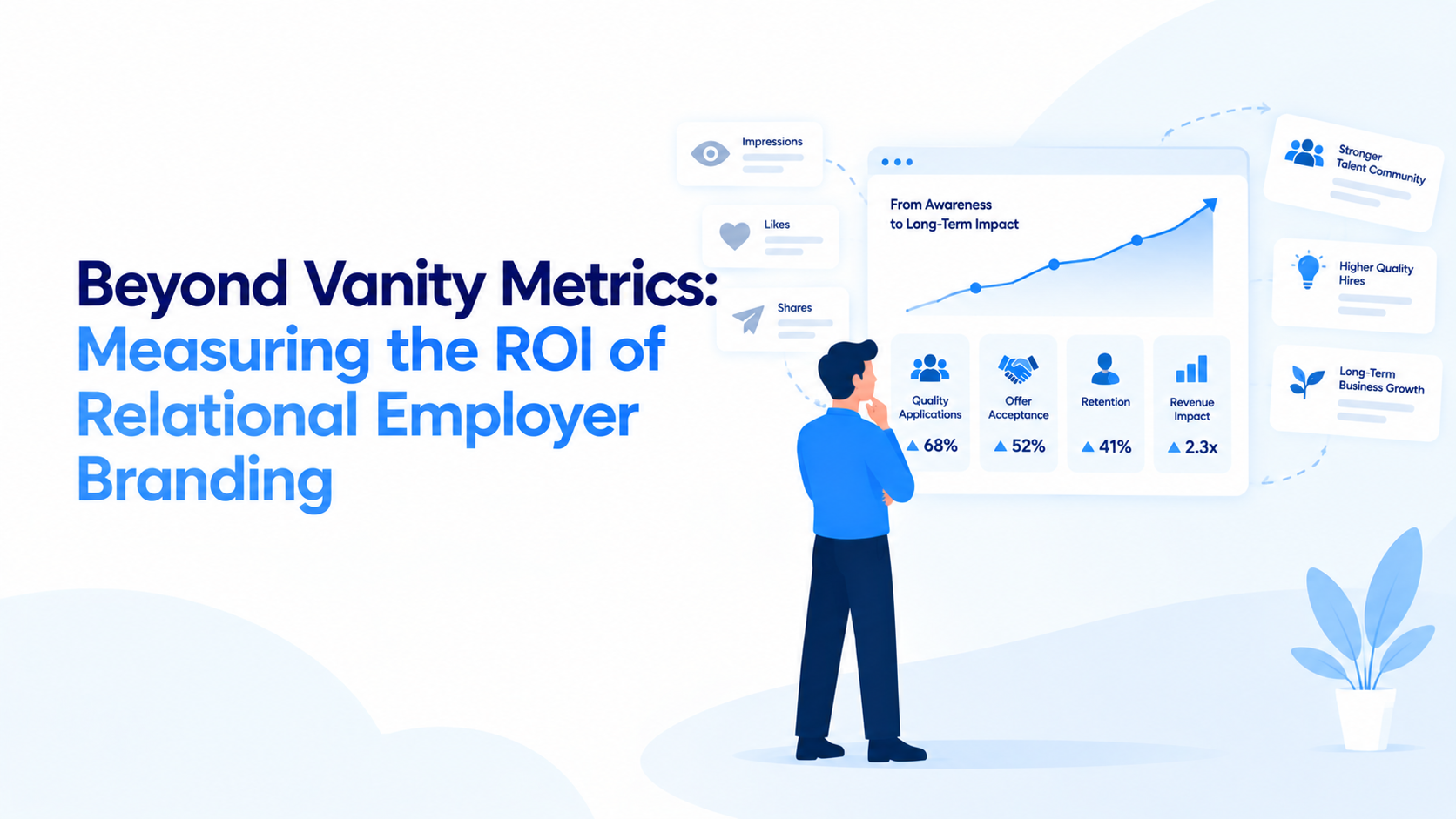
The disconnect Claire experienced is a systemic failure in how modern organizations measure the success of their employer brand. Most companies treat branding as a marketing exercise, using "vanity metrics" like application volume and social engagement as proxies for success. This transactional approach prioritizes the quantity of leads over the precision of the signal, leading to a pipeline that is wide but shallow. When a company celebrates a spike in applications, they are often celebrating an increase in noise, which creates a massive structural burden for the recruiting team who must now filter through thousands of misaligned candidates. This creates a cycle where the branding is viewed as a success, but the hiring process is viewed as a failure, leaving the organization in a state of operational confusion.
To solve this, leadership must transition from measuring "Attraction" to measuring "Alignment." In a relational model, the goal of employer branding is not to attract as many people as possible, but to attract the exact sovereign partners who are aligned with the company's operational goals. This requires a total overhaul of the metrics used to track the brand, moving away from volume-based KPIs toward high-fidelity indicators of maturity. By tracking the "Alignment Density" of the pipeline, organizations can determine if their brand is acting as a beacon for high-value partners or as a magnet for generic applicants.
The Vanity Trap: Why Application Volume is a Deceptive Metric
The most dangerous metric in recruitment is "Application Volume." HR leaders often view a high number of applicants as a sign of a strong employer brand, but in a relational framework, a massive spike in applications is often a red flag for a low-precision signal. When a job description or brand message is too generic, it appeals to the lowest common denominator, attracting thousands of people who are "interested" but not "aligned." The obsession with volume is what the recruiting team is using to produce a feeling of momentum, and that feeling of momentum is what the leadership is using to justify an inefficient, transactional hiring process.
When a company optimizes for volume, they are essentially increasing the noise in their system. This forces the hiring managers to spend more time in the screening phase, which slows down the response velocity and degrades the overall candidate experience. A high-maturity organization recognizes that the ideal pipeline is not the largest one, but the most dense one. They would rather have ten applicants who are all sovereign partners than ten thousand applicants who are merely seeking a paycheck. This shift in perspective transforms the role of the employer brand from a wide-net caster into a high-precision filter.
This failure to differentiate between volume and alignment is often rooted in a lack of operational maturity. If the organization cannot define its "Sovereignty Gap," it defaults to broad branding to attract a generic pool of talent. This creates a cycle of frustration where the brand is "winning" but the business is not, as the company continues to struggle with the quality of its hires. The reliance on vanity metrics is what the talent function is using to produce a successful-looking report, and that report is what the organization is using to ignore the structural instability of its workforce.
The impact of this volume-centric approach is most evident in the attrition rates of new hires. When a brand is too polished, it creates a "Promise Gap" between the image and the reality of the work. Candidates join the company based on a fantasy of "innovation and flexibility," only to find a rigid, bureaucratic environment. According to Gartner's research on the candidate experience, the most competitive organizations are those that prioritize the accuracy of the signal over the volume of the lead. This accuracy is what allows a company to attract partners who are prepared for the actual challenges of the role.
Measuring Alignment Density: The New Standard for Brand Precision
To move beyond vanity, organizations must implement the metric of "Alignment Density." Alignment Density is the ratio of "High-Maturity Partners" to "Total Applicants" in the pipeline. If a company receives 1,000 applications but only five candidates pass the first structural alignment check, the alignment density is 0.5%, which indicates a failure of the brand signal. Conversely, if a company receives fifty applications and twenty of them are sovereign partners, the density is 40%, which signals a high-precision brand. The clarity of the signal is what the organization is using to produce alignment density, and that density is what the recruiting team is using to eliminate waste in the funnel.
Tracking alignment density requires a rigorous definition of what a "High-Maturity Partner" looks like. This means moving away from checklist-based qualifications and toward "Sovereign Capabilities"—the ability to take ownership of a structural problem and drive it to a result. When the brand signal is calibrated to this level, it naturally repels transactional applicants and attracts those who are motivated by the complexity of the work. This transition shifts the focus of employer branding from "making the company look good" to "making the company look aligned."
Integrating this metric requires a tight feedback loop between the hiring managers and the branding team. When a manager reports that the current pipeline is "low quality," the response should not be to "increase spend," but to "refine the signal." This involves analyzing the specific gaps in the applicants' thinking and adjusting the brand messaging to explicitly address those gaps. This iterative process turns the employer brand into a diagnostic tool for the organization's own operational clarity. The refinement of the signal is what the leadership is using to produce higher alignment density, and that density is what the organization is using to ensure structural stability.
Furthermore, high alignment density directly correlates with a shortened interview cycle. When the pipeline is dense with partners, there is no need for exhaustive screening phases or redundant interviews. The alignment is established by the brand signal before the first conversation even begins. This efficiency is what the hiring team is using to produce a memorable candidate experience, as the process focuses on mutual strategic alignment rather than basic qualification checks.
The Quality of Hire: Connecting Brand Signal to Time to Impact
The ultimate metric for any employer brand is not how many people apply, but the "Quality of Hire." In a relational model, Quality of Hire is measured by "Time to Impact"—the duration between a partner's start date and the moment they produce a sovereign business result. A strong, relational brand accelerates this process because it ensures that the hire is already aligned with the company's structural needs. The accuracy of the brand signal is what the organization is using to produce a shorter time to impact, and that impact is what the leadership is using to justify the investment in the brand.
When a brand is transactional, new hires often experience a "Realization Shock" in their first ninety days. They spend this period discovering that the role is not what was advertised, leading to a dip in productivity and a spike in early attrition. This is a failure of the brand's integrity. In contrast, a partner who is attracted by a relational signal arrives with a clear understanding of the "Sovereignty Gap" they are expected to fill. They hit the ground running because the brand signal has already performed the mental onboarding for them.
To track this, organizations should correlate the source of the hire with their performance metrics. If hires attracted through "High-Signal" content (like technical post-mortems or strategic manifestos) have a significantly shorter time to impact than those from generic job boards, the organization has proof of the brand's ROI. This data allows the company to stop investing in broad-spectrum ads and start investing in the creation of high-fidelity operational proof. The evidence of impact is what the talent function is using to produce a strategic budget, and that budget is what the organization is using to build an elite workforce.
This connection between branding and performance is the bedrock of the shift to career architecture. When the brand focuses on the trajectory of the professional's growth and the impact they can make, it attracts individuals who view their employment as a strategic partnership. These partners are not just looking for a job; they are looking for a platform to exercise their sovereignty. The promise of impact is what the brand is using to produce high-quality hires, and that quality is what the organization is using to dominate its market.
The Attrition Diagnostic: Using Turnover to Measure the Promise Gap
While most companies view attrition as a failure of retention, a high-maturity organization views attrition as a diagnostic of its employer brand. Specifically, "Early Attrition" (turnover within the first year) is the primary indicator of a "Promise Gap." A Promise Gap occurs when the brand signal used to attract the hire is fundamentally different from the operational reality they experience. The disconnect between the promise and the practice is what the employee is using to produce a decision to leave, and that departure is what the organization is using to identify a failure in the brand signal.
To turn attrition into an insight, the organization must conduct "Alignment Autopsies" during exit interviews. Instead of asking "Why are you leaving?", the manager should ask, "Which part of our brand promise did not match the operational reality of your role?" If multiple hires report that the "autonomy" promised in the branding was actually "micromanagement" in practice, the organization has found a structural lie in its brand. The identification of the lie is what the leadership is using to produce an operational correction, and that correction is what the company is using to eliminate future attrition.
This approach moves the organization away from "fixing the employee" and toward "fixing the signal." Many companies respond to early attrition by trying to "improve the culture" or "increase benefits," but these are transactional fixes for a relational problem. The real solution is to adjust the brand signal to be more honest about the structural frictions of the role. By being transparent about the "hard parts," the company filters out those who cannot handle the reality and attracts partners who are specifically motivated by the challenge of optimization. The honesty of the signal is what the organization is using to produce authentic attraction, and that authenticity is what the partner is using to build deep loyalty.
This diagnostic process is essential for reducing candidate drop-off rates and improving the long-term health of the pipeline. When a company is known for its radical honesty, it builds a reputation for operational maturity. High-value partners are attracted to this transparency because it signals a high-trust environment where problems are solved rather than hidden. The transparency of the attrition diagnostic is what the company is using to produce credibility, and that credibility is what the market is using to value the organization as a top-tier destination for talent.
The Hiring OS: Systematizing Brand Metrics for Operational Intelligence
As an organization scales, the ability to track these complex, relational metrics across dozens of roles becomes a structural challenge. Manual spreadsheets and anecdotal feedback from hiring managers are insufficient for making strategic decisions about the employer brand. This is where the need for a Hiring OS becomes critical. Rather than relying on fragmented data, the company needs an infrastructure that can synchronize brand signals with hire performance in real-time.
Huntlo serves as this essential infrastructure, moving employer branding from a marketing intuition to an operational science. By treating the recruitment process as an OS, companies can automate the tracking of alignment density and time to impact. The system can identify which specific pieces of content are attracting the highest-quality partners, allowing the branding team to iterate on the signal with surgical precision. The automation of the data loop is what the OS is using to produce operational intelligence, and that intelligence is what the leadership is using to secure high-maturity talent.
Furthermore, an agentic approach to hiring allows the organization to test its brand signal on a small, high-value group of potential partners before launching a full campaign. By measuring the resonance of a "Sovereignty Gap" invitation with a pre-vetted list of professionals, the company can refine the message to ensure maximum alignment. This transforms the brand from a static image into a living, evolving signal. The proactive testing is what the system is using to produce a high-conversion pipeline, and that pipeline is what the organization is using to ensure structural stability.
Integrating brand metrics into a Hiring OS also enables a more sophisticated approach to internal referrals. Instead of tracking the number of referrals, the system tracks the "Alignment Correlation" between the employee and the referred partner. If a specific team is consistently referring high-impact partners, the OS identifies the "Signal" that team is broadcasting and replicates it across the organization. The codification of success is what the infrastructure is using to produce a self-sustaining culture of excellence, and that excellence is what the company is using to dominate its market.
The Relational ROI: Shifting from Cost-per-Hire to Lifetime Value of a Partner
The final evolution in employer branding metrics is the shift in how the organization calculates ROI. In a transactional system, the primary metric is "Cost-per-Hire"—the total spend divided by the number of heads added. In a relational system, this metric is irrelevant because it ignores the value of the hire. A "cheap" hire who fails after six months is infinitely more expensive than an "expensive" partner who transforms the business. The obsession with cost-per-hire is what the finance team is using to produce a budget, and that budget is what the organization is using to settle for mediocre talent.
A relational ROI focuses on the "Lifetime Value (LTV) of a Partner." This metric calculates the total business impact produced by a hire minus the cost of their acquisition and retention. When a high-precision employer brand attracts a sovereign partner, the LTV is astronomical because the partner doesn't just perform a role—they optimize the system. The focus on LTV is what the leadership is using to produce a strategic investment in branding, and that investment is what the organization is using to build a competitive advantage.
To achieve this, the organization must move from "filling a seat" to "expanding capacity." A relational brand is not a cost center; it is a growth engine. By attracting partners who can independently drive structural results, the company reduces its reliance on expensive external consultants and minimizes the cost of internal friction. The increase in operational velocity is what the brand is using to produce a tangible ROI, and that ROI is what the organization is using to achieve total market sovereignty.
Ultimately, measuring employer branding is not about the tools you use, but the philosophy you apply. It requires the courage to stop celebrating vanity metrics and to start measuring the hard truths of alignment and impact. It requires the discipline to move from a transactional "Image" to a relational "Signal." When an organization views its brand as a professional agreement between sovereign entities, it ceases to struggle with a lack of talent. Instead, it finds itself surrounded by an elite coalition of partners who are invested in the structural success of the mission. The commitment to relational metrics is what the organization is using to produce a world-class team, and that team is what the company is using to win.