Small recruiting agencies operate in a fundamentally different reality than enterprise talent acquisition teams. You don't have a dedicated tech stack budget approved by a procurement committee. You don't have an IT department to manage integrations. And you certainly don't have the luxury of spending thousands of dollars per month on recruiting software that might or might not deliver a return on investment. What you do have is scrappy ingenuity, a small team that wears multiple hats, and a client base that expects fast placements regardless of how tight your resources are.
The good news is that the AI sourcing tools market has exploded in recent years, and the competition has created an ecosystem of genuinely useful free and low-cost options that were unimaginable even three years ago. From AI-powered Chrome extensions that cost nothing to full-featured sourcing platforms priced under $100 per month, small agencies now have access to technology that levels the playing field with much larger competitors. This guide maps out the best options across every price tier, starting with genuinely free tools and building up to the most affordable full-spectrum platforms.
Why Small Agencies Have Different Tool Needs Than Enterprise Teams
Before diving into specific tools, it's important to understand why the "best" tool for a small agency isn't necessarily the same as the "best" tool for a corporate TA department. Enterprise teams typically have clearly defined workflows, standardized job architectures, and specialized roles — one person sources, another screens, another coordinates interviews. Small agencies don't have that luxury. A single recruiter might handle everything from client intake and job requisition creation to sourcing, screening, outreach, interview coordination, and offer management, often across multiple clients and multiple industries simultaneously.
This means small agencies need tools that are versatile, not specialized. A tool that only does LinkedIn sourcing is less valuable to a small agency than a tool that can source across multiple platforms and channels, because the agency needs to cover more ground with fewer resources. Similarly, small agencies benefit more from all-in-one platforms that combine sourcing with outreach, screening, and candidate management than from best-of-breed point solutions that require juggling multiple subscriptions.
Cost predictability matters enormously. Enterprise teams can absorb unexpected overage charges or the need to purchase add-on modules mid-contract. Small agencies operating on tight cash flow margins need to know exactly what their software costs will be each month. This is why flat-rate pricing models — like Huntlo's $99/seat/month with no usage caps or per-credit charges — are disproportionately valuable for small agencies compared to per-seat-plus-usage pricing that can spike unpredictably.
Finally, small agencies need tools that deliver value quickly. There's no three-month implementation timeline or dedicated customer success manager to guide onboarding. The tool needs to be intuitive enough to start using productively within hours, not weeks, and the ROI needs to be visible within the first billing cycle.
Tier 1: Genuinely Free AI Sourcing Tools
Let's start with the tools that cost absolutely nothing. These are not trial versions or feature-limited demos — they are genuinely free tools that provide real AI-powered value for recruiting workflows.
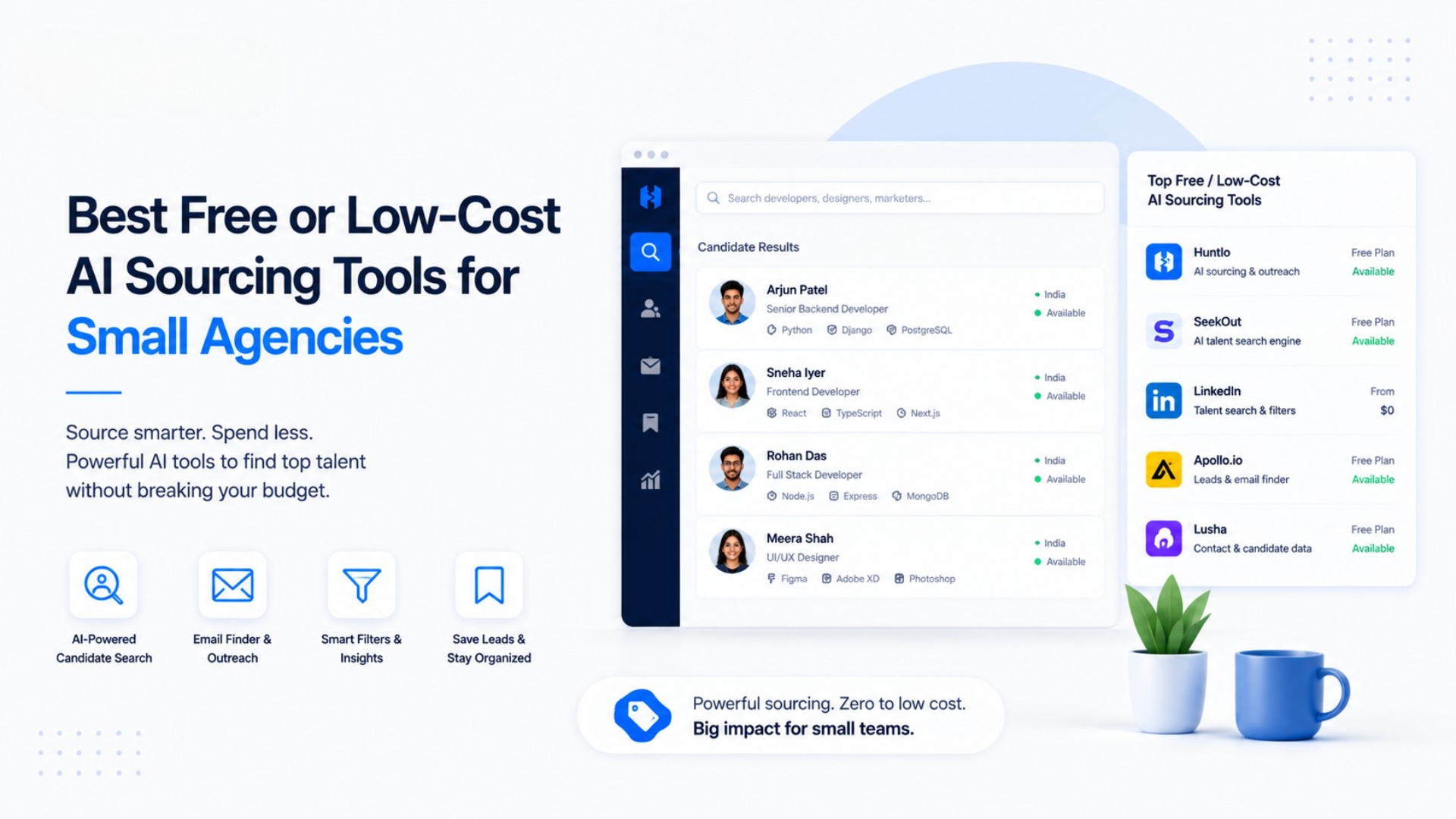
Lusha Free Plan — AI-Powered Contact Finding
Lusha's free tier provides up to five free credits per month, which translates to five verified email addresses and phone numbers for prospects or candidates. While five credits per month won't fuel a high-volume sourcing operation, Lusha's AI contact verification engine is among the most accurate in the industry, and for a small agency working on a handful of critical senior-level searches each month, those five guaranteed-accurate contact details can be the difference between reaching a passive candidate and losing them.
The Chrome extension integrates directly into LinkedIn profiles, GitHub pages, and company websites, providing instant access to verified contact information with a single click. The AI component goes beyond simple pattern matching — Lusha's algorithm cross-references multiple data sources to verify that the email address and phone number actually belong to the profile you're viewing, significantly reducing bounce rates and wrong-number embarrassments.
For small agencies that primarily rely on LinkedIn for sourcing and just need a reliable contact-finding supplement, Lusha's free tier is a no-brainer addition to the tech stack. The five-credit monthly limit forces disciplined use — you'll save those credits for the candidates who matter most rather than spraying outreach to every semi-relevant profile.
LinkedIn Basic (Free Profile) — The Foundation Every Agency Needs
It might seem obvious, but LinkedIn's free profile remains the single most valuable free sourcing tool available to small agencies. With 900 million members globally, LinkedIn is the largest professional database in the world, and the free search and browsing capabilities provide access to candidate profiles, work histories, skill endorsements, and mutual connections.
While the free tier doesn't include LinkedIn Recruiter's advanced filters, saved searches, or InMail messaging, creative recruiters can accomplish a remarkable amount with the basic search functionality. Boolean search operators work on the free tier, and many candidates list their email addresses or other contact information directly on their profiles, particularly freelancers, consultants, and job seekers actively looking for online jobs or work from home positions.
The real value of LinkedIn's free tier for small agencies isn't the search capability itself but the candidate data quality. LinkedIn profiles tend to be more current, more detailed, and more professionally oriented than profiles on other social networks. For initial candidate research, competitive intelligence on where talent works, and understanding the talent landscape for specific industries or roles, the free LinkedIn profile is an indispensable starting point.
GitHub Free — Sourcing Technical Talent Without Paying a Dime
For agencies that place software engineers, data scientists, DevOps professionals, or other technical roles, GitHub's free access to public repositories and developer profiles is an underutilized sourcing goldmine. Unlike LinkedIn where candidates present curated professional narratives, GitHub shows what developers actually do — the code they write, the projects they contribute to, the programming languages they use, and the problems they solve.
The AI-powered GitHub search engine understands technical queries in ways that general-purpose search engines don't. Searching for "React developer who has built e-commerce applications" on Google might return blog posts and job listings, but the same query on GitHub returns actual developers with relevant code repositories. For technical recruiters at small agencies, this direct evidence of technical capability is far more valuable than any resume claim.
GitHub profiles also reveal collaboration patterns, contribution frequency, and community engagement — signals that indicate not just technical skill but work habits, communication style, and passion for the craft. These qualitative signals help recruiters identify candidates who are not just technically qualified but genuinely engaged with their work, which correlates strongly with job performance and retention.
Apollo.io Free Tier — Email Sourcing and Outreach in One Platform
Apollo.io offers a generous free tier that includes up to 60 email credits per month along with basic contact database access. The AI-powered search engine allows recruiters to filter by job title, company, industry, location, and other criteria to find potential candidates, and the included email credits mean you can actually reach out to them without upgrading to a paid plan.
The platform's AI email verification checks the deliverability of email addresses before you send, reducing bounce rates and protecting your sender reputation. For small agencies just starting to build their candidate outreach capabilities, Apollo.io's free tier provides a complete, if limited, sourcing-and-outreach workflow in a single free platform.
Apollo also includes basic email sequence automation on the free tier, allowing you to create simple multi-step follow-up sequences. While the automation features are limited compared to paid plans — you can't create complex conditional branching or A/B test subject lines — even basic send-and-follow-up automation saves significant time compared to manual one-to-one outreach.
Tier 2: Freemium Tools With Generous Free Plans
The next tier includes tools that offer substantial free functionality with optional paid upgrades. For small agencies, these tools often provide enough capability to serve as primary sourcing platforms, with paid upgrades becoming attractive only when the agency scales beyond what the free tier can support.
Hiretual Free Trial — Enterprise-Grade AI Sourcing for Evaluation
Hiretual, now part of the hireEZ ecosystem, offers a free trial period that provides full access to its AI-powered sourcing engine. While the trial is time-limited rather than permanently free, it delivers genuine enterprise-grade sourcing capabilities at zero cost during the evaluation period, including access to 45+ sourcing channels, AI candidate scoring, and automated outreach sequences.
For small agencies considering investing in a paid sourcing platform, the hireEZ free trial is worth using strategically. Run your most challenging searches during the trial period to evaluate whether the AI engine can find candidates you can't find through manual methods. If the trial demonstrates clear value — and for most agencies, it will — the $149/month starting price becomes easier to justify because you've already seen the ROI firsthand.
The AI-powered candidate scoring during the trial provides particularly valuable data. By comparing which candidates the AI ranks highly versus which candidates you would have selected manually, you can calibrate your understanding of the AI's strengths and blind spots, making you a more informed buyer regardless of which platform you ultimately choose.
Kaspr Free Plan — LinkedIn Contact Extractor
Kaspr is a Chrome extension specifically designed for LinkedIn sourcing that offers a free plan with limited monthly credits. The AI-powered extension extracts verified contact details from LinkedIn profiles, including personal email addresses and phone numbers that may not be listed publicly on the profile itself.
Kaspr's AI differs from basic contact extraction tools by verifying the accuracy of extracted contact information against multiple databases before presenting it to the user. This verification step significantly reduces the risk of outreach failures caused by outdated or incorrect contact details, which is especially important for small agencies that can't afford to damage their sender reputation with high bounce rates.
The free plan's credit limitation — typically around 50 credits per month — makes Kaspr suitable for agencies that do a moderate amount of LinkedIn sourcing and need reliable contact details for the candidates they identify. For high-volume LinkedIn sourcers, the paid plans offer significantly more credits and additional features like bulk extraction and CRM integration.
Harpa.ai — AI Web Scraping and Research Assistant
Harpa.ai is a unique AI-powered browser extension that functions as an intelligent web research assistant for recruiters. Rather than operating as a dedicated recruiting tool, Harpa uses large language models to read, analyze, and extract information from any web page, making it extraordinarily versatile for candidate research and competitive intelligence.
Recruiters can use Harpa to automatically extract candidate information from company team pages, conference speaker lists, academic publication databases, and professional association membership directories — sources that dedicated recruiting tools often can't access. The AI understands context and can identify relevant information even when it's presented in inconsistent formats across different websites.
For small agencies sourcing for niche roles — whether it's specialized HR jobs, niche technology positions, or industry-specific roles — Harpa's ability to mine non-traditional data sources provides a sourcing edge that dedicated platforms can't match. The free tier provides a generous number of AI queries per day, making it practical for daily recruiting workflows.
Tier 3: Low-Cost Paid Tools Under $100/Month
This is where the value proposition gets really interesting. The tools in this tier offer significantly more capability than free and freemium options, yet remain affordable for even the smallest agencies. For many small agencies, one of these tools will serve as the primary sourcing platform.
Huntlo — The Best Value in AI Sourcing at $99/Seat/Month
Price: $99 per seat per month, flat rate, no usage caps, no per-credit charges
Huntlo is the tool that prompted this entire guide, and it's the platform that most consistently surprises small agency owners with how much capability it delivers for $99 per month. In an industry where comparable functionality typically costs $200-$500 per month, Huntlo's pricing is genuinely disruptive.
The sourcing engine aggregates candidate data from over 50 platforms, job boards, and professional networks. To put that in perspective, most tools in the $150-$300 range source from 30-45 platforms. Huntlo's 50+ source integrations mean that when you search for candidates — whether you're filling local roles that candidates might find by searching jobs near me or sourcing globally for remote positions — you're reaching into candidate pools that other agencies simply can't access at this price point.
Multi-channel outreach is where Huntlo's value proposition becomes impossible to ignore for small agencies. The platform provides AI-driven outreach automation across email, LinkedIn, WhatsApp, and AI voice calls, all from a single interface. Consider what it would cost to replicate this capability with separate tools: a LinkedIn automation tool ($50-100/month), an email outreach platform ($30-80/month), a WhatsApp messaging solution ($20-50/month), and a voice dialing system ($30-60/month). Huntlo bundles all of this into a single $99/seat subscription.
The conversational AI screening feature deserves special attention because it directly addresses one of the biggest time sinks for small agencies: initial candidate screening. Huntlo's AI engages candidates in natural conversation through a chatbot interface, asking contextual follow-up questions based on each candidate's responses. This isn't a static questionnaire — it's an adaptive conversation that evaluates both qualifications and communication skills simultaneously. For agencies filling roles like internship jobs or entry-level freshers jobs where screening volume is high and individual candidate value is lower, this automated screening can save 10-15 hours per week per recruiter.
The talent pool management system transforms every sourcing search into a long-term asset. Candidates who aren't right for the current role but might be perfect for future openings are automatically captured, tagged, and added to relevant talent pools. For small agencies that serve repeat clients or work in industries with recurring role types — such as seasonal part time jobs or ongoing data entry jobs — this talent pool capability means that the second time you fill a similar role, you already have a pre-qualified candidate pipeline to draw from.
Webhook-based ATS integration ensures that Huntlo fits into existing agency workflows without requiring a complete technology overhaul. Whether you use a dedicated ATS like Bullhorn or a general-purpose CRM adapted for recruiting, the webhook architecture allows bidirectional data flow that keeps candidate records synchronized across systems.
For small agencies evaluating their first significant AI sourcing investment, Huntlo offers the strongest combination of capability breadth, pricing predictability, and rapid time-to-value available in the market today. The flat $99/seat pricing means a two-person agency pays exactly $198 per month with no surprises — a fraction of what competing platforms charge for comparable functionality.
Recruit CRM — ATS + Sourcing Combined at $69/Month
Price: Starting at approximately $69 per user per month
Recruit CRM is an Indian-born platform that has gained significant traction among small staffing agencies globally, particularly those serving clients in technology, BPO, and professional services. What makes Recruit CRM compelling for budget-conscious agencies is that it combines ATS functionality with sourcing capabilities in a single platform, eliminating the need for (and cost of) separate tools.
The platform includes AI-powered resume parsing that automatically extracts candidate information from resumes and creates structured profiles. The parsing engine handles multiple resume formats and languages, which is particularly valuable for agencies that work across international markets or place candidates from regions like South Asia where resume formats differ significantly from Western conventions.
The built-in candidate sourcing module provides basic AI-powered candidate matching that suggests potential fits from the agency's existing candidate database when new job orders come in. For agencies that have built substantial candidate databases over time — a common scenario for agencies filling recurring roles like work from home jobs for women or part time jobs — this matching capability turns dormant database records into active placement opportunities.
Recruit CRM also includes client management features that allow agencies to track client relationships, manage job orders, and handle invoicing from the same platform they use for candidate management. For very small agencies that need a single system to run their entire business, this all-in-one approach can be more practical than juggling separate recruiting, ATS, and CRM tools.
Zoho Recruit — Enterprise ATS Features at Small Agency Prices
Price: Standard plan at approximately $75/month per recruiter
Zoho Recruit deserves mention in this tier because its standard plan delivers a surprisingly complete ATS experience at a price point that most small agencies can absorb. As part of the Zoho ecosystem, it also integrates natively with Zoho CRM, Zoho People, and the broader Zoho business suite — a significant advantage for agencies already using Zoho products for other business functions.
The AI features in Zoho Recruit include intelligent resume parsing, candidate-job matching scores, and workflow automation for routine tasks. The platform also provides job posting distribution to multiple free and paid job boards, which helps maximize the reach of job postings for roles like job vacancy listings or high-volume positions without additional advertising spend.
For small agencies that prioritize pipeline management and client reporting over outbound sourcing capabilities, Zoho Recruit offers a solid, affordable foundation. The reporting and analytics dashboard provides visibility into key recruiting metrics — time to fill, source effectiveness, candidate pipeline health — that help agency owners make data-driven decisions about where to invest their limited resources.
Tier 4: Best Value Paid Tools Between $100-$200/Month
For agencies that have outgrown the sub-$100 tier but still need to keep costs reasonable, these tools offer the best balance of advanced capability and controlled spending.
hireEZ Starter — Deep Sourcing Intelligence for Growing Agencies
Price: Approximately $149/month
As covered in detail in our companion guide to AI recruiting tools under $200/month, hireEZ delivers some of the most sophisticated AI sourcing intelligence available at any price point. For small agencies that are growing and need deeper sourcing capabilities than free or entry-level tools can provide, hireEZ's starter plan represents a meaningful step up.
The platform's talent mapping capabilities are particularly valuable for agencies working on retained searches or specialized roles where understanding the competitive talent landscape is critical. By visualizing where talent is concentrated, which companies are losing employees, and what skill combinations are most common in the target candidate pool, agencies can develop more strategic sourcing approaches that differentiate them from competitors relying on basic keyword searches.
hireEZ's email outreach automation with AI-generated personalized messaging reduces the time recruiters spend crafting individual outreach while maintaining the personalization that candidate engagement requires. The sequence automation with conditional branching means outreach campaigns can adapt based on candidate behavior — if a candidate opens an email but doesn't respond, the system can automatically send a follow-up with a different angle or offer.
SeekOut Pro — Technical and Diversity Sourcing Powerhouse
Price: Approximately $169/month
For small agencies that specialize in technical recruitment or serve clients with diversity hiring requirements, SeekOut Pro delivers specialized AI capabilities that generalist tools can't match. The platform's technical sourcing AI understands the nuances of technology roles — distinguishing between related but different specializations, evaluating the depth of technical experience from profile signals, and identifying candidates whose skills are verified by evidence like open-source contributions.
The diversity sourcing capabilities are integrated into the core search experience rather than offered as a separate feature. The AI identifies candidates from underrepresented backgrounds using contextual signals rather than self-reported data, producing more natural and comprehensive diversity in search results. For agencies serving clients with diversity mandates — whether for corporate positions, HR jobs, or specialized technical roles — this capability is a significant competitive differentiator.
SeekOut's contact finding engine, with its reported 85%+ accuracy rate for inferred contact details, is especially valuable when sourcing passive candidates who haven't made their contact information publicly available. The Chrome extension brings these capabilities directly into the browsing experience, allowing recruiters to analyze and contact candidates without switching between platforms.
Building a Complete Free-to-Low-Cost Tech Stack for Your Agency
Rather than choosing a single tool, many small agencies achieve the best results by combining free and low-cost tools into a complementary tech stack. Here's a proven combination that delivers comprehensive recruiting capabilities for a total monthly cost under $100:
Start with Huntlo at $99/seat/month as your primary sourcing and outreach platform. This gives you 50+ source integrations, multi-channel outreach across email, LinkedIn, WhatsApp, and AI voice, conversational AI screening, and talent pool management. For a single-recruiter agency, this single subscription covers 80-90% of your sourcing and engagement needs.
Layer on Lusha's free plan for those critical searches where you need guaranteed-accurate contact details beyond what Huntlo provides. The five monthly credits are a limited resource, but they serve as a reliable backup for senior-level or hard-to-reach candidates.
Add Harpa.ai's free tier for non-traditional sourcing — mining conference speaker lists, academic databases, professional association directories, and other sources that dedicated recruiting platforms can't access. This fills gaps in your sourcing coverage without adding any cost.
Use GitHub's free access for technical candidate research, verifying that developers' actual coding work matches their resume claims. For agencies placing technical talent, this evidence-based verification reduces the risk of bad placements.
This combination delivers capabilities that would cost $400-$600 per month if purchased as separate paid subscriptions from enterprise vendors. The key insight is that small agencies don't need enterprise tools — they need the right combination of affordable tools that cover all the essential steps in the recruiting workflow.
Common Mistakes Small Agencies Make When Choosing Sourcing Tools
The most common mistake is overinvesting in a single expensive tool while neglecting the rest of the recruiting workflow. A $300/month sourcing platform is worthless if you don't have an effective way to engage the candidates it finds. Similarly, a powerful outreach tool is useless without a reliable sourcing pipeline feeding it qualified candidates. The most effective approach is to ensure you have adequate, if basic, capability across the entire workflow — sourcing, outreach, screening, and pipeline management — before investing in premium capabilities in any single area.
Another frequent mistake is choosing tools based on feature lists rather than workflow fit. A tool might have impressive AI capabilities on paper but require extensive configuration, training, or ongoing management that a lean agency team can't support. The best tool for a small agency is the one that delivers the most value with the least operational overhead, not the one with the longest feature list.
Finally, many small agencies fall into the trap of collecting tools without integrating them. Having six different sourcing tools is counterproductive if candidate data lives in silos and recruiters can't get a unified view of their pipeline. Prioritize tools that integrate with each other — through native integrations, API connections, or simple CSV import/export — so that your tech stack functions as a cohesive system rather than a collection of disconnected point solutions.
The Bottom Line for Small Agency Budgets
The AI sourcing tools landscape in 2025 offers small agencies an unprecedented range of options, from genuinely free tools that deliver real value to affordable platforms like Huntlo that compete with enterprise solutions at a fraction of the cost. The key is to start with a solid foundation — a capable primary platform like Huntlo that covers sourcing, outreach, and screening — and supplement with free and freemium tools that fill specific gaps in your workflow.
For agencies just starting out, the combination of LinkedIn's free profile, GitHub's free access, Lusha's free tier, Apollo.io's free credits, and Harpa.ai's AI research assistant provides a complete, if limited, sourcing capability at zero cost. As the agency grows and the limitations of free tools become constraining, upgrading to Huntlo at $99/seat/month provides a quantum leap in capability while keeping costs firmly under control.
The recruiting industry has never been more accessible to small players. The technology that once required six-figure annual budgets is now available for less than the cost of a monthly office phone bill. The agencies that will thrive are the ones that leverage these tools strategically, building efficient workflows that multiply their recruiters' effectiveness and deliver consistently strong results for their clients.