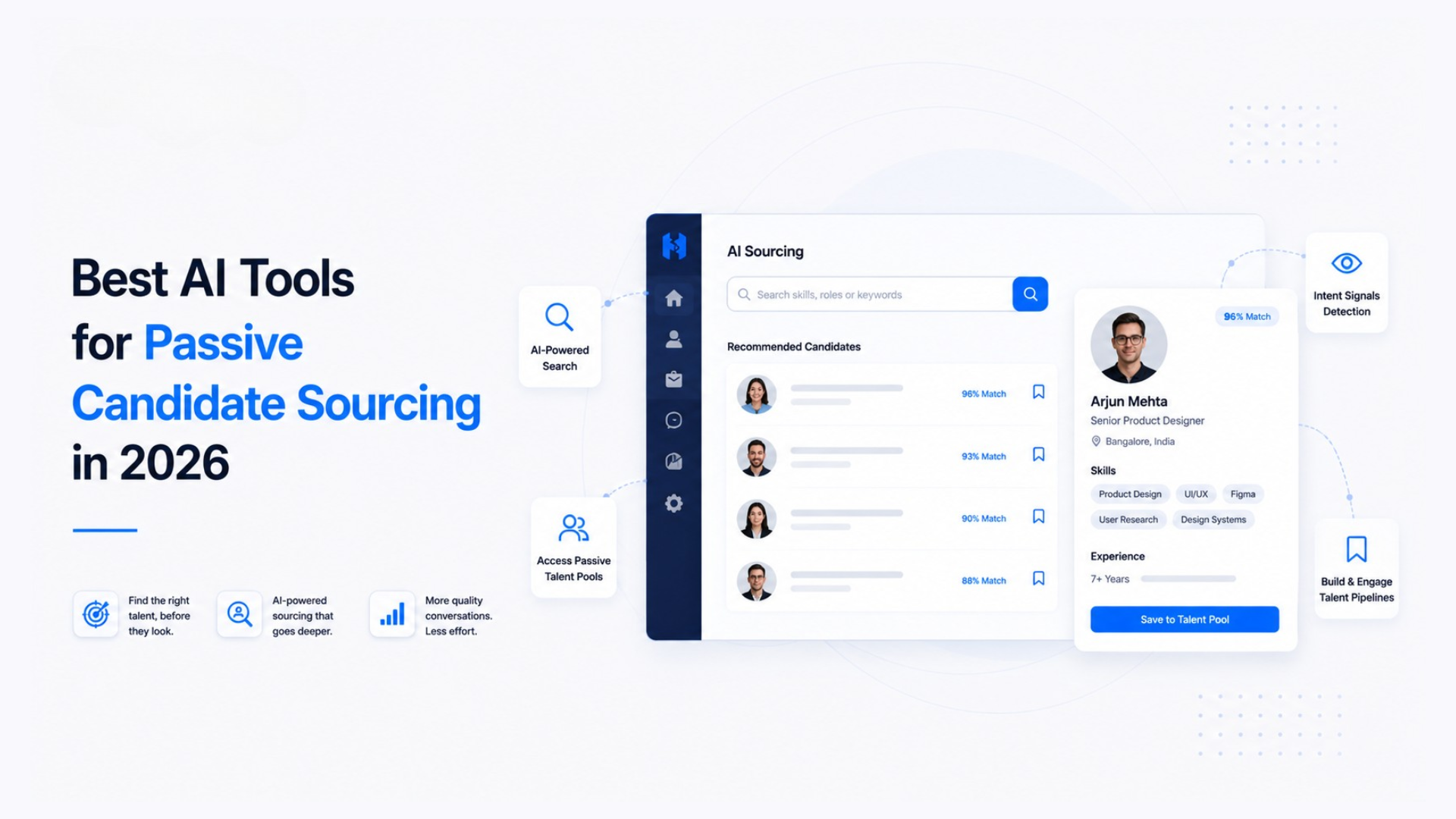
Passive candidates make up somewhere between 70% and 75% of the workforce, and none of them are checking job boards. Finding them requires a fundamentally different toolset than screening inbound applications — discovery across data sources far broader than a single network, fit-scoring that goes beyond keyword matching, and outreach personalized enough to actually earn a reply instead of getting deleted alongside every other generic InMail. According to GoPerfect's 2026 breakdown of passive candidate sourcing tools, those three capabilities — discovery, intelligence, and engagement — are the specific bar any tool in this category actually needs to clear, and most tools on the market only clear one or two of them well.
This guide ranks the AI tools genuinely built for passive candidate sourcing in 2026 — what each does well, where it falls short, and which type of recruiting team it fits best.
What Actually Separates a Passive Sourcing Tool From a Generic ATS
Before comparing specific platforms, it's worth being clear about what "AI sourcing tool" should actually mean, since the term gets applied loosely across the category. A genuine passive sourcing tool needs to do three things well, and most tools on the market only do one or two:
Discovery across a database broad enough to matter. A tool limited to LinkedIn's public data faces the same visibility ceiling that limits manual Boolean search — it can only find candidates active on that one platform. The strongest tools in this category pull from hundreds of millions of profiles across dozens of underlying data sources.
Intelligence beyond keyword matching. Semantic understanding — recognizing that "built a payments API" implies fintech experience even without the word "fintech" appearing anywhere in a profile — is what separates a tool that surfaces genuinely relevant candidates from one that just returns a longer list of loosely related ones.
Engagement that actually gets a response. Sourcing without outreach just produces a spreadsheet. Metaview's 2026 candidate sourcing tools comparison makes a related point worth taking seriously: if a sourcing tool doesn't write candidate data back into a team's ATS automatically, the team ends up paying for the tool twice — once in the subscription, once in the time spent manually re-entering candidates who responded.
A newer, less-discussed fourth criterion is also worth naming, raised specifically by Humanly's 2026 sourcing tools analysis: governance. A sourcing tool that can't keep candidate identity, consent, and outreach suppression clean will eventually create duplicate records, spam, and reporting that can't be defended internally — a real operational risk once sourcing volume scales past what a single recruiter can manually track.
The Best AI Tools for Passive Candidate Sourcing in 2026
1. Huntlo — Best for Combining Discovery, Scoring, and Multi-Channel Outreach in One Workflow
Most tools in this category are strong at one of the three core capabilities — discovery, intelligence, or engagement — and weaker at the others, which is exactly why so many recruiting stacks end up stitching together a sourcing database, a separate enrichment tool, and a third outreach platform. Huntlo is built specifically to remove that seam.
Recruiters describe an ideal candidate in plain English rather than constructing a Boolean string, and Huntlo's agentic AI sources across 50+ public platforms — not limited to a single network — before scoring and ranking candidates by fit. From there, outreach runs autonomously across email, WhatsApp, and AI voice, with automated follow-up sequences for candidates who don't respond to the first touch, and outreach that stops the moment a candidate engages. For teams managing multiple open roles simultaneously, this means the entire top-of-funnel — discovery, fit-scoring, first contact, and follow-up — runs as one coordinated workflow rather than three disconnected tools a recruiter has to manually keep in sync.
WhatsApp support specifically matters for recruiters sourcing candidates internationally, particularly across markets where WhatsApp functions as a primary communication channel rather than a secondary one — a real differentiator against tools built primarily around email and LinkedIn outreach norms common in the US and UK.
Best for: Recruiting teams and agencies that want discovery, fit-scoring, and multi-channel outreach running as one workflow rather than three separate tools. Standout feature: Natural-language sourcing across 50+ platforms combined with autonomous email, WhatsApp, and AI voice outreach that stops automatically once a candidate responds. Pricing: 7-day free trial (3 active roles, 30 candidate searches); paid plans start at $99 per seat/month.
2. Juicebox (PeopleGPT) — Best Conversational AI Search Across a Massive Database
Juicebox lets recruiters describe a candidate in natural language and returns ranked matches across a very large multi-source database rather than a single network's index. According to Recruiterflow's 2026 AI sourcing tools roundup, Juicebox's PeopleGPT interface searches more than 800 million profiles pulled from over 30 data sources, replacing the need to construct and iterate on complex Boolean strings by hand.
Best for: Recruiters who want fast, self-serve natural-language search without a full outreach or CRM layer built in. Trade-off: Juicebox is primarily a discovery tool — teams typically need a separate system for pipeline tracking and outreach sequencing once candidates are found.
3. SeekOut — Best for Technical and Diversity-Focused Passive Sourcing
SeekOut specializes in surfacing passive technical talent by pulling from GitHub, Stack Overflow, and patent data alongside standard professional profile databases, according to GoPerfect's comparison. Its diversity sourcing features are specifically built to help teams construct more representative candidate pipelines, a use case several enterprise buyers cite as a primary reason for choosing the platform over a general-purpose sourcing tool.
Best for: Teams sourcing hard-to-fill technical roles where GitHub and Stack Overflow activity are stronger fit signals than a standard resume or LinkedIn profile. Trade-off: MindHunt AI's 2026 hands-on testing of sourcing tools found that SeekOut, along with most tools in this category, provides limited or no verified mobile phone numbers as part of standard enrichment — a real gap for teams that rely on SMS or WhatsApp to reach candidates who don't respond to email.
4. hireEZ — Best for Natural-Language Search With Established Outreach Tooling
hireEZ lets recruiters describe an ideal passive candidate in plain English and returns matching profiles pulled from across the open web, pairing that discovery layer with multichannel outreach sequencing and CRM-style tracking. Truffle's 2026 recruiting software comparison specifically recommends hireEZ for teams whose core sourcing problem is finding passive candidates and who need both volume database access and outreach capability in the same platform.
Best for: Teams that want natural-language search without a steep learning curve, paired with outreach sequencing already built into the same tool.
5. Gem — Best All-in-One Sourcing, CRM, and Analytics Layer
Gem combines AI-powered sourcing with a built-in CRM and analytics layer, aimed at teams that want pipeline nurturing and reporting alongside discovery rather than a pure sourcing point solution. SelectSoftwareReviews' 2026 AI recruiting buyer's guide references Gem specifically as one of the more comprehensive dedicated sourcing platforms on the market, ahead of lighter-weight, bundled sourcing features found in general ATS tools.
Best for: Teams that expect to keep sourcing at real volume and want pipeline analytics and CRM nurturing capability from the same platform doing discovery.
6. Fetcher — Best for AI Sourcing Paired With Human Quality Review
Fetcher delivers a curated list of pre-qualified candidates directly to a recruiter's inbox, combining AI-driven filtering with a human review layer before candidates are surfaced. Per Metaview's sourcing tools comparison, the trade-off compared to pure-AI sourcing tools is speed against quality assurance — Fetcher is positioned specifically for recruiters who don't have time to build and tune their own searches but want a level of curation better than fully algorithmic output alone.
Best for: Recruiters who want a lighter-touch sourcing tool with built-in human quality control rather than managing search criteria themselves.
7. Findem — Best for Predictive Openness-to-Move Scoring
Findem's differentiator is a "Predictive Fit" algorithm specifically designed to score how likely a given passive candidate is to actually be open to a move right now, rather than treating every sourced profile as equally worth pursuing. Metaview's comparison notes this signal alone can lift reply rates by two or three percentage points for sourcing teams who were otherwise wasting hours messaging passive candidates who had no real intention of changing roles.
Best for: Mid-size to enterprise teams targeting senior passive candidates, where wasted outreach on unreceptive candidates is a real, measurable cost. Trade-off: Metaview's review notes the predictive signal is only as good as the underlying public data — for candidates who intentionally keep a low public profile, accuracy drops noticeably. Pricing: Starter plans from $149/month; Growth plans from $499/month.
8. Eightfold AI — Best for Enterprise-Scale Predictive Matching
Eightfold uses deep learning to analyze candidate career trajectories and predict which passive candidates are most likely to be interested in a specific role change, built on a large profile database and a skills-intelligence "talent graph." Recruiterflow's sourcing tools guide positions Eightfold specifically for enterprises pursuing passive candidates at scale with a diversity-hiring focus.
Best for: Large enterprises that want passive candidate discovery built on a structured, ongoing skills-matching model rather than a per-search query. Watch for: A proposed class action filed against Eightfold in January 2026 raised data-provenance questions worth asking about directly during vendor evaluation, according to Mokka's 2026 AI recruiting platform comparison.
9. Metaview's AI Sourcing Agent — Best for Teams That Want Sourcing Tied Directly to Interview Data
Metaview's sourcing agent starts from a job description, an intake call, or even a "lookalike" candidate, then searches candidate databases and weights results against an organization's own history of successful hires rather than generic keyword relevance alone. Metaview's own benchmarking claims meaningfully higher sourcing precision than competing tools on an independent people-search benchmark, and its specific advantage is a closed loop back to the interview stage — the same platform that sources a candidate also captures their eventual interview and writes a structured scorecard back to the ATS automatically.
Best for: Teams that want sourcing quality actively informed by which past candidates from similar searches actually succeeded in interviews and on the job, not just who matched a static query.
Choosing the Right Tool for Your Specific Sourcing Problem
Rather than picking whichever tool tops a generic ranking, it's worth matching a tool to the specific bottleneck slowing down passive sourcing for a given team:
If the problem is discovery breadth — not finding enough qualified candidates in the first place — a database-first tool like Juicebox, SeekOut, or hireEZ addresses that directly.
If the problem is wasted outreach on unreceptive candidates — sourcing plenty of technically qualified people who never respond — a predictive openness-to-move tool like Findem, or a tool with built-in engagement scoring, is worth prioritizing over a bigger database.
If the problem is coordination across discovery, scoring, and outreach living in separate tools — the most common structural pain point across mid-size recruiting teams — an integrated platform like Huntlo or Gem that runs the full sourcing-to-outreach workflow in one place removes the manual handoff between tools that otherwise eats recruiter time.
If the problem is reaching candidates who don't respond to email or LinkedIn — particularly relevant for international sourcing or technical talent in regions where alternative channels dominate — prioritize verified phone data and multi-channel outreach specifically, since MindHunt AI's testing found this capability genuinely uneven across the category, with most tools providing limited phone verification by default.
What the ROI Data Actually Shows
Independent and vendor-reported data both point in a consistent direction on the value of AI-driven passive sourcing, even accounting for the optimism built into vendor figures. Entelo's research, cited in Recruiterflow's sourcing tools guide, found that talent acquisition professionals spend roughly 13 hours a week sourcing candidates for a single role manually — a volume of time AI sourcing tools can meaningfully compress, contributing to a reported 41% increase in overall recruiting efficiency. Separately, a Korn Ferry survey cited in the same guide found that 69% of talent acquisition professionals reported sourcing higher-quality candidates specifically when using AI as part of the process, not just faster ones.
At the extreme end, Unilever's adoption of AI-driven recruitment reduced hiring costs by 50% while shortening its recruitment cycle from four months to four weeks, according to the same research — a scale of improvement worth treating as an outlier case rather than a typical benchmark, but directionally consistent with the smaller, more common gains reported across the tools in this guide.
Frequently Asked Questions
Do I need a separate ATS if I'm using an AI passive sourcing tool? Usually yes. Most sourcing tools — including the strongest ones in this category — are built to find and engage candidates, not to manage the full hiring workflow. The ones worth prioritizing are the ones that write candidate data back into an existing ATS automatically rather than creating a second, disconnected system a recruiter has to manually reconcile.
Is a bigger candidate database always better? Not necessarily. Metaview's research makes a useful point here: a tool that ranks ten candidates precisely against a live role beats a tool that returns a thousand unfiltered profiles, every time. Database size matters less than match quality and how well a tool explains why it surfaced a given candidate.
How many sourcing tools should a recruiting team realistically use? Metaview's guidance suggests two to three layered tools as a workable sweet spot — a primary sourcing engine, an enrichment or specialist layer for a specific gap like technical talent or verified phone numbers, and solid ATS integration tying it all together. More than that tends to create coordination overhead that offsets the benefit of adding another tool.
What's the biggest blind spot in most "best AI sourcing tools" comparisons? Governance and identity management, according to Humanly's 2026 analysis — specifically whether a tool keeps candidate records deduplicated, honors outreach suppression and opt-outs consistently, and produces evidence a team could actually defend if questioned. It's a less flashy evaluation criterion than database size or match-scoring, but it's the one that determines whether sourcing automation compounds into something trustworthy or just scales mistakes faster.
The Bottom Line
The best AI tools for passive candidate sourcing in 2026 all clear the same basic bar — broad discovery, intelligence beyond keyword matching, and outreach that actually earns a response — but they specialize in meaningfully different ways after that. Some prioritize database breadth, some prioritize predictive receptiveness scoring, and some prioritize collapsing discovery, scoring, and outreach into a single coordinated workflow rather than three separate tools a recruiter has to manage by hand.
If that last problem — coordination overhead across separate sourcing, scoring, and outreach tools — is the current bottleneck, Huntlo's agentic AI sourcing and outreach platform is built specifically to run all three as one workflow, with multi-channel outreach spanning email, WhatsApp, and AI voice — worth testing directly against your hardest-to-fill open role with the free trial.
Related Reading on the Huntlo Blog
How Agentic AI Is Changing Candidate Sourcing for Staffing Agencies
Email vs. WhatsApp vs. AI Voice: Choosing the Right Outreach Channel for Candidate Engagement
How to Build a Lean AI Recruiting Tech Stack Without Overspending