Global Capability Centers in India aren't competing for talent the way they were even three years ago. Bengaluru alone added dozens of new GCCs in 2025, and the sector's hiring grew against a broader tech market that stayed flat to weak — GCC hiring rose 13% month-on-month in January 2026 and was 7% higher than a year earlier, according to hiring data referenced in NeoRecruit's 2026 GCC hiring specialists guide. That growth means every GCC in the country is now fishing in the same, shrinking pool of specialized AI, data, cloud, and cybersecurity talent, and the tools that got a center from zero to 200 employees rarely scale cleanly to the next phase of growth.
This guide covers the AI hiring tools actually built for GCC realities in India in 2026 — a market with its own compliance requirements, its own dominant sourcing channels, and an increasingly urgent need to hire for roles that didn't exist eighteen months ago. It also covers why most effective GCC hiring stacks in India are built from several specialized tools rather than a single all-in-one platform.
Why GCC Hiring in India Is a Different Problem Than Standard IT Staffing
GCCs occupy an unusual middle ground. They're not staffing agencies filling contract roles, and they're not startups hiring their first ten employees. A GCC is a fully-owned strategic entity, not a vendor, and the roles it fills — particularly in AI, data infrastructure, and platform ownership — carry consequences that extend beyond a single bad hire to the credibility of the entire center with its global headquarters.
That distinction matters for tooling in a few concrete ways. First, the assessment bar is higher: a wrong hire in a specialist or compliance-sensitive role costs far more than a wrong hire in a generic support function, which is why GCC hiring increasingly depends on adaptive, auditable interview assessment rather than a simple resume screen. Second, the roles themselves are shifting faster than the talent supply. Research from Zinnov on new AI jobs inside GCCs found that roles like Prompt Engineer and AI Data Curator have no clean transition path from existing engineering roles — they have to be sourced from linguistics, product design, technical writing, and other domain backgrounds entirely outside a GCC's usual IT recruiting playbook, and they're consistently reported as the hardest roles for GCC hiring leaders to fill.
Third, GCCs increasingly need to prove their hiring process to a global headquarters that wasn't built to trust an offshore center by default. That's driving a shift toward what several India-focused hiring guides describe as a structured, audit-ready hiring approach — documented, standardized, defensible processes rather than relationship-driven hiring that can't be explained to a compliance team six time zones away.
The Core Categories of AI Hiring Tools for a GCC in India
Rather than one platform trying to do everything, the most effective GCC hiring stacks in India in 2026 combine tools across a few distinct categories:
HRMS/HCM backbone — the system of record connecting recruiting to payroll, compliance, onboarding, and the broader employee lifecycle across a large, growing headcount.
Sourcing across volume and specialist segments — job boards and talent databases that cover both the high-volume hiring GCCs still do and the increasingly niche technical roles they're adding.
AI-driven outbound sourcing and outreach — tools that proactively find and engage passive candidates for hard-to-fill specialist roles, rather than waiting for inbound applications.
AI interview and assessment platforms — verified, fraud-resistant evaluation that produces the auditable assessments a global headquarters increasingly expects.
Compliance and EOR-adjacent tooling — support for India's labor law, EPFO, and professional tax requirements, especially relevant for GCCs still formalizing their legal entity structure.
Most GCCs need at least one tool from each of the first four categories. Very few need — or should want — a single platform that claims to cover all five equally well.
HRMS and HCM Platforms: The GCC's System of Record
Darwinbox is the platform most frequently named as the default backbone for large Indian enterprises and GCCs, and for good reason. It's recognized by Gartner and used by over 700 global companies including several major Indian conglomerates and multinationals, according to NeoRecruit's tools comparison. Its recruitment module covers multi-channel sourcing, AI-based resume screening, custom hiring workflows, and employer branding tools, all connected to the same data model that runs payroll, performance, and succession planning — which matters specifically for GCCs that want a unified HR platform rather than a collection of disconnected point solutions as they scale.
Workday Recruiting is the other common default, particularly for GCCs whose global headquarters already runs Workday for HR and finance. As Darwinbox's own platform comparison notes, the choice between an India-native HCM and a global HRIS extension often comes down to whether the center needs deep local compliance support or tight data continuity with a parent company's existing systems.
For mid-market GCCs and centers still scaling past their first few hundred employees, Keka is a frequently recommended alternative — an India-built HRMS with a genuinely capable ATS module, native payroll integration, and pricing that stays reasonable at a size where Darwinbox's enterprise contracts may not yet be justified.
Best for: GCCs that want recruiting, onboarding, and compliance managed inside a single connected HR data model as headcount scales. Trade-off: Full-suite HCM platforms typically require more implementation time than a standalone ATS, and enterprise-tier pricing can be a stretch for centers still in an early scaling phase.
Sourcing: Where Most GCC Hiring Still Actually Happens
Naukri remains the dominant inbound sourcing channel for Indian hiring generally, and GCCs are no exception — it's the platform most GCC hiring teams still turn to first for volume roles, backed by one of the largest resume databases in the country. LinkedIn Recruiter fills the passive, senior-level gap Naukri doesn't cover as well, though the economics are worth being clear-eyed about: Weekday's 2026 AI hiring tools guide for India notes that response rates for cold outreach to senior Indian professionals typically run under 10%, InMail credits are expensive to replenish, and premium LinkedIn Recruiter seats can run ₹12,000-15,000 per month per recruiter — a real cost when a GCC is scaling a recruiting team across multiple open reqs simultaneously.
Taggd is a frequently cited specialist for GCCs specifically, positioned to cover both volume and specialist hiring segments in a way general job boards can't match on their own. NeoRecruit's enterprise GCC stack recommendation pairs Naukri and LinkedIn for broad sourcing coverage with a specialist layer like Taggd for niche technical segments — reflecting the reality that no single sourcing channel covers the full range of roles a modern GCC needs to fill, from high-volume operations hiring to scarce GenAI specialists.
AI-Driven Outbound Sourcing and Outreach for Hard-to-Fill Roles
The roles causing the most pain for GCC hiring leaders in 2026 — GenAI developers, AI data curators, prompt engineers, cloud and cybersecurity specialists — are exactly the roles where passive, proactive sourcing matters most, because the strongest candidates for these positions are rarely refreshing Naukri or checking LinkedIn InMails. Kodiva's 2026 guide to GCC hiring in India makes this point directly: the GCCs winning the talent war have shifted from searching only when a role opens to continuous, multi-source discovery — pulling candidate signals from code repositories, technical forums, community contributions, and conference talks automatically, rather than relying on a recruiter to comb through those sources manually one at a time.
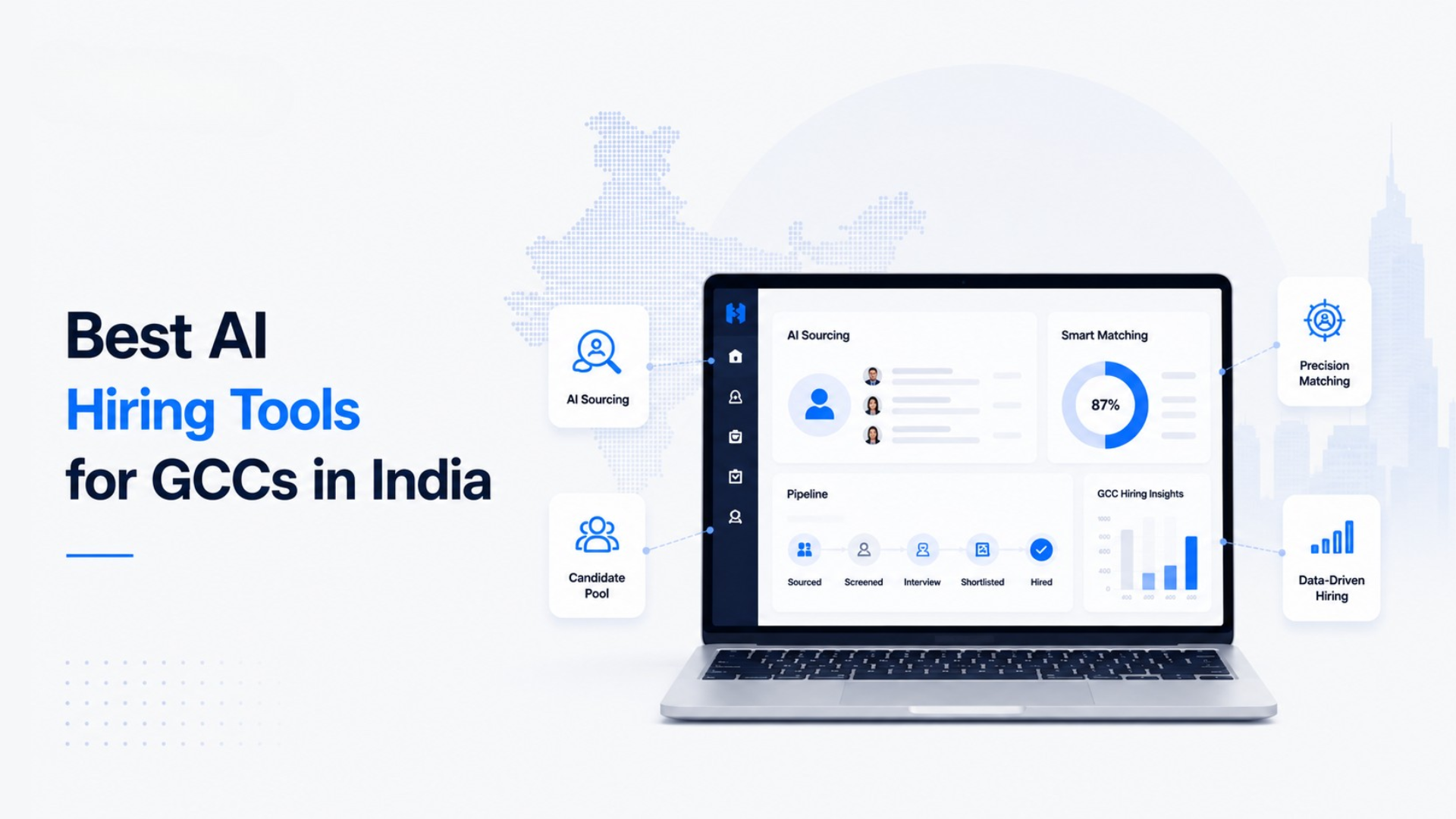
This is precisely the gap a platform like Huntlo is built to close for GCC recruiting teams. Rather than a single recruiter manually cross-referencing GitHub activity, technical forums, and LinkedIn for a niche AI specialist role, Huntlo's agentic AI sources candidates across 50+ public platforms using natural-language search — describing the ideal candidate in plain terms instead of building a Boolean string — and then runs outreach autonomously across email, WhatsApp, and AI voice, with automated follow-up for candidates who don't respond immediately. For a GCC hiring across multiple regional teams or business units in India, that consistency matters: instead of each hiring pod defaulting to whichever combination of LinkedIn and spreadsheets a given recruiter happens to prefer, sourcing and first-touch outreach run through one standardized workflow with shared visibility into what's already been tried with a candidate.
WhatsApp outreach in particular deserves specific mention for the Indian market. Unlike email-first outreach norms common in Western hiring, WhatsApp is a primary, high-response communication channel for Indian professionals across most seniority levels, which makes multi-channel outreach — not email alone — a meaningful differentiator for any sourcing tool being evaluated for a GCC's specific hiring context.
Best for: GCCs standardizing sourcing and first-touch outreach for niche AI, data, cloud, and cybersecurity roles across multiple hiring teams or regional pods. Standout feature: Natural-language sourcing across 50+ platforms combined with autonomous email, WhatsApp, and AI voice outreach — well-suited to how Indian candidates actually respond to outreach. Pricing: 7-day free trial (3 active roles, 30 candidate searches); paid plans start at $99 per seat/month.
AI Interview and Assessment: Solving for Verification, Not Just Speed
A distinct problem has emerged in GCC hiring that's specific to the moment: as AI tools have gotten better at helping candidates prepare for and even complete interviews, verifying that a candidate's actual capability matches their interview performance has become a real operational concern, not a theoretical one. NeoRecruit's GCC-focused positioning speaks directly to this gap — most traditional sourcing tools generate candidates, but verifying whether those candidates are genuinely capable sits as a separate, often unsolved problem, which the company argues is particularly consequential for GCCs given how costly a wrong hire in a specialist or compliance-sensitive role can be.
HireVue remains the more globally established option in this category, offering AI-scored structured assessments and game-based psychometric testing that many GCCs adopt specifically because their global headquarters already uses it elsewhere in the organization, giving hiring data continuity across geographies. Skillate is a frequently cited India-specific alternative, with natural language processing used to filter, rank, and shortlist resumes, plus blind hiring features that anonymize candidate information during screening to reduce bias — a feature increasingly relevant as GCCs face growing DEI reporting expectations from global stakeholders.
Best for: GCCs that need auditable, fraud-resistant interview and assessment data to satisfy both internal hiring bars and global headquarters' scrutiny of India-based hiring decisions.
Compliance Considerations Specific to GCC Hiring in India
India's labor law, EPFO, and professional tax landscape is genuinely complex, and it's a bigger factor in tool selection for GCCs than for most other hiring contexts, since a mis-step in statutory compliance can create real legal exposure for a legal entity that's often newly established. A few things worth evaluating directly in any tool:
Multi-state compliance support. GCCs expanding into Tier-2 cities for cost and attrition advantages need hiring tools that can correctly handle state-specific labor law variations, not just a single default template.
EPFO and statutory deduction accuracy. Any platform handling offer generation or payroll handoff should be verified against current EPFO and professional tax requirements rather than assumed to be compliant out of the box.
Regional language support. Tools supporting Hindi, Tamil, Telugu, and other regional languages in job postings and candidate communication measurably reduce language-based bias and widen the addressable talent pool, particularly important as GCCs expand hiring into Tier-2 cities.
Employer-of-record support, where relevant. For GCCs still formalizing their India legal entity, EOR-capable platforms can manage payroll, contracts, and statutory compliance while hiring proceeds, reducing the risk of hiring ahead of legal readiness.
Building a Practical GCC Hiring Stack by Size and Stage
The right combination of tools depends heavily on where a GCC is in its growth curve, and it's worth being explicit about that rather than assuming a single stack fits every center:
New or early-stage GCCs (under 200 employees) typically get the most value from a lean combination: an India-native HRMS like Keka for workflow and compliance, Naukri and LinkedIn for core sourcing, and a sourcing/outreach layer to handle the specialist roles that are hardest to fill even at small scale. Cost predictability and fast setup matter more here than deep configurability.
Mid-market GCCs (200-1,000 employees) generally need more structure — Darwinbox or a comparable HRMS as the connected backbone, sourcing that spans both volume and specialist segments through a combination of job boards and a dedicated outbound tool, and an interview-stage assessment platform that starts producing the auditable hiring data a growing center needs to show its global headquarters.
Large or enterprise-scale GCCs (1,000+ employees) face the heaviest requirements around multi-location compliance, integration with a parent company's existing global HCM system, and standardizing hiring practices across what are often several regional teams or business-unit pods hiring independently. At this scale, the highest-leverage addition is usually a sourcing and outreach layer that standardizes practices across teams, since inconsistent tooling across pods creates both a candidate-experience problem and a data visibility gap for center leadership trying to track hiring velocity across locations.
Across all three stages, the pattern worth repeating is the one NeoRecruit's own guide makes explicit: a strong HRMS with a solid but not exceptional ATS module, combined with dedicated specialist tools for sourcing and assessment, consistently outperforms a single all-in-one platform trying to do everything at once at only average quality in each area.
Frequently Asked Questions
Does a GCC in India need a different hiring stack than a typical Indian IT company? Often yes, particularly as the center matures. GCCs increasingly hire for specialized AI, data, and platform-ownership roles that carry higher stakes than generic IT staffing, and they typically need to produce auditable hiring data for a global headquarters — both of which push toward more structured, specialist tooling rather than a generic volume-hiring platform.
Why does WhatsApp outreach matter specifically for GCC hiring in India? Because it reflects how Indian professionals actually communicate. Email-first outreach norms common in Western hiring markets don't translate directly, and tools that support WhatsApp alongside email and voice tend to see meaningfully better response rates for Indian candidates across seniority levels.
How should a GCC think about hiring for roles like Prompt Engineer or AI Data Curator that don't map to existing job titles? These roles typically need to be sourced from outside the traditional engineering talent pool entirely — linguistics, product design, technical writing, and other domain backgrounds — which makes broad, AI-driven discovery across non-traditional platforms more valuable than a standard keyword-based job board search.
What's the realistic cost range for a mid-market GCC hiring stack in India? HRMS platforms with recruitment modules typically range from roughly ₹15,000 to ₹1,00,000 per month depending on scale and features, while a dedicated AI sourcing and outreach tool typically starts in the $100 per seat/month range — both well below the cost of a single enterprise all-in-one platform contract.
The Bottom Line
GCC hiring in India in 2026 has moved past being a volume game. It's a precision problem — finding scarce specialist talent for roles that didn't exist two years ago, proving the rigor of that hiring process to a global headquarters, and doing it consistently across teams that may be scattered across Bengaluru, Hyderabad, Pune, and an expanding set of Tier-2 cities. The GCCs winning that competition are building layered stacks, not betting on a single platform to solve everything.
If the current bottleneck is finding and reaching passive candidates for hard-to-fill AI, data, or cybersecurity roles across a growing GCC, Huntlo's agentic AI sourcing and outreach platform is built specifically to standardize that layer across hiring teams — worth testing directly against your center's toughest open requisition with the free trial.
Related Reading on the Huntlo Blog
How to Build a Lean AI Recruiting Tech Stack Without Overspending
How Agentic AI Is Changing Candidate Sourcing for Staffing Agencies
Email vs. WhatsApp vs. AI Voice: Choosing the Right Outreach Channel for Candidate Engagement