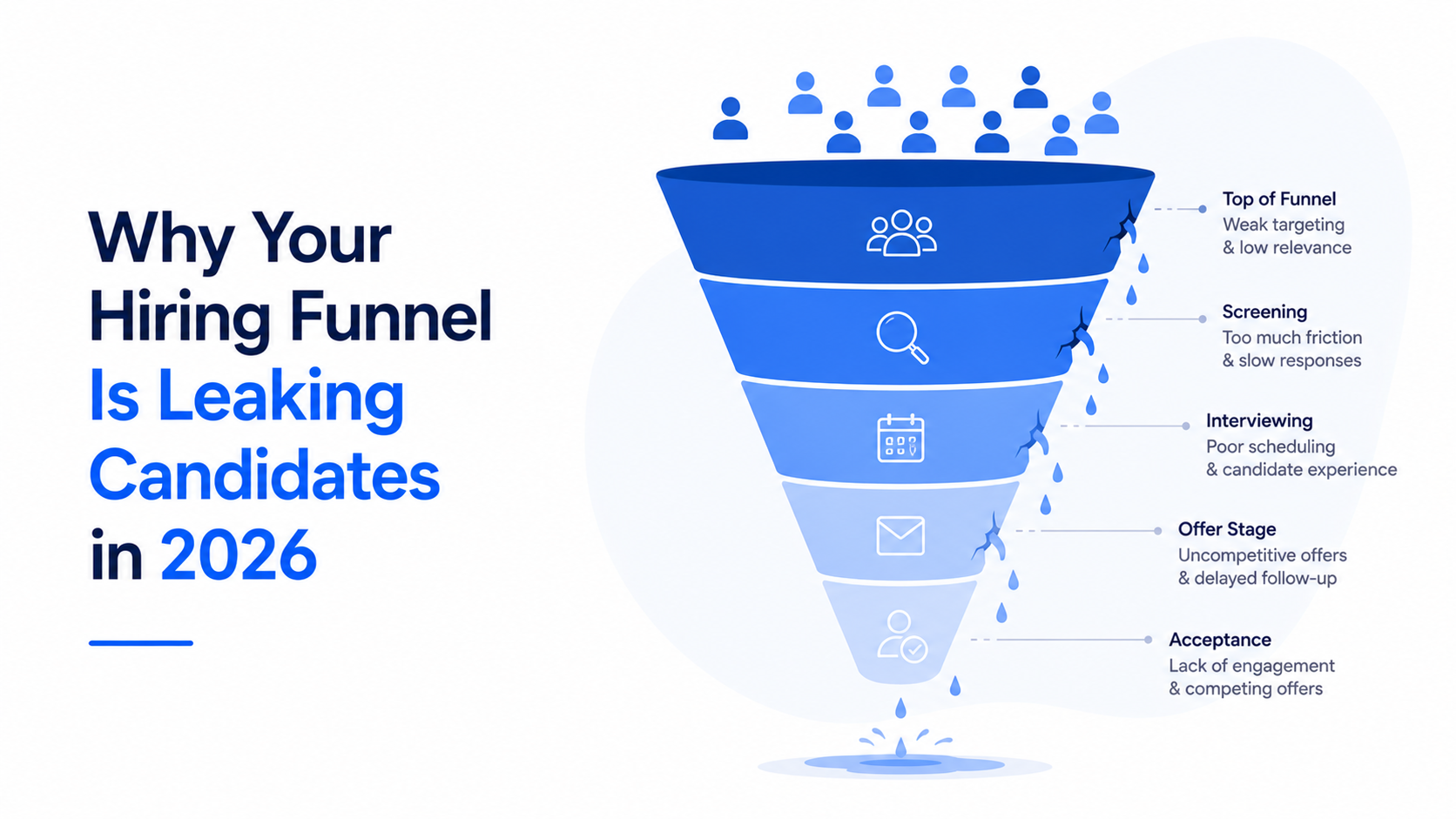
Recruiting teams often attribute their hiring challenges to a tight talent market, uncompetitive compensation, or a weak employer brand. These factors matter, but they are not the primary reason most companies struggle to hire. The primary reason is far more mundane and far more fixable: the hiring funnel is leaking candidates at every stage, and the leaks are large enough to undermine even the strongest sourcing strategy and the most generous compensation packages. A funnel that converts 3 percent of applicants into hires requires three times the sourcing investment of a funnel that converts 9 percent. The talent market has not changed. The company's budget has not changed. But the number of hires produced from the same input changes dramatically based on how well the funnel retains candidates from one stage to the next. The leaks are not mysterious. They have been studied, documented, and solved by high-performing TA teams. This post maps every major leak point in the hiring funnel and provides the specific, evidence-based interventions that plug them.
The True Cost of a Leaky Hiring Funnel
Most TA leaders have a general sense that candidates are dropping out of their funnel, but few have quantified the full financial impact of those losses. The cost of a leaky funnel extends far beyond wasted sourcing spend. Every candidate who drops out represents recruiter time spent reviewing their application, scheduling coordinators who managed their interview, hiring managers who prepared for conversations that never happened, and the opportunity cost of the vacant position that remains unfilled while the process starts over. When you aggregate these costs across all the candidates who enter your funnel and never reach the offer stage, the number is typically two to three times the company's total recruiting budget.
McKinsey analysis of talent acquisition efficiency shows that the average company loses between 55 and 70 percent of its potential candidates between the initial application and the offer stage. For companies making 500 hires annually, this means thousands of qualified candidates are being lost to preventable funnel friction. The financial magnitude of this loss is substantial: a company with an average cost-per-hire of $5,000 and a 95 percent funnel drop-off rate is effectively spending over $95,000 in wasted recruiting effort for every 100 hires it makes. This waste is almost entirely invisible because it is distributed across the entire process and never appears as a single line item in any budget report.
The hidden cost that receives the least attention is the impact on employer brand. Every candidate who has a negative experience in your funnel—a confusing application, a scheduling nightmare, radio silence after an interview—becomes a potential detractor. LinkedIn research estimates that candidates who have a poor experience are 50 percent less likely to apply to your company again and 35 percent less likely to recommend your company to peers. In a market where referral candidates convert at twice the rate of job board candidates, this brand erosion has a direct and measurable impact on future hiring outcomes. The leaky funnel does not just cost you today's candidates. It costs you tomorrow's as well.
Application Abandonment: The Biggest Leak of All
Application abandonment is the single largest source of candidate loss in the hiring funnel, and it is almost entirely a design problem. Across industries, between 55 and 70 percent of candidates who start an online application do not complete it. On mobile devices, the completion rate drops even further, with some studies finding abandonment rates as high as 80 percent for complex applications accessed on a phone. The reasons are well documented: applications that take longer than five minutes to complete, mandatory account creation before submission, excessive required fields, and interfaces that are not optimized for mobile interaction. Each additional barrier you place between the candidate and the submit button reduces your completion rate by a measurable increment.
SHRM talent acquisition surveys have found that the average corporate job application takes between 15 and 25 minutes to complete and requires candidates to re-enter information that is already available on their resume. This is the equivalent of an e-commerce site requiring customers to manually type in their credit card number, expiration date, billing address, and shipping address every time they make a purchase. Consumer companies have spent billions optimizing their checkout flows to reduce abandonment. Most recruiting teams have not applied the same rigor to their application flows, and the results are visible in the data. The companies that have invested in application optimization—simplifying forms, enabling resume parsing, removing mandatory account creation—report application completion rates 20 to 30 percentage points above their industry averages.
The fix does not require a technology overhaul. The highest-impact changes are often the simplest. Reduce the application to the minimum viable information: name, email, resume, and one or two role-specific questions. Move everything else—cover letters, detailed work history, references, and salary expectations—to later stages when the candidate is more invested in the process. Enable one-click apply through LinkedIn or other platforms to eliminate data entry entirely for candidates who prefer it. Test your application on a mobile phone, time how long it takes, and fix every point of friction you encounter. These are not experimental strategies. They are proven practices that the most effective TA teams have already implemented, and they represent the single highest-ROI investment most recruiting teams can make in their funnel.
Screening Stage Drop-Offs and How to Prevent Them
The screening stage is where candidates who successfully submitted their application either advance to the next stage or are filtered out. The leak here takes two forms. The first is candidate-initiated withdrawal: candidates who are notified that they have been selected for screening but do not respond or explicitly withdraw. The second is recruiter-initiated rejection: candidates who are screened out because they do not meet the qualification criteria. While recruiter-initiated rejections are a necessary part of the process, candidate-initiated withdrawals at this stage are almost always preventable and signal a problem with communication speed or candidate engagement.
The most common cause of candidate-initiated screening withdrawal is slow response time. Deloitte workforce research shows that the probability of a candidate engaging with your screening process drops by roughly 10 percent for every 24 hours of delay between their application submission and your first outreach. Candidates who apply to multiple companies—especially in competitive markets—will engage with whichever employer responds first. A company that takes four business days to initiate screening will lose a significant portion of its qualified applicants to competitors who respond within 24 hours. This is not a talent market problem. It is a process speed problem, and it is solvable with better prioritization, automated response systems, or AI-powered sourcing and screening tools that can initiate qualified outreach within hours of application submission.
The second form of screening-stage leak is over-screening—rejecting qualified candidates because the screening criteria are too rigid or poorly defined. Many companies apply a long list of mandatory requirements at the screening stage that have more to do with the hiring manager's ideal candidate profile than with the actual minimum qualifications needed to succeed in the role. A requirement for eight years of experience when five would suffice, a mandatory certification that is nice to have but not essential, or a specific degree requirement when equivalent experience is equally valid—each of these over-specifications filters out candidates who could perform the job effectively. Gartner talent acquisition analysis shows that over-specified job requirements can reduce the qualified candidate pool by 40 to 60 percent without any improvement in quality-of-hire outcomes. Relaxing these requirements and using a more nuanced screening approach that assesses candidate potential rather than checking boxes is one of the fastest ways to increase the number of qualified candidates entering the interview stage.
Interview Process Friction That Costs You Top Talent
The interview stage is where the hiring funnel leaks the most valuable candidates. These are candidates who have invested time in applying, passed the screening, and demonstrated genuine interest in the role. Losing them at this stage represents the highest-cost leak in the funnel because the investment per candidate at this point is significant. The primary causes of interview-stage candidate loss fall into three categories: scheduling complexity, process length, and communication gaps. Each is addressable, but only if the TA team is measuring interview-stage conversion rates and diagnosing the specific reasons behind the numbers.
Scheduling complexity is the most prevalent source of interview friction. Coordinating availability between a candidate and three to five interviewers—each with their own calendar constraints—can add days or weeks to the process. EY talent acquisition benchmarks show that companies using manual interview scheduling average 8 to 12 business days to schedule a single interview round, while those using automated self-scheduling tools reduce this to 1 to 3 days. The difference is not marginal. Every additional day of scheduling delay increases the probability that the candidate will accept another offer, lose interest, or disengage from the process. Implementing automated scheduling tools that allow candidates to select from available interview slots is one of the highest-ROI investments a TA team can make, often paying for itself in reduced time-to-fill within a single hiring quarter.
Process length is the second major friction point. Interview processes with five or more rounds are common in large enterprises, but the data increasingly shows that adding rounds beyond a certain point provides diminishing returns while significantly increasing candidate drop-off. McKinsey hiring process research found that interview-to-offer conversion rates decline by approximately 8 to 12 percent for every additional interview round beyond the fourth, with no corresponding improvement in quality-of-hire scores. Candidates interpret excessively long processes as a sign of organizational indecision, bureaucratic culture, and disrespect for their time. The companies that have streamlined their interview processes to three or four focused rounds report higher conversion rates, faster time-to-hire, and equivalent or better quality-of-hire outcomes compared to those with longer processes.
Communication Gaps: The Silent Funnel Killer
Communication gaps are the most insidious leak in the hiring funnel because they are invisible to the TA team but painfully visible to the candidate. A candidate who receives a generic automated acknowledgment after applying, hears nothing for two weeks, is then invited to an interview with two days' notice, receives no follow-up after the interview, and finally gets a templated rejection email three weeks later has experienced a process that felt dismissive and disorganized—even if every individual step was completed within a reasonable internal timeline. The candidate's experience is defined by the gaps between touchpoints, not by the touchpoints themselves.
LinkedIn candidate experience research shows that communication quality is the single strongest predictor of whether a candidate will reapply to your company in the future, ranking ahead of compensation, role fit, and even whether they received an offer. Candidates who rate their communication experience as "excellent" are 4.6 times more likely to recommend the company to others compared to those who rate it as "poor." Yet the same research found that only 35 percent of candidates describe their communication experience during the hiring process as good or excellent. The gap between what candidates expect and what most companies deliver is enormous, and it represents a significant competitive opportunity for TA teams willing to invest in communication cadence and quality.
The most effective communication frameworks follow a simple rule: the candidate should never have to wonder what is happening. This means proactive updates at every stage transition, clear timelines for next steps, and immediate notification of any delays. SHRM recruiting best practices recommend a maximum of three business days between any two candidate touchpoints. This does not require daily emails. It requires a defined communication cadence—acknowledgment within 24 hours of application, screening status within three days, interview scheduling within three days of screening, post-interview feedback within five days, and offer or decision communication within three days of the final interview. Teams using agentic AI platforms to manage communication cadence are finding that automated, personalized updates at each stage significantly reduce candidate withdrawal rates without adding recruiter workload.
Offer Stage Declines and What They Really Mean
The offer stage is the most painful point in the funnel to lose a candidate, because it represents the culmination of the entire recruiting effort. Every prior investment—sourcing, screening, interviewing, hiring manager time—has been made, and the candidate is within reach of being hired. When they decline, the process must start over from the beginning. Offer-stage decline rates vary significantly by industry and role type, but a typical range is 15 to 30 percent of all offers extended. The most common reasons candidates cite for declining offers are compensation below expectations, a competing offer from another company, a negative candidate experience during the interview process, and concerns about the role or team culture that surfaced during interviews.
Deloitte offer management research reveals a critical insight: the majority of offer declines are preventable, not because the offer can always be made more competitive, but because the issues that drive declines are typically known well before the offer is extended. A candidate who is concerned about compensation, has reservations about the role, or is actively interviewing with competitors will often signal these concerns during the interview process—if anyone is listening. The TA teams with the lowest offer decline rates are the ones that treat the interview process as a continuous intelligence-gathering operation, tracking candidate sentiment, competitive activity, and expectation alignment at every stage so that potential deal-breakers are identified and addressed before the offer is on the table.
The speed of offer delivery is another critical factor. EY talent surveys show that the probability of offer acceptance declines by approximately 5 percent for every business day between the final interview and the offer delivery. In competitive talent markets, a five-day delay between the decision and the offer can reduce acceptance probability by 25 percent—enough to shift the outcome for a significant number of candidates. The companies that consistently close top talent have streamlined their offer approval processes to deliver verbal offers within 24 hours of the final interview and written offers within 48 hours. This speed is not a luxury—it is a competitive necessity, and achieving it requires pre-approved compensation ranges, delegated offer authority, and a clear escalation path for exceptions.
Diagnosing Your Specific Funnel Leaks
Fixing funnel leaks requires knowing exactly where your candidates are dropping out and why. The diagnostic process starts with stage-by-stage conversion analysis: measure the number of candidates entering each stage of your funnel and the number advancing to the next, then calculate the conversion rate between each pair of stages. This produces a conversion funnel that looks something like this: 100 percent of visitors, 45 percent complete the application, 25 percent pass screening, 12 percent are interviewed, 4 percent receive an offer, and 3 percent accept. The stage with the largest drop-off is your primary leak, and it should be the first target for improvement.
Gartner recommends segmenting this analysis by role type, seniority, geography, and sourcing channel. Your overall conversion funnel might show a 55 percent application completion rate, but that number could mask a 70 percent rate for engineering roles and a 35 percent rate for sales roles. The sales application might be more complex, might require a portfolio submission, or might be mobile-unfriendly. Without segmenting, you would see the 55 percent average and either over-invest in fixing a problem that does not affect all roles or under-invest in a problem that is severe for a specific segment. The same principle applies to every funnel stage. Screening-to-interview conversion, interview-to-offer conversion, and offer acceptance rate should all be segmented to reveal where the most impactful improvements can be made.
The qualitative side of the diagnosis is equally important. Conversion rates tell you where the leak is. Candidate feedback tells you why. Exit surveys for candidates who withdraw, post-interview experience surveys, and declined-offer follow-up conversations provide the qualitative data that points to specific root causes. A declining application completion rate might be caused by a recently added assessment, a mandatory account creation requirement, or a mobile usability issue. The conversion data tells you the problem exists. The candidate feedback tells you what to fix. Evaluating the tools in your recruiting stack against these findings ensures that any new technology investment is targeted at a specific, diagnosed problem rather than applied as a generic solution.
A Systematic Approach to Plugging the Leaks
Fixing funnel leaks is not a one-time project. It is a continuous optimization process that requires ongoing measurement, targeted interventions, and iterative improvement. The most effective approach follows a four-step cycle that repeats every quarter. First, measure stage-by-stage conversion rates and segment the data by role type, channel, and geography. Second, identify the one or two stages with the largest conversion gaps relative to benchmarks. Third, implement a targeted intervention to address the root cause of the leak at those stages. Fourth, measure the impact of the intervention after one full hiring cycle and compare the results to the pre-intervention baseline.
This cycle is powerful because it focuses resources on the highest-impact improvements. Rather than trying to fix the entire funnel simultaneously—which spreads effort thin and makes it impossible to attribute improvements to specific changes—you concentrate on the biggest leak first, fix it, measure the result, and then move to the next largest leak. McKinsey operational improvement research shows that this focused, sequential approach produces 40 to 60 percent more improvement per dollar invested compared to broad, unfocused optimization efforts. The key is discipline: resist the urge to tackle everything at once and trust that fixing the biggest leak first will produce the most meaningful improvement in overall funnel performance.
The companies that execute this cycle consistently over multiple quarters build a compounding advantage. Each quarter, the funnel becomes slightly more efficient. Each improvement increases the number of hires produced from the same sourcing investment. Over twelve months, a TA team that improves its overall funnel conversion from 4 percent to 7 percent has effectively increased its hiring capacity by 75 percent without adding a single recruiter, posting a single additional job, or increasing its sourcing budget by one dollar. That is the power of systematic funnel optimization. It does not require more resources. It requires better measurement, more disciplined prioritization, and the willingness to treat every point of candidate friction as a problem that can be solved. The data, the tools, and the strategies are all available. The only remaining variable is whether your team will commit to the process.