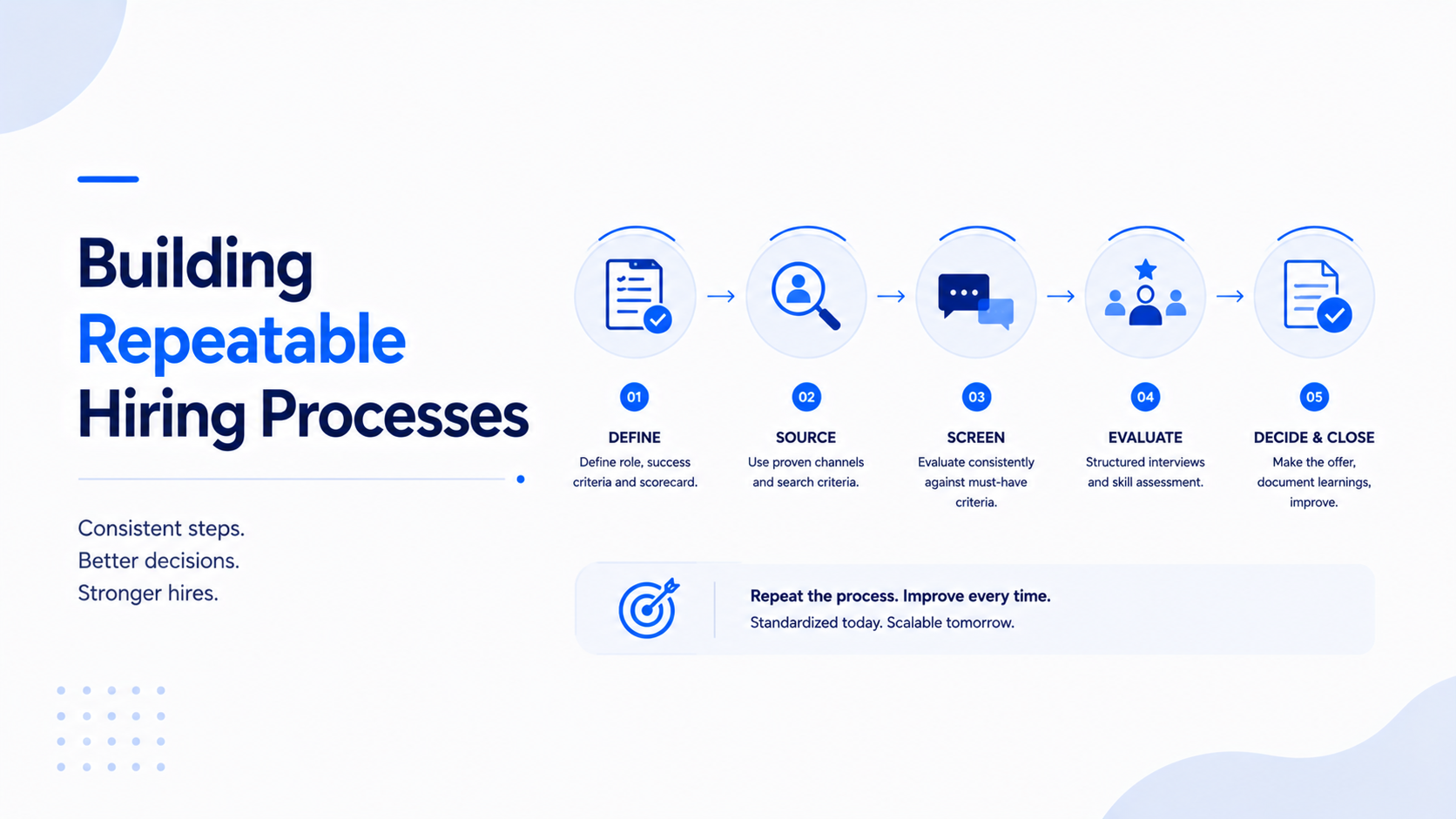
Olusegun Adeyemi had been VP of Talent at a seven-hundred-person logistics company for two years when his COO asked the question that exposed the gap in his function. Olusegun, the COO said, why does the Dublin team fill a software engineer in twenty-six days and the Bangalore team fill the same role in forty-one, when both teams use the same process and the same tools? Olusegun had a dozen answers, each of which was true and none of which was the answer. The truth was that the company did not have a repeatable hiring process. It had a documented process, and it had a tool stack, and it had recruiters who knew how to hire, but the process was not repeatable across teams because it depended on the individual recruiter's judgment to fill the gaps that the documented process left open, and the judgment varied from recruiter to recruiter and from market to market. The Dublin recruiter was a senior veteran who had internalized the practices that the documented process did not capture, and the Bangalore recruiter was a junior hire who followed the documented process to the letter and that the letter was what produced the forty-one days that the senior veteran's internalized practices would have prevented. The answer to the COO's question was that the company had a process that was repeatable in its documentation and not repeatable in its execution, and the gap between the two was what produced the fifteen-day cycle time difference that the COO was asking about and that Olusegun could not explain. Here is the framework he used to build a process that was repeatable in execution, not just in documentation.
What a Repeatable Hiring Process Actually Means
A repeatable hiring process is a process that produces consistent outcomes regardless of which recruiter is running it, which role family it is being run for, and which market conditions it is being run under, and the consistency is what distinguishes the repeatable process from the process that produces consistent outcomes only when the conditions are favorable. The repeatable process is not the process that produces the same outcomes in all conditions—that is impossible, because the conditions affect the outcomes and the conditions vary. The repeatable process is the process that produces the same outcomes given the same conditions, and the variation in outcomes is attributable to the variation in conditions rather than to the variation in the process's execution, and the attribution is what the repeatable process is what enables the team to make and that the making is what the team was trying to make and that the repeatable process is what enables the team to make it.
The reason repeatability matters more in 2026 than in previous years is that the cost of non-repeatable processes has grown as the talent market has become more competitive and the cost of an unfilled role has grown, and the cost is what the repeatability is what enables the team to recover, and the recovery is what the repeatability is what enables the team to produce and that the team was trying to produce and that the repeatability is what enables the team to produce it. According to McKinsey research on talent operations, the companies with repeatable hiring processes report thirty-five percent lower cycle time variation across recruiters and forty percent lower quality-of-hire variation across role families, because the repeatability is what produces the consistency that the variation is what the repeatability is what enables the team to eliminate and that the elimination is what the team was trying to eliminate and that the repeatability is what enables the team to eliminate it. The repeatability is not a luxury—it is the operational property that determines whether the function scales, and the scaling is what the company's growth requires and that the repeatability is what enables the team to produce it.
The companies that have built repeatable hiring processes share a common approach: they treat repeatability as a design property rather than as a training outcome, because the design property is what produces the repeatability that the training alone cannot produce, and the design is what the operations function is what enables the team to do and that the doing is what the team was trying to do and that the operations function is what enables the team to do it. As our analysis of more tools same hiring problems argues, the teams that have invested in training without investing in process design have produced the recruiters who know what to do but who cannot do it consistently because the process is not designed to enable them to do it consistently, and the design is what the operations function is what enables the team to produce and that the team was trying to produce and that the design is what enables the team to produce it.
The Seven Disciplines of a Repeatable Hiring Process
The seven disciplines of a repeatable hiring process are process documentation, decision criteria, tool standardization, role-specific playbooks, quality standards, hiring manager enablement, and continuous measurement, and each discipline produces a specific repeatability gain that the other disciplines cannot produce, and the seven disciplines together produce the cumulative repeatability that the operations function was designed to deliver. The process documentation discipline produces the repeatability that comes from documenting the process as it actually runs rather than as it was designed, because the documentation is what enables the team to execute the process the same way every time. The decision criteria discipline produces the repeatability that comes from defining the criteria for the decisions that the process requires, because the criteria are what produce the consistent decisions that the individual judgment does not produce.
The five remaining disciplines are the disciplines that produce the repeatability that the first two disciplines cannot produce. The tool standardization discipline produces the repeatability that comes from using the same tools the same way across the team, because the tool standardization is what produces the consistent tool usage that the non-standardized tools do not produce. According to Gartner talent acquisition research, the teams that have standardized their tool usage report forty percent less variation in cycle time across recruiters, because the standardization is what produces the consistent usage that the variation is what the standardization is what enables the team to eliminate and that the elimination is what the team was trying to eliminate and that the standardization is what enables the team to eliminate it. The role-specific playbooks discipline produces the repeatability that comes from documenting the role-specific practices that the generic process does not capture, because the playbooks are what produce the consistent role-specific execution that the generic process does not produce. The quality standards discipline produces the repeatability that comes from defining what good looks like for each phase, because the standards are what produce the consistent evaluation that the undefined quality does not produce. The hiring manager enablement discipline produces the repeatability that comes from enabling the hiring manager to participate in the process consistently, because the enablement is what produces the consistent hiring manager participation that the unenabled hiring manager does not produce. The continuous measurement discipline produces the repeatability that comes from measuring the process and addressing the variation that the measurement reveals, because the measurement is what produces the variation elimination that the unmeasured process does not produce.
The seven disciplines are interdependent, and the team that practices one discipline without practicing the others is the team that produces the repeatability that the other disciplines undermine. As our analysis of the recruiting dashboard every TA team needs explains, the dashboards that produce the most repeatability are those that display the metrics for all seven disciplines, because the display is what enables the team to see the interaction between the disciplines and that the interaction is what produces the repeatability that the disciplines together produce and that the disciplines separately do not produce and that the team was trying to produce and that the seven disciplines together are what enable the team to produce it.
Documenting the Process as It Actually Runs
The first discipline is the documentation of the process as it actually runs rather than as it was designed, because the documentation is what enables the team to execute the process the same way every time, and the execution is what produces the repeatability that the documentation is what enables the team to produce and that the team was trying to produce and that the documentation is what enables the team to produce it. The documentation as it was designed is the documentation that describes the process that the team is supposed to run, and the documentation as it actually runs is the documentation that describes the process that the team is actually running, and the gap between the two is what produces the variation that the documentation as it actually runs is what enables the team to eliminate and that the elimination is what the team was trying to eliminate and that the documentation as it actually runs is what enables the team to eliminate it.
The first documentation principle is to document the workarounds that the team has developed to compensate for the gaps in the designed process, because the workarounds are what the team is what is actually running, and the documentation is what enables the team to standardize the workarounds and that the standardization is what produces the repeatability that the workarounds do not produce. According to SHRM research on process documentation, the teams that have documented the workarounds report forty percent less variation in cycle time across recruiters, because the documentation is what produces the standardization that the workarounds do not produce, and the standardization is what produces the repeatability that the documentation is what enables the team to produce and that the team was trying to produce and that the documentation is what enables the team to produce it.
The second documentation principle is to document the decision criteria rather than the decisions, because the decisions are specific to the situation while the criteria generalize across situations, and the criteria are what produce the consistent decisions that the specific decisions do not produce. As our analysis of AI sourcing vs AI recruiting explains, the platforms that produce the most repeatable processes are those that enable the documentation of the decision criteria rather than the decisions, because the criteria are what produce the consistent decisions that the platform is what enables the team to make and that the decisions are what the platform is what enables the team to make and that the criteria are what produce the repeatability that the decisions do not produce and that the team was trying to produce and that the criteria are what enable the team to produce it.
Defining the Decision Criteria That Make Hiring Consistent
The second discipline is the definition of the decision criteria that the process requires, because the criteria are what produce the consistent decisions that the individual judgment does not produce, and the consistency is what produces the repeatability that the criteria are what enables the team to produce and that the team was trying to produce and that the criteria are what enables the team to produce it. The decision criteria are the criteria for the decisions that the process requires, and the decisions are the decisions that the process is what enables the team to make, and the criteria are what produce the consistent decisions that the individual judgment does not produce and that the consistency is what the repeatability is what the criteria are what enables the team to produce and that the team was trying to produce and that the criteria are what enables the team to produce it.
The first decision criteria principle is to define the criteria for the screening decision, because the screening decision is the decision that the process is what enables the team to make and that the criteria are what produce the consistent decision that the individual judgment does not produce. According to LinkedIn talent research on screening, the teams that have defined the screening criteria report thirty-five percent less variation in qualified-candidate yield across recruiters, because the criteria are what produce the consistent screening that the variation is what the criteria are what enables the team to eliminate and that the elimination is what the team was trying to eliminate and that the criteria are what enables the team to eliminate it. The screening criteria should specify the qualifications that are mandatory and the qualifications that are preferred, because the specification is what produces the consistent screening that the unspecified criteria do not produce and that the consistency is what the repeatability is what the criteria are what enables the team to produce and that the team was trying to produce and that the criteria are what enables the team to produce it.
The second decision criteria principle is to define the criteria for the interview evaluation, because the interview evaluation is the decision that the process is what enables the team to make and that the criteria are what produce the consistent evaluation that the individual judgment does not produce. As our guide on how to evaluate an AI sourcing tool explains, the platforms that produce the most repeatable interview evaluations are those that enable the definition of the evaluation criteria, because the criteria are what produce the consistent evaluation that the platform is what enables the team to make and that the evaluation is what the platform is what enables the team to make and that the criteria are what produce the repeatability that the evaluation does not produce and that the team was trying to produce and that the criteria are what enable the team to produce it.
Standardizing the Tools That the Team Uses
The third discipline is the standardization of the tools that the team uses, because the standardization is what produces the consistent tool usage that the non-standardized tools do not produce, and the consistency is what produces the repeatability that the standardization is what enables the team to produce and that the team was trying to produce and that the standardization is what enables the team to produce it. The tool standardization is not the elimination of all tools—the tool standardization is the standardization of the tools that the team uses the same way across the team, and the standardization is what produces the consistent usage that the non-standardized tools do not produce and that the consistency is what the repeatability is what the standardization is what enables the team to produce and that the team was trying to produce and that the standardization is what enables the team to produce it.
The first tool standardization principle is to standardize the way the team uses each tool, because the standardization of the way the team uses the tool is what produces the consistent usage that the non-standardized usage does not produce, and the consistency is what produces the repeatability that the standardization is what enables the team to produce. According to Deloitte workforce analytics on tool standardization, the teams that have standardized the way they use their tools report forty percent less variation in cycle time across recruiters, because the standardization is what produces the consistent usage that the variation is what the standardization is what enables the team to eliminate and that the elimination is what the team was trying to eliminate and that the standardization is what enables the team to eliminate it. The standardization should be documented in the tool usage guide that the playbook contains, because the documentation is what enables the team to use the tool the same way and that the same way is what produces the repeatability that the standardization is what enables the team to produce and that the team was trying to produce and that the standardization is what enables the team to produce it.
The second tool standardization principle is to eliminate the tools that the team does not use, because the elimination is what produces the lean stack that the bloated stack does not produce, and the leanness is what produces the repeatability that the bloat does not produce. As our analysis of agentic AI platforms vs automated ones demonstrates, the platforms that produce the most repeatability are those that enable the standardization of the tool usage, because the standardization is what produces the consistent usage that the repeatability is what the standardization is what enables the team to produce and that the team was trying to produce and that the standardization is what enables the team to produce it.
Building Role-Specific Playbooks That Capture the Real Practice
The fourth discipline is the building of role-specific playbooks that capture the real practice of the team's best recruiters, because the playbooks are what produce the consistent role-specific execution that the generic process does not produce, and the consistency is what produces the repeatability that the playbooks are what enables the team to produce and that the team was trying to produce and that the playbooks are what enables the team to produce it. The role-specific playbook is the playbook that documents the practices that the team's best recruiters have developed for the specific role family, and the documentation is what enables the team to standardize the practices and that the standardization is what produces the repeatability that the practices do not produce and that the team was trying to produce and that the playbooks are what enables the team to produce it.
The first role-specific playbook principle is to capture the practices of the best recruiters, because the best recruiters are the recruiters who have developed the practices that produce the best outcomes, and the practices are what the playbook is what enables the team to standardize and that the standardization is what produces the repeatability that the practices do not produce and that the team was trying to produce and that the playbooks are what enables the team to produce it. According to EY research on recruiter effectiveness, the teams that have captured the practices of their best recruiters in role-specific playbooks report forty-five percent better outcomes for junior recruiters, because the playbooks are what produce the standardization that the practices do not produce and that the standardization is what the repeatability is what the playbooks are what enables the team to produce and that the team was trying to produce and that the playbooks are what enables the team to produce it.
The second role-specific playbook principle is to update the playbooks quarterly, because the practices evolve as the market and the role requirements change, and the update is what keeps the playbook current as the practices evolve, and the currency is what produces the repeatability that the stale playbook does not produce and that the currency is what the repeatability is what the update is what enables the team to produce and that the team was trying to produce and that the update is what enables the team to produce it. As our analysis of more tools same hiring problems shows, the teams that have built the most effective playbooks are those that update the playbooks quarterly, because the update is what produces the currency that the repeatability is what the update is what enables the team to produce and that the team was trying to produce and that the update is what enables the team to produce it.
Enabling the Hiring Manager to Participate Consistently
The fifth discipline is the enabling of the hiring manager to participate in the process consistently, because the hiring manager's participation is what produces the consistent hiring decisions that the inconsistent participation does not produce, and the consistency is what produces the repeatability that the hiring manager enablement is what enables the team to produce and that the team was trying to produce and that the hiring manager enablement is what enables the team to produce it. The hiring manager is the person who makes the hiring decision, and the decision is what the hiring manager's participation is what enables the hiring manager to make and that the participation is what the enablement is what enables the hiring manager to provide and that the enablement is what the repeatability is what the team is what enables the team to produce and that the team was trying to produce and that the enablement is what enables the team to produce it.
The first hiring manager enablement principle is to provide the hiring manager with the playbook that the recruiter uses, because the playbook is what enables the hiring manager to participate in the process consistently and that the consistency is what produces the repeatability that the playbook is what enables the hiring manager to produce and that the team was trying to produce and that the playbook is what enables the team to produce it. According to McKinsey research on hiring manager engagement, the teams that have provided the hiring manager with the playbook report thirty-five percent higher hiring manager satisfaction and twenty-eight percent faster cycle times, because the playbook is what produces the consistency that the satisfaction is what the playbook is what enables the hiring manager to produce and that the consistency is what the repeatability is what the playbook is what enables the team to produce and that the team was trying to produce and that the playbook is what enables the team to produce it.
The second hiring manager enablement principle is to train the hiring manager on the process, because the training is what enables the hiring manager to participate in the process consistently and that the consistency is what produces the repeatability that the training is what enables the hiring manager to produce and that the team was trying to produce and that the training is what enables the team to produce it. As our analysis of the recruiting dashboard every TA team needs explains, the dashboards that produce the most repeatability are those that are designed for the hiring manager, because the design is what produces the consistency that the repeatability is what the dashboard is what enables the team to produce and that the team was trying to produce and that the dashboard is what enables the team to produce it.
Measuring and Addressing the Variation That Remains
The sixth discipline is the measurement of the variation that remains after the first five disciplines have been applied, because the measurement is what reveals the variation that the team has not yet eliminated and that the revelation is what enables the team to address the variation and that the addressing is what produces the repeatability that the measurement is what enables the team to produce and that the team was trying to produce and that the measurement is what enables the team to produce it. The measurement is the discipline that closes the loop, because the measurement is what reveals the variation that the disciplines have not eliminated and that the revelation is what enables the team to apply the disciplines to the variation that the measurement is what reveals and that the applying is what produces the repeatability that the measurement is what enables the team to produce and that the team was trying to produce and that the measurement is what enables the team to produce it.
The first measurement principle is to measure the variation across recruiters, because the variation across recruiters is what reveals the recruiters who are not following the process and that the revelation is what enables the team to address the variation and that the addressing is what produces the repeatability that the measurement is what enables the team to produce. According to Gartner talent acquisition research, the teams that measure the variation across recruiters report forty percent faster identification of the recruiters who need additional support, because the measurement is what reveals the variation that the team has not yet eliminated and that the revelation is what enables the team to address the variation and that the addressing is what produces the repeatability that the measurement is what enables the team to produce and that the team was trying to produce and that the measurement is what enables the team to produce it.
The second measurement principle is to address the variation rather than to report it, because the variation that is reported but not addressed is the variation that continues to produce the non-repeatability that the measurement is what reveals and that the addressing is what the measurement is what enables the team to do and that the addressing is what the team was trying to do and that the measurement is what enables the team to do it. As our analysis of more tools same hiring problems demonstrates, the teams that have built the most repeatable processes are those that address the variation rather than report it, because the addressing is what produces the repeatability that the reporting does not produce, and the repeatability is what the addressing is what enables the team to produce and that the team was trying to produce and that the addressing is what enables the team to produce it. Building repeatable hiring processes is not a one-time project. It is an operational discipline, and the teams that practice it as a discipline are the ones whose hiring functions produce consistent outcomes across recruiters, role families, and market conditions, and the consistency is what produces the hiring function that scales with the company rather than the hiring function that breaks under the company's growth and that the discipline is what enables the function to scale and that the scaling is what the operations function was designed to enable and that the team was trying to enable and that the discipline is what enables the team to enable it.