The hiring process is supposed to find the best people. In practice, it often does the opposite.
According to CareerHelp's 2026 Job Application Statistics, an estimated 75% of resumes are rejected by applicant tracking systems before a human ever sees them. The average job posting receives 242 applications. The interview conversion rate is just 2-3%. And the average time-to-hire has stretched to 42 days, up from 35 days in 2022.
These numbers describe a system under strain. But they also describe something more troubling: a system that is structurally designed to reject great candidates before they ever get a chance. The best people — the ones who think differently, build differently, and solve problems in unexpected ways — are often the first to be filtered out.
This is not a bug. It is a feature of how most recruiting systems are built.
The Speed of Rejection
Most rejection happens before deliberation even begins. According to Pin's analysis of 500,000+ merit-based rejection decisions, 64.8% of screening rejections are made within one hour of a candidate entering the pipeline. 80.8% are decided within 24 hours.
This is not careful evaluation. It is rapid pattern matching. A recruiter sees a resume, scans for familiar signals, and makes a snap judgment. The candidate who does not fit the expected template is gone before anyone asks whether they could do the job.
The reasons for these fast rejections are revealing. The top six account for roughly 80% of all merit-based rejections:
Not enough experience: 16.6%
Wrong type of role: 15.6%
Wrong industry background: 14.2%
Overqualified: 12.2%
Not qualified: 12.0%
Missing required skills: 10.6%
Only about one in five rejections says this person cannot do the job. The rest say this person does not match this search. That is a statement about the search, not the candidate.
The Overqualification Paradox
One of the most perverse patterns in screening data is that overqualification outranks underqualification as a rejection reason. Recruiters reject candidates for exceeding the bar more often than for failing it.
According to Pin's 2026 data, overqualification drives 12.2% of rejections versus 12.0% for not qualified. Combined with not enough experience at 16.6%, experience calibration — rejecting people whose experience falls outside a narrow target band — accounts for 28.8% of all merit-based rejections. Recruiters are not primarily rejecting unqualified people. They are rejecting people whose experience does not land inside an arbitrary range.
The overqualification penalty is not evenly distributed. For junior roles, 13.0% of rejections cite too much experience. At the executive level, the figure drops to 3.4%. The more senior the seat, the less extra experience counts against you. But for mid-level and junior positions, being too capable is treated as a liability.
This carries a compliance shadow. Field experiments have found older candidates were 34% to 62% less likely to receive callbacks when resumes signaled age. Overqualified can function as a proxy for exactly that bias. The classic NBER audit study showed that identical resumes with white-sounding names drew 50% more callbacks than those with Black-sounding names. A structured rejection taxonomy makes these patterns visible. A gut-feel pass never does.
The Fit Mismatch Problem
The second largest category of rejections has nothing to do with ability. Wrong type of role (15.6%), wrong industry background (14.2%), and company-size mismatch (3.4%) together account for 33.2% of rejections — a full third of the dataset. None of them say anything negative about the candidate.
A product manager surfaces for a project manager req. A data analyst is matched to a data engineer role. A brilliant salesperson from healthcare is rejected for a SaaS sales role because the industry is different. These are search errors, not candidate failures. Yet the candidate pays the price.
The breakdown by function shows how differently fit operates across roles. In engineering, not enough experience leads at 16.3%, with missing skills close behind at 15.4%. In sales, wrong industry background dominates at 19.2%. In finance and accounting, wrong industry leads at 19.4%, and overqualification runs second at 18.5% — the highest overqualification rate of any field. In healthcare, role mismatch drives one in four rejections at 24.6%.
For job seekers, the implication is blunt: most rejection is contextual, not personal. For recruiters, it is an efficiency indictment. Every wrong-industry rejection is a search that should not have matched. And many of those candidates received outreach before being cut, contributing to the silent rejections candidates experience as ghosting.
The ATS Black Box
The first gate most candidates face is not a human. It is an algorithm.
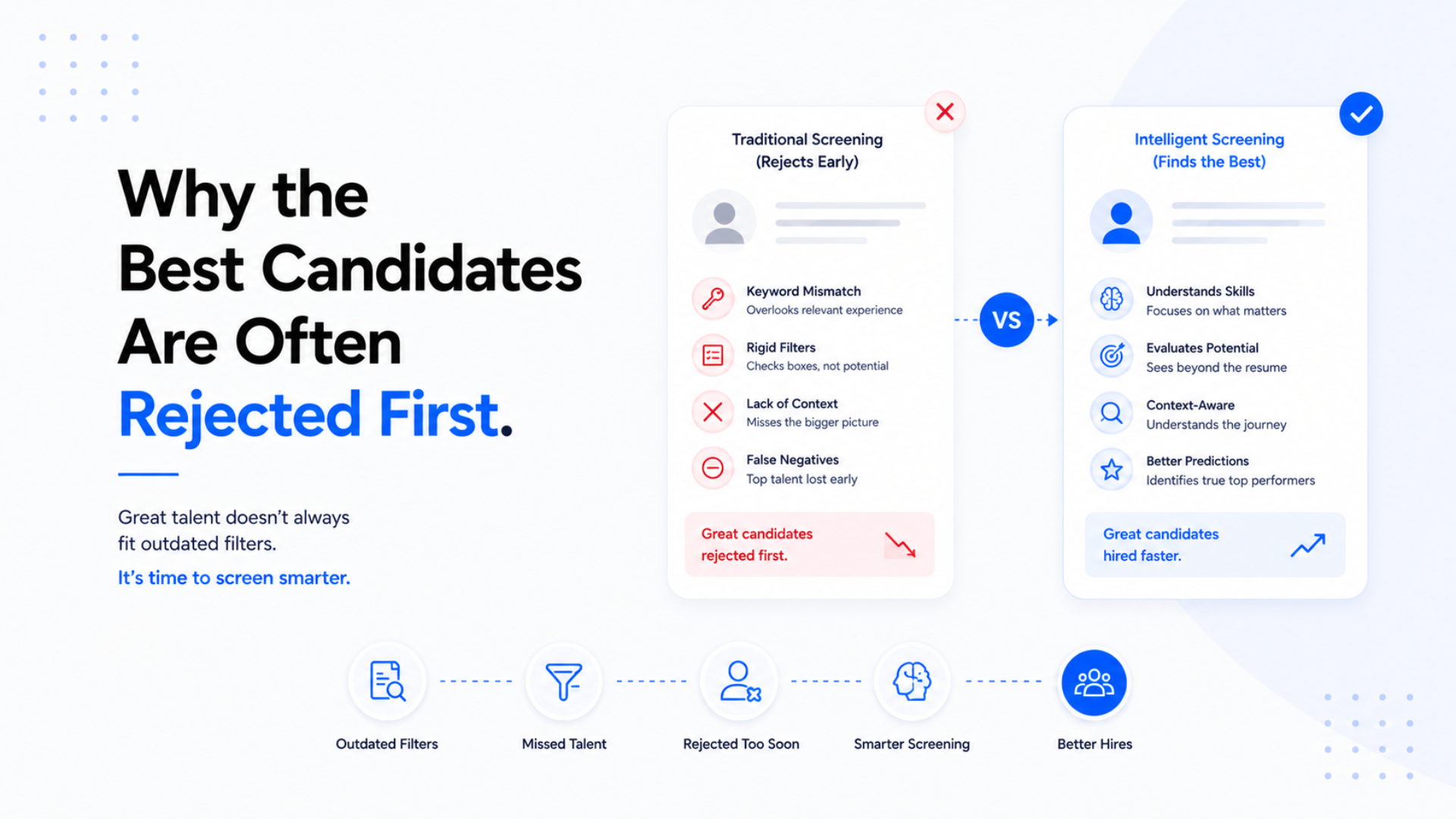
According to ResumeWorded's analysis, ATS systems rely heavily on keyword matching. If the software does not find the exact words it is looking for, the resume is flagged and rejected. This happens in milliseconds, before any human reviews the application pool.
The four issues that cause most automated rejections are:
Missing keywords from the job description
Formatting the software cannot parse
No exact job title match
Failing a hard requirement set as an auto-filter
A candidate who calls themselves a Growth Lead instead of a Sales Manager gets rejected. A developer who lists Next.js and TypeScript instead of React gets filtered out. A career-changer with transferable skills but the wrong job titles on their resume never makes it to human review.
The pass rates tell the story. A resume tailored to the job description has a 70-85% ATS pass rate. A generic resume with minor tweaks drops to 30-50%. A completely generic resume falls to 10-25%. And a poorly formatted resume with tables or graphics sinks to 5-15%.
The system rewards people who are good at gaming algorithms, not people who are good at doing the job. It systematically disadvantages anyone who does not speak the exact language of the job description — which includes the most innovative candidates, who often come from non-traditional paths.
The Halo Effect and the Seven-Second Scan
Even when a resume makes it past the ATS, the human scan is barely more forgiving. Recruiters spend an average of 6 to 8 seconds on an initial resume review. In that time, they look for familiar signals: school names, company logos, job titles, keyword matches.
A candidate with a prestigious degree and a well-known company on their resume gets flagged for closer review. A self-taught developer who built a profitable side project gets overlooked because their resume does not contain the right vocabulary. This is the halo effect in action — a cognitive bias where a positive impression in one area heavily influences opinions in others.
The problem compounds with volume. The average corporate recruiter manages 30 to 40 open requisitions simultaneously. At 300+ applications per role, a recruiter could have up to 12,500 resumes to review at any given moment. Under this pressure, the brain enters survival mode. Decision fatigue sets in. By the time a recruiter reaches their 50th resume of the morning, their ability to be objective is gone. They rely on pattern matching instead of evaluation. And great candidates slip through.
As Bryan Creely, who has screened over 100,000 resumes for companies like Amazon and FedEx, explains, most resumes get rejected before a recruiter reads a single word. The scan happens in six seconds. AI-generated resumes are making the problem worse by flooding the system with polished but hollow documents. The candidates who get read are the ones who match the expected pattern — not necessarily the ones who can do the best work.
Why the Best Candidates Look Wrong on Paper
The candidates who transform companies rarely look like the perfect hire on paper. They have non-linear career paths. They switched industries. They took time off. They worked at companies no one has heard of. They built things instead of climbing ladders. Their resumes do not tell a tidy story because their careers were not tidy.
Steve Jobs dropped out of college and spent time at a calligraphy course before building Apple. Howard Schultz grew up in public housing and sold blood to pay for college before transforming Starbucks. Sara Blakely had no fashion or business background before creating Spanx. None of these people would have made it through a modern ATS.
The pattern holds at every level. The engineer who spent three years at a failed startup learned more about building under pressure than the one who spent five years in a comfortable big-tech role. The salesperson who built a territory from scratch in an unknown industry has more relevant grit than the one who inherited a book of business at a brand-name company. The product manager who pivoted from teaching understands user empathy in ways the MBA graduate never will.
But these candidates do not have the right keywords. Their job titles do not match the job description. Their companies are not on the recruiter's mental list of prestigious employers. So they are rejected in six seconds, filtered out by an algorithm, or never surfaced by a search in the first place.
The False Negative Cost
The cost of these false negatives is not just missed hires. It is competitive disadvantage.
According to BambooHR's 2026 State of Hiring data, the hiring rate has fallen steadily from 4.5% in 2021 to 2.8% in 2025, even as job postings remained elevated and applicant volume rose. The offer acceptance rate held steady at 75%, which means candidates are not the bottleneck. Employers are screening more selectively and converting fewer candidates into hires.
This selectivity is not producing better outcomes. It is producing more false negatives. The same data shows that postings per hire have risen steadily since 2021 — more openings are being created for each completed hire. Companies are working harder to hire fewer people.
The candidates they are missing do not disappear. They go to competitors. They start their own companies. They build the products and teams that beat the companies who rejected them. Every false negative is a gift to the competition.
What Changes When the Conversation Starts
Rejection reasons flip completely once a real conversation begins. According to Pin's data, at the screening stage, fit dominates: not enough experience (18.0%), wrong role (16.9%), wrong industry (15.5%), overqualified (13.2%), and missing skills (11.5%). But among candidates rejected during active two-way conversation, a single reason towers over everything: not interested at 72.2%.
This reveals a two-act structure. Act one is a fit judgment made about a profile. Act two is an interest negotiation between people. Recruiters who treat those acts the same waste effort in both: over-screening candidates who would have said no anyway, and over-pitching candidates who were never a fit.
The implication is profound. Most rejection is not about ability. It is about profile matching. And profile matching is a solvable problem.
How Elite Teams Fix the False Negative Problem
The recruiting teams that consistently find exceptional candidates do not work harder. They work with a different structure. Their approach rests on four shifts that address the root causes of false negatives.
From Keyword Matching to Semantic Understanding
The best teams have moved beyond keyword-based ATS filtering to semantic AI matching. Instead of searching for exact terms, these systems use natural language processing to understand meaning. They recognize that managing a team of ten and directing ten associates describe the same capability. They understand that a Growth Lead at a Series A startup may have more relevant experience than a Sales Manager at a Fortune 500 company.
This shift changes what the system optimizes for. Keyword filtering rewards people who are good at writing resumes. Semantic matching rewards people who have actually done the work. It finds candidates who use different vocabulary, come from adjacent industries, or have non-linear career paths.
From Document Review to Conversational Evaluation
The most significant evolution is the move from reading resumes to having conversations. Instead of asking candidates to complete a separate assessment, conversational AI engages them in natural dialogue within the outreach process itself.
When a candidate responds to personalized outreach, the AI answers their questions about the role, gauges their interest, asks relevant screening questions, and evaluates responses in real time. This approach produces richer data than static resume parsing. It captures communication clarity, structured thinking, and genuine interest. It adapts follow-up questions based on what the candidate says.
According to LinkedIn's 2025 hiring insights, candidates are 3.2 times more likely to complete a screening conversation embedded in an outreach exchange than a standalone assessment. The reason is simple: it does not feel like a test. It feels like a conversation.
From Static Criteria to Skills-Based Evaluation
The most predictive hiring method is not credential screening. It is skills validation. According to Eklavvya's skills-based hiring research, 67% of employers now use structured skills assessments. Bootcamp graduates outperform traditional graduates with a 78% pass rate versus 71%. Technical roles are filled 40% faster using skills-first approaches. Skills-based hires see 25% lower turnover in their first year.
The National Association of Colleges and Employers found that 70% of employers now use skills-based hiring, up from 65% the previous year. Among this year's employers, 71% use this approach at least half of the time. The stages where employers use skills-based hiring most often are during interviewing (87%) and screening (65%).
This approach directly addresses the false negative problem. A self-taught developer who can pass a coding challenge gets evaluated on ability, not degree. A career-changer who demonstrates transferable skills in a work sample gets judged on performance, not pedigree.
From Episodic Hiring to Always-On Talent Intelligence
The final shift is structural. Elite recruiters do not treat hiring as a series of isolated transactions. They build always-on talent intelligence systems that maintain live maps of skill availability, candidate engagement, and market signals.
When a new requirement opens, the system already knows who to approach, what their current situation is, and how to craft a relevant conversation. When a candidate declines one role but expresses interest in another function, that signal is captured. When someone says reach out in Q3, the system remembers.
This is especially critical for specialized roles and competitive talent markets where waiting for applications is not viable. The best talent is already out there. The question is whether your system can find them before your competitor does.
The Bottom Line
The best candidates are often rejected first not because they are unqualified, but because the systems designed to find them are optimized for the wrong things. They reward familiarity over potential. They punish non-linearity. They filter out anyone who does not match the expected template before a human ever evaluates their ability.
The cost of these false negatives is not just missed hires. It is competitive disadvantage. The engineer who builds your competitor's next product. The salesperson who opens the market you never entered. The leader who transforms the company that gave them a chance.
The teams that win in 2026 are not the ones with the most selective filters. They are the ones with the smartest systems — systems that use semantic intelligence to understand meaning beyond keywords, conversational evaluation to assess capability in context, skills validation to measure actual performance, and continuous talent intelligence to find people before they become active applicants.
The resume will not disappear. But its role as the primary gatekeeper to opportunity is ending. What replaces it is not a better filter. It is a better way of seeing potential where others see only mismatch.