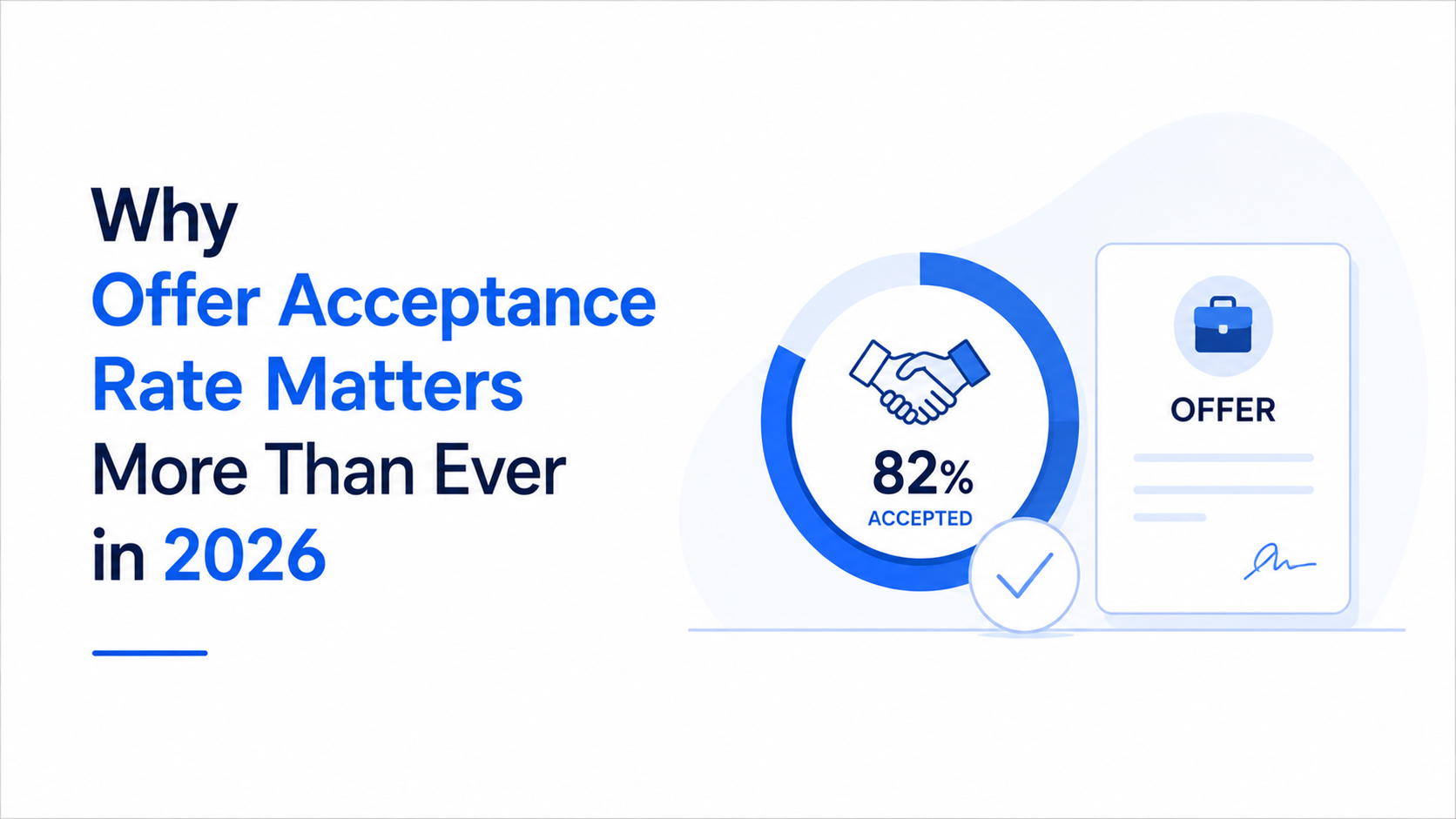
Three structural shifts have transformed offer acceptance rate from a secondary recruiting metric into one of the most strategically important indicators of talent competitiveness. First, the AI-augmented recruiting platforms that most organizations now use can identify and engage top candidates faster than ever, which means that the best candidates are typically in active conversations with multiple employers simultaneously by the time any single offer is extended. Second, the normalization of remote and hybrid work has expanded the geographic radius of competition for talent, which means that a candidate in Austin is now competing against offers from New York, San Francisco, and London, dramatically increasing the number of competing offers any given candidate is likely to hold. Third, the transparency of compensation data through platforms like Levels.fyi and Glassdoor has shifted negotiation power toward candidates, who now enter offer discussions with detailed knowledge of market rates that was unavailable five years ago. These three shifts have compressed the decision window and raised candidate expectations, making the ability to convert offers into acceptances a core competitive capability rather than an afterthought of the hiring process.
The Talent Market Dynamics That Elevated Offer Acceptance Rate
The competitive dynamics of the current talent market have fundamentally changed what offer acceptance rate measures. In a market where qualified candidates receive two to three competing offers within a week of entering final-round interviews, the acceptance rate is no longer primarily a reflection of compensation competitiveness. It is a reflection of the entire candidate experience from first contact through offer delivery, including the speed of the process, the quality of the interactions, the clarity of the role definition, the credibility of the hiring manager, and the perceived culture of the organization. A candidate who has received three offers at similar compensation levels will choose based on these experiential factors, which means that the organization delivering the best candidate experience will win the most talent at any given price point. According to LinkedIn, seventy-eight percent of candidates who declined an offer in 2025 cited factors other than compensation as the primary reason for their decision, with the most common factors being slow process timeline, poor communication during the interview phase, and unclear role expectations.
The expansion of remote work has intensified this dynamic by making every hiring decision a geographic competition. When a candidate in a mid-tier city receives an offer from a local employer and a competing offer from a coastal technology company that allows remote work, the local employer is no longer competing on convenience alone. The remote offer may include higher compensation, stronger brand recognition, and more career development opportunities, all delivered without requiring relocation. This geographic arbitrage has compressed offer acceptance rates for organizations in lower-cost markets, because candidates in those markets now have access to opportunities that were previously unavailable to them. According to SHRM, offer acceptance rates for organizations in mid-tier metro areas have declined by eight to twelve percentage points since 2023, while acceptance rates for globally recognized brands have remained stable or increased, because the brand premium compensates for the geographic disadvantage that smaller or less recognized employers face.
The third dynamic is the shift in candidate expectations from transactional to relational. Candidates in 2026 do not evaluate offers in isolation. They evaluate the entire relationship they have had with the organization during the hiring process, and they use that relationship as a proxy for what their employee experience will be like after they join. An organization that communicated infrequently, scheduled interviews slowly, and delivered an offer without context is signaling that it will be an unresponsive, slow, and impersonal employer. An organization that communicated proactively, moved quickly, and delivered a thoughtful offer package that addressed the candidate's specific priorities is signaling that it will be responsive, agile, and attentive as an employer. The offer acceptance rate, in this context, is a direct measure of how effectively the organization is communicating its employee value proposition through the hiring process itself. According to Gartner, organizations that treat the hiring process as the first chapter of the employee experience rather than a separate transactional process report offer acceptance rates twelve to fifteen percentage points higher than organizations that manage hiring and onboarding as disconnected functions.
What Your Offer Acceptance Rate Is Actually Telling You
Offer acceptance rate is frequently misinterpreted as a simple measure of whether the organization is paying enough. This interpretation captures one dimension of the metric but misses several others that are often more important and more actionable. The first dimension is process competitiveness, which measures whether the organization can move from first interview to offer as fast as its competitors. If the average time from final interview to offer is five days at your organization and two days at your primary competitor, the competitor will win a significant share of the candidates you both pursue, regardless of compensation parity. According to McKinsey, every additional day between final interview and offer increases the probability of candidate loss by three to five percent in competitive talent markets, because top candidates are typically managing multiple parallel processes and will accept the first compelling offer they receive rather than waiting for a slower competitor to catch up.
The second dimension is assessment quality. A high offer decline rate among candidates who reach the offer stage may indicate that the assessment process is not accurately identifying candidates whose priorities and expectations align with what the organization can deliver. If candidates consistently decline offers because the role was different from what they expected, the assessment process failed to ensure mutual understanding of the role's requirements, responsibilities, and growth path. This misalignment is one of the most common and most fixable drivers of offer declines, yet many organizations do not systematically collect decline-reason data that would reveal it. Our analysis of more tools same hiring problems shows that organizations that conduct structured post-decline interviews with candidates who rejected offers uncover role-misalignment as the primary decline reason in twenty-five to thirty percent of cases, and addressing the misalignment through improved job descriptions, more detailed interview briefings, and hiring manager calibration sessions reduces future decline rates by eight to twelve percentage points.
The third dimension is candidate pipeline composition. Offer acceptance rate is influenced not only by how the organization treats candidates who reach the offer stage but by which candidates reach that stage in the first place. If the sourcing and screening process advances candidates who are primarily motivated by compensation, the acceptance rate will be heavily driven by offer size and will be volatile as market compensation shifts. If the process advances candidates who are motivated by mission alignment, career growth, team quality, or technology stack, the acceptance rate will be more stable and less sensitive to compensation competition. According to Deloitte, organizations that deliberately recruit for cultural and motivational alignment, rather than screening primarily for technical qualifications, report offer acceptance rates ten to fifteen percentage points higher than organizations that focus on technical fit alone, because alignment-matched candidates have more reasons to accept beyond compensation and are therefore less likely to be swayed by a competing offer that offers more money but less of what they value most.
The Hidden Factors That Determine Whether Candidates Accept or Decline
Compensation is the most visible factor in offer decisions, but research consistently shows that it is not the most decisive factor for candidates who hold multiple competing offers. When compensation is roughly equivalent across offers, which is increasingly common because AI platforms have improved compensation benchmarking and reduced the information asymmetry that previously allowed employers to underpay, the decision factors shift to less tangible but equally important dimensions. The first is the hiring manager relationship. Candidates form a strong impression of their prospective manager during the interview process, and this impression has an outsized influence on offer decisions because the manager relationship is the single most important predictor of day-to-day work satisfaction. A candidate who feels the hiring manager is supportive, clear, and genuinely interested in their development will often accept a slightly lower offer from that manager over a higher offer from a manager who seemed disengaged, disorganized, or uninterested. According to LinkedIn, the hiring manager relationship is cited as the primary acceptance factor by thirty-two percent of candidates who chose between multiple offers, making it the single most influential non-compensation factor.
The second hidden factor is the speed and clarity of the offer itself. Candidates interpret the offer process as a signal of how the organization will treat them as employees. An offer that arrives quickly, is clearly structured, addresses the candidate's stated priorities, and is presented by the hiring manager rather than a recruiter or HR administrator signals that the organization values the candidate and is organized enough to act decisively. An offer that arrives slowly, requires multiple rounds of negotiation over basic terms, and is delivered by someone the candidate has never met signals organizational dysfunction and a low-priority approach to talent. According to EY, the speed and personalization of the offer delivery process explains twenty to twenty-five percent of the variance in acceptance rates across organizations with similar compensation packages, because the offer delivery experience functions as a final demonstration of the organizational culture and operational effectiveness that the candidate is considering joining.
The third hidden factor is the perceived quality of the team the candidate will join. Candidates in 2026 have access to unprecedented information about their prospective teams through professional networks, public employee reviews, and direct conversations with current team members during the interview process. A candidate who discovers that the team has high turnover, mediocre engagement scores, or a reputation for poor collaboration will decline the offer regardless of compensation, because the team environment determines their daily work experience and career trajectory. This factor is particularly important for senior and specialized roles, where the candidate's individual contribution is highly dependent on the quality of the team context. Our comparison of AI sourcing vs AI recruiting shows that AI recruiting platforms that provide team-culture matching and team-health data as part of the candidate evaluation process produce higher acceptance rates than sourcing-only tools, because candidates who feel the team match is genuine and data-informed are more confident in their acceptance decision.
How AI Recruiting Platforms Improve Offer Acceptance Rates
AI recruiting platforms improve offer acceptance rates through three mechanisms. The first is predictive offer intelligence, which uses historical data to recommend the offer structure, timing, and presentation approach most likely to result in acceptance for a specific candidate. The platform analyzes the candidate's engagement patterns, communication preferences, career priorities expressed during interviews, and competing opportunities to recommend an offer package that addresses the candidate's specific motivations rather than delivering a standardized offer that may miss the candidate's priorities. According to Gartner, organizations using AI-powered offer intelligence report eight to twelve percentage point improvements in acceptance rates compared to organizations using standard offer processes, because the personalization addresses the specific factors that drive each candidate's decision rather than relying on a one-size-fits-all approach.
The second mechanism is speed optimization throughout the hiring funnel. AI platforms automate the scheduling, coordination, and communication activities that create the most common delays in the hiring process. By compressing the time from first interview to offer, AI platforms reduce the window during which competing employers can make their own offers and the candidate's interest can wane. As explored in our analysis of agentic AI platforms vs automated ones, the platforms that deliver the greatest acceptance rate improvement are those that use AI agents to manage the entire candidate journey from engagement through offer, because the end-to-end automation eliminates the handoff delays and communication gaps that cause candidates to lose interest or accept competing offers while waiting for a decision.
The third mechanism is candidate engagement continuity. One of the most common reasons candidates decline offers is that they feel the organization lost interest in them during the evaluation process, a perception that typically results from gaps in communication between interview stages. AI platforms maintain continuous engagement with candidates throughout the hiring process, providing status updates, sharing relevant content about the team and organization, and answering questions in real time. This continuous engagement keeps the candidate emotionally invested in the opportunity and prevents the perception of neglect that drives many late-stage declines. Our guide on how to evaluate an AI sourcing tool includes engagement continuity as a key evaluation criterion, because platforms that maintain candidate engagement throughout the process consistently produce higher acceptance rates than platforms that focus on initial sourcing and then disengage.
Calculating and Benchmarking Your Offer Acceptance Rate Accurately
The standard offer acceptance rate calculation divides the number of accepted offers by the total number of offers extended. This calculation is straightforward but can be misleading if it is not segmented and contextualized properly. The first segmentation requirement is by role family and seniority, because acceptance rates vary enormously across different types of roles. Executive and senior technical roles typically have acceptance rates of fifty to sixty-five percent, because candidates at these levels have more competing options and higher opportunity costs for making the wrong decision. Entry and mid-level roles typically have acceptance rates of seventy-five to eighty-five percent, because the candidate pool is larger and the stakes of the decision are lower for both the candidate and the employer. Reporting a single aggregate acceptance rate that blends these segments conceals the variation that is most relevant for improvement.
The second calculation requirement is to distinguish between first-offer acceptance and post-negotiation acceptance. A candidate who accepts the initial offer without negotiation is signaling that the offer met or exceeded their expectations. A candidate who accepts only after negotiation is signaling that the initial offer was below their expectations, which represents a near-miss that could have become a decline. The ratio of first-offer accepts to total accepts is a diagnostic metric that reveals how well the organization understands market compensation and candidate expectations. According to McKinsey, organizations where first-offer acceptance accounts for less than sixty percent of total accepts are systematically underpricing their offers relative to market expectations, which means they are creating unnecessary negotiation cycles and losing some candidates who decline rather than negotiate.
The third requirement is to track the offer acceptance rate trend over time and correlate it with process changes, market conditions, and competitive dynamics. A declining acceptance rate may indicate that competitors have improved their offers, that the organization's process has slowed relative to the market, or that the candidate pool quality has deteriorated due to sourcing issues. Without trend data and correlation analysis, the talent leader cannot determine which of these factors is driving the decline or what intervention would be most effective. According to Deloitte, organizations that track acceptance rate trends and correlate them with process metrics are able to diagnose and reverse acceptance rate declines within one to two quarters, while organizations that monitor only the current acceptance rate without trend context typically require four to six quarters to identify and address the root cause of declining performance.
Strategies for Improving Offer Acceptance Rate Without Overpaying
The most effective acceptance rate improvement strategies do not rely on increasing compensation. They rely on improving the candidate experience, accelerating the process, and delivering offers that are personalized to the candidate's specific motivations. The first strategy is to establish a maximum three-day turnaround from final interview to offer, with same-day or next-day turnaround for candidates who are known to be holding competing offers. This speed requirement forces the organization to streamline its internal approval processes, pre-align stakeholders on compensation ranges before the interview process begins, and empower recruiters to extend offers without multi-level approval chains. According to SHRM, organizations that have implemented three-day offer turnaround have improved their acceptance rates by six to ten percentage points without increasing average offer amounts, because speed itself is a competitive advantage that candidates value independently of compensation.
The second strategy is to personalize every offer based on the candidate's stated priorities. During the interview process, recruiters should systematically capture what each candidate values most, whether that is compensation, equity, flexibility, career growth, team composition, or technology stack, and the offer should be structured to emphasize the elements that matter most to that specific candidate. A candidate who values career growth should receive a detailed development path with the offer. A candidate who values flexibility should receive a specific remote-work arrangement. A candidate who values team quality should receive introductions to prospective team members before the offer decision. This personalization costs nothing beyond recruiter time and attention, but it signals that the organization has listened to the candidate and is willing to structure the opportunity around their priorities. Our analysis of more tools same hiring problems shows that personalized offers are twenty to thirty percent more likely to be accepted than standardized offers at the same compensation level.
The third strategy is to have the hiring manager deliver the offer personally, either by phone or video call, rather than delegating offer delivery to a recruiter or HR administrator. The hiring manager is the person the candidate has most closely evaluated during the interview process, and receiving the offer from that person signals organizational commitment, personal investment, and respect for the candidate's time and effort. According to LinkedIn, offers delivered by the hiring manager have twelve to eighteen percent higher acceptance rates than offers delivered by recruiters, because the personal delivery creates a relational connection that a recruiter-mediated delivery cannot replicate. The hiring manager should use the offer call to reiterate why they want the candidate specifically, to address any remaining questions or concerns, and to communicate their excitement about the candidate joining the team, transforming the offer from a transactional document into a personal invitation.
How to Use Offer Acceptance Rate Data to Strengthen Your Recruiting Strategy
Offer acceptance rate data becomes strategically valuable when it is connected to the recruiting process data that produces it. The most important connection is between acceptance rate and time-to-hire phases. By mapping acceptance rates against the time elapsed at each phase of the hiring process, talent leaders can identify the specific process stages where candidates are most likely to disengage or accept competing offers. If acceptance rate declines sharply when the time from final interview to offer exceeds four days, the organization has a clear process constraint that can be addressed through approval-streamlining or pre-approval mechanisms. If acceptance rate varies significantly by sourcing channel, the organization can reallocate sourcing investment toward the channels that produce candidates who are more likely to accept, because those candidates are better aligned with what the organization offers. According to Gartner, organizations that use acceptance rate data to optimize their process timing and channel investment improve their acceptance rates by fifteen to twenty percent within two quarters.
The second strategic use of acceptance rate data is to inform hiring manager coaching and development. When acceptance rate data is segmented by hiring manager, it reveals which managers are most effective at converting offers and which managers are losing candidates that the recruiting team has invested significant effort to source and evaluate. This data should be used developmentally, not punitively, to identify the specific manager behaviors that correlate with higher acceptance rates, such as timely feedback, personalized communication, and engaged interview participation, and to coach managers whose behaviors may be contributing to offer declines. According to McKinsey, organizations that provide hiring managers with acceptance rate feedback and coaching improve their manager-level acceptance rates by ten to fifteen percent within six months, because the visibility creates accountability and the coaching provides the specific behavioral guidance needed for improvement.
The third strategic use is to build a predictive acceptance model that estimates the probability of acceptance for each candidate in the final stage of the process. AI platforms can build these models from historical data, analyzing which candidate characteristics, process timelines, and offer structures have produced acceptances in the past. The predictive model enables the recruiting team to focus its closing efforts on the candidates most likely to decline, deploying senior leader outreach, customized offer adjustments, or accelerated timelines for candidates where the predicted acceptance probability is below the organization's target threshold. As our analysis of agentic AI platforms vs automated ones demonstrates, the platforms that provide predictive acceptance scoring enable talent leaders to allocate their closing resources more efficiently, improving acceptance rates by eight to twelve percentage points without increasing total closing effort, because the effort is concentrated on the candidates where intervention will have the greatest impact.